AIKO vs Jinko Solar Panels

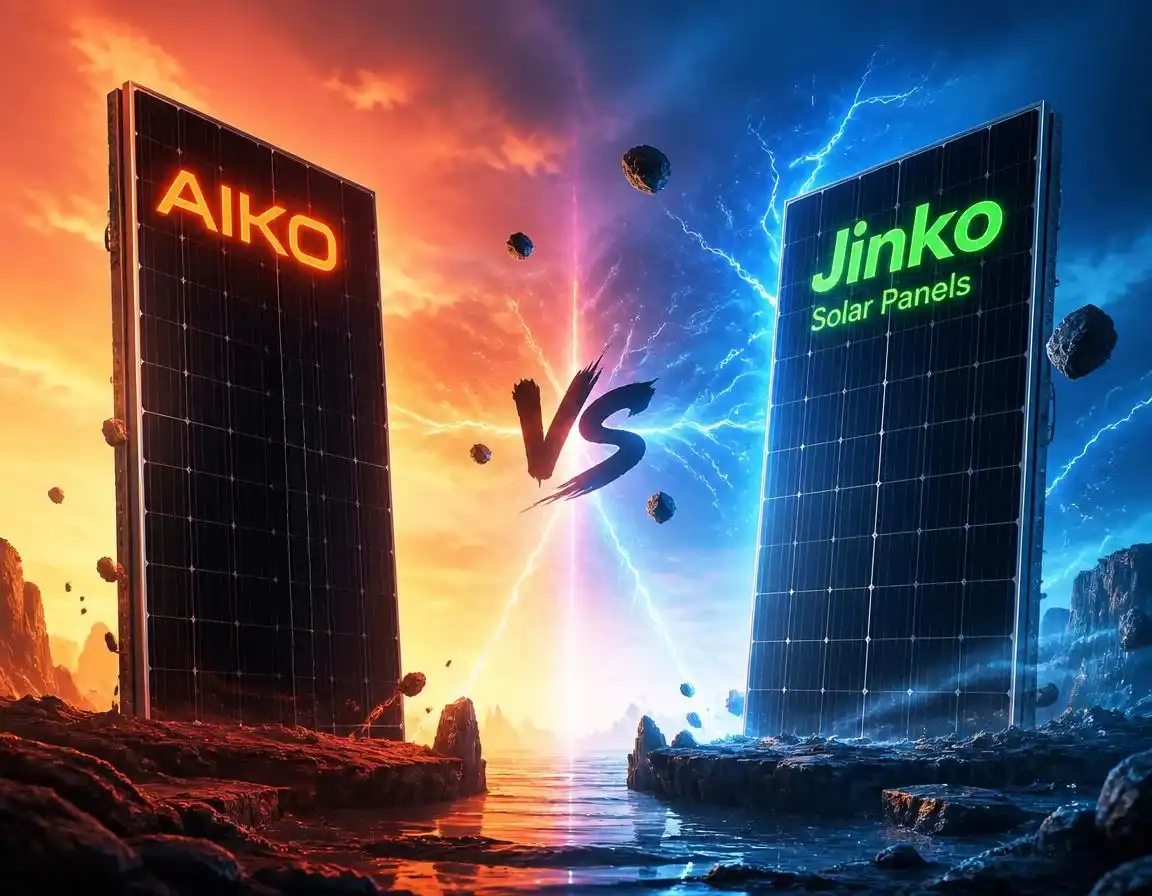
AIKO’s ABC back-contact panels beat Jinko’s Tiger Neo on most datasheet lines: up to 24.4% vs 21.5–22.3% efficiency for Jinko’s standard model, a better temperature coefficient, and a stronger product warranty at the top of its range. Jinko wins where it always does: price (£70–£100 vs £90–£130 per panel), UK stock depth and installer familiarity. My rule: AIKO when roof space is tight or you’re keeping the house for decades; Jinko when it isn’t and you’re not.
AIKO vs Jinko Solar Panels: The Honest UK Head-to-Head (2026)
These are the two names I get asked about most in 2026 — Jinko, the volume king sitting on half the quotes in the country, and AIKO, the efficiency challenger that’s convinced a lot of premium installers to switch exclusively. I’ve specified both, read both datasheets line by line, and priced both through real UK trade lists. Here’s the comparison I wish someone had handed me five years ago.
The 30-second verdict ⚡
If your roof is space-limited — a typical UK semi where ten panels is all you’ll fit — I’d specify AIKO in 2026 and I wouldn’t lose sleep about the premium. If your roof has room for eleven or twelve panels of anything, or you’re doing a ground mount, or your quote budget is the binding constraint, Jinko remains the sensible, boring, excellent choice. Both are BloombergNEF Tier 1 manufacturers with decades-scale warranty backing. The difference isn’t quality; it’s what you’re buying per square metre.
ABC vs TOPCon, in plain English 🔬
Every solar cell needs metal contacts to carry the current away. Conventional cells — including Jinko’s N-type TOPCon — put those contacts on the front as thin silver busbars. They’re necessary, and they shade a sliver of the cell that could otherwise be generating.
AIKO’s ABC (All Back Contact) moves every contact to the rear. The whole front face is active silicon, which is how a mass-produced residential module reaches 24.4% efficiency — a number that was lab-only territory not long ago. Jinko’s answer is its newer Tiger Neo 3.0 platform, which pushes output up to 495W and efficiency up to 23.5%, but the standard 430–445W Tiger Neo panels most UK installers are actually quoting in 2026 sit at 21.5–22.3% efficiency.
Neither approach is fragile, exotic or unproven at scale. This is a philosophy difference: AIKO squeezed the last percent out of the cell face; Jinko squeezed cost per watt out of the factory. Both strategies show up exactly where you’d expect — on the price list.
Specs side by side 📊
| Specification | AIKO Neostar 3S+ (UK stock) | Jinko Tiger Neo (UK stock) |
|---|---|---|
| Cell technology | N-type ABC (all back contact) | N-type TOPCon |
| Residential outputs | 460–490W | 430–445W (Tiger Neo 3.0: up to 495W) |
| Module efficiency | 23.6–24.4% | 21.5–22.3% (Tiger Neo 3.0: up to 23.5%) |
| Temperature coefficient (Pmax) | -0.26%/°C | -0.29%/°C |
| Degradation | ≤1% year one, ≤0.35%/yr after | ≤1% year one, ≤0.40%/yr after |
| Product warranty | 25 years (3S+); 15 years (3P) | 12 years standard (up to 25 years on Tiger Neo 3.0) |
| Performance warranty | 30 years, to 88.85% output | 30 years linear, to 87.4% output |
| Bifacial option | Dual-glass variants | Dual-glass variants, ~80–85% bifaciality |
| Typical UK panel price | £90–£130 | £70–£100 |
| UK wholesale availability | Growing, via major wholesalers | Deepest stock of any premium brand |
Two lines do the real work here: efficiency and product warranty. Everything else is close enough that it shouldn’t drive your decision. Full context on each brand lives in our AIKO review and Jinko review if you want the deeper dive.
The 25-year degradation maths 📉
Warranty percentages sound interchangeable until you do the arithmetic. Here’s what each brand’s own degradation figures produce over the life of the system:
On a 4.8kWp array, 1.45 percentage points at year 30 is roughly 70 kWh a year of difference — worth about £18 at current prices. Meaningful over three decades, but not the reason to choose AIKO. The reason to choose AIKO is year one, not year thirty: more kilowatts on the roof from day one.
UK weather, shading & heat ☁️
Three climate factors actually move the needle in Britain, and the brands split them:
Heat. UK panels routinely run 30–35°C above test conditions on a July roof. AIKO’s -0.26%/°C against Jinko’s -0.29%/°C means about a 1% output advantage on those days — small, real, and slightly ironic given how few of them we get. Cloud. Both are N-type and both cope fine with diffuse light; there’s no meaningful gap here despite what marketing will tell you. Wind and snow. Jinko’s newer panels are certified to handle wind loads up to 4,000 Pascals and snow loads up to 6,000 Pascals, with strong salt-mist resistance for coastal sites — AIKO doesn’t publish directly comparable figures, so ask your installer for the datasheet if you’re on an exposed roof. Shade. This is the one to watch. AIKO’s back-contact layout handles partial shading gracefully at panel level, and Jinko’s dual-glass bifacial panels earn their keep on flat roofs and ground mounts where light bounces off the surface below. But if a chimney or a neighbour’s tree covers part of your array for hours a day, neither brand’s cell chemistry saves you — you want panel-level optimisation, and our microinverter vs string inverter guide explains the trade-off properly.
Whichever brand you pick, the clock that matters in 2026 is VAT, not panel tech. Residential solar and battery installs stay at 0% VAT until 31 March 2027 under HMRC’s energy-saving materials relief, then revert to 5%. On a £7,000 system that’s £350 of pure deadline money.
Price & installed cost 💷
Panel supply prices through UK installers in 2026: AIKO Neostar 3S+ typically £90–£130 per panel, Jinko Tiger Neo £70–£100. Trade lists sit below that — a standard 445W Jinko panel typically works out at £58–£71 before VAT (13 to 16 pence per watt) — but you’re buying an installed system, not a pallet, so here’s the maths that matters on a real roof.
| Ten-panel south roof, ~900 kWh/kWp | AIKO 480W ×10 | Jinko 445W ×10 |
|---|---|---|
| System size | 4.80 kWp | 4.45 kWp |
| Estimated annual generation | 4,320 kWh | 4,005 kWh |
| Panel supply cost (10 panels) | £900–£1,300 | £700–£1,000 |
| Value of the 315 kWh difference | ≈ £62/yr (half self-used at 26.32p cap price = £41.45, half exported at 13p SEG = £20.48) | |
| Fully installed system context | A 4kWp system installs for £5,500–£7,500 at 0% VAT — see our UK solar cost guide | |
Read that last block carefully. On a roof that fits exactly ten panels, AIKO’s £200–£300 premium buys 315 extra kWh every year and repays itself in about five years — after which it’s pure profit for two decades. On a roof that fits twelve panels, an extra Jinko panel costs less than the AIKO premium and generates more. Same brands, opposite answers. This is why I ask to see your roof before I’ll recommend a panel.
Worth knowing either way: China removed its 9% export VAT rebate on solar panels from 1 April 2026, which is expected to push UK panel prices up 8 to 15 percent later this year. If you’re close to deciding, getting a quote sooner rather than later could save you a few hundred pounds regardless of which brand you pick.
On export income, remember the tariff matters more than the panel: the gap between a 3p default SEG rate and Fuse Energy’s 13p open, no-strings tariff is worth hundreds a year on this generation. Our best SEG tariff rates guide keeps the ladder current.
Warranty small print 🛡️
Here’s where I get genuinely opinionated. AIKO’s Neostar 3S+ carries a 25-year product warranty — the component-failure cover — plus the 30-year performance warranty to 88.85%. The cheaper 3P drops to 15 years product. Jinko’s Tiger Neo carries a 12-year product warranty as standard, extending to 25 years on the newer Tiger Neo 3.0 generation — worth asking your installer exactly which platform you’re being quoted, in writing. The 30-year linear performance warranty to 87.4% is consistent across the range either way.
So when you compare quotes, ignore the big “30 YEAR WARRANTY” badge both brands print and ask one question: how many years of product warranty on this exact model? That single number separates a 25-year AIKO 3S+ from a 12-year standard Jinko Tiger Neo, and it’s the line item quotes get wrong most often — even some of the “at a glance” summaries you’ll see floating around the web mix this up. Our warranty explainer shows you exactly what each type covers when something actually fails.
Which one for your roof 🏠
My specification rule for 2026
Specify AIKO Neostar 3S+ when: your roof caps out at ten panels or fewer, you’re keeping the property 15+ years, or you want the cleanest all-black aesthetic on the market — no busbars at all, even close up. The premium earns its keep on constrained roofs and nowhere else.
Specify Jinko Tiger Neo when: there’s roof area to spare (an eleventh panel beats any premium), you’re ground-mounting or on a flat roof where bifacial dual-glass adds real yield, your installer stocks it deeply and quotes it sharply, or you simply want the most-proven N-type module in the UK with the shortest lead times.
Skip both when: your quote lands above roughly £2,000 per kWp installed for a standard roof. At that price the brand is the least of your problems — get three more quotes, and check every installer’s certification on the MCS register before you sign anything.
Frequently asked questions ❓
Is AIKO better than Jinko?
On datasheet numbers, yes: AIKO’s ABC back-contact panels carry higher module efficiency (up to 24.4% against roughly 22% for the standard Jinko Tiger Neo modules most UK installers stock), a better temperature coefficient and a stronger product warranty at the top of its range. On price, availability and installer familiarity, Jinko wins. Neither is a bad panel — the better choice depends on your roof space and how long you’ll keep the system.
Are AIKO panels worth the extra cost over Jinko in the UK?
Only in specific situations. On a 10-panel roof, AIKO’s extra wattage adds around 315 kWh a year, worth roughly £60-65 at October 2026 cap prices with half exported on a 13p SEG tariff, against a panel premium of £200-300. On a tight roof that pays for itself in around five years. On a big open roof where you could simply fit an extra Jinko panel, it doesn’t — put the money into a battery.
Which has the better warranty, AIKO or Jinko?
AIKO, generally. Its Neostar 3S+ range carries a 25-year product warranty plus a 30-year performance warranty ending at 88.85% of original output, while the cheaper 3P keeps a 15-year product term. Jinko’s Tiger Neo typically carries a 12-year product warranty — stretching to 25 years on the newer Tiger Neo 3.0 panels — alongside the same 30-year linear performance warranty ending near 87.4%. Both are Tier 1 manufacturers, but read the product warranty line for the exact model you’re quoted, not just the performance one.
Twenty years in this industry has taught me one reliable truth: the best panel is the one whose numbers match your roof, not the one with the prettiest datasheet. AIKO and Jinko are both excellent engineers’ answers to different questions. Work out which question your house is asking — space or budget — and the answer picks itself.