

Solar Battery fire safety

Solar Battery Fire Safety UK: What the Regulations Actually Require
Battery fires make brilliant headlines. Almost none of them are coming from a solar battery sat quietly in someone’s garage. Here’s what genuinely changed in UK rules this year, exactly where your battery can and can’t go, and what it means whether you’re weighing up your first one or you’ve already got one running.
The short version
Since 15 April 2026, home batteries in the UK have their own dedicated chapter in the wiring regulations for the first time (Chapter 57 of BS 7671 Amendment 4), working alongside the existing PAS 63100:2024 fire safety specification. Together they rule out lofts, bedrooms and escape routes, set a 1-metre outdoor clearance from doors and windows, and demand proper ventilation and smoke detection wherever a battery lives. None of it is retrospective, and every new installation must comply by 15 October 2026.
I’ll be honest, when most people hear “battery” and “fire” in the same breath, they picture their new solar battery going up the moment the sun sets. That’s not really what the data shows. But 2026 has genuinely brought new rules for where a home battery can go and how it has to be fitted, and if you’re weighing one up, or you’ve already got one, it’s worth a few minutes to know what’s actually law, what’s just good practice, and what your installer is now required to do.
Why this suddenly matters
Home battery numbers in the UK have grown roughly tenfold in five years, helped along by 0% VAT on installs and smart tariffs that finally make the sums add up. More batteries going into more houses was always going to bring more scrutiny, and the headlines about lithium battery fires haven’t helped. So let’s look at where those fires are actually coming from before we get into the rulebook.
UK fire brigade call-outs to fires linked to any lithium-ion battery — phones, e-bikes, vapes, laptops and more. Source: QBE Insurance FOI data, 42 of 49 UK fire services.
That’s a real rise, and it’s worth taking seriously. But almost none of it is about home solar battery storage. Those numbers cover every lithium-ion device in the country, and e-bikes alone accounted for around 520 of the 1,760 fires in 2025, roughly a third. Phones, vapes, laptops and power tools make up most of the rest.
- Homes — 46%
- Outdoors — 31%
- Commercial premises — 23%
Again, this is all lithium-ion devices combined, not battery storage systems specifically. Source: QBE Insurance / RES Fire & Security, 2026.
The one genuinely home-battery-specific incident worth knowing about is Tesla’s recall of around 10,500 Powerwall 2 units in November 2025, after 22 reports of overheating (six involving smoke, five involving fire causing minor property damage, no injuries) traced to a faulty batch of cells from a third-party supplier. It affected units sold between November 2020 and December 2022, including some in the UK, and Tesla is replacing every affected unit free of charge. It’s a useful reminder that even well-established brands aren’t immune to a bad component batch, and it’s part of why the wider rulebook below now exists.
The rulebook, untangled
Ask five installers what the rules actually require and you’ll often get five slightly different answers, not because anyone’s wrong, but because battery fire safety in the UK sits across four separate documents, each written by a different body for a different purpose. Here’s what each one actually is and whether it’s genuinely compulsory.
| Document | What it actually is | Legally binding? | Covers |
|---|---|---|---|
| BS 7671 Amendment 4 (Chapter 57) | The IET/BSI wiring regulations — the rulebook every electrician works to | Yes, via Building Regs Part P | Clearance, ventilation, isolation and fire separation for the electrical installation |
| PAS 63100:2024 | A publicly available specification from BSI, government-sponsored but not a British Standard | No, voluntary | Where a battery can physically be sited to limit fire risk and spread |
| MCS MIS 3012:2025 | The installer certification standard, required for MCS registration | No, but tied to grants & SEG | Installer competence, commissioning, and design sign-off |
| Building Regs Part B (Approved Doc B) | Statutory guidance underpinning the Building Regulations 2010 | Yes | General fire safety of the dwelling as a whole |
In short: PAS 63100 isn’t law on its own, but it’s now baked into BS 7671 Amendment 4, which is. Ignore it and you’re not just cutting a corner on paper, you’re looking at an installation that’s genuinely difficult to certify, insure, or sell a house with later.
How we got to Chapter 57
This didn’t arrive overnight. Here’s the sequence that got the UK to a dedicated wiring chapter for batteries.
As I’m writing this in early August 2026, that final deadline is a little over two months away — worth asking your installer about directly if you’re mid-quote.
Where your battery can and can’t go
This is the part that actually changed people’s day-to-day reality. Both PAS 63100 and the new Chapter 57 point the same direction: keep the battery away from where people sleep and away from how they’d escape a fire, and favour outdoor or outdoor-equivalent locations wherever you reasonably can.
| Location | Allowed? | Why |
|---|---|---|
| Loft, roof space or void | No | Poor ventilation, big temperature swings, hard to reach, and fire spreads straight to bedrooms below |
| Bedroom, or a cupboard opening into one | No | Sleeping occupants can’t be exposed to a battery thermal event |
| Stairs, landings, hallways used as escape routes | No | A fire here would block the way out |
| Sealed internal cupboard with no ventilation | No | Normal off-gassing needs somewhere to go |
| Outdoors, within 1m of a door, window or vent | No | Smoke and gas must not be able to enter the home |
| Attached garage, fire-separated from the house | Yes | Contained, ventilated, away from habitable rooms |
| Detached garage or outbuilding | Yes | Treated as outdoor-equivalent for fire safety |
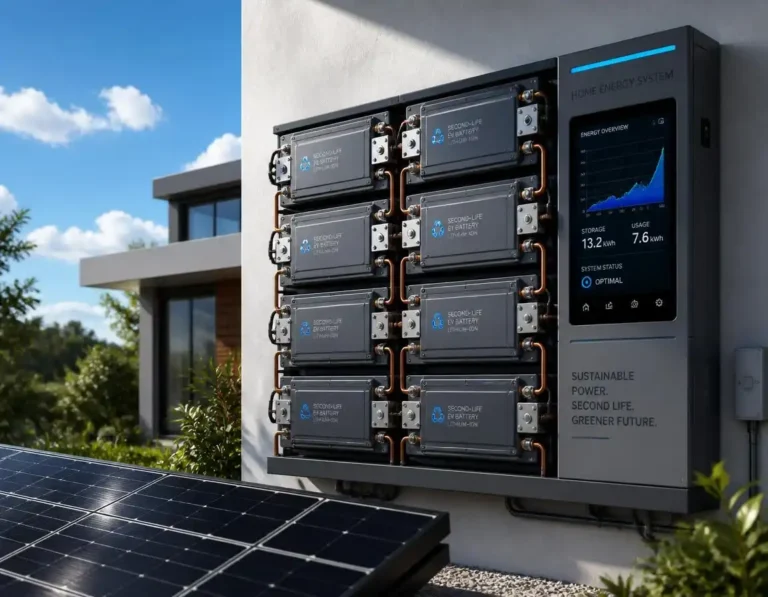
| External wall mount, weatherproof, 1m+ from openings | Yes | PAS 63100’s preferred default location |
| Utility or plant room with proper fire separation | Yes | Contained within a fire-rated enclosure |
| Purpose-built ground-mounted garden enclosure | Yes | Fully outdoor, away from the building |
Clearance, ventilation and detection
Location is the headline change, but three quieter details in Chapter 57 matter just as much day to day.
| Requirement | What it means in practice |
|---|---|
| Clearance around the unit | Roughly 30cm clear space on every side — no shelving or combustible material pressed against the battery or inverter |
| Outdoor clearance | At least 1 metre from any door, window or air vent, so smoke or gas can’t drift indoors |
| Ventilation | A vented outdoor enclosure or a passively ventilated indoor room — sealed cupboards aren’t acceptable, even in an outbuilding |
| Indoor fire separation | Walls, ceiling and floor rated REI 30 (30 minutes’ fire resistance) if the battery sits in a habitable part of the home |
| Attached outbuilding separation | A fire-rated wall, typically REI 120, tested to BS EN 13501, to count as outdoor-equivalent |
| Fire detection | A smoke or multi-sensor alarm in the room, with extra emphasis on infrequently visited spaces like garages |
Most of this simply formalises what a decent installer was already doing. If you’re comparing options, LiFePO4 (LFP) chemistry is now the UK default for exactly this reason — it’s markedly more stable under fault conditions than the older nickel manganese cobalt cells some early systems used. Our best solar battery guide breaks down which current models use it and what they cost installed.
Do you need planning permission?
Almost always, no. A domestic battery is treated as ancillary equipment under permitted development, the same category that covers most solar panels and EV chargers, so you generally won’t need to apply for anything. The exceptions are worth knowing before you commit to a spot: listed buildings usually need listed building consent for anything fixed to the fabric, and conservation areas can be stricter about external enclosures being visible from the street. If in doubt, a quick call to your local planning department settles it in minutes. Our guide to solar panel planning permission covers the wider rules in more depth, and remember that planning approval and your DNO’s G98/G99 grid connection notification are two completely separate processes.
What this means for your insurer
This is the bit people forget, and it’s the one that actually bites. Most home insurers treat a battery as a material change to your property, not an invisible extra. Tell them before installation, not after: if a fire happens later and they discover an undeclared battery, they can decline the whole claim, even in cases where the battery had nothing to do with the cause. Keep your MCS certificate and PAS 63100 compliance paperwork somewhere you can lay hands on quickly, because a documented, compliant installation is exactly what strengthens your position if you ever need to make a claim. Our solar panel insurance guide goes through what most UK policies do and don’t cover.
If you’ve already got a battery, here’s your quick health check
None of this is retrospective. If your system was installed legally to the standard in force at the time, nobody is going to make you rip it out. A few things are still worth ten minutes of your time.
Check where it actually sits
If it’s in a loft, that’s the one location genuinely worth a conversation with your installer, mainly because it’s also the hardest for a fire brigade to reach quickly.
Confirm you’ve got a working smoke alarm nearby
Most modern UK homes already have interlinked alarms under Building Regs, but a garage or outbuilding battery is easy to miss.
Check your warranty terms
A few manufacturers have quietly tightened location and temperature clauses over the past couple of years — worth five minutes reading the small print.
Tell your insurer if you haven’t already
Even an existing, perfectly compliant battery needs to be on your policy schedule.
Keep your paperwork together
MCS certificate, PAS 63100 statement of conformity and installer contact details — all in one place, ideally digital and backed up.
Choosing an installer who’ll actually get this right
The single best filter is a genuinely MCS-certified installer who can confirm, in writing, that your design complies with both BS 7671:2018+A4:2026 and PAS 63100:2024. Ask which clause of PAS 63100 covers your chosen location, what fire separation and ventilation they’re adding, and whether your paperwork will show the new edition rather than the old one. A reputable installer will answer all three without blinking. If you’re adding storage to existing solar panels rather than fitting everything from scratch, the same rules apply in full, retrofit is not treated any differently.
💬 What about plug-in solar batteries?
Everything above covers fixed, professionally installed home battery storage. Plug-in and balcony solar kits sit under a different, still-evolving framework, legalised from 27 August 2026 under DESNZ’s Interim Product Specification, and it currently excludes storage entirely. If you’re looking at a balcony or plug-in system rather than a fixed battery, our guides to the 800W balcony solar rule, the BSI plug-in solar standard and DESNZ’s regulation response cover that separate rulebook in full.
Common questions
Is PAS 63100 a legal requirement for my home battery?
Not on its own — PAS 63100 is a specification, not a law, so nobody can prosecute you for ignoring it directly. But it’s now woven into things that are compulsory: BS 7671 Amendment 4 draws on it for the UK’s wiring regulations, Building Control expects it, and most MCS-certified installers and home insurers treat it as the baseline. In practice, skipping it makes your installation very hard to certify, insure or sell a house with later.
Can I still put a solar battery in my loft in 2026?
No, not for a new installation. Both PAS 63100 and the new Chapter 57 of BS 7671 Amendment 4 rule lofts out, mainly because of poor ventilation and how close a fire there would be to the bedrooms below. If you already have a battery in your loft, the rules aren’t retrospective, but it’s worth a conversation with your installer and insurer about whether to move it.
Do I need to tell my home insurer about a solar battery?
Yes, and before it goes in rather than after. Most insurers treat a home battery as a material change to your property, and if a fire happens and they discover it wasn’t declared, they can refuse the claim even if the battery had nothing to do with the cause. Keep your MCS certificate and installation paperwork somewhere you can find it.


8 Comments