
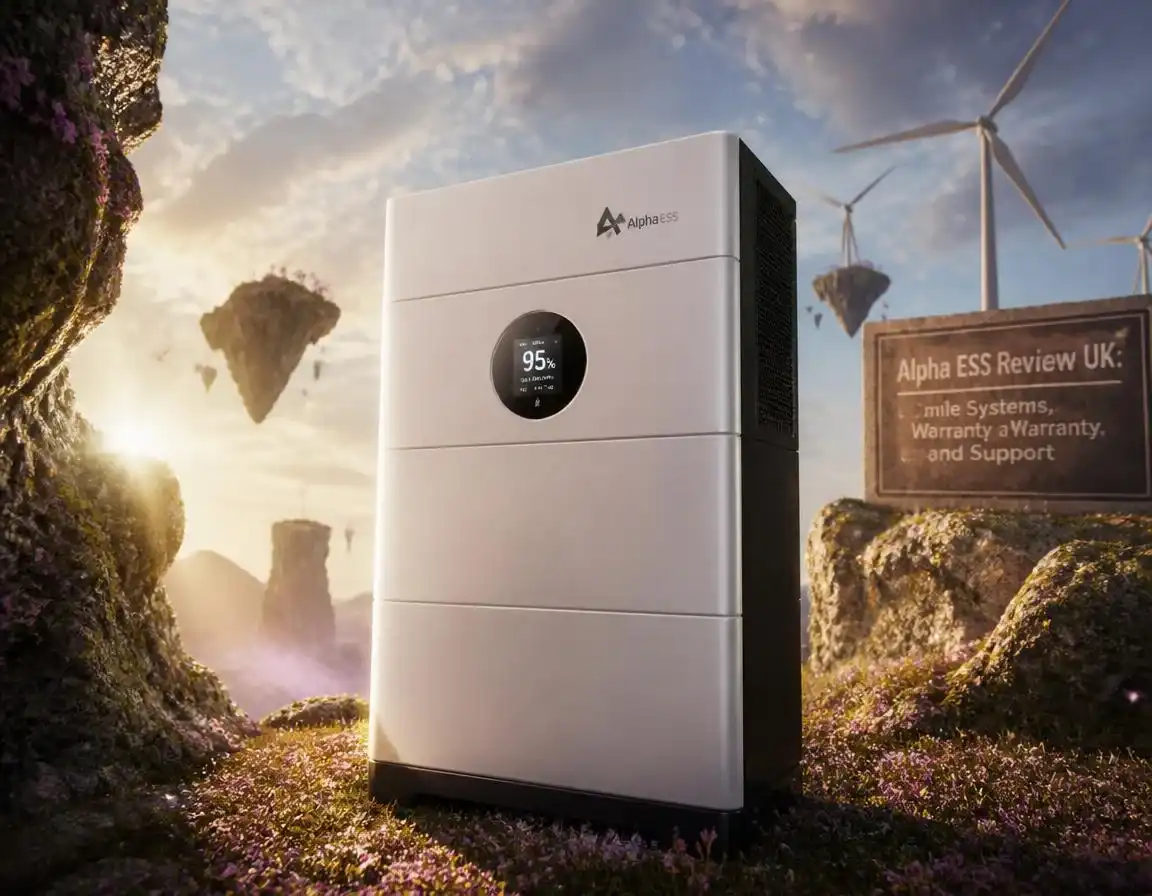
Alpha ESS Review UK: Smile Systems, Warranty and Support

Alpha ESS Review UK 2026: Smile G3 Price, Warranty and Support
Updated 10 October 2026. Checked against the AlphaESS UK G3 warranty conditions (December 2024 edition), Alpha ESS datasheets, Alpha ESS UK’s Works with Octopus listing and SolarBriton’s 2026 UK installed-price tracking.
Alpha ESS (also written AlphaESS) is the home battery I’d call the sensible middle of the UK market: modular lithium iron phosphate storage, a perfectly usable app, and a price that sits below Tesla and above the budget imports. This review covers what the Smile G3 range actually is, what the UK warranty really promises, how it behaves on Octopus tariffs, and who you ring when something goes wrong in year six.
I’ve written it from the primary documents rather than the brochures: the AlphaESS UK Ltd warranty conditions for the G3 series, the manufacturer datasheets and the Octopus compatibility lists. Where a figure comes from a retailer’s listing rather than from Alpha ESS itself, I say so.
The short version
Alpha ESS makes solid, unfussy LFP batteries, and the Smile G3 is the range most UK installers now quote. On paper the UK warranty is strong: 10 years, 70% capacity guaranteed at year 10, and unlimited cycles for ordinary solar self-use and time-of-use tariffs. The catch is the conditions: an AlphaESS-certified installer, a system kept permanently online (otherwise cover drops to 3 years) and faults reported within ten working days. The hardware rarely disappoints; the paperwork and the installer chain are where owners get stuck. Buy it for the modularity and the Octopus support, choose the installer carefully, and keep it connected.
Alpha ESS Smile G3 at a glance
| Spec | Smile G3 (UK) |
|---|---|
| Chemistry | Lithium iron phosphate (LFP) |
| Usable depth of discharge | 95%, so a 10.1 kWh module delivers about 9.6 kWh |
| Single-phase inverters | SMILE-G3-S3.6 (3.68 kW) and SMILE-G3-S5 (5 kW) |
| Three-phase inverters | SMILE-G3-T6, T10, T12, T15 and T20 (6–20 kW) |
| Single-phase module sizes | 3.8, 4.8 and 10.1 kWh nominal |
| Weather rating | Battery modules IP65. Check your inverter’s rating, because some Alpha inverters are IP21 (indoor only) |
| UK warranty | 10 years; 70% energy retention at year 10; 3 years if the system is not kept online |
| Octopus | “Works with Octopus” certified; Intelligent Octopus Flux listed |
| Typical installed price | About £3,800–£5,200 for a 9.6 kWh system with 0% VAT (to 31 March 2027) |
Capacity and rating figures come from Alpha ESS datasheets and UK retailer listings. Confirm them against the datasheet for the exact model on your quote.
Who Alpha ESS are, and who backs you in the UK
Alpha ESS Co., Ltd. was founded in 2012 and is based in Nantong, China. The company says it supplies residential and commercial storage in more than 50 countries; I can’t audit that figure, but it has been selling Smile batteries in Britain for years, which is longer than many of its rivals have existed.
What matters for you is the UK arm. AlphaESS UK Ltd, registered in Chester, issues the UK warranty and delivers warranty service through its installer network. It also describes itself as a BloombergNEF Tier 1 storage manufacturer. Tier 1 is a lender-confidence label, not a promise about your claim, but a named UK subsidiary with a support line is a better position than a brand whose only address is overseas. That matters more than it used to: GivEnergy’s manufacturing company entered administration on 9 April 2026 and stopped honouring hardware warranties, as we explain in our GivEnergy administration guide.
Alpha ESS does not sell to households directly. Your contract is with the installer, and the manufacturer’s warranty only works through a certified one. Keep that in mind, because it shapes every section below.
The Alpha ESS Smile G3 range, translated
Alpha ESS model names confuse everyone. G3 is the current generation. Older Smile5, B3 and T10 systems still turn up on resale listings and older quotes, so check which generation you are being sold:
| Family | Setup | Capacity | Notes |
|---|---|---|---|
| SMILE-G3-S3.6 and S5 | Single-phase hybrid inverter, 3.68 kW or 5 kW | Retailer listings show up to 15.2 kWh on 3.8 kWh modules and up to 60.6 kWh on 10.1 kWh modules | The usual choice for new solar plus storage on a single-phase supply |
| SMILE-G3-B5 | Battery inverter, usually AC-coupled | Same G3 module family | Suits adding storage to existing panels |
| SMILE-G3-T6 and T10 | Three-phase hybrid, 6 kW or 10 kW | 4.0–24.0 kWh (4.0 kWh modules) or 8.2–49.2 kWh (8.2 kWh modules) | Larger homes on three-phase supplies |
| SMILE-G3-T12 to T20 | Three-phase hybrid, 12 kW, 15 kW or 20 kW | 7.7–23.0 kWh or 8.2–49.2 kWh | Indoor inverter (IP21). The 2023 datasheet lists a 5-year product warranty with 10 years on battery performance |
| Earlier Smile5, B3 Plus and T10 | Previous-generation hybrid, AC-coupled and three-phase systems | Various module sizes | Covered by older warranty documents, so read the one for your serial number |
| STORION series | Commercial platform | Tens of kWh and up | Farms, shops and small industrial units |
Capacity bands and module sizes come from Alpha ESS datasheets and UK retailer listings, and they move between product revisions.
Two things I like. First, modularity: adding a module later is normal practice, which matters if your use grows (a heat pump or EV is the usual trigger). Second, the G3 can be fitted either AC-coupled or DC-coupled, which makes it flexible for retrofits; see our guide to adding a battery to existing solar panels for how to decide.
The trade-offs are lock-in and mixing. Retailer specifications describe Alpha’s hybrid inverters as companions to Alpha’s own modules, so expansion means more Alpha modules rather than another brand’s. At the time of writing, retailers also report that the 4.8 kWh and 9.6 kWh module types cannot share one stack, so tell your installer now if you plan to grow. If you want to compare a modular rival, our BYD Battery-Box review sets the two approaches side by side.
Real-world performance on a UK roof
Spec sheets promise; a January evening tells the truth. The G3 gives you what LFP usually gives you: a deep usable share of nominal capacity (95%), thousands of cycles before meaningful fade and no drama. Newer G3 modules include integrated heating to keep the cells in their safe temperature range through frosty UK winters, which is a sensible detail for garage and outdoor installs.
The number I would argue about is continuous power, not capacity. A 5 kW SMILE-G3-S5 will run a normal house’s evening comfortably. It will not happily shoulder an immersion heater, an oven and a shower pump at once the way a larger inverter can. Size for your worst evening, not your average one, and if you have a heat pump and an EV, ask about the three-phase or higher-power options.
On efficiency, Alpha publishes datasheet figures, but brands do not measure them on a like-for-like basis (battery only versus whole system), so I won’t rank them. Ask your installer for the figure on your exact model and whether it covers the inverter losses.
That shape of charge cheap, then cover the evening peak, is where UK batteries earn their keep now, which is why tariff compatibility matters as much as chemistry. The next section covers it.
Alpha Cloud app and Octopus tariff compatibility
The Alpha Cloud portal and app show the essentials clearly: state of charge, solar generation, import and export, history. It does the job without being the slickest app on the market. Two practical points: installers can usually see diagnostics through the portal, so ask yours to keep that access after commissioning, and the system has to stay online for the warranty to hold in full (more on that below).
On tariffs, Alpha ESS UK is a “Works with Octopus” certified product partner. It says its residential range is verified for Intelligent Octopus Flux, with built-in scheduling for Intelligent Go, Octopus Go and Cosy Octopus. Here is how that plays out in practice:
| Tariff | Alpha ESS status | What to check |
|---|---|---|
| Intelligent Octopus Flux | Listed by Alpha ESS UK and in Octopus’s sign-up list | Octopus controls the battery. Availability has changed more than once in 2026 and was limited to Octopus-installed solar and battery systems on 23 September 2026, so check your Octopus account first |
| Octopus Flux (standard) | Works with any battery you can schedule | You set the charge and discharge windows yourself |
| Intelligent Go, Octopus Go and Cosy | Built-in scheduling, according to Alpha ESS UK | Match the charge windows to the tariff’s cheap periods |
| Agile Octopus | Not on Alpha’s compatibility list | Manual or third-party app control; some owners report cloud-API limits that make half-hourly automation awkward |
| Octopus Charge Pack | AlphaESS is on Octopus’s supported list | A guaranteed minimum monthly payment for grid-support sessions; read the terms before stacking it with other schemes |
Tariff availability changes quickly. Octopus’s eligibility checker in your account is the final word.
For the full picture of which brands Octopus can actually control, see our Agile and Flux battery compatibility guide. If flexibility income is the plan rather than a bonus, read how home batteries earn from smart tariffs first, and check how any grid-services scheme counts towards Alpha’s warranty throughput rules (see the warranty section).
Safety, siting and the new battery wiring rules
Every Smile G3 module is lithium iron phosphate, the thermally stable chemistry most serious home-battery makers now use. LFP is forgiving, not magical, so siting still matters. Ask your installer for the datasheet certifications on the exact model and for UKCA or CE marking on the paperwork, not only in the marketing PDF.
The rules around siting have tightened. BS 7671:2018+A4:2026 was published on 15 April 2026 and adds a new Chapter 57 covering stationary batteries, working alongside PAS 63100:2024 for domestic installs. The previous edition is withdrawn on 15 October 2026, so new work from then on follows the new rules. In practice that steers batteries away from lofts, bedrooms and escape routes, towards an external wall, a garage or a proper enclosure. Our battery fire safety guide explains what to ask any installer, and using an MCS-certified installer is the single cheapest risk reduction available to you.
Alpha ESS warranty UK: what it really covers
This is the table I wish every battery brochure printed on the front. It summarises the AlphaESS UK Ltd warranty conditions for the G3 series (December 2024 edition):
| What | What the UK G3 warranty says | The catch nobody reads |
|---|---|---|
| Product warranty | 10 years on G3 battery units and on SMILE-G3-S5, S3.6 and B5 systems, including the hybrid inverter | The clock starts at installation or 365 days after manufacture, whichever is earlier |
| Battery performance | 120 months, with 70% energy retention at year 10 | Unlimited cycles for solar self-use and time-of-use charging. Any other application, or a combination including one, is capped at 3.11 MWh per kWh installed |
| Internet connection | Mandatory | Not connected means 3 years, not 10. Tell your installer if an outage lasts 14 days or more |
| Installer | Must be AlphaESS-certified, with a signed commissioning report | A qualified installer must also be available to swap the unit and recommission it |
| Reporting a fault | Report to an authorised installer within ten working days | The installer must submit the claim within 4 weeks of the failure, and later claims are not considered |
| Costs | No charge to you for processing, replacement parts or freight on a valid claim | The document does not say who pays the installer’s time on site, so agree that in writing. Replacements may not be brand new |
| Selling the house | The warranty transfers with the building | It is otherwise non-transferable |
| Installation workmanship | Your installer’s own guarantee, usually 2–10 years | This is not Alpha ESS’s promise, and it is the gap that bites |
Older generations and some three-phase inverters have different terms (for example a 5-year product warranty). Read the document that applies to your serial number, not this table.
Three habits separate a smooth claim from a two-month argument. Keep the system online from day one, and ask your installer to confirm it is connected to Alpha Cloud at commissioning. Keep the commissioning report, serial numbers and installer certification, because the claim form asks for all of them. And report faults immediately: the ten-working-day rule is unforgiving.
Two small-print points are worth knowing. The warranty is governed by Chinese law, with a third-party testing body for disputes, and Alpha’s liability is capped at the purchase price. Separately, under the Consumer Rights Act 2015 you can still claim against the installer who sold you the system for up to six years (five in Scotland) if the goods were not of satisfactory quality. Our guide to what solar warranties actually cover explains how product, performance and workmanship cover fit together.
Alpha ESS support in the UK: who you call, and what if your installer folds
When a Smile misbehaves, the claim travels a chain. Know it before you need it.
The UK warranty says you can claim through your installer or contact AlphaESS directly through the Alpha Cloud customer feedback form or by email, and the document lists a UK support line (0330 043 2610). It promises like-for-like replacement but publishes no turnaround time, so I would not promise you a number of days. What the warranty does require is a qualified, AlphaESS-certified installer to swap the unit and recommission it, which is why the installer matters so much.
That brings me to the uncomfortable scenario. If your installer collapses mid-warranty, the manufacturer’s product cover does not automatically end, but your labour, diagnostics and commissioning paperwork can end up orphaned. The UK has form here: read our notes on an installer going bust mid-install. Before you sign for any battery, ask four questions and write the answers down:
- Are you AlphaESS-certified, and can I see the certificate? (It is a warranty precondition.)
- Who pays your labour on a warranty swap, and what happens if you stop trading?
- Is your workmanship guarantee insurance-backed, and will you give me the registered certificate?
- Will you connect the system to Alpha Cloud at commissioning and tell me if it drops offline?
If the answers wobble, walk away, and use our installer comparison to find alternatives. Some owners also layer on cover for the gap; our guide to solar panel warranty insurance explains what each protection layer pays for, including the MCS financial protection products installers must move to by 31 March 2027.
Alpha ESS price in 2026, and how it compares
On SolarBriton’s tracking of UK installer quotes, a 9.6 kWh Smile G3 lands at about £3,800–£5,200 installed. The wider market runs about £3,000–£4,500 for a 5 kWh system and £4,800–£7,000 for a 10 kWh system, and retrofitting a battery to existing solar typically adds 10–20% compared with fitting it alongside new panels. Roof-to-plant-room cable runs, isolation gear and whether solar is going in at the same time move the final number. That puts Alpha ESS where it usually sits: above the budget imports, below the premium integrated units. These are indicative ranges, not quotes, so get three. See our best solar battery UK 2026 roundup and the battery storage hub for the wider market.
VAT is the other number to watch. Installation of qualifying batteries is zero-rated until 31 March 2027, whether fitted with solar or added later (standalone and retrofit batteries have qualified since 1 February 2024), and the rate returns to 5% from 1 April 2027, according to HMRC’s VAT Notice 708/6. The relief covers Northern Ireland as well as Great Britain. Ask your installer what happens to a job that straddles the deadline.
| System | Chemistry | Published warranty | Typical installed price | Who fixes it in the UK |
|---|---|---|---|---|
| Alpha ESS Smile G3 (9.6 kWh) | LFP | 10 years; 70% at year 10; unlimited cycles for solar self-use and time-shifting | £3,800–£5,200 | Your certified installer, then AlphaESS UK |
| Tesla Powerwall 3 (13.5 kWh) | LFP | 10 years, unlimited cycles | £7,500–£10,500 | Tesla’s certified installers and its own service team |
| BYD Battery-Box HVS 10.2 | LFP | 10 years or 6,000 cycles; 60% retained; throughput cap | £5,500–£7,500 | Installer plus a distributor chain; see our BYD review |
| Fox ESS H3 (10 kWh) | LFP | 10 years | £4,800–£6,200 | Installer network |
| GivEnergy | LFP | Manufacturer in administration since 9 April 2026; hardware warranty no longer honoured | Existing systems only | Your installer first; see our GivEnergy guide |
Published terms and prices at time of writing; always recheck the current warranty document and get written quotes.
Verdict: is Alpha ESS worth buying?
Buy it if…
- You want proven, modular LFP at a price below Tesla and most rivals.
- You are on Octopus Go, Cosy or Intelligent Flux and want a battery that is listed for them.
- You have found an MCS-certified, AlphaESS-certified installer who answers the four support questions well.
- Your broadband is reliable, because the warranty depends on it.
Skip it if…
- You want whole-home backup muscle and heavy simultaneous loads from a single unit.
- You expect a premium app and fully automated Agile trading out of the box.
- Your only quote is from a firm that is not AlphaESS-certified or is vague about labour terms.
- Your system will sit offline, because the warranty drops from 10 years to 3.
Exciting batteries tend to mean new chemistry, new firmware and a support line nobody has tested. The Smile G3 is none of those things. It is a dependable middle-of-the-road machine whose real risk lives in the paperwork and the phone chain, and both of those you can control before you pay a deposit.



One Comment