
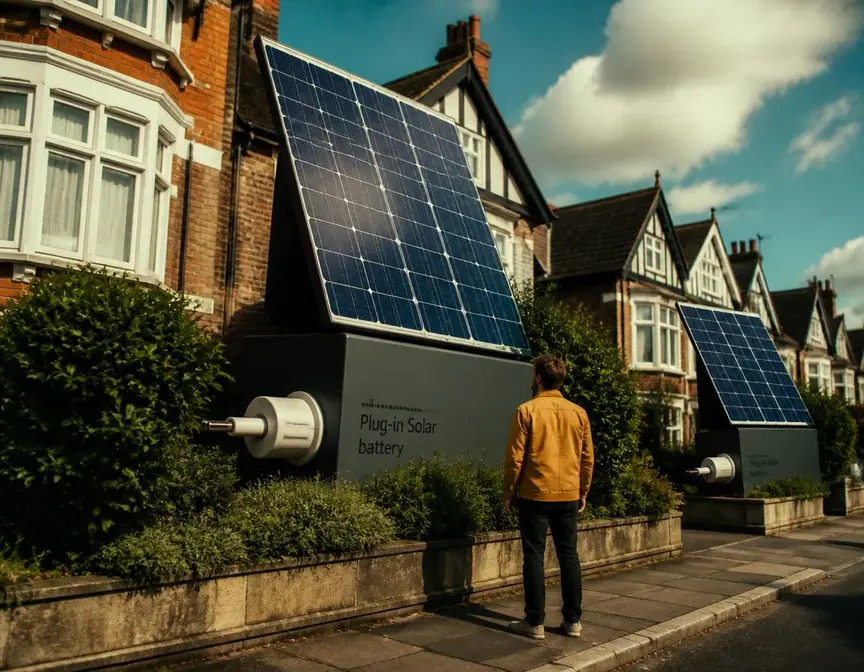
Plug-in batteries in the UK

Plug-in batteries in the UK: why they’re excluded, what’s legal now, electrician-fitted options, and what to watch in 2027
The short version
Plug-in solar became legal on 27 August 2026, but plug-in batteries were deliberately left out. The new law only covers kits that turn sunlight into electricity and don’t store it, and the wiring rules still bar anything that feeds power back through a socket. Today, the legal way to add a battery is to have an electrician hardwire it on its own circuit, ideally supplied and fitted before 31 March 2027 while installed batteries are zero-rated for VAT. Power stations are fine as long as they only run what’s plugged into them. The government’s safety study is due to start in late November, with first findings around mid-2027, so late 2027 is the earliest realistic date for true plug-in batteries.
Plug-in solar went legal on 27 August 2026, and the obvious next question is whether you can plug in a battery as well. You can’t, not yet. Plug-in batteries in the UK were left out of the new rules on purpose, and the reasons have more to do with wiring and fire safety than politics. Below I’ve set out what the law actually says, what you can legally do today, what an electrician-fitted battery costs, and the dates worth watching through 2027.

2026Plug-in solar became legal. Batteries didn’t.
2027Last day of 0% VAT on installed batteries
What the law actually says
The change came through SI 2026/848. It amended the Plugs and Sockets etc. (Safety) Regulations 1994 and the Electricity Safety, Quality and Continuity Regulations 2002, usually shortened to ESQCR. It was made on 16 July and came into force on 27 August 2026.
Everything hangs on one definition. A “plug-in microgenerator” is a source of energy that:
- generates electricity from the direct conversion of sunlight
- has a maximum AC output of 800 watts or less
- connects to your home’s wiring through a standard plug and socket
- is designed to run in parallel with the grid
- isn’t designed to import electricity from your home’s wiring to store it for later, apart from minor control and auxiliary functions
That last line is the battery clause. A battery charges from your sockets and gives the energy back later, which is exactly what it rules out. A battery fails the first line too. It doesn’t make electricity from sunlight; it just moves it around.
The second layer is the Plug-in Solar Device Interim Product Specification, version 2, published on 16 July. The amended ESQCR says a plug-in microgenerator has to comply with it, and its scope section lists what it doesn’t cover. Two items on that list are plug-in battery systems and plug-in solar devices with batteries built in. It goes a step further, too. Every compliant kit’s instructions must carry a prominent warning that the device isn’t intended to be connected to, operated with or used in conjunction with a battery energy storage system.
So this isn’t a grey area. The government said it in the consultation, said it again in its July response and wrote it into the spec. You can read both on the government’s plug-in solar consultation page. I went through the response line by line when it landed, in my breakdown of the DESNZ plug-in solar decision.
The ESQCR change applies in England, Wales and Scotland. Northern Ireland has its own connection rules, so this guide is written for Great Britain.
Why plug-in batteries were left out
The official reason is short. In its response, the government said battery-integrated products “raise additional technical and regulatory considerations which have not been assessed as part of this work”. In plain English: the safety study behind plug-in solar only looked at solar, so there was no evidence to approve anything else.
It wasn’t for lack of asking. The exclusion of battery storage was one of the most common complaints in the consultation. When people were asked about unintended consequences, a majority wanted to know why batteries weren’t included.
Behind the official line, I see three real problems.
The wiring can’t see a battery
UK circuits are protected by a breaker in the consumer unit, and the breaker only measures current coming from the consumer unit. A battery feeding a socket adds current it never measures. That’s called load masking, and I’ve put numbers on it in the next section.
Fire and stored energy
A plug-in solar kit stops producing when the sun goes in or the plug comes out. A battery holds kilowatt-hours of energy indoors, all day and all night. Fixed home batteries now have their own fire-safety specification, PAS 63100:2024. And since 15 October 2026, Amendment 4 has been the only current edition of BS 7671, the wiring regulations, with a new Chapter 57 for stationary batteries that points home installations to PAS 63100. Those rules assume a fixed battery in a sensible spot. They don’t map neatly onto a box you can carry from room to room.
Batteries discharge when circuits are busiest
This one is my own reading rather than anything in the government papers. Plug-in solar peaks around the middle of the day, when most homes are using relatively little. A battery’s whole job is to discharge in the early evening, when the kettle, oven and tumble dryer are already loading the circuits. Extra unseen current at the busiest time of day is exactly what the wiring rules are written to stop.
None of that means plug-in batteries can’t be made safe for UK homes. It means nobody had done the work. The government has now paid for exactly that work, and I’ve covered the timetable in the 2027 section.
Load masking in plain numbers
Each circuit in your consumer unit has a breaker matched to its cable. A typical socket ring has a 32 A breaker, and radial circuits often use 20 A. The breaker only sees current flowing out of the consumer unit. It has no idea what’s happening further along the cable.
Now plug in a battery and let it discharge. Appliances on that circuit can draw from the battery and the consumer unit at the same time. The breaker will still let a full 32 A through before it trips, so the appliances can pull 32 A plus whatever the battery adds. Part of the cable ends up carrying more than the breaker was chosen to protect, and nothing trips.
Simplified as a single run of cable. A 3 kW battery adds about 13 A that the breaker never measures, so the cable between the battery and the appliances can carry around 45 A.
The wiring regulations already cover this. Regulation 551.7.2 of BS 7671 says that when a generating source sits on a final circuit, the cable has to be rated for the breaker plus the source (written as Iz ≥ In + Ig), and the source mustn’t be connected by a plug and socket. Ordinary socket circuits are sized to their breaker, not to the breaker plus a battery.
Plug-in solar got around this with a cap and a narrow exemption written into the ESQCR. At 800 W, a kit can push in about 3.5 A, and the government’s safety study concluded that kits like this are safe on UK circuits within defined limits. A hardwired home battery is a different animal. EcoFlow quotes up to 3,000 W of AC output for its STREAM 5000, which is about 13 A.
Total current appliances could draw on one 32 A circuit. On a ring, current splits two ways, so what any one stretch of cable carries depends on where things are plugged in. Amps = watts ÷ 230 V.
That’s why the new government study is testing batteries limited to 800 W of output. I’d be surprised if anything bigger is ever allowed on a socket.
What’s legal right now, and what isn’t
Here’s where people get tripped up. Plenty of battery set-ups are perfectly legal today. The one thing that isn’t allowed is a battery feeding your house wiring through a socket.
| Set-up | Allowed? | Why |
|---|---|---|
| Power station charged from a socket, running appliances plugged into it | ✓ Yes | It’s just a load on the circuit. Nothing flows back into your wiring. |
| Solar panels charging a power station directly, with no link to your wiring | ✓ Yes | It’s an off-grid gadget, not grid-connected generation. |
| Power station running chosen circuits through an electrician-fitted changeover switch | ✓ Yes, if fitted properly | The switch disconnects those circuits from the grid first. |
| Battery hardwired on its own circuit by an electrician, with the network operator notified | ✓ Yes | Done properly, it meets BS 7671 and the G98 connection rules. |
| Battery plugged into a wall socket, feeding your wiring | ✗ No | It isn’t a plug-in microgenerator, and BS 7671 bars generating sources on a plug and socket. |
| All-in-one plug-in solar kit with a built-in battery | ✗ No | The product spec excludes battery-integrated kits. |
| Plug-to-plug lead back-feeding a socket in a power cut | ✗ No, and dangerous | Exposed live pins, and a risk of pushing power towards engineers working on the network. |
A few notes on that table. Power stations are fine as appliances. Charge one from the wall, plug the fridge into it, job done. If you want it to run selected circuits during a cut, that’s a changeover switch fitted by an electrician, and my guide to whole-house backup with a portable power station covers how that’s done properly.
Buying a plug-in battery isn’t the problem. Plugging it in so it feeds your wiring is what falls outside the rules. If it ever caused a fire, I’d expect a difficult conversation with your insurer.
Never use a plug-to-plug lead to back-feed a socket during a power cut. The pins on the loose end are live, and if your main switch isn’t off you can push power back towards the network while engineers are working on it.
Batteries on sale now, and the ones on the way
Battery makers aren’t waiting for the rules. Several already sell compact, “plug-in style” storage in the UK, but read the small print. Every one you can buy today needs an electrician.
| Product | Battery | Price | How it connects today |
|---|---|---|---|
| Anker SOLIX Solarbank 4 E5000 Pro | 5 kWh | £1,699 at launch (£2,129 list) | Hardwired on a dedicated circuit by a Part P-registered electrician, according to Anker’s UK page |
| EcoFlow STREAM 5000 | 5 kWh, up to 3,000 W AC | £1,599 early-bird (AC 5000: £1,499) | Professional installation by a certified electrician |
| Fox ESS Mini Qube | About 2 kWh per unit | Sold in solar kits | Fox says to install it to existing UK electrical and grid standards until the rules are defined |
| Octopus Nook Cube | 2 kWh, stacks to 10.5 kWh | Not announced | Not on sale yet. Octopus says Q1 2027, and that you’ll plug it into a standard socket |
| Fuse Jules | 2.5 kWh, plus up to four 500 W panels | £577 (announced) | Waitlist only. First deliveries “expected post legislation approval in 2027” |
Two things stand out. The batteries you can actually buy are hardwired batteries dressed for the plug-in market. And the two genuinely plug-in products, Octopus’s Nook Cube and Fuse’s Jules, both depend on rules that don’t exist yet. Octopus’s own page says you’ll “simply plug it into a standard socket”. That can only happen legally once the law changes, so watch how the first UK units actually connect.
The Advertising Standards Authority has already stepped in once. It upheld a complaint about an EcoFlow ad for its STREAM range that promised “Effortless DIY installation – no electrician required”, because in the UK the product has to be wired into the consumer unit by an electrician. If a listing says a battery is DIY in the UK, ask how it connects. If the answer is a 13 A plug feeding your sockets, walk away.
The electrician-fitted route
If you want a battery now, this is how to do it legally. The battery goes on its own circuit from the consumer unit, with no sockets or other loads on it. Nothing else draws from that circuit, so the load masking problem disappears.
What the job involves
- A battery that’s type-tested to G98. The Solarbank 4 Pro, for example, has passed G98 testing and is listed on the Energy Networks Association’s device database.
- A compliant spot. Under PAS 63100, a home battery can’t go in a bedroom, on an escape route such as a hallway or landing, or in a loft or void. In a flat, that can rule out more of the home than you’d expect. My home battery fire safety guide has the full list.
- A new dedicated circuit with its own protective device, usually an RCBO, plus the isolation and labelling that Chapter 57 now asks for.
- The paperwork. In England and Wales a new circuit is notifiable building work, so use an electrician registered with a competent person scheme. You should get an Electrical Installation Certificate, and the installer has to notify your network operator under G98 no later than 28 days after commissioning.
- Permission if you rent or lease. Hardwiring anything is an alteration, so get your landlord’s or freeholder’s written consent first.
The 16 A catch if you already have plug-in solar
G98 covers up to 16 A per phase of generation, about 3.68 kW on a normal single-phase supply, on a simple notify-after basis. Batteries count, and so does a plug-in solar kit. Add an 800 W kit (3.5 A) to a battery that can export 3 kW (13 A) and you’re at 16.5 A. That tips you into G99, which means applying to your network operator and waiting for approval before you switch on. A good installer will check the total and either pick a battery inverter that keeps you under 16 A or handle the G99 application.
What it costs
| Item | Typical cost | Notes |
|---|---|---|
| 5 kWh plug-in style battery | £1,499 to £2,129 | EcoFlow and Anker launch and list prices |
| New dedicated circuit with an RCBO | £200 to £500 | 2026 trade pricing guides; long cable runs cost more |
| Replacement consumer unit | £550 to £1,500 | Only if yours is full or out of date |
For context, Regen estimates that installation is typically £1,000 to £1,500 of the cost of a professionally installed home battery, and that part of the bill doesn’t shrink with battery size. A small battery on a short new circuit should come in well under that if your board has a spare way.
Is it worth it?
Here’s a rough guide to what shifting your electricity is worth. I’ve assumed you charge overnight at 8p/kWh, use the stored energy instead of paying the October to December 2026 price cap rate of 26.32p/kWh, do one full cycle a day and lose 10% in the round trip. Check your own tariff, because those two rates make or break it.
| Usable battery | Energy back out per day | Rough yearly saving |
|---|---|---|
| 2 kWh | 1.8 kWh | £115 |
| 3 kWh | 2.7 kWh | £172 |
| 5 kWh | 4.5 kWh | £286 |
Treat those as best-case figures. Days when you don’t use the whole battery, or a narrower gap between your cheap and normal rates, pull them down. Even so, a 5 kWh battery at about £1,500 plus a £300 circuit pays back in just over six years on these numbers. A 2 kWh battery struggles to justify an electrician at all.
That’s the whole case for genuine plug-in batteries. Regen’s modelling of a 3 kWh unit on a time-of-use tariff paid back from around two and a half years, precisely because there’s no installation bill.
VAT: 0%, 5% or 20%?
VAT trips up a lot of people with these batteries, so here’s HMRC’s position. Electrical storage batteries installed in homes are zero-rated until 31 March 2027, and that includes a standalone battery storing electricity from the grid. From 1 April 2027, the rate goes to 5%.
The catch is the word installed. HMRC’s guidance says that if you supply energy-saving materials without installing them, the supply is standard-rated. Buy a battery off the shelf and you pay 20% on it, even if an electrician fits it afterwards. The fitting itself can still be zero-rated, but the VAT on the box doesn’t come back.
VAT on the battery alone. £1,416 is what a £1,699 battery costs with the 20% taken off.
On that one item, having your electrician supply the battery is worth £283 today and £212 after April. Ask for a quote that covers supplying and fitting as a single job. If you’re weighing up timing on a bigger system, I’ve run the numbers on what the 5% rate from April 2027 really costs.
One date to keep an eye on: the Autumn Budget is on Wednesday 28 October. If the zero rate were to be extended, that’s where you’d expect to hear it. Until then, plan around 31 March 2027.
Which route suits you?
Here’s how I’d approach it, depending on where you live.
Renting
Power station, or plug-in solar on its ownPlug-in solar is an option if your landlord agrees, and my guide to the 800 W balcony solar rules for renters and flats covers it. A hardwired battery needs written consent and stays behind when you move, so most renters are better off waiting for proper plug-in batteries.
Own a flat
Check the lease and the battery location rules firstHardwiring is possible, but between your lease and PAS 63100 there may be nowhere compliant to put a battery. Ask your freeholder before spending anything. If there’s no suitable spot, a power station or patience wins.
House with plug-in solar
Small hardwired battery, fitted before AprilIt works, as long as the G98 16 A total adds up. Get the battery supplied and fitted as one job before 31 March 2027 to keep the VAT at 0%.
House without plug-in solar
Compare quote for quoteThe whole range of hardwired batteries is open to you. A plug-in style unit makes sense if you want something small, but price it against a conventionally installed battery, fitting included.
What to watch in 2027
These are the dates I’m tracking. Some are fixed, some are the government’s own estimates, and two are manufacturer promises.
- 28 Oct 2026 FixedAutumn Budget. The obvious place for any change to battery VAT, though nothing has been promised.
- 6 Nov 2026 EstimateDESNZ expects to choose the contractor for its plug-in battery safety study. Bids closed on 21 October.
- 25 Nov 2026 EstimateThe £300,000 study is due to start. Phase 1 covers batteries with up to 800 W of AC output, tests products of 1 to 5 kWh, and should recommend the technical and regulatory changes needed for safe, legal use.
- Q1 2027 Company promiseOctopus says its Nook Cube is due to launch. Watch how it connects.
- 31 Mar 2027 FixedLast day of 0% VAT on installed batteries.
- 1 Apr 2027 FixedInstalled batteries move to 5% VAT.
- Mid-2027 EstimateThe Phase 1 report. According to Plug-In Solar Explained, which has been through the full tender pack, it’s due seven months after the contract starts, so around June if the start date holds.
- 2027 Company promiseFuse says first Jules deliveries are “expected post legislation approval in 2027”.
- Late 2027 at the earliest EstimateAny change to the law. Plug-in solar went from a government commitment in March 2026 to legal on 27 August. Batteries also need answers on fire safety and the wiring side, so 2028 wouldn’t surprise me.
- 31 Mar 2028 EstimateThe latest end date for the study contract. A later stage compares batteries sold for electrician-installed set-ups with the safety requirements recommended for plug-in batteries.
And one to file under maybe. In July, The i Paper reported that DESNZ had looked at bulk-buying plug-in batteries for lower-income homes. A department insider later told The Eco Experts there were still “questions to answer” on cost and safety. It can’t happen without the same rule change, so it’s tied to the same timetable.
If you want storage this winter, hardwire it and have it supplied and fitted before April to keep the VAT at zero. If you can wait, wait. Properly tested plug-in batteries capped at 800 W look likely in the end, but I wouldn’t plan around one arriving before late 2027.
FAQs
Can I plug a battery into a normal socket in the UK?
No. The August 2026 change only covers solar kits that turn sunlight into electricity and don’t store energy for later. A battery that feeds power back through a 13 A socket isn’t covered, and BS 7671 still says a generating source mustn’t be connected to a final circuit by a plug and socket. Running appliances from a power station’s own outlets is fine.
Can I add a battery to my plug-in solar kit?
Not to the kit itself. The government’s product specification excludes battery-integrated kits, and every compliant kit’s instructions must warn against using it with battery storage. If you want storage alongside plug-in solar, the legal route is a separate battery hardwired on its own circuit by an electrician, with your total generation kept within G98’s 16 A limit or approved under G99.
When will plug-in batteries be legal in the UK?
There’s no date yet. The government’s safety study for plug-in batteries with up to 800 W of output is due to start in late November 2026, with first findings expected around mid-2027. Any change to the law would come after that, so late 2027 is the earliest realistic point, and 2028 wouldn’t surprise me.



One Comment