Was I Mis-Sold Solar Panels? How to Check (UK 2026)

Was I Mis-Sold Solar Panels? How to Check (UK 2026)
Over-promised savings, a salesman who wouldn’t leave, a loan that outlives the promises? Here’s how to tell mis-selling from buyer’s remorse — and the exact complaint ladder to climb if you were.
What “mis-sold” actually means — and what it doesn’t
Let’s start with the honest bit, because half the forum arguments about this come down to a muddled definition. Mis-selling isn’t “I bought solar and it’s not as amazing as I hoped.” It’s a misleading or false statement that pushed you into signing: a savings figure that could never have been real for your roof, export income quoted at rates the market doesn’t pay, pressure that rushed you past your legal cooling-off window, or a loan whose true cost was never explained. Under the Consumer Rights Act 2015 and consumer protection law, that’s a misrepresentation — and it carries remedies.
What it is not: a well-designed system underperforming a glossy brochure because your roof shades from the neighbour’s chimney in winter, or because you use less electricity in the day than the estimate assumed. That’s buyer’s remorse territory — frustrating, sometimes fixable, but a different complaint with a different route. We’ve documented the real owner complaints behind both categories in our “I regret my solar panels” investigation, and the pre-signature warning signs in our 7 red flags guide. This page is for people who’ve already signed and want to know where they stand.
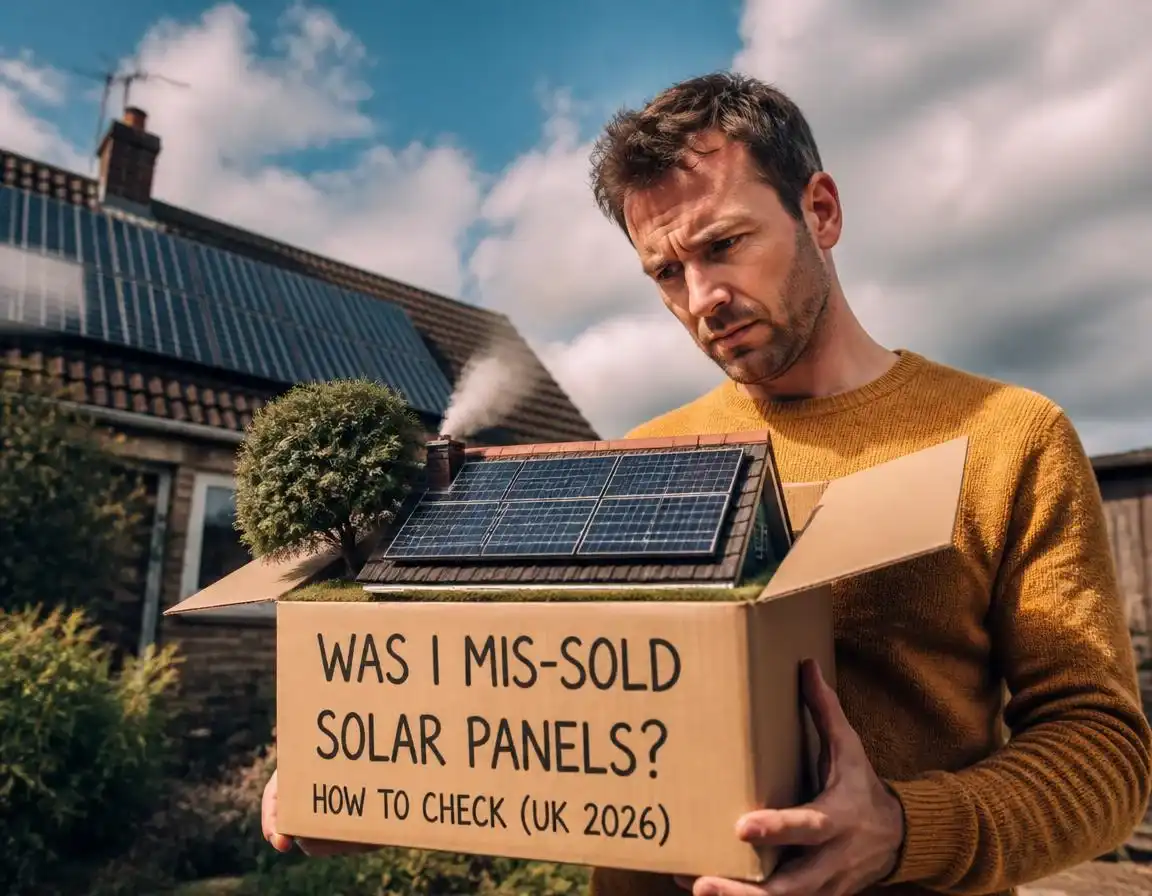
The whole exercise in one picture: hold the pitch up to the light and check the working.
The 10-question self-check
Grab your paperwork and run through these. Each “no” or “hmm” isn’t proof on its own — but stack three or more and you’ve got a case worth pursuing.
- Was the sale done at your door, by phone or online?If yes, you had a legal 14-day cooling-off period with a full refund — and if you were rushed past it, that rushing is itself evidence.
- Do you have a written, fixed-price quote — not just a brochure?Verbal “today only” prices that vanished when you asked for time are a classic rogue-trader marker.
- Does the savings estimate show its assumptions?Energy price, export rate, self-consumption percentage, month-by-month generation. One headline number with no working is a red flag, not a quote — the Competition and Markets Authority has told installers they shouldn’t advertise payback or savings figures without showing the assumptions behind them.
- Was the estimate based on your bills and your roof?A survey that never asked for your electricity usage or checked shading was guesswork dressed up as maths.
- Was export income promised above what open SEG tariffs pay?Genuinely open tariffs, with no tied battery or import deal, currently top out in the low-to-mid twenties in pence per kWh. Anything markedly higher usually needs a bundled deal with one supplier. Anyone promising “guaranteed Feed-in Tariff-style income” after FIT closed to new applicants on 1 April 2019 was selling fiction.
- Was payback promised in under ~6 years without a battery?Independent 2026 estimates put an honest payback at roughly 7–12 years. See the benchmark chart below.
- Was the finance fully explained — APR, total amount repayable, lender name?“The panels pay for themselves” pitched against a 9–11% loan is the single biggest mis-selling pattern we see.
- Were MCS certification and SEG eligibility confirmed in writing?No MCS certificate means no SEG export income at all — a material fact that had to be disclosed. Our MCS badge guide explains what it does and doesn’t guarantee.
- Did you pay a deposit before seeing a written contract, with no deposit protection mentioned?Protected deposits through RECC or HIES are refundable and insured. Unprotected ones evaporate when the company does.
- Is there a lease hiding in the “free panels” small print?Rent-a-roof deals from 2010–2015 are still blocking house sales and remortgages today, with buyout costs that can run to five figures — sometimes upwards of £20,000. Our free-panels investigation has the case files.
Promised vs realistic: the 2026 numbers
This is the part claims companies hope you never do — comparing the pitch against independent current figures. Electricity is capped at around 26p/kWh for a typical household this quarter (Ofgem’s July–September 2026 cap), the Energy Saving Trust puts typical bill savings for a home system at roughly £400–£700 a year, and genuinely open export tariffs pay a couple of hundred pounds at best on a typical system’s surplus. Add them up and a genuinely good setup does very well — just not “£1,500 a year and free heating” well.
Annual savings: the pitch versus what 2026 supports
Benchmarks from the Energy Saving Trust and current open SEG tariff ranges. Battery + smart-tariff setups can add more, but change the upfront cost too.Same story on payback: independent UK estimates for 2026 cluster around 7–12 years for an outright purchase. If your quote promised five — and especially if a loan was involved to make the “savings cover the payments” — that promise is worth putting at the top of your complaint. And if the price itself looks wild compared with the market, our analysis of what MCS data shows typical systems costing and our payback period guide give you the honest comparators.
Mis-selling vs buyer’s remorse — which do you have?
| Signal | Likely mis-selling | Likely remorse / underperformance |
|---|---|---|
| Savings figure | Written promise far beyond any 2026 benchmark | Estimate was plausible; your usage or shading differs |
| Sales conduct | Pressure, fake urgency, no time to compare | You signed willingly after comparing quotes |
| Paperwork | Missing contract, no MCS certificate, no assumptions | Full paperwork exists; expectations drifted |
| Finance | Loan cost buried; “pays for itself” pitch | You understood the APR and chose to finance |
| Best route | The complaint ladder below, possibly s.75/FOS | Performance fixes, tariff optimisation, or a negotiated goodwill gesture |
Neither column is a dead end — but they’re different journeys, and mis-selling is the one with legal teeth.
Time limits that apply
- 14 days from signing for any doorstep, phone or online sale — cancel for any reason, full refund of what you’ve paid (you only pay for work you asked to start inside the window).
- Six years in England and Wales for breach of contract and misrepresentation claims; courts have applied that limit to mis-sold solar finance cases too.
- Five years in Scotland under its own prescription rules — don’t import English deadlines north of the border.
- Finance complaints: the Financial Ombudsman has its own clocks (generally six years from the event, or three from when you knew you had cause) — another reason not to sit on it.
Practical translation: if you’re inside 14 days, stop reading and cancel in writing today. If you’re inside six years, you’ve got time — but evidence goes stale and companies go bust, so earlier is always stronger.
Build your evidence file before anyone calls anyone
Every rung of the ladder below runs on documents, not feelings. Gather: the contract and any quote or brochure; the savings estimate (the single most valuable page in the file); emails, texts and a dated note of who said what on calls; the finance agreement with APR and total repayable; your MCS certificate (or proof it was never issued); and 12 months of generation data from your inverter app or meter. Scan everything, store it in two places. Ten minutes of admin now is the difference between “he said, she said” and a file a scheme adjudicator can act on.
Complain to the installer — in writing, with a deadline
Every formal route requires you to give the installer first crack at it, so make this one count. Write (email is fine): what was represented, what the reality is, which documents prove it, and what you want — refund, compensation, re-survey, whatever “good” looks like to you. Give them 14 days to respond with a plan, which is the maximum MCS itself considers reasonable. A surprising number of cases end here, because a firm facing a paper trail behaves differently to one facing a shouty phone call.
Escalate: MCS, RECC and HIES
| Body | When to use it | What to expect |
|---|---|---|
| MCS | Any MCS-certified installer, after step 1 fails | Acknowledged in 5 working days, updates at least every 10, most cases resolved within 8 weeks; can order remedial work |
| RECC → Green Homes Dispute Resolution | RECC-registered sellers (020 7981 0850) | Free, CTSI-approved independent dispute resolution for sales-conduct complaints — exactly mis-selling territory |
| HIES | HIES-member installers | Free mediation and an ombudsman route; insurance-backed guarantees if the firm has gone under |
| Dispute Resolution Ombudsman (FHIO) | After MCS concludes, within 12 months | Binding ADR for installers certified under the redeveloped MCS scheme |
If your installer has already gone bust, the route changes but doesn’t disappear: manufacturer warranties usually survive an installer collapse, an insurance-backed guarantee covers workmanship, and HIES deposit protection exists precisely for this. Our installer-gone-bust guide walks through which document saves which situation.
The finance angle — where the real money sits
If any part of the purchase went on a credit card, Section 75 of the Consumer Credit Act makes the card provider jointly liable with the seller for misrepresentation, on purchases between £100 and £30,000 — even if the card only covered the deposit. If it was a regulated loan arranged alongside the sale, the lender carries connected-lender liability for the same misrepresentations. The Financial Ombudsman has worked through around 2,000 complaints about mis-sold solar finance in one well-documented wave alone — Barclays, which financed a number of the deals in question, set aside £38 million for potential claims after an independent survey found one customer’s panels wouldn’t cover a £10,000-plus loan even after 20 years. Complain to the lender directly first; if you get a final rejection or eight weeks of silence, the Ombudsman is free to use. Our solar finance debt-trap piece explains which deals tend to end up here.
Trading Standards, Action Fraud — and court as the last rung
For aggressive or deceptive conduct, report through the Citizens Advice consumer helpline on 0808 223 1133, which logs it with your local Trading Standards team. If money changed hands under false pretences — the fake “government refund” pattern, say — that’s Action Fraud on 0300 123 2040 (Police Scotland on 101).
And if every rung above fails, the small claims track exists for exactly this kind of dispute. You don’t need a solicitor to bring a claim for a few thousand pounds — just the evidence file from Step 0 and a clear, documented account of what was promised versus what was actually delivered.
Where this usually ends
Here’s the reassuring close to a gloomy-sounding topic: most mis-selling cases that are properly evidenced settle at step 1 or 2, because no certified installer wants an adjudicated misrepresentation on their record. The people who lose out are the ones who never check, or who hand their case to a cold-caller. Run the checklist, build the file, write the letter. Solar done honestly is still one of the better home upgrades available in Britain right now — which is exactly why the dishonest version deserves chasing.
Frequently asked questions
What counts as mis-sold solar panels in the UK?
Mis-selling means a misleading or false statement pushed you into signing — savings or payback promises that could never have been realistic, export income quoted above market rates, pressure tactics that rushed you past your 14-day cooling-off period, or finance terms that weren’t properly explained. It’s different from buyer’s remorse: a system that underperforms because your roof shades in winter isn’t automatically mis-sold, but one sold with a written five-year payback promise was never realistic to begin with.
How long do I have to complain about mis-sold solar panels?
You always get 14 days to cancel a doorstep, phone or online sale with no reason needed. After that, breach of contract and misrepresentation claims in England and Wales generally have a six-year limit, while Scotland runs its own five-year prescription rules, and regulated finance complaints to the Financial Ombudsman have separate deadlines. The sooner you build your evidence file, the stronger your position.
Can I get compensation if my solar panels were mis-sold?
Often, yes. Depending on how you paid, you might cancel for a full refund, win compensation for the gap between promised and realistic performance, or hold a credit card or loan provider jointly liable under Section 75 of the Consumer Credit Act for purchases between £100 and £30,000. Most cases settle through the installer, HIES, RECC’s dispute service or MCS long before court enters the picture — the Financial Ombudsman has worked through around 2,000 complaints of this kind already, with one lender alone setting aside £38 million for potential claims.