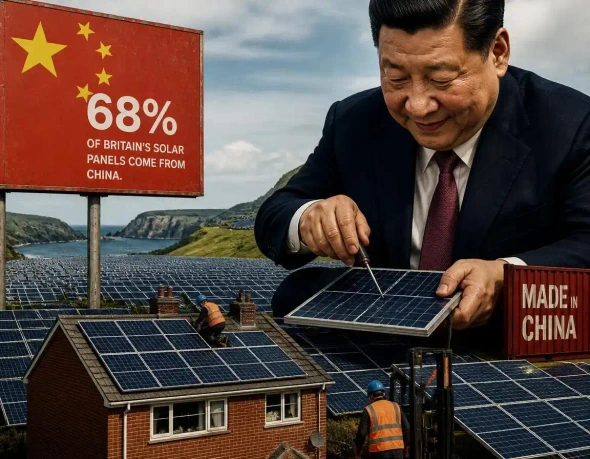
68% of Britain’s Solar Panels Come From China

68% of Britain’s Solar Panels Come From China — Here’s What That Actually Means for You
That number is real, the headlines are loud, and the word “security” is being thrown about like confetti. I’ve spent a fortnight digging through trade data, parliamentary debates and cyber-security rulebooks so you don’t have to. Here’s the plain-English truth — no panic, no sales pitch.

📊Where does the 68% number come from?
The 68% estimate has been cited in Parliament itself — a June 2026 Hansard record of a Commons debate on Chinese-manufactured solar panels put the figure at 68%, alongside a striking related stat: two-thirds of NHS trusts are also dependent on Chinese solar. It’s a significant jump from the “more than 40%” figure that was widely reported back in April 2025, when the government first moved to block forced-labour-linked panels from Great British Energy’s supply chain — a sign of just how quickly Chinese import share has grown in little over a year.
Illustrative UK Solar Panel Import Split (2026)
🛡️What is the actual security risk?
Politicians talk about panels being “switched off” remotely. This is technically impossible for a standard solar panel. The risk lies entirely in the smart inverters and monitoring apps that connect your roof to the internet.
⏳How did we get here?
HMRC-sourced reporting around GB Energy’s forced-labour policy put Chinese import share at “more than 40%”.
UK law mandates baseline security for all smart home gadgets, including solar inverters.
The UK hits a historic milestone, passing 2 million solar installations (22.1GW total capacity), confirmed by GOV.UK.
Solar output hit a record 15.42GW on Britain’s grid, per National Energy System Operator data.
Hansard records the updated 68% estimate during a Commons debate on Chinese-manufactured solar panels.
💸The cost of avoiding Chinese panels
If you want to avoid Chinese brands, you will pay a premium. But does it buy you security? No. Almost all non-Chinese brands still use Chinese wafers.
| Panel Origin | Example Brands | Avg Cost (10 panels) | Security Rating | Value |
|---|---|---|---|---|
| Chinese | Jinko, JA Solar | £6,000 – £7,500 | Safe | Excellent |
| Non-Chinese | REC, Maxeon | £7,000 – £8,500+ | Safe | Premium |
❌Myths vs Reality
Panels are hardware. They cannot be hacked remotely. Only smart inverters have connectivity.
Almost all panels use Chinese silicon wafers, even if assembled elsewhere.
They are as safe as any smart thermostat. Just change your default passwords.
✅Your 5-point security checklist
Update your inverter’s app and admin panel with a strong, unique password.
Put your inverter and monitoring hub on a separate network from your main devices.
Check for inverter updates quarterly to ensure you have the latest security patches.
Ensure your installer is MCS-certified and configures the system securely.
❓Frequently Asked Questions
Are Chinese solar panels safe to put on a UK home in 2026?
Should I pay extra for non-Chinese solar panels to avoid the risk?
Can my solar inverter or monitoring app be hacked?
Sources & References
- Hansard, UK Parliament — Chinese-Manufactured Solar Panels debate (2 June 2026)
- GOV.UK — Britain continues to break clean power records (solar deployment & generation data, 2026)
- National Energy System Operator (NESO) — record solar generation data, April 2026
- Product Security and Telecommunications Infrastructure (PSTI) Act 2022
- Solar Energy UK Market Report