
Solar Inverter Fault Codes Explained UK

Solar Inverter Fault Codes Explained UK: What Yours Means & What to Do Next
Kettle’s on, the app’s showing a red dot, and there’s a code on the inverter you’ve never seen before. I’ve been around UK solar for over twenty years, so here’s the first thing I always tell people: most fault codes are your inverter doing its job, not dying. This page is the translator I wish my customers had — what the code means, how urgent it is, and exactly what to do next.
🔴 What an inverter fault code is (and isn’t)
Think of the inverter as the referee in your solar system. It watches the grid side, the DC side coming off the roof, the insulation between them, and its own temperature — all day, every day, several times a second. When something drifts outside its safety envelope, it stops feeding power and logs a code telling you which protection just operated.
That’s the key mental shift. A fault code is a symptom label, not a verdict that the box is broken. “Grid overvoltage” means the grid misbehaved, not the inverter. “Insulation low” usually points at a soggy connector on the roof. The code tells you where to look, and that’s half the battle won before the engineer even picks up the phone.
So rule one: read the code, screenshot it, don’t fear it. Everything below is about turning that screenshot into a sensible next step.
🚦 Warnings, alarms and lockouts: the three tiers
Not all codes are born equal. After two decades of support calls, I sort every message an inverter throws into one of three tiers, and I’d encourage you to do the same before you panic.
| Tier | What the inverter is saying | Typical examples | Your move |
|---|---|---|---|
| Warning | “Something’s off, but I’m still working.” | Comms loss, derating, fan running slow | Note it, keep an eye on it, no panic |
| Transient alarm | “I’ve paused to protect myself.” | Grid overvoltage, over-temperature, frequency blip | Watch the pattern; one controlled reset is fine |
| Lockout fault | “Stop. A human needs to look at this.” | Earth fault, arc fault, RCD trip, relay fault | Book an engineer; stop resetting |
The comms ones deserve a special mention, because they cause more needless worry than everything else combined. If the app says the inverter is offline but the generation light is green and the meter’s still spinning, your solar is almost certainly fine — it’s just the Wi-Fi dongle that’s sulked off. I’ve written about the monitoring side in my round-up of the best solar monitoring apps, including each brand’s usual comms gremlins.
🔌 The UK’s most common trip: grid overvoltage
If your system trips on bright weekdays, roughly eleven to one, and happily works again on dull days — this is it. Grid overvoltage is by a distance the most common “fault” I see on UK systems, and it’s not a fault at all.
Here’s the physics in one breath. UK mains voltage is nominally 230V, and the law allows it to sit anywhere up to 253V. When you export, the voltage at your inverter’s terminals gets pushed up a little above what your neighbours see. Add a sunny day, low local demand, and a rural or end-of-street supply that already runs high, and your inverter nudges past 253V. At that point the G99 connection rules require it to disconnect. It’s obeying the law, grumpily, while your panels have never worked better.
Why sunny days trip the inverter
Voltage at your inverter’s terminals across a day (illustrative example)
Illustrative voltages to show the headroom problem, not a live dataset.
What can you actually do about it? First, gather evidence: a week of app screenshots with timestamps beats any argument. Then your installer raises it with the DNO — usually as a voltage rise review or a G99 flexible connection request. The fixes run from tweaking the approved setpoint, to a fatter AC cable on longer runs, to (last resort, in my view) a small export limit that costs you a sliver of SEG income. If export earnings matter to you, it’s worth checking our comparison of the best SEG tariff rates before you agree to cap anything.
One line I’ll die onDon’t let anyone “fix” overvoltage by hacking the grid profile in the installer menu on a whim. Those settings are part of your G99 agreement with the DNO, and cowboy adjustments can void warranties and your MCS paperwork in one tap.
💧 The damp family: earth faults, RCD trips and low insulation
Britain being Britain, this is the autumn special. The pattern is unmistakable: the system trips first thing on damp mornings, sometimes repeatedly between six and nine, then “miraculously” clears by lunchtime as the sun dries the roof out.
What’s happening is moisture getting somewhere it shouldn’t — most often a roof connector. MC4 connectors are brilliant when fitted well and ruthless when they’re not, and a slightly weedy seal will let in just enough damp to drag the insulation resistance below the inverter’s safety threshold. You’ll see it as “PV isolation low”, “GFDI”, “earth fault” or an RCD tripping at the consumer unit, depending on the brand.
An engineer finds the culprit in an hour or so with an insulation resistance test on each string, and the fix is frequently just re-terminating a connector or two. What you mustn’t do is sit on it. Earth fault protection exists for shock and fire safety, and a fault that “clears up” every afternoon is still a fault. This is also a good moment to look at our annual solar maintenance checklist — most damp-family call-outs I’ve attended were catchable at a routine service.
⚡ Arc faults: the codes to respect
Modern inverters carry arc-fault detection (AFCI), and if yours logs a genuine arc fault, that’s the one code I want treated as urgent. An arc is electricity jumping a bad connection — a loose connector, a crushed DC cable — and it’s the classic precursor to the kind of DC fault nobody wants.
My rule for homeowners is simple: don’t keep resetting an arc fault. One controlled reset to see if it was a one-off glitch is reasonable. If it comes straight back, leave the isolators alone and get an engineer out the same day. And never, ever unplug DC connectors on the roof yourself to “have a look” — DC from a string is live whenever there’s daylight, even with the AC side completely off. If you’ve ever wondered what your system does in other odd situations, our piece on what happens to solar during a power cut covers the same “live when sunny” surprise — your panels keep generating in daylight even when the inverter itself has shut down.
Red lineNo homeowner checks inside the inverter or on the roof. There are no user-serviceable parts in there, and the DC bus can hold a nasty voltage on a grey day.
🌡️ Overheating, derating and the loft problem
Every July, without fail, my inbox fills with “inverter derating” and “over temperature” messages. Inverters hate heat about as much as they hate damp, and a unit sitting in a loft that’s touching 45°C will deliberately throttle itself to survive. You’ll see it as reduced midday output rather than a hard trip — the system quietly leaving money on the table on your sunniest days.
Fan faults (a Growatt favourite) are the same family: the cooling’s struggling, so the inverter protects itself. Dust is the silent accomplice. If your inverter lives somewhere hot, give it airflow, keep the heatsink fins clear, and make it part of the annual once-over. Derating that persists into autumn, though, points at a failing fan or sensor — that’s an engineer job, and on an inverter heading past ten it starts the “repair or replace” conversation below.
📟 Brand-by-brand fault code translator
Same physics, different dialects. Here’s how the common brands in UK homes tend to announce the usual suspects. Firmware versions change the exact wording, so treat this as a decoder ring, not gospel — and always screenshot your exact message before it scrolls away.
| Brand | Where codes show | Overvoltage looks like | Earth / RCD / arc looks like |
|---|---|---|---|
| Fronius | Solar.web app, LCD on some models | State 102-family codes, “AC voltage too high” | “RCD” or insulation (“Riso”) warning states |
| SMA | Sunny Portal, display | “Grid overvoltage” / Vac-max event | “Earth fault” / RCD event |
| SolarEdge | LCD under the unit, monitoring app | “Vac High”, “Waiting for AC” | “RCD”, “GFDI”, “Arc Detected” |
| Enphase | Enlighten app, per-panel | “AC voltage high”, “No utility” | “GFDI”, “DC overvoltage” events |
| Huawei | FusionSolar app | Alarm state — “Grid Overvoltage” | DC input alarms, AFCI arc-fault alarm |
| Growatt | OLED screen, ShinePhone app | “AC V Outrange” | “PV Isolation Low”, “GFCI” |
| GivEnergy | Portal and app | “Grid Volt High” / Vac protect | RCD / earth fault flags |
| SolaX | LCD, SolaXCloud | “Grid Volt Fault” | “RCD Fault”, “Bus Volt Fault” |
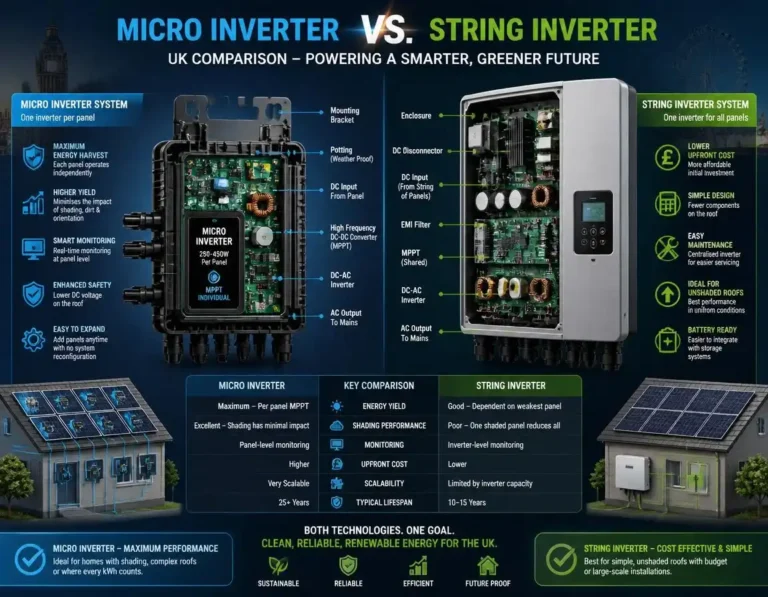
If you’re trying to work out what you’ve got on the wall, my Huawei SUN2000 review and the Growatt vs GivEnergy vs SolaX verdict both cover how each brand’s app reports faults in plain English — worth flagging that Huawei withdrew from new UK residential sales in January 2026, though every SUN2000 already on a British roof keeps its warranty and support unaffected. And if yours is a microinverter system, the rules change pleasantly: one failed micro affects one panel, not the whole array — our micro vs string inverter guide goes into that trade-off.
🧰 Safe checks before you book a call-out
I’d lose count of the call-outs that ended with an engineer switching an isolator back on and charging for the visit. Run this list first — all of it safe, all of it from ground level.
- Screenshot everything. The code, the date, the time, the generation graph. Engineers diagnose patterns, and patterns need timestamps.
- Check the isolators. Is the AC isolator next to the inverter fully on? Has an RCD or breaker in the consumer unit tripped? (Only touch your consumer unit if you’re dry, confident and it’s easily accessible.)
- Log the pattern. Midday sun trips point at voltage. Damp-morning trips point at insulation. Random trips point at the grid or comms.
- One controlled reset. AC isolator off, five minutes, back on. Once. If a lockout-type code returns, stop.
- Eyes-only roof scan from the ground. Binoculars or a phone zoom. Any lifted panel, dangling cable or obvious connector damage? Tell the engineer before they arrive.
- Check the boring stuff. Router on? Dongle seated? Half the “system faults” I’ve closed were a broadband change that orphaned the Wi-Fi dongle.
📞 Installer, DNO or manufacturer?
The fastest way to a long wait on hold is ringing the wrong organisation. Use this to aim your first call correctly.
| Symptom | Likely cause | Who to call |
|---|---|---|
| Sunny-day midday trips (overvoltage) | Local network voltage plus your export | Installer first — they liaise with the DNO |
| Damp-morning trips clearing by lunch | Soggy connectors, ageing DC cable | Installer |
| Arc fault code | Loose or damaged DC connection | Installer, same day — treat as urgent |
| Dead screen, relay or internal fault | The inverter itself | Manufacturer, via the warranty route |
| App offline, generation fine | Wi-Fi dongle or router | You — re-pair the dongle, check the router |
| Nothing after a power cut | Grid supply or isolation | Check isolators; if the whole street’s dark, the DNO |
One nuance people miss: overvoltage is a network issue, but you still call your installer first. They hold your G99 paperwork and know what to ask the DNO for. Calling the DNO direct without that paperwork usually gets you a polite dead end.
💷 Warranty, replacement costs and when to upgrade instead
String inverters typically give 10 to 15 years of honest service before the electronics start to tire; a well-specified microinverter routinely outlives the panels it’s bolted behind. Warranties vary a fair bit by brand: Enphase’s 25 years on its microinverters is still the standout, Huawei, Fronius, SMA, GivEnergy and SolarEdge’s inverter ranges typically run 10 to 12 years as standard (often extendable to 15–20 for a fee), and budget string brands like Solis or Growatt commonly start at just 5 years, stretching to 10 if you register in time. Our solar warranty explainer covers the small print that decides whether your claim sails through or sinks.
And a word of hard-earned caution: a warranty is only as good as the company standing behind it. GivEnergy entered administration on 9 April 2026 — a sobering moment for the industry. The hardware and the app both carried on working exactly as before, but the manufacturer itself can no longer honour new hardware warranty claims directly. We’ve covered exactly what that means for owners in our GivEnergy administration piece. It’s why I always say the badge on the wall matters as much as the years on the brochure; choosing an MCS-certified installer is your first layer of protection, because it keeps the paperwork trail intact if a manufacturer vanishes.
If you’re out of warranty, budget roughly £600 to £1,500 fitted for a like-for-like string or hybrid inverter swap — that’s the range UK installers are actually quoting for supply and fit in 2026. Microinverters rarely need replacing at all given their 25-year cover, but if one genuinely fails, the part itself is inexpensive — around £60 to £120 — with a roof-access call-out on top. Before you sign for a like-for-like swap, price the alternative: if you’ve been eyeing a battery, moving to a hybrid inverter now can make the “repair” budget do double duty — our guide to adding a battery to existing solar panels runs those numbers properly.
When replacement beats repairOut of warranty plus a repair quote over half the price of a new unit; an obsolete model with no spares; or a non-hybrid inverter blocking the battery you actually want. Those are the three moments I tell people to stop repairing and start upgrading.
❓ FAQs
Is it safe to reset my solar inverter after a fault code?
Usually yes, if it is a one-off grid or comms fault. Switch off the AC isolator, wait five minutes, switch it back on. If the same code returns, or the code is an arc fault, earth fault or RCD trip, stop resetting and book an engineer. Repeatedly resetting a genuine fault can turn a cheap fix into a new inverter.
Why does my inverter trip around midday on sunny days?
That pattern is the classic sign of grid overvoltage. Exporting power pushes the voltage at your inverter up, and UK rules force it to disconnect once that voltage passes 253V. The inverter is doing its job, not breaking down. Your installer or your DNO can usually sort it with a setpoint change, a cable upgrade or a small export limit.
How much does a solar inverter replacement cost in the UK?
Expect roughly £600 to £1,500 fitted for a like-for-like string or hybrid inverter swap, depending on size and brand — that’s what UK installers are actually quoting for supply and fit in 2026. Microinverters rarely need replacing at all thanks to their 25-year warranty, but if one genuinely fails, the part itself is only around £60 to £120, plus a roof-access call-out. If you are out of warranty, compare a like-for-like swap with upgrading to a hybrid inverter — the gap is often smaller than you think.
Most fault codes, in the end, are just your system protecting itself — and now you know which ones mean “ignore me”, which mean “watch me”, and which mean “phone someone today”. Screenshot the code, check the pattern, and you’ll walk into that phone call with the upper hand.

4 Comments