
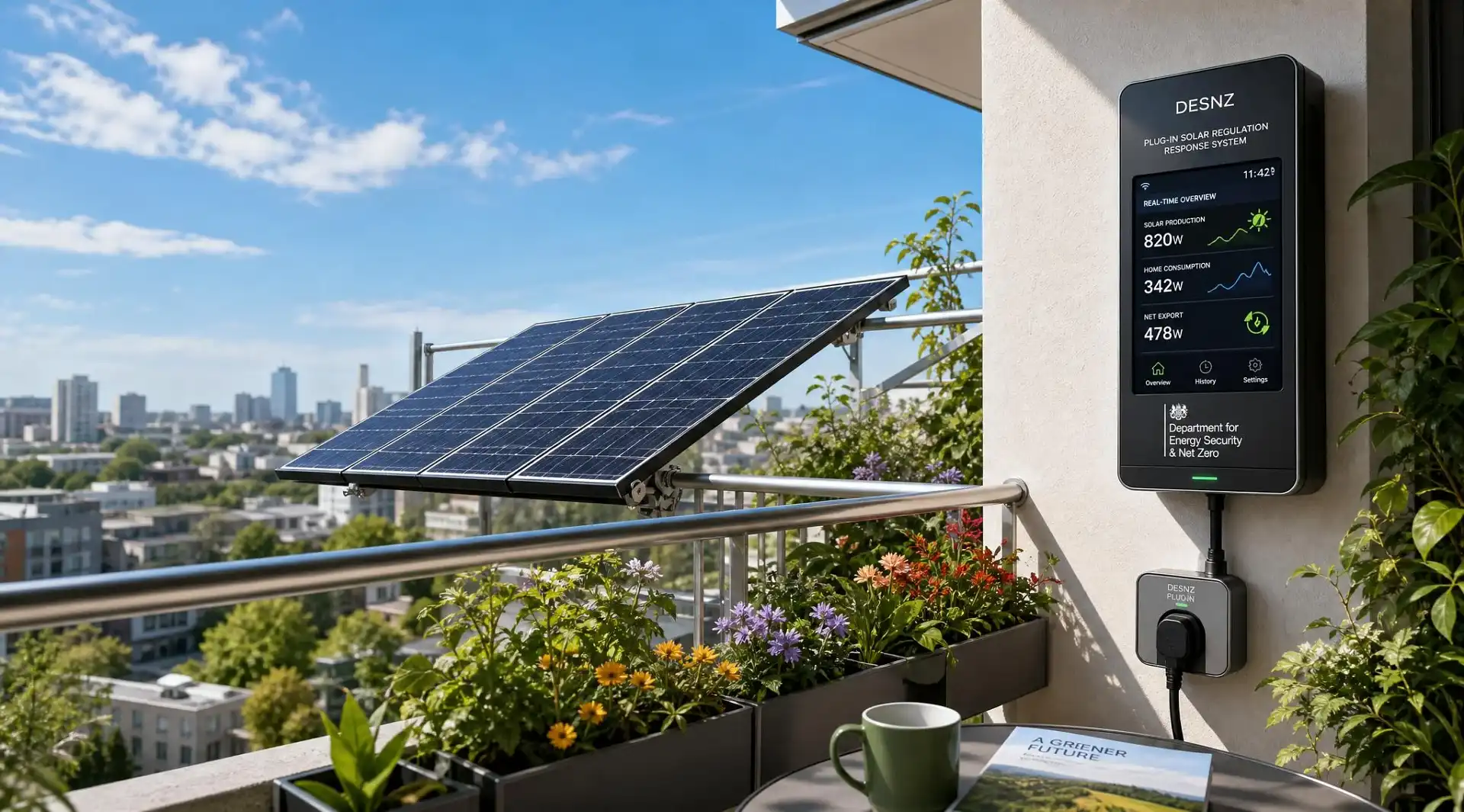
DESNZ plug-in/balcony solar regulation response

Plug-In Solar Is Now Law: DESNZ’s Response Explained

This one’s genuinely worth stopping and reading properly. On 16 July 2026, the Department for Energy Security and Net Zero published its response to the plug-in solar consultation, and six days ahead of schedule too. Within the same afternoon, a real piece of legislation followed it. I’ve gone through the government response and the actual legal text so you don’t have to, and I’ll give you the plain English version, the dates that matter, and what’s genuinely still missing.
What Actually Happened, in One Paragraph
Plug-in solar (also called balcony solar) has been stuck for years behind one oddly specific technical problem: the standard UK three-pin plug isn’t legally allowed to connect a generating device to a socket. DESNZ ran a two-week consultation in June 2026 proposing to fix that, plus a new safety specification for the kit itself. On 16 July, it published its response confirming both changes, and a Statutory Instrument, SI 2026/848, followed the same day. That instrument comes into force on 27 August 2026. That’s the date the law explicitly allows a solar generator to be connected through a normal plug and socket, something the rules have quietly forbidden for years.
The Numbers Behind the Decision
What struck me most reading the response is how one-sided the feedback was. For a fairly technical energy consultation that ran for just two weeks, 466 responses is a strong turnout, and they came from electricians, engineers, the fire service, housing associations and a good number of private individuals, not just industry.
Source: DESNZ, Plug-in solar: regulatory amendment and interim product specification — government response, published 16 July 2026.
What Counts as a “Plug-In Microgenerator”?
This is the actual legal definition now written into both the Plugs and Sockets Regulations and the Electricity Safety, Quality and Continuity Regulations. To qualify, a device must tick every single box below, and it’s worth reading carefully because point five is the one that’s caused the most argument.
| # | Requirement |
|---|---|
| 1 | Generates electricity from the direct conversion of sunlight only |
| 2 | Maximum rated AC output of 800 watts |
| 3 | Designed for connection via a standard plug and socket |
| 4 | Designed to operate in parallel with the electricity network |
| 5 | Must not be designed to import and store electricity for later use |
Point one rules out plug-in wind turbines or anything else that isn’t solar. Point two puts the 800-watt cap directly into law rather than just a specification document that could quietly shift later. And point five is the one worth sitting with: it writes battery storage out of the entire framework at the definition stage, not just as a policy choice in the small print. A plug-in battery that charges up and discharges later simply isn’t a “plug-in microgenerator” in the eyes of this law, full stop.
The Genuine Surprise: One Device Per Circuit, Not Per Household
Here’s the bit I didn’t see coming. The consultation asked whether households should be limited to one plug-in solar device in total, or one per individual power circuit in the home. 63% of respondents wanted the per-circuit option, and the government agreed with them.
In practice, that means a house with separate circuits could eventually run a panel off an east-facing wall on one circuit and a west-facing one on another, each with its own 800W inverter, spreading generation across more of the day. It’s a genuinely more flexible position than Germany’s model, which this whole framework borrows heavily from.
What Got Tightened in the Final Specification
The Interim Product Specification published alongside the response (version 2) isn’t identical to the June draft. A few things were added or firmed up:
- A 5 milliamp cap on residual DC current from the inverter at full output, aimed at preventing older AC-only RCDs from being desensitised by DC leakage.
- Mandatory consumer guidance from manufacturers on identifying your RCD protection, testing it, and knowing when to call an electrician.
- Fire safety requirements for the backing material in panels, with tighter restrictions on higher-risk buildings, following concerns raised by the fire service about external fire spread on tall blocks.
- Defined cable routing rules for running the DC cable from an outdoor panel to an indoor socket safely.
- Compulsory registration on the ENA G98 Type Test Register before a product can be sold, with a visible declaration of compliance and clear labelling.
That last point is genuinely useful for anyone shopping later this year: once compliant kit exists, the register becomes the simple way to check whether a product is legitimate, rather than trusting a marketplace listing at face value.
What Stayed the Same
The headline 800W AC output limit survived the consultation untouched, as did the 2,000W DC input cap (though DESNZ says it’ll keep that one under review as real-world data comes in). There’s no requirement for professional installation, no mandatory third-party certification beyond the IPS route, and no new inspection regime; the government considered all three and judged them disproportionate for a product this size. The independent safety study also gave ring final circuits, the standard UK socket wiring, a clean bill of health at 800W, which should settle the most persistent technical objection people have raised.
Batteries: Still Excluded, No Date Given
This was the most-raised concern in the open comments, and it’s the one part of the response that will disappoint plenty of people. Respondents argued that pairing plug-in solar with a battery is what actually makes the savings add up, since it lets you keep your own generation rather than exporting it for nothing. DESNZ’s answer hasn’t moved since June: battery-integrated products raise technical and regulatory questions that haven’t been assessed yet, they stay out of scope, and the department will “continue to develop evidence” before considering it further. No phase-two date was given, not even a rough one.
So Can You Actually Plug One In on 28 August?
Not quite, and it’s worth being straight about this rather than letting the headline do the talking. What becomes legal on 27 August is operating a compliant device, and nothing on general sale today has been through the compliance chain, because that chain didn’t exist until last week. A kit needs: plug approval from a notified body under the new route, verification against IPS version 2, a listing on the ENA G98 Type Test Register, and the correct declaration and labelling. None of that happens overnight.
There’s also a Northern Ireland wrinkle worth knowing about: the plug approval change applies UK-wide, but the ESQCR amendment only covers England, Wales and Scotland, since Northern Ireland runs its own separate electricity safety regulations. Anyone in NI will need a further instrument before the operating side of this applies there too.
Government Sources for This Article
Everything above is drawn directly from the primary documents rather than secondhand reporting. If you want to read the originals yourself, the government response sits on the consultation page at GOV.UK: Plug-in solar, regulatory amendment and interim product specification, and the legal text itself, including the full definition of a plug-in microgenerator, is published at legislation.gov.uk: SI 2026/848, as made.
Frequently Asked Questions
Is plug-in solar legal in the UK now?
Not yet, but it has a confirmed legal date. SI 2026/848, the Statutory Instrument that amends the relevant safety regulations, comes into force on 27 August 2026. From that date, connecting a compliant plug-in solar device through a standard plug and socket is explicitly provided for in law. However, no product has yet completed the certification process needed to count as “compliant,” so plugging a kit into a socket is not lawful until certified products actually reach the market.
What is the maximum size for a legal plug-in solar device in the UK?
The law sets a maximum rated AC output of 800 watts per device, and this figure is written directly into the legal definition of a “plug-in microgenerator” in SI 2026/848, not just a specification document. There’s also a 2,000 watt DC input cap, which the government has said it will keep under review as real-world data becomes available.
Can I use a plug-in solar battery under the new rules?
No. The legal definition of a plug-in microgenerator specifically excludes any device designed to import and store electricity for later use, which rules out battery-integrated plug-in kits. This was the most commonly raised concern in the government’s consultation, but DESNZ has confirmed batteries remain out of scope for now, with no timeline given for when or whether that might change.
This article summarises DESNZ’s government response (published 16 July 2026) and SI 2026/848 as made. Details of the framework, including the Interim Product Specification and the Engineering Recommendation G98 notification limit, may be updated further before the 27 August 2026 commencement date. This is not legal advice — always check the current primary sources linked above, and consult a Competent Person Scheme registered electrician and your Distribution Network Operator before connecting any generation equipment to your home’s electricity supply.


2 Comments