
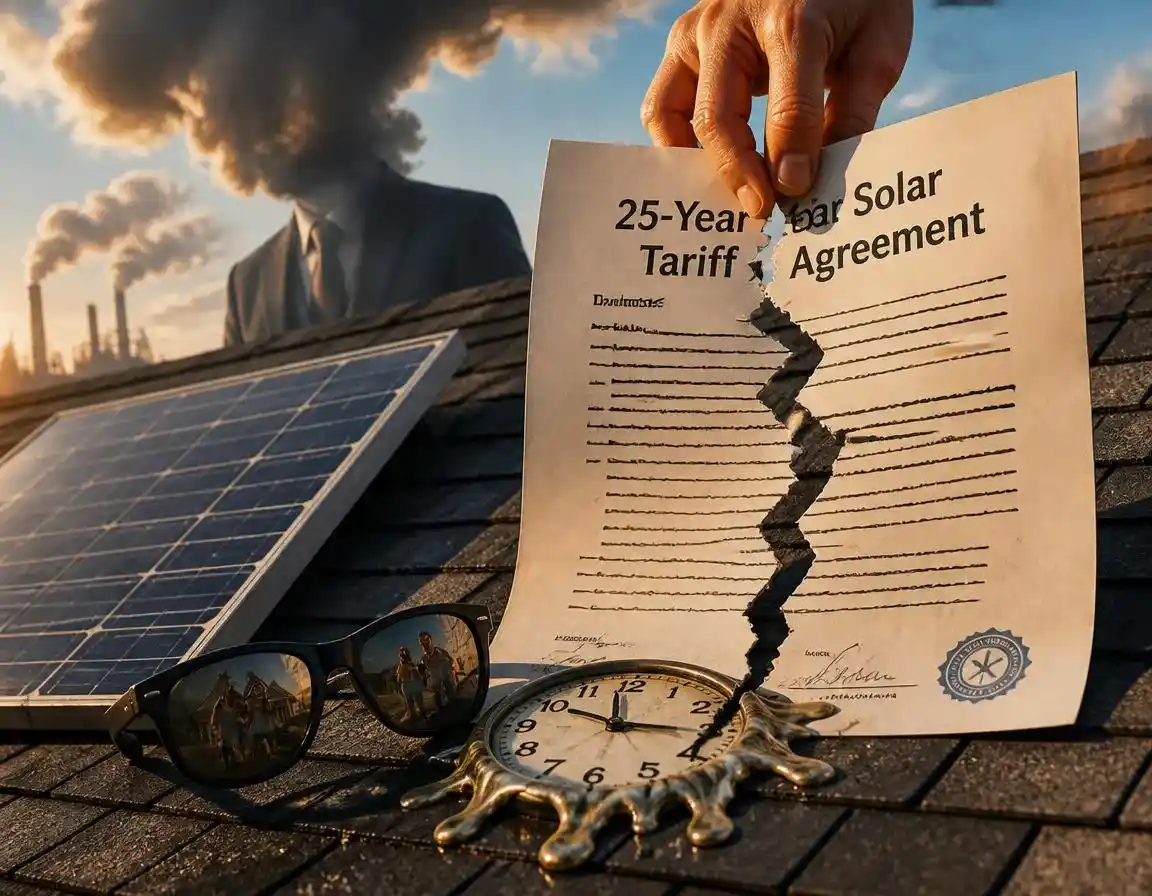
Broken Promise? Why the Government Wants to Cut Your 25-Year Solar Tariff

UK FEED-IN TARIFF · WHAT CHANGED IN 2026
Broken Promise? Why the Government Wants to Cut Your 25-Year Solar Tariff
If you’ve had solar panels since the early 2010s, you’ll remember the pitch: fixed payments, guaranteed for up to 25 years, rising with inflation every single year. That’s exactly what you were promised. Here’s what’s actually changed in 2026, why it happened, and what it really means for the money landing in your account.

I’ll be straight with you: the headline sounds worse than the reality, but it’s not nothing either. Nobody’s ripping up your contract. Nobody’s cutting your base rate. What’s changed is quieter than that, and in some ways sneakier — the government has swapped the ruler it uses to measure your annual pay rise, and the new ruler is shorter.
For years, if you were one of the 800,000-plus households on the Feed-in Tariff (FiT), your generation and export payments went up every April in line with the Retail Prices Index (RPI). That was the deal. From 1 April 2026, that link to RPI is gone. Your payments now rise with the Consumer Prices Index (CPI) instead — a measure that’s almost always lower. Nobody’s payment has gone down. But almost everyone’s future payments will grow more slowly than they were promised when they signed up.
From April 2026, Feed-in Tariff generation and export payments rise each year using CPI instead of RPI. Your base tariff rate hasn’t been cut, your contract length hasn’t been shortened, and payments will still increase annually — just by less than they would have under the old system. DESNZ’s own consultation figures put the FiT-specific saving at around £70 million a year by 2030/31, rising to roughly £310 million a year by 2031/32 once combined with the related change to the Renewables Obligation scheme, which mostly affects larger-scale generators. A tougher option — freezing your payments outright for several years — was on the table too, and was dropped after a public backlash.
What Changed
RPI vs CPI: the one-letter switch behind all of this
Both RPI and CPI measure inflation, but they’re calculated differently, and RPI almost always comes out higher — partly because it includes housing costs like mortgage interest that CPI leaves out. The UK’s statistics watchdog stopped treating RPI as a “national statistic” years ago because of known flaws in how it’s calculated, and government policy has been steadily phasing RPI out of official use across the board, not just for solar. That’s the backdrop here: this isn’t really a solar-specific decision, it’s a solar-specific consequence of a much wider RPI phase-out.
In cash terms, that gap is exactly what landed on 1 April 2026: Ofgem’s Feed-in Tariff rates rose by 3.4%, not the roughly 4.2% they’d have risen under the old RPI link. On its own, a single year’s difference is modest — a few pounds either way for most households. The real story is what happens when that smaller gap compounds, year after year, for the rest of a contract that can run another 10, 15 or even 18 years for the earliest adopters.
Say you earn £1,000 a year from your FiT generation. Under the old RPI link (4.2%), next year you’d earn £1,042. Under the new CPI link (3.4%), you’ll earn £1,034. That’s an £8 difference in year one. But because the percentage compounds annually, that gap widens every year it’s applied. Assuming that 0.8-point gap between RPI and CPI held steady for a remaining 15-year contract — which won’t be exactly true, since both measures move with the economy — your cumulative income would come in at roughly £1,370 lower in total than under the old RPI link, with the yearly shortfall alone reaching around £200 by year fifteen. Small in year one, real money by the time the contract ends.
Fact-Checking The Headline
Is this really a “cut”? What’s changing and what isn’t
This is where a lot of the coverage gets muddled, so let’s separate the two things that are genuinely different.
The inflation measure used for your annual increase
- Generation and export tariffs now rise with CPI, not RPI, from the 2026/27 FiT year onwards
- Because CPI usually runs lower, each year’s increase will typically be smaller than under the old rules
- The gap compounds every year for the remaining life of your contract — the earlier you signed up, the longer that compounding has left to run
- Ofgem’s tariff-rate publication deadline is normally 1 February each year; for 2026 only, it was pushed back to before 1 April to give DESNZ time to make the switch, reverting to 1 February from 2027 onwards
The core deal you signed up to
- Your base generation and export tariff rates are untouched — nobody’s had their p/kWh rate cut
- Contract length is exactly the same: 20 years for most, 25 years if you joined before 1 August 2012
- Payments still rise every year — this isn’t the freeze option, which would have meant no rise at all for several years
- Eligibility, metering rules and how you’re paid all stay as they were
So no, this isn’t the government reaching into your contract and slashing the number on the page. It’s closer to being promised a pay rise tied to your local supermarket’s prices, then being told it’ll now track a slightly gentler measure instead. Real money, just less of it over time — and for anyone who signed up expecting RPI specifically, a promise that’s been quietly redrawn.
Who Feels This Most
Why your installation date matters more than almost anything else
The Feed-in Tariff was never one flat rate — it stepped down sharply as more households signed up and panel prices fell, which means two neighbours with identical roofs can be on wildly different tariffs depending purely on when they installed.
Figures are for a 4kW system meeting the higher Energy Efficiency Requirement band, illustrative of the scale of the gap between early and late FiT vintages — your own rate depends on your system size, band and exact commissioning date.
Put those two numbers next to the RPI-to-CPI change and the picture gets clearer. A household on 74p/kWh is earning roughly thirteen times more per unit than a household on 5.65p/kWh, so a smaller annual percentage increase is a much bigger cash difference for the early adopters. Those same early adopters are also the ones most likely to be on the original 25-year contract (anyone who signed up before 1 August 2012), meaning they’ve got the longest run of compounding still ahead of them. If you’re in that first wave — installed 2010 to mid-2012 — you’re the household this change affects most, in pounds and pence terms, even though the percentage change applied to you is identical to everyone else’s.
It’s easy to conflate this with your panels’ 25-year manufacturer’s warranty — they’re completely separate things. The warranty is a guarantee about how long your physical panels should keep performing. The 25-year figure in this article is about how long your original FiT payment contract runs. One is about your hardware, the other is about your income — see our guide to what your solar panel warranty actually covers if you want the hardware side explained properly.
How We Got Here
The timeline: from consultation to your April payment
31 October 2025 — DESNZ opens the consultation
The Department for Energy Security and Net Zero launched parallel consultations on changing how both the Feed-in Tariff and the older Renewables Obligation scheme are indexed to inflation, putting two options on the table.
12 December 2025 — Consultation closes
Over 2,800 responses came in from individual FiT generators, community energy groups, large asset owners, investors and consumer bodies — a genuinely big response for an energy consultation.
28 January 2026 — Government confirms its decision
DESNZ published its response, ruling out the harsher freeze option and confirming Option 1: an immediate switch from RPI to CPI indexation, effective from the 2026/27 FiT year.
7 January 2026 — Publication deadline pushed back
A negative statutory instrument, the Feed-in Tariffs (Amendment) Order 2026, was laid in Parliament, delaying the 2026 FiT rate publication deadline from its usual 1 February to before 1 April — giving DESNZ time to finalise the licence changes needed to switch the indexation measure.
1 April 2026 — New rates take effect
The 2026/27 FiT year began with generation and export tariffs uplifted by 3.4% (CPI), rather than the roughly 4.2% they’d have received under the old RPI link. From 2027 onwards, Ofgem returns to its normal 1 February publication deadline.
History Repeating
This isn’t the first time a government’s tried to touch the FiT
If any of this feels familiar, it should. Back in 2011, the then coalition government tried to bring forward a scheduled cut to solar FiT rates, applying it to a much earlier “reference date” than anyone had planned for. Friends of the Earth and two solar companies, Solarcentury and HomeSun, took the Department of Energy and Climate Change to judicial review over it — and won. The High Court ruled the plan unlawful, the government appealed, and the Court of Appeal upheld the original ruling. The then Energy Secretary, Chris Huhne, had to give a written statement to Parliament confirming the government had lost.
That history is exactly why some energy lawyers watching the 2026 consultation used the same kind of language this time round — several pointed out that changing terms on existing contracts risks a “breach of legitimate expectations” claim, which is the technical starting point for a judicial review. As of writing, no legal challenge to the 2026 CPI switch appears to have been reported. That’s arguably one reason the government went with the milder of its two options: the freeze scenario, which would have meant zero increases for years, sat far closer to the kind of retrospective rule-change that got the 2011 policy struck down in court.
Who Said What
The reaction, in three voices
Lewis was one of the loudest voices during the consultation, warning that the freeze option in particular would have “felt” like a breach of promise to households who signed up trusting the long-term RPI-linked deal. He welcomed the government dropping that option, while noting the CPI switch still means smaller rises than people were originally promised.
Listed renewable funds with legacy FiT and RO assets, including NextEnergy Solar Fund, publicly opposed the changes, warning they risk unsettling investor confidence in UK renewables at a time the government is trying to attract private capital into clean power.
DESNZ’s position is that CPI is simply the more accurate, more widely used measure of inflation — it’s already the basis for pensions, benefits and the Bank of England’s own target — and that switching brings the FiT scheme in line with “regulatory best practice” while easing costs on everyone’s energy bills.
Several energy law firms tracking the consultation noted that industry responses used language associated with judicial review, around retrospective changes and “legitimate expectations” — while also observing that the milder option chosen makes any legal challenge considerably harder to bring.
What This Means For You
What to actually do about it
Realistically, there’s no action that reverses this — it’s now law, applying to every FiT generator across Great Britain. But there are a few genuinely useful things worth doing with the time you’d otherwise spend being annoyed about it.
| Element | Before April 2026 | From April 2026 |
|---|---|---|
| Base generation rate | Set at commissioning | Unchanged |
| Base export rate | Set at commissioning | Unchanged |
| Annual increase linked to | RPI | CPI |
| 2026/27 increase applied | — | 3.4% |
| Contract length | 20 or 25 years | Unchanged |
| Ofgem rate publication | 1 February | Pushed to before 1 April for 2026 only; back to 1 February from 2027 |
First, check your actual new rate rather than relying on percentages — Ofgem publishes the full FiT tariff tables, broken down by technology, size and commissioning date, so you can see the real pence-per-kWh figure you’re now on. Second, remember that your export payment and your generation payment are treated differently: you can leave your generation payment on FiT (there’s no alternative for that part) while shopping around for a better deal on the export side through the Smart Export Guarantee, provided you’ve got an export meter. Plenty of SEG tariffs currently pay more per kWh than the FiT export rate — our Best SEG Tariff Rates guide and Smart Export Guarantee comparison walk through how to work out whether switching is actually worth it for your export volumes.
Many FiT households never had an export meter fitted and instead get “deemed” export payments — the government simply assumes you export 50% of what you generate. If that’s you, switching to a metered SEG tariff only pays off if you genuinely export close to or more than half your generation. Check your actual export percentage first, ideally via a solar monitoring system, before assuming a headline SEG rate beats your deemed FiT export payment.
It’s also worth remembering that this is happening against a backdrop of otherwise rising panel output value — with electricity prices where they are, the electricity your system generates and you use yourself is worth more than ever, regardless of what happens to the export tariff. If your system’s underperforming or you’ve noticed a drop in output, that’s a bigger lever on your annual income than this indexation change will ever be — our maintenance checklist is a sensible place to start if you haven’t had a check-up in a while, and if a recent storm is the reason you’re worried, see what actually happens to your panels in a lightning strike or major storm.
The quick recap
- From 1 April 2026, Feed-in Tariff payments rise each year using CPI instead of RPI — your base rate and contract length are untouched.
- The 2026/27 uplift landed at 3.4% (CPI), rather than the roughly 4.2% RPI would have given — a small gap in year one that compounds over the rest of your contract.
- A harsher option — freezing payments for several years — was proposed and then dropped after public and industry pushback, including from Martin Lewis.
- Early adopters (installed before August 2012, on the original 25-year contracts) feel this most in cash terms, because they’re on the highest rates with the most years left to run.
- This echoes a 2011/12 fight over FiT cuts that the government lost in court — this time, the milder option chosen makes a repeat legal challenge much less likely.
- Your export payment can still be shopped around via the Smart Export Guarantee; your generation payment stays on FiT regardless.
❓ Common Questions
Frequently asked questions
Is my Feed-in Tariff payment actually being cut in 2026?
No — your base generation and export tariff rates haven’t been reduced, and your contract length hasn’t changed. What’s changed is how your annual increase is calculated: from 1 April 2026, it’s linked to CPI inflation instead of RPI. Because CPI usually runs lower than RPI, your payments will still rise every year, just typically by a smaller amount than they would have done under the old system.
Does this affect me if I have a 20-year contract, or only the original 25-year ones?
It applies to everyone still on the Feed-in Tariff, regardless of whether you signed up before August 2012 (25-year contracts) or after (20-year contracts). In practice, the households who feel the biggest cash impact tend to be the earliest adopters on the original 25-year, RPI-linked deals, since they’re on the highest per-kWh rates and have the most years of compounding still ahead of them.
Should I switch from Feed-in Tariff export payments to the Smart Export Guarantee?
You can’t move your generation payment off the Feed-in Tariff, but you can compare your FiT export rate against current Smart Export Guarantee (SEG) tariffs and switch just the export side if it pays more. It’s usually only worth it if you have an export meter and export a genuinely high share of what you generate — many FiT households are on “deemed” export payments assuming 50% export, so check your real figures before switching.
Keep reading on SolarBriton
Tariffs, income & finance
- Best SEG Tariff Rates UK 2026
- Smart Export Guarantee Rate Comparison 2026
- Octopus Energy Solar Export Tariff 2026
- Solar Panel Payback Period UK 2026
- Solar Panel Grants UK 2026: Free Funding, 0% VAT & What You Can Claim
- Energy Price Cap October 2026
- Get Paid by Tesla, Octopus or Axle to Share Your Solar Battery
- Do Solar Panels Increase House Value?
Keeping your system earning
- Solar Panel Maintenance UK 2026
- Solar Panel Monitoring System UK
- Best Solar Monitoring Apps UK 2026
- Solar Panel Warranty UK: What’s Covered
- What Happens to Your Panels in a Lightning Strike or Major Storm?
- Solar Panel Insurance UK 2026
- Buying a House with Solar Panels in the UK
- “I Regret My Solar Panels” — Is It Ever True?
Sources: GOV.UK, Changes to inflation indexation in the Feed-in Tariffs (FiT) scheme — government response (28 January 2026); GOV.UK consultation, “Feed-in Tariffs (FiT) scheme: indexation changes”; GOV.UK written ministerial statement by the Rt Hon Chris Huhne MP on Feed-in Tariffs (2012); Ofgem, Feed-in Tariff transparency documents and FIT Year 16/17 tariff tables; Which?, “What was the feed-in tariff?”; MoneySavingExpert, coverage of the FiT indexation consultation and government decision (Nov 2025–Jan 2026); Homebuilding & Renovating, coverage of the 800,000-household impact; energy law briefings from Travers Smith, Osborne Clarke and Burges Salmon on the RO/FiT indexation consultation. This article is for general information only and isn’t financial or legal advice — always check your own tariff schedule and contract documents, or speak to Ofgem or your FiT licensee directly, for figures specific to your installation.




2 Comments