Solar Panels for Schools UK

From Great British Energy’s £100 million school rollout to Salix interest-free loans — here’s the honest guide to getting solar panels on your school’s roof in 2026.
Energy bills have been one of the biggest pressures on UK school budgets for the past few years. We’re talking about £30,000–£100,000 a year for a typical secondary school — money that should be going on teaching, resources, and the kids in front of you. Solar panels are one of the most powerful ways to take a serious bite out of that bill, and in 2026 there’s more government backing behind school solar than at any point in history. From a dedicated Great British Energy programme to 0% interest Salix loans, the question isn’t really “can we afford it?” — it’s “which funding route is right for us?”
This guide cuts straight to what matters: what it costs, what grants are available, what schools are actually saving, and how to get the ball rolling.
Check out Solar Panel Grants U.K.
Why Schools Are Almost Perfect for Solar
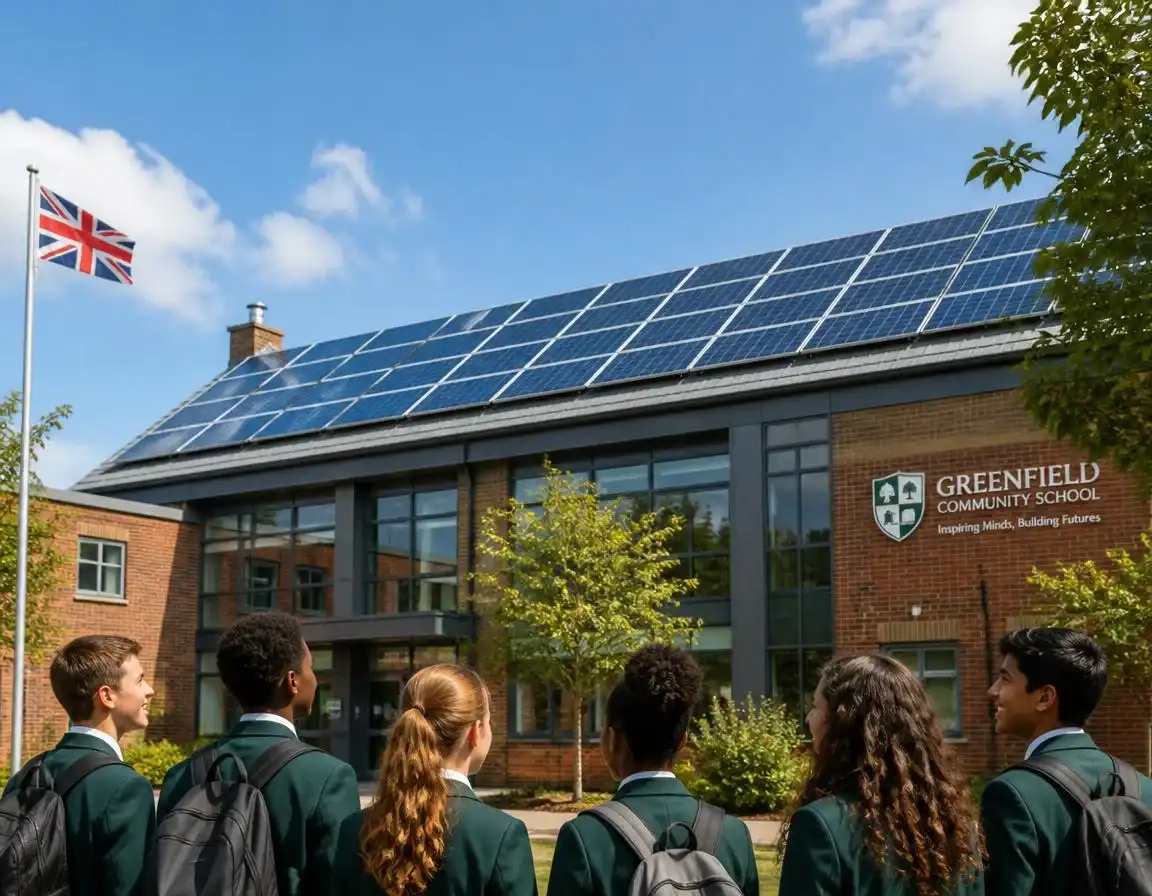
Think about what a school building actually is: a large, relatively flat or shallow-pitched roof, facing a mix of directions, with significant electricity use during daylight hours Monday to Friday. It’s a near-ideal solar site. Lighting, ICT equipment, heating controls, kitchens and ventilation all draw power during the day — exactly when panels are generating at their peak. Self-consumption rates of 60–80% are commonly achieved, meaning the school actually uses most of what the panels produce rather than exporting it cheaply.
The Carbon Trust estimates UK schools collectively could save £44 million per year and offset 625,000 tonnes of CO₂ annually by making the most of solar and wider energy efficiency measures. Most schools are nowhere near that potential yet, which means the opportunity for early movers is significant.
Check out how many solar panels are required in the U.K.
What Does It Cost to Install Solar Panels at a School?
Solar costs vary widely by school type and roof size, but here’s an honest range for 2026 based on UK market pricing. Note that with grants and funding in place, many schools pay nothing upfront — these are gross costs before any financial support.
| School Type | Typical System | Annual Output | Gross Cost | Annual Saving | Payback (unfunded) |
|---|---|---|---|---|---|
| Small Primary | 15 kWp (30–40 panels) | ~14,000 kWh | £10,000–£16,000 | £3,500–£4,500/yr | 3–5 yrs |
| Larger Primary | 30 kWp (60–80 panels) | ~28,000 kWh | £20,000–£28,000 | £6,000–£8,000/yr | 3–5 yrs |
| Small Secondary | 50 kWp (100–120 panels) | ~45,000 kWh | £35,000–£50,000 | £12,000–£18,000/yr | 2–4 yrs |
| Large Secondary / Academy | 100–150 kWp | ~90,000–135,000 kWh | £75,000–£120,000 | £25,000–£40,000/yr | 2–4 yrs |
| Multi-Academy Trust (per site) | 28–50 kWp avg | 26,000–46,000 kWh | £20,000–£40,000/site | £6,000–£12,000/site | 3–5 yrs |
Check out Best SEG Tariff Rates UK
Grants & Funding That Can Make School Solar Cost-Neutral
The good news is UK schools have more funding options than almost any other sector — and stacking them correctly can mean zero net outlay for your school. Here’s what’s live in 2026:
| Scheme | School Type Eligible | Max Benefit | Upfront Cost | Status (June 2026) |
|---|---|---|---|---|
| GBE Solar for Schools | State-funded primary & secondary (England) | 100% capex (share of £100m) | None | ✔ Active — 255+ schools |
| PSDS Phase 4 | State-maintained, most academies (England) | Up to 100% of qualifying capex | None (grant) | ⚡ Delivering to March 2028 |
| Salix Recycling Fund | Public sector schools (England) | Full project cost — repaid from savings | None (loan) | ✔ Ongoing — check salixfinance.co.uk |
| Power Purchase Agreement | Any school with suitable roof | Discounted electricity rate vs grid | None | ✔ Available — compare carefully |
| Smart Export Guarantee (SEG) | Any school with MCS-certified system | 3–16.5p/kWh for exported electricity | N/A (income) | ✔ Ongoing — register post-install |
| LCSF — Low Carbon Skills Fund | State-maintained schools (England) | Up to 100% of feasibility study costs | None | ℹ Check PSDS / Salix website |
Check out Solar Panels Maintenance
Smart Export Guarantee: Schools Get Paid in the Holidays
Here’s something that often surprises headteachers: school solar systems earn significant income during school holidays. With 13–15 weeks of holidays per year — Easter, summer, half-terms and Christmas — the panels are generating electricity with almost zero consumption in the building. All that output goes straight to the grid, earning income under the Smart Export Guarantee (SEG) at rates of 3–16.5p per kWh depending on your energy supplier.
For a trust of 22 primary schools (like the real case study below), combined SEG income reached £21,000 per year — a meaningful additional revenue stream on top of the direct electricity savings. The moral? Shop around for the best SEG tariff once your panels are installed. The difference between 3p and 15p per kWh over a year adds up fast.
Check out the best solar battery
Case Study: Multi-Academy Trust, North East England (2024–25)

📋 22 Primary Schools Across Durham, Tyne & Wear and Northumberland
A multi-academy trust applied for PSDS Phase 3b funding in 2023, securing a £3.6 million estate-wide decarbonisation package. Solar PV was the cornerstone technology — the grant covered 100% of qualifying capital with no contribution required from the trust’s budget.
Average school in the trust: 350 pupils · 1,500 m² floor area · consuming 110,000 kWh/year before solar.
Check out Solar panels for renters uk
The Curriculum Bonus Nobody Mentions Enough
One thing that tends to unlock governing body support very quickly is the curriculum angle. Modern school solar installations include live monitoring dashboards showing real-time generation, export, and consumption data. That’s a working data set for maths, geography, and science — covering energy in the KS2 and KS3 curriculum — that pupils can engage with every single day. You’re not just cutting the electricity bill; you’re putting a live science experiment on the classroom wall.
Schools including Christ the King RC Primary in Salford and Notre Dame RC School in Plymouth — both in the GBE programme — have already noted the impact on pupils’ understanding of sustainability and energy. It’s a genuinely powerful motivator when making the case to your governing body and the wider school community.
How to Get Solar Panels on Your School’s Roof
Here’s the straightforward sequence for 2026:
Pull 12 months of half-hourly meter data. This tells you exactly when your school uses electricity — and how big a system to size for maximum self-consumption. Many Local Carbon Skills Fund (LCSF) grants cover this cost 100% for state-maintained schools.
If you’re a state-maintained school or qualifying academy in England, PSDS / Salix grants or the GBE scheme should be your first port of call. Multi-academy trusts can stack across multiple sites for larger grant bids. Independent schools should explore PPAs or direct commercial finance.
Most school rooftop solar installations are permitted development for non-domestic buildings — no planning application needed, provided panels protrude no more than 200mm from the roof. Listed school buildings and those in Conservation Areas are the exceptions — check with your local planning authority.
MCS certification is essential for Smart Export Guarantee eligibility, PSDS compliance, and most funding applications. Get at least three quotes. Public procurement rules (Procurement Act 2023) apply for contracts above £213,000 — budget 8–12 weeks if tendering is needed.
Once installed, your MCS-certified installer provides the certificate needed to register for SEG with your energy supplier. Don’t overlook this step — holiday-period exports generate meaningful income over a 25-year system life.
☀️ Is School Solar Worth It in 2026?
Without a shadow of doubt — especially with grants and interest-free loans making upfront cost irrelevant for most state schools. A well-sized system pays for itself in 2–5 years on energy savings alone, then runs for another 20–25 years generating free electricity and curriculum content simultaneously. With Great British Energy actively pushing panels onto school rooftops and PSDS Phase 4 funds still being deployed, 2026 remains one of the best windows UK schools have ever had to make the move. The smartest thing your finance committee and governing body can do right now is get an energy audit booked.