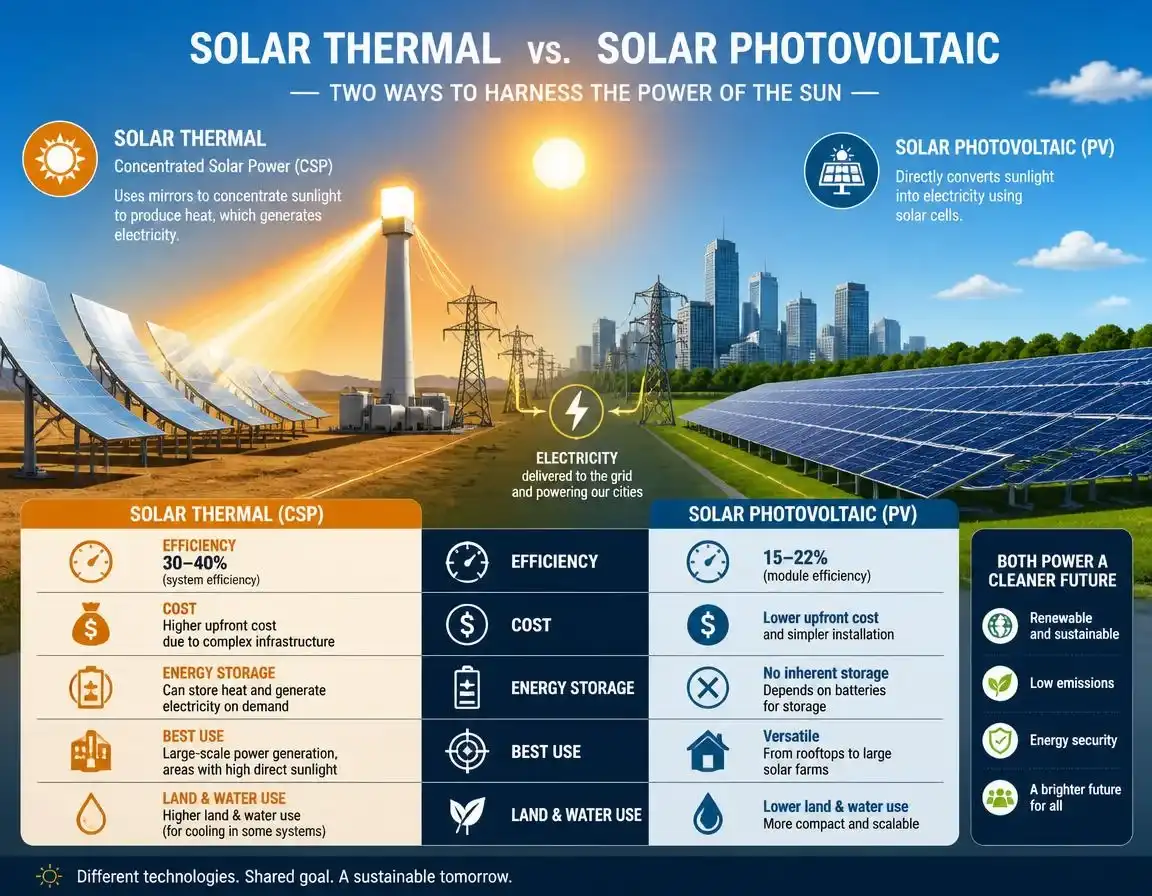
Solar Thermal vs Solar PV

Both sit on your roof and both run on British sunshine. But they do completely different jobs. Here’s the honest comparison on cost, payback and everyday usefulness, before you decide.
Solar thermal and solar PV aren’t two versions of the same thing, even though they both start with the word “solar” and both sit on your roof. One heats your water. The other makes electricity. That’s the whole difference, right at the core of it.
So which one is actually worth your money in 2026? I’ve gone through the current costs, payback times and VAT rules so you don’t have to guess. Here’s what I found:
How They Actually Work
Solar thermal panels (also called solar water heating) use roof-mounted collectors, either flat plates or evacuated glass tubes, to heat a fluid. That warmed fluid then heats the water sitting in your hot water cylinder via a coil. Simple, direct, and it only ever does the one job.
Solar PV panels do something more flexible. Silicon cells convert sunlight straight into electricity, which can then run anything in your home: the kettle, the washing machine, an EV charger. Anything you don’t use can be sold back to the grid through the Smart Export Guarantee (SEG), or saved in a solar battery for later.
The Numbers, Side by Side
Numbers settle this faster than opinions. Here’s how the two compare on a typical UK home in 2026, using current MCS installation data and HMRC’s VAT rules.
| Feature | Solar Thermal | Solar PV |
|---|---|---|
| What it produces | Hot water only | Electricity for the whole home |
| Typical cost, 2026 | £3,000–£8,000 | £5,500–£8,500 (4kW) |
| VAT rate | 0% until 31 Mar 2027 | 0% until 31 Mar 2027 |
| Sunlight → usable energy | ~60–70% | ~15–23% |
| Typical payback | 10–20 years | 7–12 years |
| Lifespan | 15–25 years | 25–40 years |
| Can earn export income? | No | Yes, via Smart Export Guarantee |
| Works with a battery? | No | Yes |
| Annual hot water coverage | 50–70% (near 100% in summer, 15–25% in winter) | Via diverter, similar range |
| Government grant? | None specific (RHI closed 2022) | None specific, but ECO4/Warm Homes may help eligible homes |
Cost and Payback
On paper, solar thermal looks like the cheaper buy. But cheaper to install doesn’t mean cheaper overall. It only ever covers hot water, and typically just 50–70% of annual demand, near 100% in summer, as low as 15–25% in winter. Payback depends heavily on what fuel it’s replacing: on mains gas, currently one of the cheaper fuels per kWh, it can stretch past 20 years. Replacing electric immersion heating or oil, it’s much quicker.
Solar PV, by contrast, tackles your whole electricity bill, not just hot water, and typically pays for itself in 7 to 12 years. Part of that comes from Smart Export Guarantee payments for anything you export, currently ranging from around 4p to 25p per kWh depending on your supplier.
So Which One Should You Actually Get?
For most UK homes in 2026, solar PV is simply the more useful investment. Solar Thermal is not relevant and useless in today’s times given the rising energy cost. Solar PV is flexible, it earns export income, it works with batteries and smart tariffs, and with a solar diverter costing around £300–£500, it can heat your water too, doing everything solar thermal does, plus a lot more. So, why would you need something else which does half the job?
Solar thermal still makes sense if…
- You’ve got a big household or B&B with very high hot water demand
- Your roof space is genuinely too tight for a proper PV array
- You’re replacing an existing thermal system like-for-like
Solar PV is the better fit if…
- You want to cut your whole electricity bill, not just hot water
- You’d like export income or the option to add a solar battery
- You’re starting from scratch on a normal semi or terrace
Both technologies currently qualify for 0% VAT on supply and installation, under HMRC’s energy-saving materials relief (VAT Notice 708/6), confirmed until 31 March 2027, after which it reverts to 5%. There’s no dedicated government grant for solar thermal specifically, since the old Renewable Heat Incentive closed to new applicants back in 2022, but solar PV, batteries and heat pumps can all still be zero-rated right now.
The Honest Verdict
If you want one system that does almost everything, powers your home, heats water via a diverter, earns export income and pairs neatly with a battery, solar PV wins for most UK households in 2026. Solar thermal isn’t obsolete and useless completely, however, these days it’s more of a specialist choice than the default option it once was. Whichever way you’re leaning, get quotes from at least two MCS-certified installers before you commit; every roof and every household’s energy use is genuinely different. If you need help weighing up your options, feel free to reach out to our team.
Frequently Asked Questions
What’s the real difference between solar thermal and solar PV?
Solar thermal panels heat water directly, using the sun’s warmth via a fluid-filled collector connected to your hot water cylinder. Solar PV panels convert sunlight into electricity using silicon cells, which can power your whole home, charge a battery, or be sold back to the grid. Thermal only heats water; PV does everything electricity can do.
Is solar thermal or solar PV cheaper to install in the UK?
Solar thermal is usually cheaper to buy, at roughly £3,000 to £8,000, versus £5,500 to £8,500 for a typical 4kW solar PV system. However, PV usually pays back faster, around 7 to 12 years, because it offsets your whole electricity bill and can earn Smart Export Guarantee income, while thermal only covers part of your hot water needs.
Can I install both solar thermal and solar PV on the same roof?
Yes, if you have enough south, east or west-facing roof space free from shading, since both need a similar pitch of around 30 to 40 degrees. In practice, many homeowners now choose a solar PV system with a solar diverter for hot water instead of a separate thermal system, since it uses less roof space and does more overall.
Sources: HMRC VAT Notice 708/6 (gov.uk); Ofgem Smart Export Guarantee guidance; MCS installation data, April 2026; Energy Saving Trust. Cost figures are UK market estimates for July 2026 and will vary by property, so always confirm with an MCS-certified installer.