
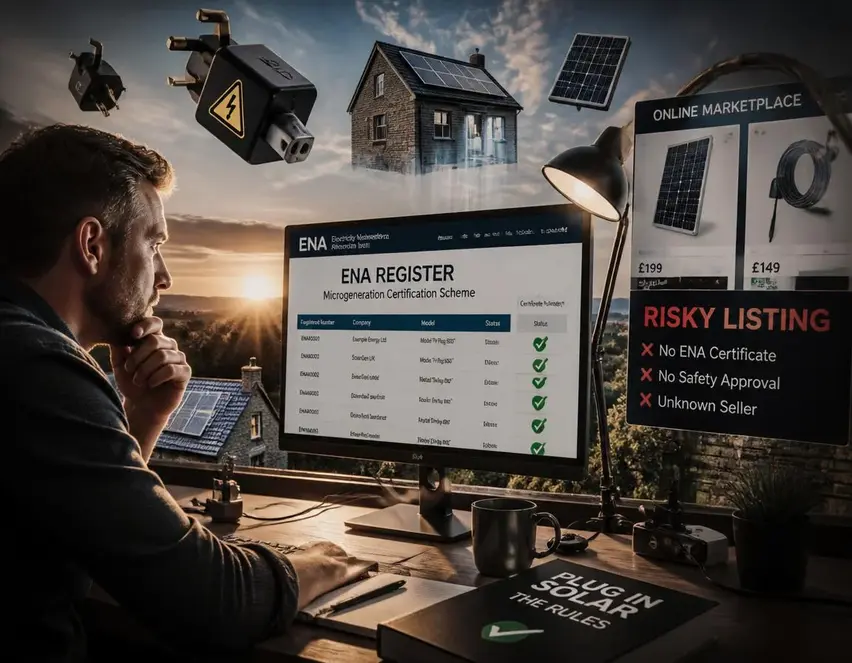
Is Your Plug-In Solar Kit Legal?

Is Your Plug-In Solar Kit Legal? How to Read the ENA Register and Spot Risky Marketplace Listings
Since 27 August, the only kits you can legally plug in are the ones listed as Compliant on the ENA register. Here’s how I check an entry, what the box and plug should show, and the listing red flags that should stop you buying.
The short version
Since 27 August 2026, a plug-in solar kit is only legal to use if it meets the government’s product specification, and that means it has to be on the ENA Type Test Register as Type “Plug-in Solar”, marked Compliant. When I checked on 26 October there were 127 compliant entries and 11 non-compliant ones. A UK plug, a UKCA mark or a “G98 certified” inverter proves nothing on its own. Match the exact model code, avoid anything sold with a battery, adaptor or extension lead, and register at myplugin.solar before you switch on. Northern Ireland isn’t covered yet.
What actually makes a plug-in kit legal
Plug-in solar has been legal in England, Scotland and Wales since 27 August 2026. But the legality belongs to the product and to how you use it. A kit can look the part on a marketplace, UK plug, certificates and all, and still be one you’re not allowed to plug in.
The change came through SI 2026/848, which amended the Electricity Safety, Quality and Continuity Regulations. The new rule is short: a plug-in solar device mustn’t be installed or used unless it complies with the government’s Plug-in Solar Device Interim Product Specification. That’s version 2.0, published in July 2026, and everyone just calls it the IPS.
The IPS then hands the gatekeeping to a register. Manufacturers have to put each device on the ENA Type Test Register and have it confirmed compliant before they sell it. It even closes the obvious loophole in writing: a device that’s only been submitted for registration doesn’t count. I went through how those rules were drawn up in my breakdown of the government’s plug-in solar response. This guide is the practical bit.
Four checks, and a kit has to pass all of them
| Check | What it means | Where you confirm it |
|---|---|---|
| On the register | Listed as Type “Plug-in Solar” with the status Compliant | ENA Type Test Register |
| Same model | The model code on the box and listing matches the entry exactly | Register entry, box and manual |
| Built to the spec | No more than 800 VA out, a moulded UK plug fused at 5 A or less, the required labels, no battery | Box, labels and plug |
| Used within the rules | One kit per household, straight into a wall socket, your network operator told, in Great Britain | Your set-up and myplugin.solar |
Fail any one and you’re outside the rules. Marketplace listings mostly come unstuck on the first two, so that’s where most of this guide goes.
Northern Ireland isn’t covered yet
The change to the regulations only applies in England, Scotland and Wales, and the IPS says its use in Northern Ireland is still under consideration. The Energy Saving Trust says plainly that plug-in solar isn’t currently permitted there. If you live in NI, nothing in this guide makes a kit legal for you yet.
How to search the ENA register, step by step
The register is free and public, and you don’t need an account. It sits on the Energy Networks Association’s Connect Direct site and covers far more than solar, from heat pumps to EV chargers. There were nearly 9,800 entries when I checked, which is why people get lost in it. Here’s the route I use.
- 1Open the register
Go to connect-direct.energynetworks.org, choose Live Device Register, then Search the ENA Type Test Register. Or jump straight to the plug-in solar search.
- 2Filter to plug-in solar
Open Filters, stay on the Generation tab and set Type to “Plug-in Solar”. That one setting clears out thousands of inverters that are approved for other jobs.
- 3Find your model
Put the model code into the Model filter, or pick the Manufacturer. Leave Compliance Status blank at first, so you can see if the kit you’re eyeing has been rejected.
- 4Open the full entry
Click through to the record. The five things I check on it are in the next section.
- 5Keep a copy
Note the System Reference, which looks something like ABCDE/12345/V1/A1, and screenshot the page with the date showing. If there’s ever a dispute, that’s your proof you bought a listed model.
The list moves fast
When I went through it on 26 October there were 138 plug-in solar entries from 36 companies. Of those, 127 were Compliant and 11 Non-compliant, and 28 of the companies had at least one compliant kit. Check on the day you buy, not the day you read this.
Plug-in solar entries by the month they were published
ENA Type Test Register, Type “Plug-in Solar”, status as at 26 October 2026
My own count of the live register on 26 October 2026. October runs to the 26th. The earliest plug-in entry is dated 18 August, nine days before the rules took effect.
September was the rush: 90 entries, 85 of them Compliant. The bit I’d pay attention to is the red. Non-compliant entries were still being added in October, so a kit turning up in your search tells you nothing until you’ve read its status.
Reading an entry: the five things I check
A lot of guides stop at “look for the word Compliant”. That’s only the first box to tick. This is the order I go through a record in.
- Manufacturer
- Example Solar Ltd
- Type
- Plug-in Solar
- Model
- EXS-800-2P
- Capacity (kW)
- 0.8
- Category
- Inverter
- Phase
- Single
- Device Comments
- 2 × 460 W PV modules + 1 × 800 W microinverter + 5 m AC cable with moulded BS 1363 plug
- Compliance Status says Compliant. The full record spells out what that means: the device has been assessed by ENA’s engineers and “deemed acceptable for use by Distribution network operators”. A Non-compliant record says network operators are “unlikely to accept this equipment”.
- Type says Plug-in Solar. If it says PV, you’re looking at something approved for hard-wired installations. That’s the trap I cover next.
- The model code matches, character for character. Compare it with the box, the listing and the manual. Near-identical codes can be different kits with different results.
- Capacity is 0.8 kW or less. This is the AC output, not the panels added up. Of the 138 entries, 124 are exactly 0.8 kW, and the other 14 range from 0.34 kW to just under 0.8 kW.
- Device Comments describe your kit. This is where the submitter lists what’s in the box. One compliant entry I looked at reads “2 pieces of 460 W PV modules + 1 unit of 800 W microinverter”, followed by the cable and plug. If your listing shows three panels and the entry says two, it isn’t the same product.
One quirk to know about. The Manufacturer field often shows the UK company that submitted the kit, which can be a brand or a distributor rather than the factory. That’s fine, as long as it’s the same name you see on the box or the seller’s paperwork.
The “G98 certified inverter” trap
This is the one that catches people, and I can see why. Search the register for a popular microinverter, Hoymiles’ HM-800 for instance, and you’ll find it listed as Compliant. But it’s listed under Type “PV”, not “Plug-in Solar”. That approval covers the inverter being wired into a conventional installation by an electrician. It says nothing about a kit with a plug on the end.
Plenty of listings lean on this. “G98 certified inverter” and “ENA approved microinverter” can both be perfectly true while the kit itself is one you can’t legally plug in. Plug-in approval belongs to the whole kit: the panels, inverter, cable and plug are registered together as one product.
Same brand, different answer
On the day I checked, one supplier had two 800 W kits built around the same inverter. One was Compliant and the other Non-compliant, and their model codes differed by one character at the very end. A brand having “an approved kit” tells you nothing about the one in your basket.
“Pending” isn’t approved
Some sellers say registration is “in progress” or “submitted”. The IPS is explicit that submitting a device doesn’t make it compliant. If it isn’t listed as Compliant today, it isn’t compliant today.
Building your own from parts
Panels, a microinverter and a plug lead bought separately don’t add up to a registered product, so they can’t be a compliant plug-in kit, however good each part is. Go down that road and you’re into a conventional installation: an electrician, a proper circuit and the usual G98 notification.
What the box, labels and plug should show
When the kit arrives, or before if the listing has decent photos, check the hardware against the IPS. It sets out a strict list of markings, and that makes grey imports and relabelled kits easier to spot.
There should also be a durable sticker for your consumer unit, so the next electrician knows there’s a generator on the circuit. Look for a clear warning not to use the kit with battery storage, too, and instructions for telling your network operator, often as a QR code.
✓ A moulded UK plug with a 5 A fuse and a warning label on the lead.
✗ A two-pin plug pushed into a travel adaptor. Send it back.
Why the plug matters so much
An ordinary plug is safe because nothing behind it can push power back out. A solar kit can. So the IPS requires the inverter to shut down within 100 milliseconds of losing mains power and to keep the voltage at the pins below 34 volts. The approved plug is part of that safety case, which is why an adaptor or a rewired plug fails it.
Check your fuse board as well
The kit’s instructions have to tell you to check the circuit is protected by an RCBO and to test it now and then; the Energy Saving Trust suggests every six months. Electrical Safety First wants at least a Type A RCD that’s bidirectional, and says homes with older Type AC devices should upgrade before using plug-in solar at all. Use a socket on an ordinary socket circuit, not a lighting circuit or a spur for a cooker or boiler. And if you need an outdoor socket, it has to be weatherproof and fitted by an electrician.
How to spot a risky marketplace listing
The government’s consultation response recorded concern about non-compliant imports sold through online marketplaces. Electrical Safety First has gone further and pointed out that marketplaces aren’t currently legally responsible for the safety of goods sold through them. New duties for marketplaces have been proposed under the Product Regulation and Metrology Act 2025, but the consultation only closed in June and nothing is in force yet.
So the checking falls to you. On Amazon, look at who the listing says it’s sold by and dispatched from. A UK retailer using a marketplace is a very different prospect from an overseas seller you’ve never heard of. On eBay, check you’re buying from a business seller, because your rights against a private seller are much thinner. If the seller is abroad, there may be no UK business answerable for the product, and refunds can drag on.
These are the red flags I look for, and what I’d do about each.
| What you see | Why it matters | My call |
|---|---|---|
| “G98 certified” or “ENA approved” inverter | That’s the inverter, not the kit | Ask for the System Reference |
| Only CE, UKCA, TÜV or VDE 4105 marks | None of them is a GB register listing. VDE-AR-N 4105 is Germany’s grid code | Check the register |
| Two-pin plug, or “UK adaptor included” | Adaptors are banned outright | Walk away |
| Inverter over 800 W, or “upgradeable” | AC output is capped at 800 VA | Walk away |
| Battery included, or a “storage-ready” inverter | Plug-in kits with batteries are excluded | Walk away |
| Extension lead, splitter or “link several kits” | One device per circuit, and one per home for now | Walk away |
| No model code, or one that doesn’t match the photos | You can’t match it to an entry | Ask, or skip it |
| “Registration pending” | Submitted isn’t the same as compliant | Wait until it’s listed |
| “No registration needed” | Telling your network operator is mandatory | Seller doesn’t know the rules |
| Overseas seller, no UK address | Harder to enforce your rights | Prefer a UK seller |
A note on wattage, because it confuses people. Listings often add up the panels, so a kit with two 460 W panels gets sold as “920 W”. That’s allowed: the IPS permits up to four panels and up to 2,000 W of them. The 800 limit is on the inverter’s AC output, so it’s the inverter line you need to read.
It’s a different world from the doorstep tactics in my guide to solar panel scams, but the instinct is the same. If a seller can’t give you a straight answer you can check, walk away.
Run a listing through my red-flag checker
Tick anything you’ve spotted in the listing, on the box or in the register entry. Nothing is saved or sent anywhere; it just tells you where you stand.
Why kits with batteries are out
Batteries are where a lot of the confusion sits, because several of the big European balcony-solar brands sell their systems with storage built in. The rules here leave no wiggle room. The IPS excludes plug-in battery systems and solar kits that include a battery, and every compliant kit has to carry a prominent warning not to use it with battery storage. Even the legal definition in SI 2026/848 leaves out any device designed to import energy for storage.
So a kit that pairs the panels with a battery and feeds your sockets isn’t a legal plug-in device, whatever the listing says. Panels that only charge a portable power station, with nothing plugged back into the mains, are a separate off-grid set-up. If you want proper storage for your home, that means an installed battery, fitted by an electrician to the current wiring rules. My guides to home battery storage and battery fire safety cover that side.
The government is looking at it. DESNZ has put a research contract out to tender to test plug-in batteries, running to March 2028 with a first report pencilled in for mid-2027. Until the rules change, a battery in the box is a no. If you already have rooftop solar or a battery, the Energy Saving Trust also suggests checking with your installer or an electrician that adding a plug-in kit won’t overload your system.
Where you can, and can’t, put it
The IPS rules out fixing a kit to ACM, MCM, HPL or timber cladding, to a timber balcony, or to any building that’s going through cladding remediation. Anything outdoors has to be rated at least IP55. London Fire Brigade’s advice is to buy from trusted sellers and not to block escape routes.
In England, the planning rules were updated for plug-in solar from 27 August by SI 2026/896. The new permitted development rights don’t cover kits on a wooden wall, balcony or enclosure, on timber-clad walls, or on a wooden fence, gate or wall. Listed buildings need consent, and conservation areas add limits on walls facing a road. Scotland and Wales run their own planning systems, so check with your council there.
It’s one kit per household for now. The IPS allows one per circuit, but the current version of G98 limits it to one per home.
Renting, or in a flat? Get written permission from your landlord, freeholder or building manager first, especially before any drilling. And tell your home insurer before you fit it; my solar insurance guide covers what to ask.
Registering it at myplugin.solar
Once a kit has passed everything above, there’s one job left: telling your network operator. It’s a legal requirement, and the Energy Saving Trust says to do it before you start using the kit. The route is myplugin.solar, run by the Energy Networks Association, which passes your details to your local network operator.
- 1Sign in with your email
You’ll need your name and postcode, plus the make and model of the kit.
- 2Find your address
Enter your postcode and pick your home from the list.
- 3Choose your make and model
Select your kit from the portal’s list. If yours isn’t there, stop and recheck the register before going any further.
- 4Save the confirmation
You get an on-screen confirmation rather than an email, so screenshot it and keep it with your receipt.
Taking the kit down for good, or moving house? Tell them again. The IPS makes notifying a disconnection mandatory as well.
Already bought a kit that isn’t listed?
Don’t plug it in. Ask the seller, in writing, for the kit’s ENA System Reference, and look it up yourself rather than trusting a screenshot. If they can’t give you one, or it turns out to be a PV-only listing or a Non-compliant entry, use your rights while the clock is still running.
| Your position | What you can do | Time limit |
|---|---|---|
| Bought online from a business | Cancel for any reason under the Consumer Contracts Regulations 2013 | 14 days from delivery |
| The listing said it was approved, and it isn’t | Reject it as not as described under the Consumer Rights Act 2015 | 30 days for a full refund |
| Paid by credit card, £100 to £30,000 | Claim against the card provider under Section 75 | Use it alongside the above |
| Bought from a private seller | It has to be as described, and that’s about it | No set window |
If the seller says registration is pending, you can wait. Just don’t plug it in until it’s listed as Compliant, and don’t let your return window run out while you’re waiting. My guide to cancelling a solar contract explains cooling-off periods and Section 75 in more detail.
Past the deadline? Ask an electrician whether the panels and inverter could go in as a conventional, hard-wired system instead. That only works if the inverter is on the register for that use, and it means a proper circuit, the usual notification and a bill, so it rarely makes sense for a cheap kit. Whatever you do, don’t sell it on as UK-legal.
Prices, VAT and export payments
None of this changes whether a kit is legal, but it does change whether it’s worth buying.
| What | Figure | Notes |
|---|---|---|
| Kit price | From about £450 | Octopus’s own kits launched at £450 for one panel and £650 for two |
| VAT on a boxed kit | 20% | The 0% rate is only for installed systems |
| Typical saving | £70 to £100 a year | Energy Saving Trust, 800 W kit. The government says up to £110 |
| Payback | About 4½ to 6½ years | My sum: £450 divided by £70 to £100 a year |
| Export payments | Usually none | SEG needs MCS. Octopus pays for kits bought from Octopus |
The Energy Saving Trust’s figures assume an 800 W kit facing south at 30° in Manchester, a home using 2,500 kWh a year and electricity at 24.7p per kWh. On that basis a kit makes about 700 kWh a year. If you’re out at work all day you’ll sit at the bottom of the range, because more of what the kit makes goes to the grid unpaid.
The VAT point trips people up. The 0% rate is for solar that’s supplied and installed, and it becomes 5% from 1 April 2027. A kit you buy in a box and fit yourself has always been charged at 20%. There’s more on that in my VAT explainer.
On export, the Smart Export Guarantee normally needs an MCS-certified installation, which a plug-in kit isn’t, so most owners won’t be paid for what they send to the grid. Octopus pays export on kits bought from Octopus, and other suppliers have said they’re working on something. My SEG tariff comparison covers the rates for conventional systems.
FAQs
How do I check if a plug-in solar kit is legal in the UK?
Search the ENA Type Test Register on the Energy Networks Association’s Connect Direct website. Set the Type filter to “Plug-in Solar”, then find the exact model code from your box or listing and check its Compliance Status says Compliant. If the model isn’t listed as a compliant plug-in solar device, it isn’t legal to plug in. Once you have a listed kit, register it with your network operator at myplugin.solar before you start using it. These rules cover England, Scotland and Wales; plug-in solar isn’t currently permitted in Northern Ireland.
Does a UKCA mark or a “G98 certified” inverter mean a plug-in solar kit is legal?
No. A UKCA or CE mark is the manufacturer’s own declaration about general product safety, and an inverter listed on the ENA register under Type “PV” is approved for hard-wired installations, not for plugging into a socket. The plug-in rules need the whole kit, meaning panels, inverter, cable and moulded UK plug, registered as one product under Type “Plug-in Solar” and marked Compliant.
What should I do if I’ve already bought a plug-in solar kit that isn’t on the ENA register?
Don’t plug it in. Ask the seller in writing for the kit’s ENA System Reference and check it yourself. If you bought online from a business, you can normally cancel within 14 days of delivery. If the listing said the kit was approved and it isn’t, you can reject it as not as described within 30 days for a full refund, and a credit card purchase between £100 and £30,000 may also be covered by Section 75.
What I’d do before clicking buy
Get the model code first and look it up on the register yourself. A seller’s screenshot doesn’t count; you want the live entry, with Type showing Plug-in Solar and the status showing Compliant.
Then read the listing for the deal-breakers: a battery, an adaptor, an extension lead, more than 800 W out. Any one of those and I close the tab.
If it passes, buy from a seller you could actually get a refund from, register at myplugin.solar before you switch on, and tell your insurer. That’s a quarter of an hour of checking for something you’ll be living with for years.
The Energy Saving Trust’s plug-in solar checklist is a good second opinion, and I’ll keep the register figures on this page up to date as more kits are approved.






One Comment