
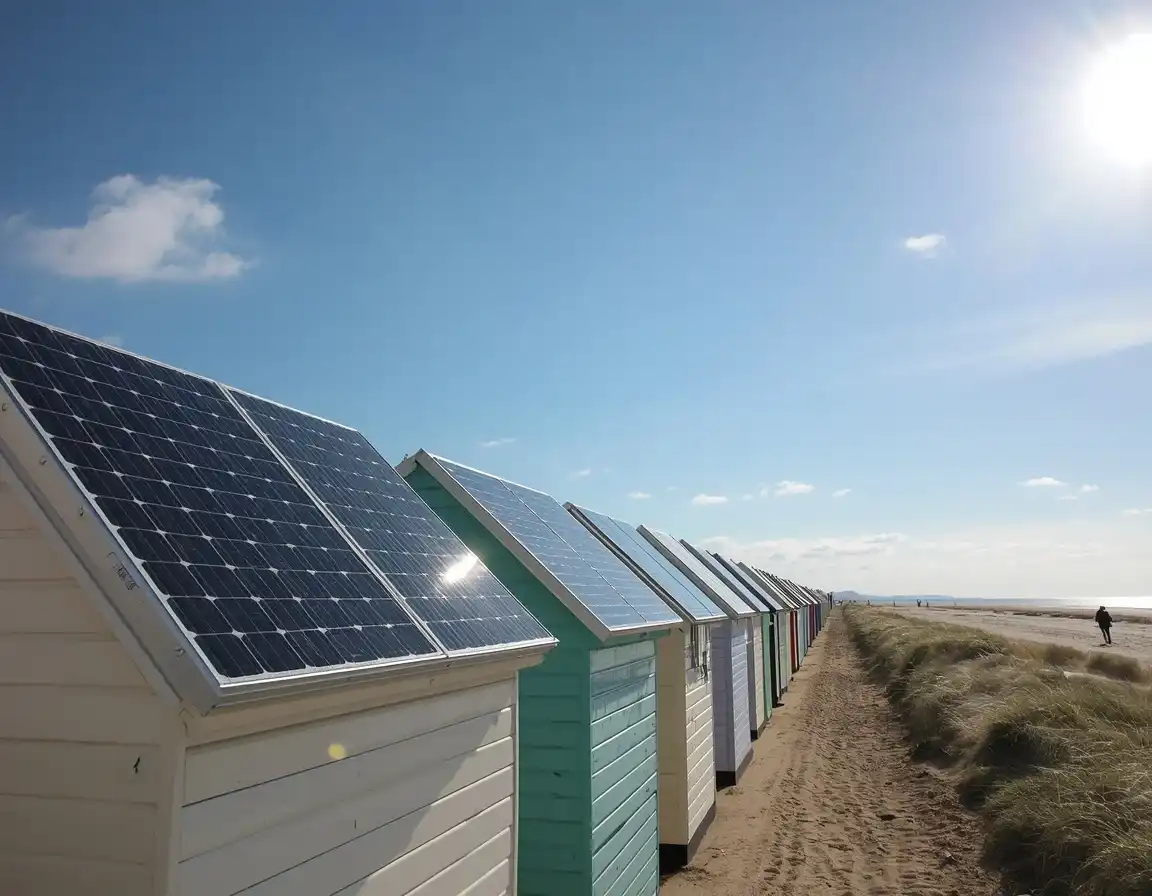
Solar Panels for Beach Huts UK

Off-Grid Solar · Updated for 2026
Solar Panels for Beach Huts UK: The Honest 2026 Guide to Costs, Kit and Permission
No mains, no bother. Here’s how to light your hut, keep the drinks cold and charge your phone on nothing but UK daylight — what it costs, which kit survives the salt air, and what your council actually needs to say yes to.

I spent three summers watching the couple two huts down light theirs up like a little lantern every evening, while mine went dark by half six and I fumbled about with a wind-up torch looking for the bottle opener. Turns out they’d fitted a small panel to the roof two years earlier, for roughly the cost of a decent day out for the family.
That’s what sent me down this rabbit hole. If you own a beach hut anywhere from Whitstable to Christchurch, you already know the reality: no mains electricity, a phone that dies by lunchtime, and a kettle that stays firmly at home. Solar fixes that, and 2026 happens to be a genuinely good moment to sort it — component prices have settled after a few volatile years, plug-in solar has just become law for the small number of huts with an actual mains socket, and there’s finally some clarity on what does and doesn’t need permission for a structure that sits outside the normal planning rules altogether.
This guide covers what you actually need to spend, which kit copes with sand and salt spray, what your council will and won’t sign off, and when a solar setup genuinely beats lugging a gas canister or a bag of spare batteries down the prom every weekend.
Do Beach Huts Actually Have Electricity in the UK?
For the vast majority, no. Councils up and down the country license beach huts as day-use structures rather than dwellings, and that classification means most sites were never wired for power in the first place. There’s no meter, no consumer unit, nothing to plug into. A handful of exceptions exist — the eight council-owned huts at Seaton Carew in Hartlepool come with an electricity supply, and some larger “beach chalets” licensed for overnight stays are built to a higher specification that includes wiring — but if you own a standard bathing hut, the honest starting point is that you’re working entirely off-grid.
That’s not a downside, really. It’s exactly the kind of small, low-demand application that solar was made for. You’re not trying to run a house — you want light after dark, a phone charged, maybe a radio and a cool box. A modest panel and a decent battery cover that comfortably, and you never have to think about it again once it’s set up.
What Size Solar Kit Does a Beach Hut Actually Need?
Most beach huts share a similar footprint to the ones the council in Canterbury lists for sale on the Kent coast — around 2.4m by 2.9m, with a pitched roof and eaves under two metres. That’s a small, sloped surface, so don’t let anyone talk you into an oversized system you’ll never fit on the roof. Work backwards from what you actually want to power.
Wattage recommendation by beach hut use · Solar Panels for Beach Huts UK, 2026.
A kettle deserves a special mention, because it’s the appliance almost everyone asks about first. A typical electric kettle draws 2,000–3,000W to boil — miles beyond what a hut-scale solar setup can sensibly deliver. Bring a gas stove or a flask for hot drinks and put the solar budget toward lighting, charging and keeping things cold instead. It’s a far better use of your money.
The Kit You’ll Need: Four Parts, Wired Simply
A beach hut solar system is a short chain of four components. Here’s roughly what each one costs to buy in the UK in 2026.
| Component | What it does | 2026 cost | Best pick for a beach hut |
|---|---|---|---|
| Solar panel | Mounts to the roof, converts daylight to DC electricity | 100W: £40–£70 200W: £70–£120 | Flexible mono for thin felt roofs; rigid mono if the roof is sound |
| Charge controller | Regulates current so the battery isn’t over or undercharged | PWM: £10–£20 MPPT: £25–£60 | MPPT — pulls noticeably more from a panel on a grey coastal afternoon |
| Battery | Stores power for the evening and for cloudy spells | Lead-acid: £50–£120 LiFePO4: £120–£350 | LiFePO4 — copes far better with cold, damp storage |
| Inverter (optional) | Converts DC to 230V for mains-style plugs | £25–£80 | Only needed if you want to run a 230V appliance rather than 12V lights/USB |
| Cabling, gland & mount | Connects everything and seals the roof entry point | £20–£60 | Marine-rated cable gland is worth the extra couple of pounds |

Salt, Sand and Sea Spray: Why a Beach Hut Needs Tougher Kit Than a Garden Shed
This is the part that genuinely separates a beach hut from a garden shed or a caravan pitch — you’re not just near the coast, you’re often within a few strides of the high tide mark. Salt-laden air corrodes untreated aluminium and standard steel fixings surprisingly fast, and standard mounting hardware within a few hundred metres of the sea can start showing structural corrosion in well under five years.
0–20m · On the sand or prom
Maximum salt spray. Marine-grade hardware essential, mount as high on the roof as practical.
20–100m · Behind a wall or low dunes
Still high exposure. Marine fixings strongly recommended, rinse every few months.
100m+ · Set back from the frontage
Moderate exposure. Standard Tier 1 kit is usually fine with an annual check.
Look for panels carrying an IEC 61701 salt mist certification, ideally Level 6, the highest rating, which means the panel has been tested against the equivalent of 112 days of continuous simulated sea spray with under 2% power loss. For fixings, insist on 316-grade stainless steel rather than standard 304 or zinc-coated fittings, and make sure any junction box carries at least an IP67 rating. This is exactly the same specification we recommend for coastal properties along the South East coast — a beach hut just sits far closer to the source of the problem, so it’s not optional.
Rinse it regularly. A fresh-water rinse every three to six months, plus a quick check after any big storm, stops salt film building up on the glass and keeps output from quietly dropping. Left unchecked, salt deposits alone can cut a panel’s output by up to 6%.
Mount above the storm surge, not just above the tide
Ordinary tide charts don’t account for a big onshore blow pushing water further up the beach than usual. Fit the panel to the roof, not a ground-standing frame, and keep the battery up off the floor of the hut on a shelf or in a raised, ventilated box. It’s a small habit that saves you replacing a battery after the first proper autumn storm.
Permission: The Question Most Guides Get Wrong
Here’s the bit that trips people up, because most advice about solar and outbuildings simply doesn’t apply to a beach hut. The permitted development rights that let a homeowner fit panels to a shed or garage without planning permission only cover a building within the curtilage of a dwelling — the garden or grounds of a house. A beach hut standing on its own on a council-leased seafront plot, entirely separate from anyone’s home, generally sits outside that definition altogether.
In practice, that means the planning department is rarely the gatekeeper here. Your council’s beach hut lease or licence is. Almost every lease we’ve read, from Dover to North Norfolk, explicitly requires written consent before you alter, fix anything to, or change the appearance of the hut — and several councils reserve the right to remove unauthorised additions at your expense. Before you drill a single hole, it’s worth a quick email to your local seafront or beach hut officer.
Portable, non-fixed kit
A folding panel and a portable power station you carry home each visit. No drilling, no permanent fixing, minimal permission friction.
Small roof-mounted panel
Council consent almost always required under the lease terms, even for a small screwed-down panel. A short email is usually all it takes.
Conservation area or AONB frontage
Many historic hut rows sit inside conservation areas. Visible alterations may need a formal planning check alongside council consent.
If you want something in writing, a Certificate of Lawful Development from your local planning authority gives you a legally binding answer, and costs £103 in England as of 2026. For most owners it’s overkill for a single small panel, but it’s worth knowing the option exists if your hut sits somewhere sensitive. You can check your local authority and the general rules on the Government’s own planning guidance.
Full details on the standard homeowner rules — useful background even though they won’t directly apply to a standalone hut — are on the Planning Portal’s solar panels guidance, a joint service run with the Ministry of Housing, Communities & Local Government. And for a real example of the consent wording you’ll typically be agreeing to, Brighton & Hove Council publishes its beach hut licence terms in full online, which is a fair reflection of what most seafront councils require.
The plug-in solar update — does it apply to your hut?
There’s a genuinely new piece of law worth knowing about. On 16 July 2026, DESNZ confirmed that plug-in (“balcony”) solar becomes legally recognised from 27 August 2026, once certified kit reaches the market, under Statutory Instrument SI 2026/848. It lets a small solar unit, capped at 800W, connect through a standard plug rather than needing a hardwired installation. The catch for beach hut owners: it only helps if your hut already has a mains socket to plug into, which, as covered above, is true of only a small minority of sites. For the rest of us, off-grid kit remains the only realistic route. You can read the government’s own response on the GOV.UK consultation page, and we’ve covered the full detail in our plug-in solar law explainer.
Battery Choice: Why LiFePO4 Wins on the Coast
Your battery matters as much as the panel, arguably more, because it’s what keeps the lights on after the sun goes down and through the odd overcast week that British summers are famous for. For a structure that sits empty, cold and damp for days at a time between visits, the choice is clear-cut.
⚡ LiFePO4 (Lithium)
- Usable capacity
- 80–100%
- Cycle life
- 2,000–4,000+
- Cold & damp tolerance
- Good, self-discharges very slowly between visits
- Upfront cost
- Higher, pays back over time
🔋 Lead-acid / AGM
- Usable capacity
- ~50%
- Cycle life
- 200–500
- Cold & damp tolerance
- Poor, loses charge faster when left unused
- Upfront cost
- Lower, fine for very occasional use
If your hut sits unused all winter, which most do, a LiFePO4 battery’s slow self-discharge means it’ll still have a useful charge in it come spring. We cover the same trade-off in more depth in our best solar battery UK guide, and the logic carries straight across from caravans — see our caravan solar guide for the touring equivalent of this setup.
The Portable Alternative: Power Stations You Take Home
Because most beach huts sit empty and unattended for days between visits, a fixed panel and battery permanently wired into the structure is also, unfortunately, an obvious target for theft. A lot of owners solve this neatly by going portable instead — a folding solar panel and a power station that live in the boot of the car and come down to the beach with you, rather than staying bolted to the hut. It sidesteps the permission question almost entirely, since nothing is fixed to council property, and it comes home with you at the end of the day.
| Model | Capacity | Output | Approx. UK price | Good for |
|---|---|---|---|---|
| EcoFlow RIVER 2 | 256Wh | 300W | £209 | Lights, phone and speaker for a day at the hut |
| EcoFlow DELTA 2 | 1,024Wh | 1,800W | £508 | A weekend’s cool box use plus everything above |
| EcoFlow DELTA Pro 3 | 4,096Wh | 3,600W | £2,799 | A full-season hire hut or small watersports business |
Prices observed at UK retail, June–July 2026. Jackery and Bluetti offer broadly comparable models across similar price bands — compare capacity in Wh and output in W rather than brand alone.
Pair any of these with a foldable 100–200W panel propped against the hut in daylight hours, and you’ll comfortably top the battery back up between visits without anything permanent going anywhere near the roof.
Costs and Savings: What to Actually Expect
| Setup | Typical use | Upfront cost | Payback vs. buying batteries/gas |
|---|---|---|---|
| Basic kit | LED lights, phone charging | £150–£250 | 3–5 years |
| Standard kit | Lights, charging, radio/speaker | £300–£500 | 3–5 years |
| Full kit | Above, plus a cool box or mini fridge | £500–£800 | 4–6 years |
| Portable power station | Flexible, take-home, no fixing to the hut | £200–£800+ | Convenience-led rather than pure payback |
Figures assume DIY self-installation. Payback compares against ongoing spend on disposable batteries, camping gas and portable generator hire over a typical beach hut season.
A quick word on VAT and grants
It’s worth being upfront about this one, because a lot of general solar guidance doesn’t quite fit a beach hut. The 0% VAT rate on solar equipment, running until 31 March 2027, applies specifically to installed energy-saving materials in residential accommodation. A small DIY kit you buy online and fit yourself is a standard retail purchase, so it’s typically charged at the normal 20% VAT rate regardless of where it ends up. Likewise, grant schemes such as the Warm Homes: Local Grant are tied to a property’s EPC rating, and a day-use beach hut doesn’t have one, so it won’t qualify. The one exception is a licensed overnight beach chalet with a proper professional installation — that could potentially fall under the residential VAT relief, and it’s worth asking an MCS-certified installer directly if that’s your situation.
Smart Export Guarantee payments are also off the table for almost everyone here, simply because SEG requires a grid connection to export to in the first place, which the vast majority of beach huts don’t have.
Fitting It Yourself: A Realistic Step-by-Step
Get consent in writing first
Email your council’s seafront or beach hut team before you buy anything. A one-line reply confirming they’re happy is worth more than any amount of guessing.
Choose flexible over rigid on an older roof
Many hut roofs are thin ply or bitumen felt rather than solid timber. A flexible panel bonded with adhesive avoids loading a fragile roof with brackets and a heavier rigid frame.
Mount high, angle south, seal everything
South-facing at a steep-ish pitch sheds rain and salt spray naturally. Run the cable through a marine-rated gland, never an unsealed drilled hole.
Battery first, then panel
Wire the battery to the charge controller before connecting the solar panel, to avoid a voltage spike that can damage the controller. Keep the battery raised, ventilated and out of direct sun.
Add lighting on 12V, use an inverter only if you need to
12V LED strip lights run directly off the battery with no conversion losses. Only add a small inverter if you specifically need a 230V socket for something like a laptop charger.
Plan for winter storage
Most huts sit closed up from October to March. If your kit isn’t permanently fixed, take the panel and battery home over winter — it avoids storm damage and removes the theft risk entirely during the months nobody’s checking on it.
A renewable energy installer working on the Essex coast described fitting a small standalone system to a renovated beach hut for a family who wanted enough power for LED lighting throughout and a compact fridge to keep a few essentials cool during their stays — three solar modules, a battery bank and a weatherproof, lockable outdoor enclosure for the electronics, all built to handle the coastal exposure of a hut close to the water.
Reflects a real off-grid beach hut installation reported by a UK renewable energy installer, summarised here in our own words.Best UK Regions for Beach Hut Solar
Sunshine hours vary noticeably around the coast, and a lot of the UK’s best-known beach hut rows happen to sit in some genuinely strong spots for solar.
Regional averages; Brighton, Worthing, Eastbourne and Bognor Regis specifically can reach up towards 1,920 hours in a good year. See our guides to solar panels in Cornwall and solar panels in the South East for more on regional performance.
Even the lower end of that range is entirely workable for a beach hut’s modest needs. Unlike a full house system trying to cover a heat pump or an EV, you’re asking a small panel to keep a battery topped up for a few hours of evening lighting — every UK coastal region manages that comfortably, even on a fairly average summer.
Solar vs. the Alternatives
It’s worth being honest about what you’re comparing solar against, because for a beach hut it usually isn’t mains electricity — it’s disposable batteries, a gas lantern, or a noisy petrol generator that half the beach can hear. Against those, solar wins comfortably on cost within a couple of seasons, and it’s silent, which matters when you’re a few feet from your neighbour’s hut. If you’re weighing up a fuller off-grid solar system because you’re running a hire business or a watersports hut with real daily demand, the golden rule from full off-grid design still applies here in miniature: size for your worst realistic day, not your best one, and a cloudy bank holiday Monday is exactly the day you’ll want the lights working.
Our Verdict
For the vast majority of UK beach huts, a modest 100–200W solar setup with a LiFePO4 battery, or a portable power station and folding panel if you’d rather not fix anything permanently, comfortably covers lighting, charging and a cool box for well under £600. Get written consent from your council before you fit anything to the structure, spec marine-grade hardware given how close you’ll be to the sea, and don’t waste your budget trying to run a kettle. Get those three things right and you’ll have a hut that’s still lit, charged and cold well after everyone else has packed up the torch and gone home.
Common Questions
Do beach huts in the UK have mains electricity?
Most don’t. Councils license beach huts as day-use structures rather than dwellings, so there’s usually no electricity supply to connect to. A small number of sites, including the council huts at Seaton Carew, and larger overnight beach chalets, do have a supply. Everyone else relies on an off-grid solar kit or a portable power station.
Do I need planning permission to fit solar panels on a beach hut?
Standard homeowner permitted development rights only cover buildings within the curtilage of a dwelling, which a standalone beach hut isn’t. The permission that actually matters is your council’s beach hut lease or licence, which almost always requires written consent before anything is fixed to the hut. A portable kit avoids most of this since it isn’t a permanent alteration.
How much does solar power for a beach hut cost in the UK?
A basic lighting-and-charging kit starts from around £150. A fuller setup with a cool box and evening lighting typically runs £300–£600 with a good LiFePO4 battery. Portable power stations with a folding panel start around £200–£250, rising to £500+ for something that’ll run a cool box comfortably all weekend.


One Comment