Solar Panels for Agricultural Buildings UK

Solar Panels for Agricultural Buildings UK:
Your Complete 2026 Farmer’s Guide
Farm buildings are one of the UK’s biggest untapped solar opportunities. Large roofs. High energy bills. Grants available. Here’s everything you need to know in 2026.

If I had to pick one area of UK farming that’s been the biggest sleeper hit over the past couple of years, it’d be solar panels on farm buildings. Seriously. The economics have shifted dramatically — commercial grid tariffs sitting above 22p/kWh, panel costs continuing to fall, and government grants still available — and yet a huge number of UK farms still haven’t made the move. If that’s you, this guide is exactly what you need. We’ll cover everything: costs, grants, planning rules, which farm type benefits most, and the steps to get your first quote.
The UK government’s Clean Power 2030 Action Plan sets a target of 45–57 GW of total solar capacity by 2030 — roughly 2.5 times what was installed in early 2025. A significant chunk of that growth is expected to come from rooftop solar, including agricultural buildings. In short: the direction of travel is clear, and early movers benefit most.
Why Agricultural Buildings Are Ideal for Solar
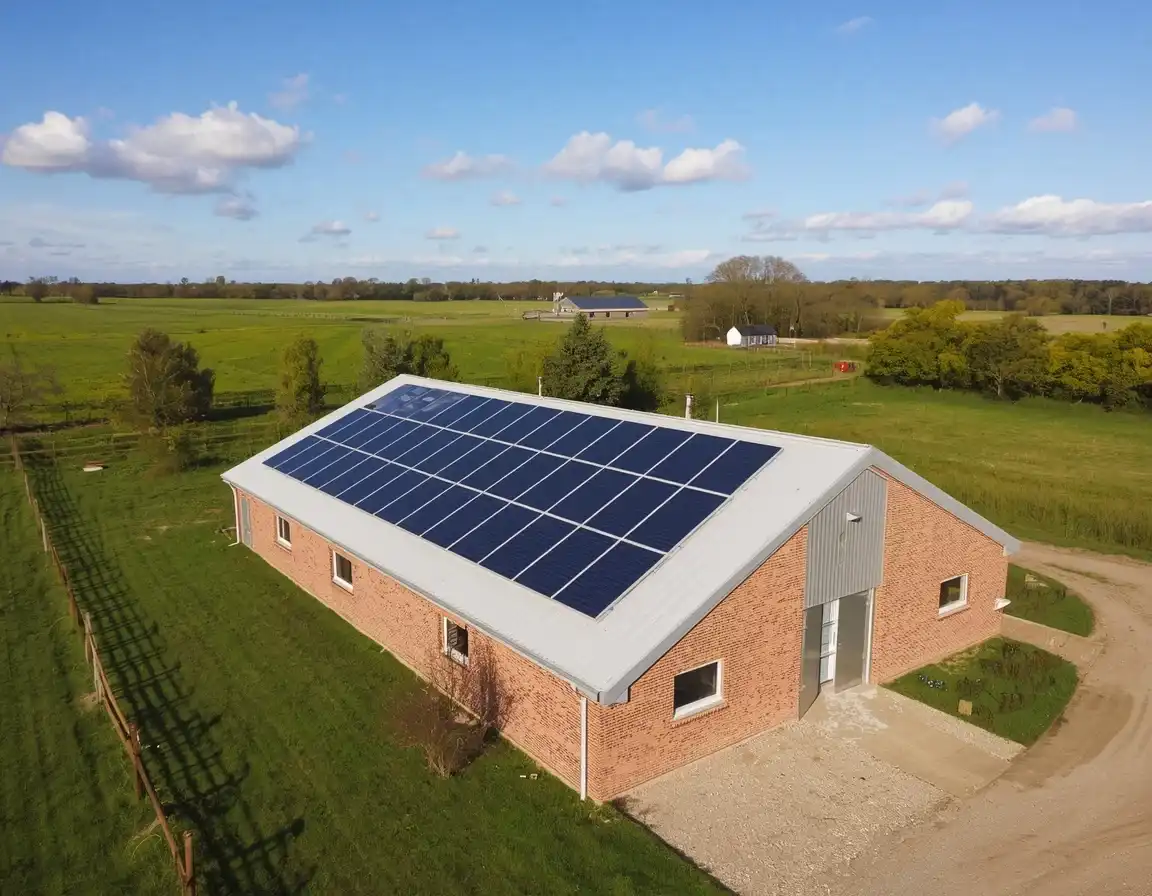
The UK is estimated to have around 1.2 million agricultural buildings — clear-span steel barns, dairy parlours, livestock sheds, grain stores, poultry units, and farm workshops. Most of them tick every box that solar needs: large unshaded south-facing (or east/west) roof planes, energy-hungry operations running during daylight hours, and no planning headache for the roof installation itself. It’s a match that’s almost too good to be true.
Dairy parlours, grain dryers, poultry ventilation systems, and robotic milking robots all run during daylight hours — exactly when solar panels generate the most electricity. That alignment between generation and consumption is what gives agricultural solar some of the strongest self-consumption rates of any commercial sector, and it’s why the payback figures can be genuinely impressive.
What Does It Cost to Install Solar on Farm Buildings in 2026?
Costs vary by system size — larger systems benefit from economies of scale. The figures below are gross costs before grants and tax relief, based on UK market rates in 2026. VAT at 20% applies to commercial farm installations but is reclaimable for VAT-registered farming businesses.
| System Size | Typical Farm Building | Cost/kWp (gross) | Gross System Cost | After 25% Grant + AIA |
|---|---|---|---|---|
| 20–30 kWp | Small barn / equestrian arena | £950–£1,100 | £19,000–£33,000 | ~£10,000–£17,500 |
| 30–50 kWp | Dairy parlour / mid-size shed | £900–£1,050 | £27,000–£52,500 | ~£14,000–£28,000 |
| 50–100 kWp | Livestock shed / grain store | £820–£950 | £41,000–£95,000 | ~£21,000–£50,000 |
| 100–250 kWp | Large barn / poultry unit | £750–£870 | £75,000–£217,500 | ~£39,000–£115,000 |
| 250 kWp+ | Large-scale multi-bay complex | £700–£850 | £175,000+ | ~£92,000+ |
Check out Solar Panel Grants U.K.
Grants & Financial Incentives for Agricultural Solar in 2026
This is where it gets really interesting. Stack these properly, and you can significantly reduce what you’re actually paying out of pocket. Here’s a rundown of everything available to UK farmers right now. For the definitive list of open funding windows, the UK government’s farmer funding page on gov.uk is the most up-to-date source.
| Grant / Incentive | Who Can Apply | Max Benefit | Status (June 2026) |
|---|---|---|---|
| Improving Farm Productivity Grant | Farmers & horticulturalists in England | £500,000 (25% of eligible cost) | ✔ Check RPA for open rounds |
| FETF 2026 (solar items) | Farmers & land managers in England | £25,000 per application | ✘ Closed May 2026 — next round TBC |
| Annual Investment Allowance (AIA) | All UK farming businesses (sole trader, partnership, Ltd) | 100% of cost up to £1m deducted year 1 | ✔ Ongoing |
| Smart Export Guarantee (SEG) | All UK MCS-certified solar owners | 8–16.5p/kWh exported | ✔ Ongoing |
| Rural England Prosperity Fund | Rural businesses in eligible areas | £5,000–£50,000 (25–50%) | ⚡ Check with your local authority |
| Welsh / Scottish Devolved Schemes | Farmers in Wales / Scotland | Varies — often higher intervention rates | ⚡ Contact devolved agency |
Check out Best SEG Tariff Rates UK
Do You Need Planning Permission for Solar on Agricultural Buildings?
For the vast majority of UK farmers, the answer is no — and that’s great news. Rooftop solar on most existing agricultural buildings falls under permitted development rights (Part 14, Class A of the Town and Country Planning (General Permitted Development) Order 2015), meaning no planning application is required as long as certain conditions are met. The exceptions are important to know, though.
| Installation Type | Planning Permission? | Key Conditions |
|---|---|---|
| Rooftop solar on agricultural building | ✔ Usually not needed | Panels must not protrude more than 200mm from roof surface; not on north-facing / heavily shaded roofs |
| Listed agricultural building | ✘ Full application required | Listed Building Consent needed; assessed case-by-case |
| Building in National Park / AONB | ⚡ Check with LPA | Article 4 directions may apply; contact your local planning authority |
| Conservation area building | ⚡ Check with LPA | Front-facing installations may require permission; rear typically permitted |
| Ground-mounted solar on farmland | ✘ Usually required above thresholds | Systems above 1 MW generally need local authority planning permission; under 100 MW since Dec 2025 |
Check out Solar panels for caravan
Agricultural Solar by Farm Type
Not all farms are equal when it comes to solar ROI. The key factor is how much electricity the farm uses during daylight hours — the higher the daytime consumption, the more solar you self-consume (rather than export), and the faster the payback. Here’s how different farm types stack up:

Check out the best solar battery
Should You Add Battery Storage to Your Farm Solar System?
Battery storage is becoming increasingly common in agricultural solar projects — and for good reason. Farms with variable demand cycles (arable operations that draw heavy power at certain times of day, or poultry units that ramp up at dawn) can store surplus midday generation and deploy it during evening peaks, significantly improving overall system efficiency. In 2026, 5–13 kWh lithium-iron-phosphate batteries with 10-year cycles are the standard, typically adding £4,000–£12,000 to a system depending on capacity.
For dairy farms with overnight milking runs, battery storage can push self-consumption rates from 70% up to 85–90% — and that difference adds thousands of pounds to the annual savings figure. It also gives you energy resilience against grid outages, which is genuinely useful in rural locations.
Check out Solar Panels Maintenance
Agrivoltaics: Solar and Agriculture on the Same Land
One of the most exciting developments in UK agricultural solar is agrivoltaics (sometimes called agri-PV) — the practice of using the same land for both solar energy generation and agricultural activity. Sheep grazing beneath and around ground-mounted solar panels is now well-established across the UK. The sheep manage vegetation naturally, panels provide shelter from weather extremes, and the landowner earns from both electricity generation and livestock farming simultaneously.
Beyond sheep grazing, elevated solar panels above lower-light-tolerant crops are being piloted across Europe, with UK trials gaining pace. Studies suggest agrivoltaic systems can increase overall land productivity by up to 73%, and they support biodiversity goals too — panels create undisturbed habitats for pollinators over their 25–30 year lifespan. For farmers worried about taking productive land out of agricultural use, agrivoltaics offers a genuine middle ground.
Check out the Solar Panels for Flat Roof
Your 6 Steps to Agricultural Solar in 2026
Getting solar on your farm buildings is more straightforward than most people expect — especially when planning permission usually isn’t needed. Here’s the logical sequence:
Pull together 12 months of electricity bills or half-hourly meter data. This tells you exactly how much electricity you’re using and when — the foundation of any accurate solar proposal.
Visit gov.uk/guidance/funding-for-farmers to check which funding windows are currently open. The Improving Farm Productivity Grant is the headline option for England — check the RPA portal for current round status.
An MCS-certified installer will survey your building’s roof structure, orientation, shading, and load-bearing capacity. Post-2000 steel-frame agricultural buildings are generally well suited. Pre-2000 buildings with asbestos cement roofs will need a specialist survey first.
For rooftop solar on most agricultural buildings, this is just a quick check: confirm it’s not a listed building and you’re not in an AONB or Conservation Area. Your installer can advise, and you can also check the Planning Portal for your area.
For systems over ~11 kW, your installer submits a G99 application to your local DNO. Budget 4–12 weeks for approval. This runs in parallel with grant applications — don’t wait for G99 before applying for grants.
MCS-certified installation typically takes 1–3 days for rooftop systems. Once commissioned, your installer registers the system on the MCS database — your certificate is needed for Smart Export Guarantee (SEG) registration.
Check out Solar panels for Garden Shed UK
🌞 Is It Worth It? Our Honest View
Absolutely — for most UK farms, solar panels on agricultural buildings now make clear financial sense. The combination of commercial electricity rates above 22p/kWh, a 25% cash grant through the Improving Farm Productivity scheme, 100% Annual Investment Allowance in year one, and ongoing Smart Export Guarantee income stacks up into one of the strongest capital investment cases in agriculture today. A 5–7 year payback on a system that runs for 25+ years is hard to argue with. The earlier you move, the more years of free electricity you pocket.