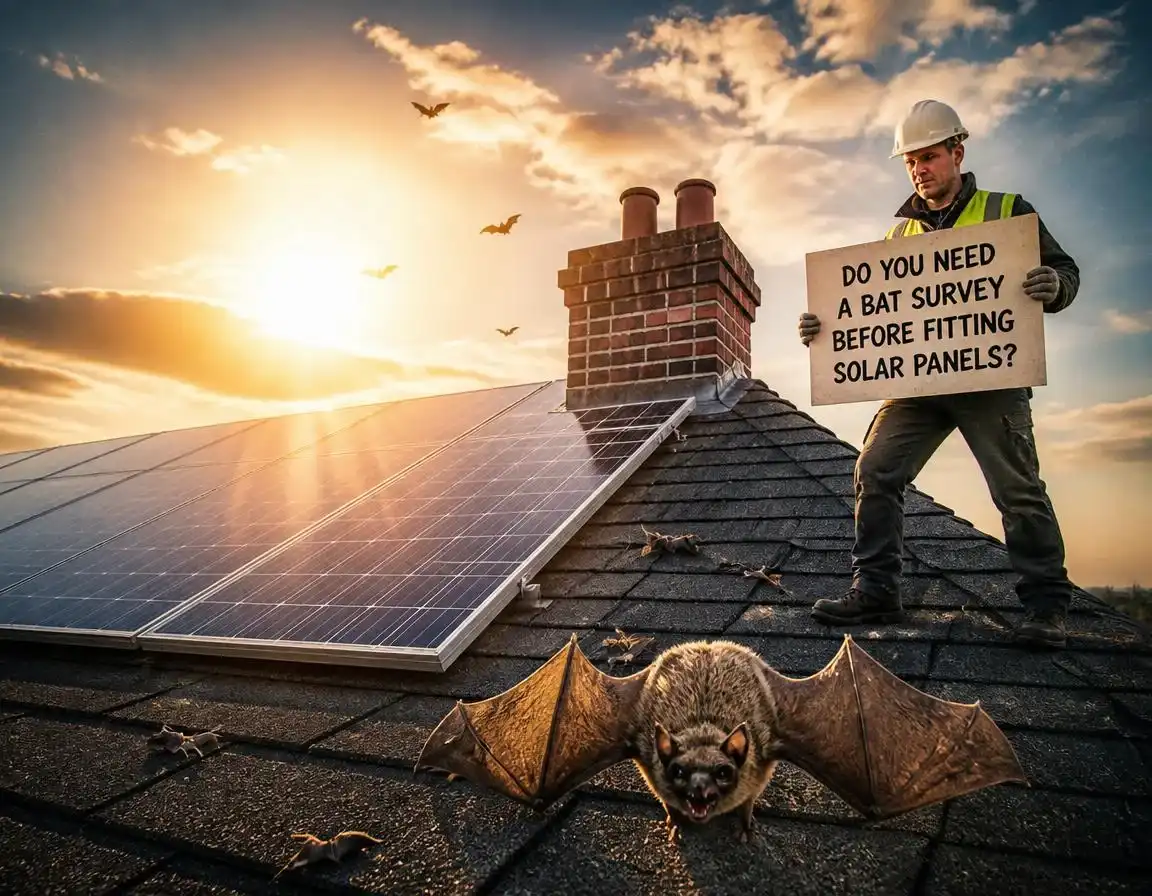
Do You Need a Bat Survey Before Fitting Solar Panels?

Wildlife law meets roof space
Do You Need a Bat Survey Before Fitting Solar Panels? When Councils Ask for One
Bats are the one wildlife issue that can halt a domestic solar job in the UK. Here’s when a council will ask for a survey, when the law applies anyway, and how to keep roosts, planners and your install date on side.
Updated 12 October 2026
The short version
Most domestic solar installs never need a bat survey, but the law doesn’t wait for your council to ask. Bats and their roosts are protected all year, so if your roof shows signs of bats, or the design could block a gap they use, you need an ecologist before anyone lifts a tile. Councils mainly ask for surveys when a planning or listed building application exists. Budget about £300 to £500 plus VAT for the first assessment and £1,000 or more if emergence surveys follow, which can only run between May and September.
The call always comes the same way. The installer’s on the ladder, the householder’s on the phone: “there’s something living under our ridge tiles, can they still fit the panels next week?” Short answer: not until someone qualified has had a look. Longer answer: it depends on your roof, your system design and whether anyone’s issuing a planning decision, but not in the way most people guess.
Two separate questions get tangled here. One is will my council make me get a bat survey? The other is does the law require one whether my council asks or not? They have different answers, and mixing them up is how people commit offences they didn’t know existed.
Why bats trump your install date
Every bat species in the UK is protected. In England and Wales the key laws are the Wildlife and Countryside Act 1981 and the Conservation of Habitats and Species Regulations 2017, and Scotland and Northern Ireland have their own equivalents. Between them it’s an offence to kill, injure or capture a bat, to disturb bats in a roost, and, this is the bit that catches solar projects, to damage, destroy or obstruct access to a roost.
Three consequences follow. First, roosts are protected even when empty. Bats return to the same roosts year after year, so the law protects the place, not just the occupants, and an unoccupied ridge void in January is still a roost. Second, the protection bites on works, not permissions: lifting tiles, sealing gaps and covering access points with panels or mesh can all be offences whether or not planning permission was needed. Third, ignorance is no defence. “My installer didn’t mention bats” has never helped anyone in court, and both householder and contractor can be in the frame.
The penalties are real: up to six months in prison and an unlimited fine, according to the government’s guidance. The statutory bodies differ by nation (Natural England, Natural Resources Wales, NatureScot and DAERA in Northern Ireland). The GOV.UK page on bats: protection and licences is the plain-English starting point for England, and Historic England’s guide to buildings, bats and the law is useful for older properties.
The misconception that costs people money
“My solar is permitted development, so no survey is needed.” Permitted development removes the need for planning permission. It doesn’t switch off wildlife law. The trigger for a bat survey is the risk your roof and design present, never the permission route you happen to be on.
When councils actually ask for a bat survey
Councils enter the picture only when a planning application exists. Most domestic solar on an ordinary house is permitted development, so there’s no application, no validation checklist and no ecology officer reading your file. That’s why plenty of installs legitimately happen with nobody mentioning bats.
Once you need consent, the ecology question opens up. Councils commonly ask for a bat survey or ecological assessment at validation, or sometimes before they’ll decide, when:
- The property is a listed building and you’re applying for listed building consent for roof works.
- The panels would sit on a roof slope facing a highway in a conservation area, or the home has an Article 4 direction removing permitted development rights. Rear and side slopes in a conservation area are usually still permitted development.
- The roof is old or traditional, with slate, hanging tiles or open ridge ends, and the works involve stripping or altering it.
- The building is a barn, chapel or other old conversion. Our guides to solar on churches and places of worship and agricultural buildings cover places where bats are almost part of the furniture.
Note that in-roof solar is normally permitted development too, so a council wouldn’t ask about it in the ordinary way. It’s still the design that most often triggers an ecologist, because it means removing tiles over the array area.
Two details catch people out. Natural England’s standing advice says surveys can’t simply be left to a planning condition, so a council that thinks bats are reasonably likely will want the survey before it decides, which can stall an application until the survey season opens. And where a mitigation licence is needed, planning permission has to be in place first. Councils expect you to commission the survey, not them.
Here’s the asymmetry nobody warns you about: council silence is not legal clearance. If your install is permitted development, no ecologist checks your file, and the full weight of bat law still sits on you and your installer. The survey question is risk-based, not permission-based. Councils are just the most visible place it surfaces.
Roost risk by roof and system type
Ecologists think in risk categories, and so should you before you sign a quote. This is the table I’d want every installer to put in front of customers at the survey visit.
| Roof / system situation | Roost risk | What that usually means |
|---|---|---|
| Modern concrete-tile roof, post-1990s, tight detailing | Low | A preliminary roost assessment is often the whole job |
| Older slate or hanging-tile roof with lifted or slipped tiles | Medium | Assessment, plus emergence surveys if the ecologist finds suitable features |
| Open ridge or hip ends, gaps at soffit, fascia or flashing | Medium to high | Treat as a roost until an ecologist says otherwise |
| In-roof solar replacing tile courses | Higher | Survey before the design is signed off, not after. Roof membranes matter too |
| On-roof panels on rails over intact tiles | Low to medium | Fine, provided no existing gap gets covered or sealed |
| Full perimeter bird proofing or mesh around panels | A risk in itself | Can obstruct roost access, which is an offence where bats are present |
| Ground-mounted array in an open garden | Negligible | Unless trees, walls or outbuildings sit in the footprint |
| Church, barn, chapel or other old conversion | High | Assume a survey. These buildings are bat magnets |
Risk categories follow standard ecological practice. Your ecologist’s preliminary roost assessment sets the formal category (negligible, low, moderate or high suitability, or a confirmed roost) and the number of survey visits that follow.
Signs that mean stop and book an ecologist
You don’t need to see a bat to have a bat problem. These are the clues to check for at quote stage, before install day:
- Droppings under ridge tiles, in the loft or on soffits. Bat droppings are dark and crumble to a powder of insect fragments, unlike mouse droppings, which are harder and don’t crumble.
- Greasy staining or polished-looking gaps around ridge, hip or soffit boards. Repeated entry and exit wears a shine.
- Scratching, fluttering or chattering from the roof space around dusk or dawn in summer.
- Small dark shapes leaving the roof shortly after sunset on warm evenings, typically May to September.
- Dead bats or scattered droppings in the loft, or insect wings clustered near a gap.
- A previous owner, neighbour or surveyor mentioning “something lives in the roof”.
One of these is a conversation with an ecologist. Three of them is a roost until proven otherwise, and the install plan changes accordingly, which is fine. Bats and solar coexist on plenty of UK roofs. What fails is surprise.
The survey process, and the season that sets your timetable
Step one is a preliminary roost assessment (PRA): a qualified ecologist inspects the roof inside and out, reviews the design and assigns a risk category. That can happen in any month. Step two, if the risk warrants it, is emergence or re-entry surveys: ecologists watch the roof at dusk or dawn with detectors and record what leaves or returns. Bat detector surveys run in the active season, typically May to September, with May to August the optimum, and need reasonably warm, dry, calm nights.
Visit numbers scale with risk. Good-practice guidance has low-suitability buildings needing one emergence visit, moderate suitability two and high suitability three, sometimes spread across the season, and your ecologist sets the plan. If you’d like to avoid a dead winter, our guide to the best month to install solar in the UK covers the weather and tariff side of the calendar, and how many days a solar install takes shows how short the on-roof window really is.
If a roost is confirmed: can you still fit solar panels?
Usually yes. A roost doesn’t ban solar, it changes the design. The ecologist works mitigation into the job: bat access tiles, roost tubes built into the roof, preserved gaps, or panels repositioned so they don’t cover an access point. Natural England’s standing advice treats avoidance first and mitigation second, so the cheapest outcome is usually a design that leaves the roost alone.
Where impact can’t be fully avoided, a mitigation licence from the statutory nature body makes the works lawful. In England that’s Natural England, and its licensing guidance is on the same GOV.UK page. If the work also needs planning permission, that has to be granted before the licence is issued. Natural England’s standing advice for planning decisions explains what councils look for. You can also get free advice on bats in your home from the Bat Conservation Trust helpline (0345 1300 228, bats.org.uk).
What a bat survey costs, and what it delays
| Stage | When | Typical cost | What you get |
|---|---|---|---|
| Preliminary roost assessment (PRA) | Any month | About £300 to £500 plus VAT | Roof inspection, risk category, written report |
| Emergence / re-entry surveys | May to September, dusk or dawn | A full survey package commonly £1,000+ | One to three watched visits, detector data, presence or absence confirmed |
| Low-risk domestic roof | Any month | PRA only, so £300 to £500 plus VAT | Written sign-off that the install can proceed with the stated precautions |
| Moderate to high-risk roof | Mostly summer | £1,000 to several thousand pounds | Multiple visits, report and a mitigation plan |
| Mitigation licence, if needed | As required | Ecologist’s time | Licence application to the statutory nature body |
Ranges from ecologists’ published price lists and trade guides in 2026 (PRAs start around £300 to £400 plus VAT, and one guide puts a typical PRA at £500). Prices vary by region and roof complexity, so get two quotes from ecologists who are explicit about visit numbers.
The delay question is really a discovery-timing question. Surface the risk at quote stage in spring and a survey slots into the normal lead time of a decent install. Surface it on install day, with the ladder up and droppings found, and you may wait months for the next survey window while scaffolding sits on your drive charging you weekly. That’s the entire economic argument for spending a few hundred pounds on an assessment early.
Bats found mid-install: the protocol
If bats or a roost turn up once works have started, the rule is simple: stop, don’t touch, don’t seal, and don’t “just finish this course of tiles”. Don’t try to move a bat either. Handling bats is an offence for anyone who isn’t a licensed bat specialist. Sealing a gap with bats inside is about as bad as this area of law gets. Call the Bat Conservation Trust helpline for advice, and let the ecologist assess, the design adapt and a licence regularise what has to happen next. Our guide to choosing a solar installer explains why you want a crew that stops when asked.
Two longer-term traps deserve a mention because nobody puts them in the quote. First, the warm gap behind solar panels is attractive real estate. Panels installed over an unsurveyed roof can create or cover a roost, which then enjoys full protection around your new array. Second, aftercare work can commit the offence the install avoided. Full perimeter bird proofing and mesh clipped around panels closes the gap under them, which is exactly what you want against pigeons and exactly what you don’t want over a bat access point. If bats are part of your roof’s story, every future roofer, panel cleaner and mesh-fitter needs to know before they start. Routine solar maintenance visits count too.
- Position on-roof rails and panels clear of known or suspected access points.
- Never seal open ridge, hip or soffit gaps as “tidying up” without an assessment.
- Treat in-roof systems on old roofs as survey-first, always.
- Keep the ecologist’s report with your installation paperwork so future works inherit the knowledge.
- Choose installers who ask about bats at the survey visit. It’s a five-second question that separates professionals from cowboys.
FAQs
Can I fit solar panels if bats are roosting in my roof?
Usually yes. A roost doesn’t ban solar, it changes the design. An ecologist will position panels and roofing works so the roost survives undisturbed, using measures such as bat access tiles, roost tubes or preserved gaps. Where the roost can’t be left untouched, a mitigation licence from the statutory nature body (Natural England in England) makes the works lawful. What you cannot do is seal, block or destroy the roost to make the job easier.
Does permitted development mean I don’t need a bat survey?
No. Permitted development removes the need for planning permission, not your duties under wildlife law. Bat roosts are protected whether or not anyone is issuing a planning decision, so the trigger for a survey is the risk your roof and design present, not the permission route you’re on. Councils only enter the picture when an application exists.
How much does a bat survey cost and how long will it delay my solar install?
A preliminary roost assessment typically costs about £300 to £500 plus VAT and can happen in any month. If it finds bat evidence or a high-risk roof, emergence surveys follow between May and September, and a full survey package commonly costs £1,000 or more. The delay depends on timing: if you find out in spring, a survey slots into a normal install lead time, but if you find out in October the job may wait until the following May.
The honest summary
Most homes will never need a bat survey, and most of those that do will end up with solar on the roof anyway, designed around the roost instead of over it. The expensive scenario isn’t having bats. It’s discovering them late, with scaffolding up and a crew booked. So ask the question at quote stage, look for the six signs, and if your roof is old, slated or full of character, spend a few hundred pounds on an assessment before anyone lifts a tile. Bats were using British roofs long before we started putting power stations on them. The least we can do is check who’s home first.