
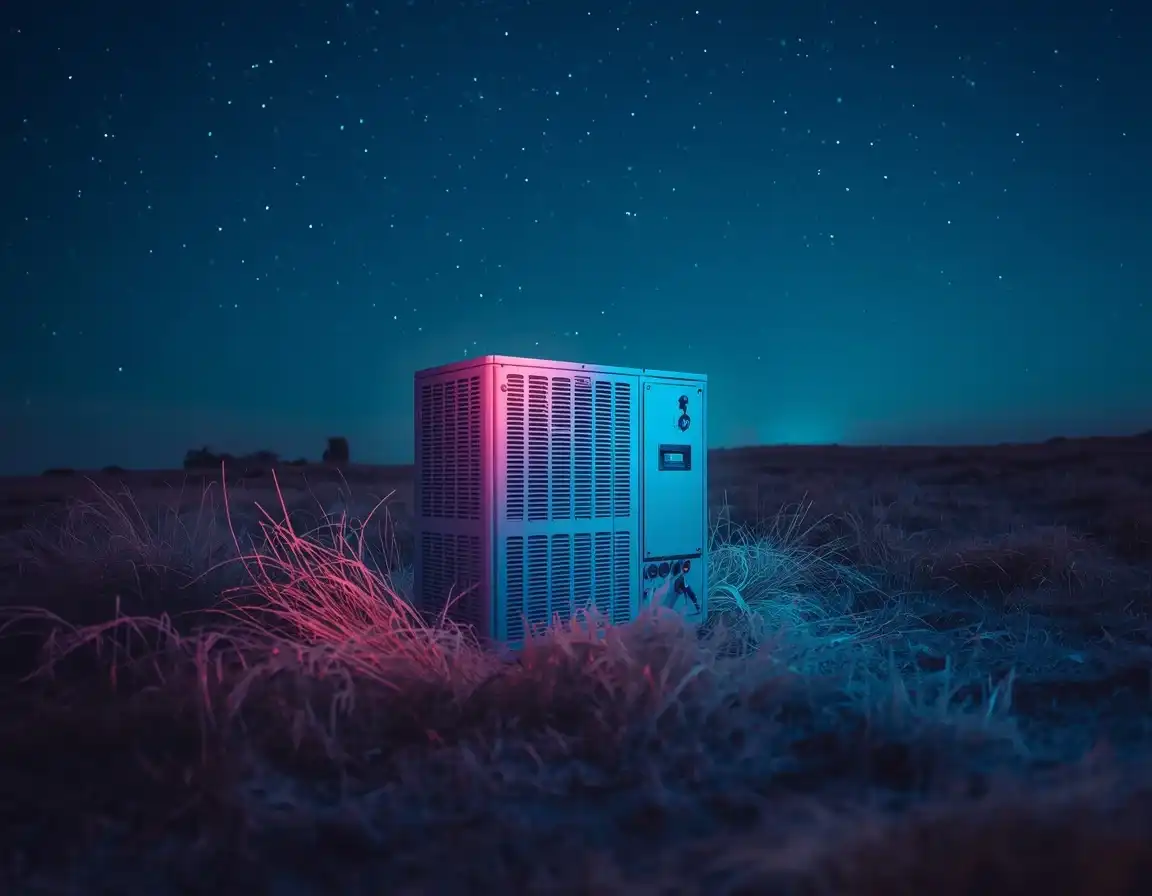
Solar Inverter Humming at Night?

You’re lying in bed, the house is dead quiet, and there’s a faint hum coming from the garage. Before you panic, or ring an electrician at 11pm, let’s work out what’s actually going on.
Is This Actually Normal?
Here’s the bit that trips people up: whether a humming inverter at night is normal depends entirely on what kind of system you’ve got. It’s not a one-size-fits-all answer, and honestly, most articles on this topic skip straight past that.
| System type | Expected behaviour at night | Should it hum? |
|---|---|---|
| Solar-only, no battery | Nothing to convert once the sun’s down — inverter sits in standby | Should be silent |
| Hybrid inverter + battery | Charging on cheap rates, balancing cells, or discharging to power the home | Soft hum is normal |
| Battery + EV smart charging | Managing two loads overnight on a scheduled charging window | Hum and occasional fan noise expected |
| Any system, new or worsening noise | Buzzing, rattling, grinding, or a noise that’s changed recently | Get it checked |
The short version: if you’ve only got panels and no battery, your inverter genuinely has nothing to do after dark, so a hum is worth investigating. If you’ve got a battery — and a growing number of UK homes now do, especially with time-of-use tariffs making overnight charging genuinely worth it — some nighttime activity is exactly what you’d expect.
Battery Charging Overnight: The Most Common Reason
This is, by far, the most likely explanation if you’ve had a battery fitted alongside your panels. Hybrid inverters manage the flow of electricity in both directions — from your panels to your battery during the day, and from the grid or your battery back to your home whenever it’s needed, including through the night.
If you’re on a time-of-use tariff such as Octopus Flux, Intelligent Octopus, or a similar off-peak deal, your system may well be deliberately topping up the battery from the grid during a cheap overnight window, then discharging it during the evening peak when electricity costs more. That’s the inverter actively working, not malfunctioning, and a low, steady hum during that charging window is completely normal for most transformer-based hybrid units.
Worth checking your own setup
If you’re not sure whether your tariff schedules overnight charging, our guide to Octopus Flux vs Cosy Octopus explains how these time-of-use tariffs actually work, and Is Octopus Energy Draining Your Solar Battery? covers a related question worth ruling out if you’re seeing unexpected overnight activity.
Standby Power, Transformers and Cooling Fans
Even outside an active charging window, most inverters keep a small amount of electronics powered around the clock — the WiFi or 4G monitoring module, the display, and the control circuitry that’s constantly watching for a signal to start converting again at first light. This standby draw is usually tiny, a few watts at most, but on a transformer-based inverter it can produce a very faint, constant 50Hz hum purely from the transformer’s core, a phenomenon called magnetostriction. It’s the same underlying effect behind the faint buzz you sometimes hear from an old fridge or a wall-mounted transformer plug.
Cooling fans are the other common culprit. Larger string inverters and most hybrid units use active cooling to stop the electronics overheating, and that fan can cycle on for a while after a hot day even once the sun’s gone, simply dissipating heat the unit built up during peak generation hours. If your hum has a slight whirring or whooshing quality rather than a flat buzz, it’s very likely the fan rather than the transformer.
Why It Feels Louder at Night (Even If It Isn’t)
This is genuinely one of the most useful things to understand, because it explains a lot of “my inverter suddenly got loud” worries that turn out to be nothing. In the daytime, household noise, traffic, appliances, the telly, general life, typically sits somewhere around 50 to 60 decibels. That’s more than enough to completely mask an inverter humming away at 35 to 45 decibels.
At night, once everything else switches off, background noise in a quiet house can fall to somewhere around 20 to 30 decibels. The inverter hasn’t changed at all, but the gap between it and everything else has grown enormously, so it suddenly seems far more noticeable. It’s exactly the same reason a dripping tap or a ticking clock feels unbearably loud once you’re trying to fall asleep.
Everyday Sounds vs a Typical Inverter Hum
Approximate decibel levels for comparison
When It’s Actually a Fault, Not Just Normal Operation
None of the above means you should ignore every noise your inverter makes. A handful of signs genuinely point to something worth getting looked at:
- The sound has changed. A hum that’s always been there is one thing; a hum that’s new, or has got noticeably louder over a few weeks, is worth investigating.
- It’s a buzz, rattle or grinding noise rather than a smooth, steady hum — this can point to a loose transformer lamination, a failing capacitor, or a fan bearing wearing out.
- There’s a burning smell, an error light, or a fault code showing on the inverter’s display. Never ignore this combination.
- It’s humming when it really shouldn’t be — a solar-only system (no battery) making noise in the middle of the night, with no charging activity to explain it.
Safety comes first
If you notice any burning smell, visible discolouration, or the unit feels warm to the touch on its casing, switch off at the isolator if you know how to do so safely and contact your installer or an MCS-certified electrician straight away rather than waiting. Our solar battery fire safety guide covers the warning signs worth knowing regardless of what’s causing tonight’s noise.
How Loud Is Too Loud?
Manufacturers publish a rated noise level for most inverters, usually somewhere between 25 and 30 decibels for smaller, fanless units, up to around 45 to 60 decibels for larger string inverters working at full output. Microinverters, fitted individually behind each panel rather than as one central box, are generally close to silent since they’re smaller and typically don’t need active cooling fans at all — worth knowing if noise is a genuine priority for you when choosing equipment. Our microinverter vs string inverter guide covers this trade-off properly.
As a rough rule of thumb: if you can hold a normal conversation standing right next to the unit without raising your voice, it’s almost certainly within a completely normal range.
Quick Troubleshooting Steps
- 1Check if you have a battery.
Solar-only system with no storage? Any nighttime hum deserves a closer look. Battery on board? Some activity is expected — carry on to the next step.
- 2Check your app or monitoring display.
Most hybrid systems show live charging or discharging status. If it shows the battery actively charging, that’s your explanation. Our solar monitoring guide covers what to look for.
- 3Note the type of sound.
Flat, steady hum: usually transformer or standby electronics. Whirring or whooshing: usually the cooling fan. Buzzing, rattling or grinding: worth flagging to your installer.
- 4Check for a fault code.
Look at the inverter’s own display or app for any error message or warning light before assuming the worst.
- 5Still unsure? Get a professional opinion.
An MCS-certified installer can confirm in minutes whether what you’re hearing is normal for your specific model.
UK Noise Guidance: What Actually Counts as “Too Loud”
If the noise is genuinely bothering you, or a neighbour has mentioned it, it’s worth knowing where the UK’s official guidance actually sits. The World Health Organization’s night noise guidelines associate average night-time exposure above roughly 40 decibels with measurable effects on sleep and wellbeing, which gives a useful benchmark, though it isn’t a hard legal cut-off for a single household appliance.
For genuine nuisance complaints between neighbours, UK local authorities handle these under the Environmental Protection Act 1990, and there isn’t one fixed decibel number that automatically qualifies as a statutory nuisance. Councils assess it case by case, based on how unreasonable the noise is, when it happens, and how it affects the people living nearby, generally with night hours treated as 11pm to 7am.
Official guidance, if you need it
GOV.UK publishes straightforward guidance on how councils deal with noise complaints, which is worth a read if a neighbour raises a concern about your installation: Noise nuisances: how councils deal with complaints.
If Noise Genuinely Matters to You: Quietest Options in 2026
If you’re planning a new system, or thinking about swapping out a particularly noisy older unit, a few equipment choices make a real difference:
Microinverters
Fitted per panel, generally fanless, and among the quietest options available. Compared in our microinverter vs string inverter guide.
Modern hybrid units
Newer hybrid inverters from brands like SolarEdge and Enphase tend to run quieter than older transformer-heavy designs. See our SolarEdge vs Enphase comparison.
Battery-brand comparisons
If you’re choosing between hybrid battery systems, our Growatt vs GivEnergy vs SolaX breakdown is a solid starting point.
Solar Inverter Humming at Night: Your Questions Answered
The Bottom Line
Most of the time, a humming inverter at night is just your battery quietly doing its job while the rest of the house sleeps, made obvious only because everything else has gone quiet around it. The real test isn’t the noise itself, it’s whether that noise has always been there and hasn’t changed. If it has changed, or you’re seeing warning signs alongside it, don’t sit on it, get a proper opinion.
Curious whether adding a battery makes sense for your own home, noise and all? Our Adding a Battery to Existing Solar Panels guide and Best Solar Battery UK 2026 roundup are good next stops.
Sources: manufacturer noise ratings for residential inverters; World Health Organization night noise guidance; GOV.UK guidance on statutory noise nuisance under the Environmental Protection Act 1990. This article is general information, not a substitute for a qualified installer’s inspection of your specific system.




One Comment