
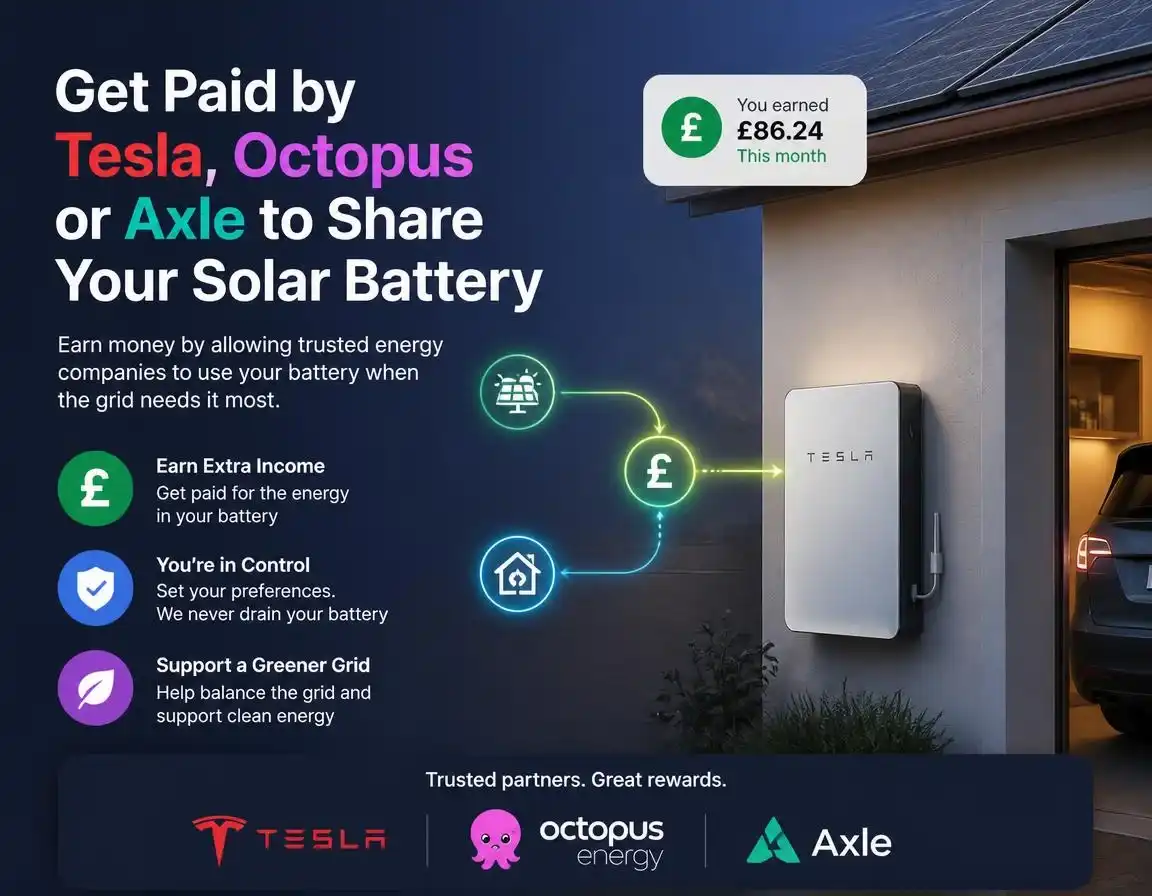
Get Paid by Tesla, Octopus or Axle to Share Your Solar Battery

Get Paid by Tesla, Octopus or Axle to Share Your Solar Battery: Virtual Power Plants Explained
Your home battery already saves you money on your own bills. In 2026, it can earn you extra cash too — by lending a hand to the national grid when it’s under pressure.

The “virtual power plant” sounds like something out of a sci-fi film. What it actually means is refreshingly simple: your battery already sits there most of the day doing very little once your evening’s covered. A VPP operator asks to briefly borrow that spare capacity when the national grid is under strain, and pays you for the privilege.
This isn’t a future promise, either. Three genuinely operating UK schemes exist right now, in 2026 — run by Axle Energy, Octopus’s Kraken platform, and Tesla — and I’ve dug into what each one actually pays, what they need from your battery, and what you’re really signing up to.
What a virtual power plant actually does
A traditional power station is one big site generating hundreds of megawatts. A virtual power plant does the same job differently: it links thousands of home batteries (and sometimes EV chargers and heat pumps) through software, so they can be told to discharge together in seconds when the grid needs a burst of power. Individually, your battery is nothing to the National Energy System Operator (NESO), which balances Great Britain’s grid second by second. Collectively, tens of thousands of batteries add up to a genuine power station’s worth of flexible capacity.
This sits within NESO’s official Demand Flexibility Service, which now has more than 2.46 million businesses and households signed up through their energy suppliers or third-party aggregators. Ofgem approved an updated design for the service on 25 March 2026, making it easier for households to take part at more times of day. If you want the regulatory detail, it’s all on Ofgem’s own site, the industry regulator overseeing the whole scheme.
The three real UK routes in 2026
Which one you can actually join comes down mostly to your battery brand and whether you’re already an Octopus customer.

| Detail | Axle Energy | Kraken (Octopus) | Tesla UK VPP |
|---|---|---|---|
| What it is | Independent flexibility platform | Octopus’s AI dispatch platform, spun off in 2025 | Manufacturer-led, via Octopus tariffs |
| Payment model | £1/kWh per dispatch event, £10/month minimum | Cheaper unit rates + Saving Sessions credits | Credits, headline “up to £300/month” |
| Need to switch supplier? | No — keep your existing tariff | Yes — need an Octopus smart tariff | Currently tied to Octopus + Powerwall |
| Compatible batteries | Fox ESS, GivEnergy, SigEnergy, Solax, Solis | Any Octopus-compatible smart battery | Tesla Powerwall only |
| Stacks with SEG export? | Yes, on top | Built into the tariff itself | Yes, on top |
Tesla launched its UK VPP in partnership with Octopus on 17 July 2025, and Powerwall owners can currently join via the Tesla app while on a linked Octopus tariff. Tesla was then granted its own Ofgem electricity supply licence on 11 March 2026, covering England, Wales and Scotland — meaning a standalone “Tesla Electric UK” offering is expected during 2026 or into 2027, separate from the Octopus partnership. If you own a Powerwall, it’s worth checking SolarBriton’s Tesla Powerwall UK Cost guide for current install pricing while you wait for that to firm up.
How much can you actually earn?
This is where a lot of headlines get misleading. Tesla’s own “up to £300 a month” launch claim is a ceiling figure from an exceptional grid event, not a typical result. The realistic, sustained number across all three schemes is more modest — but it stacks with money you’re likely already making from a smart tariff.

To put Axle’s £1/kWh in concrete terms: a 5kW inverter discharging flat out for an hour during a single stress event earns around £5. Four events in a month brings in £20, comfortably past the £10 monthly minimum. Multiply that across a typical year and £120-£300 is a realistic range — not life-changing, but genuinely free money on top of a battery you already own. For the fuller picture on what a battery earns you day to day before VPP income even enters the equation, SolarBriton’s Make Money From Home Battery Storage guide and Best Solar Battery UK 2026 are worth reading alongside this one.
What you actually need to take part
- A compatible battery brand. Axle currently supports Fox ESS, GivEnergy, SigEnergy, Solax and Solis, and is adding more. Tesla’s route needs a Powerwall specifically.
- A smart meter with export data, the same requirement as claiming the Smart Export Guarantee.
- An MCS-certified original installation in most cases — see SolarBriton’s MCS Certified Installers guide if you’re not sure your setup qualifies.
- Willingness to hand over temporary control of your battery’s discharge during grid events — more on that below.
What you’re actually giving up
Joining a VPP means the operator can discharge your battery during a stress event without asking you first, typically with limited advance notice. For most households this is genuinely no big deal, since events are infrequent and battery apps let you set minimum reserve levels so you’re never left with an empty battery unexpectedly. But it’s worth being clear-eyed about before signing up:
If you…
- Don’t rely on backup power from your battery during outages
- Can set a sensible minimum reserve in your app
- Are happy with automated, infrequent control handovers
If you…
- Bought your battery specifically for power-cut resilience
- Run medical equipment that depends on backup power
- Prefer full manual control at all times
Do you pay tax on it?
For most households, no. VPP payments typically fall well within HMRC’s £1,000 a year tax-free trading allowance, which covers small amounts of casual income like this. If your combined miscellaneous income from all sources tips over £1,000 in a tax year, it’s worth checking your position, but a typical single-battery household earning £120-£300 a year from VPP dispatch has nothing to declare.
My honest take
If you already own a compatible battery, joining a VPP is close to a no-brainer — it’s free money for spare capacity you weren’t using anyway, and you can generally opt out whenever you like. Axle is the most flexible starting point right now if your battery brand qualifies, since it doesn’t ask you to change supplier at all. If you’re already an Octopus customer on Flux or Intelligent Octopus Go, you’re likely already benefiting from Kraken without having done anything extra — worth double-checking your tariff against SolarBriton’s Octopus Flux vs Cosy Octopus comparison. And if a VPP is the deciding factor in buying a battery in the first place, remember it’s the smaller of two income streams — get the underlying battery economics right first using SolarBriton’s Solar Diverter vs Battery guide and Adding a Battery to Existing Solar Panels guide, and treat any VPP income as a genuine bonus on top.
Frequently asked questions
How much can I actually earn from a home battery VPP in the UK?
Realistic VPP dispatch earnings are around £120-£300 a year for a typical home battery, paid on top of whatever you already earn from a smart export tariff. Combined with smart-tariff arbitrage worth roughly £800-£950 a year from schemes like Octopus Go or Flux, total battery-related income can reach around £1,000-£1,250 a year. Headline figures like Tesla’s “up to £300 a month” claim are ceiling numbers from exceptional grid events, not typical monthly earnings.
Do I need to switch energy supplier to join a virtual power plant?
It depends which VPP you join. Axle Energy is an independent software platform, not an energy supplier, so you keep your existing supplier and export tariff and the VPP payments stack on top. Joining Kraken effectively means being on an Octopus smart tariff such as Intelligent Octopus Go, Cosy or Flux, since that’s how most households access it. The Tesla UK virtual power plant is currently tied to owning a Tesla Powerwall and being on a linked Octopus tariff, though Tesla’s own electricity supply licence, granted in March 2026, may lead to a standalone option.
Is virtual power plant income taxable in the UK?
For most households, no. VPP dispatch payments typically fall well within HMRC’s £1,000 a year tax-free trading allowance, which covers casual income like this alongside other small trading activities. If your total miscellaneous income from all sources exceeds £1,000 in a tax year, you may need to declare it, so it’s worth keeping a simple record of what you’re paid, but most typical battery owners won’t owe any additional tax on VPP earnings.



4 Comments