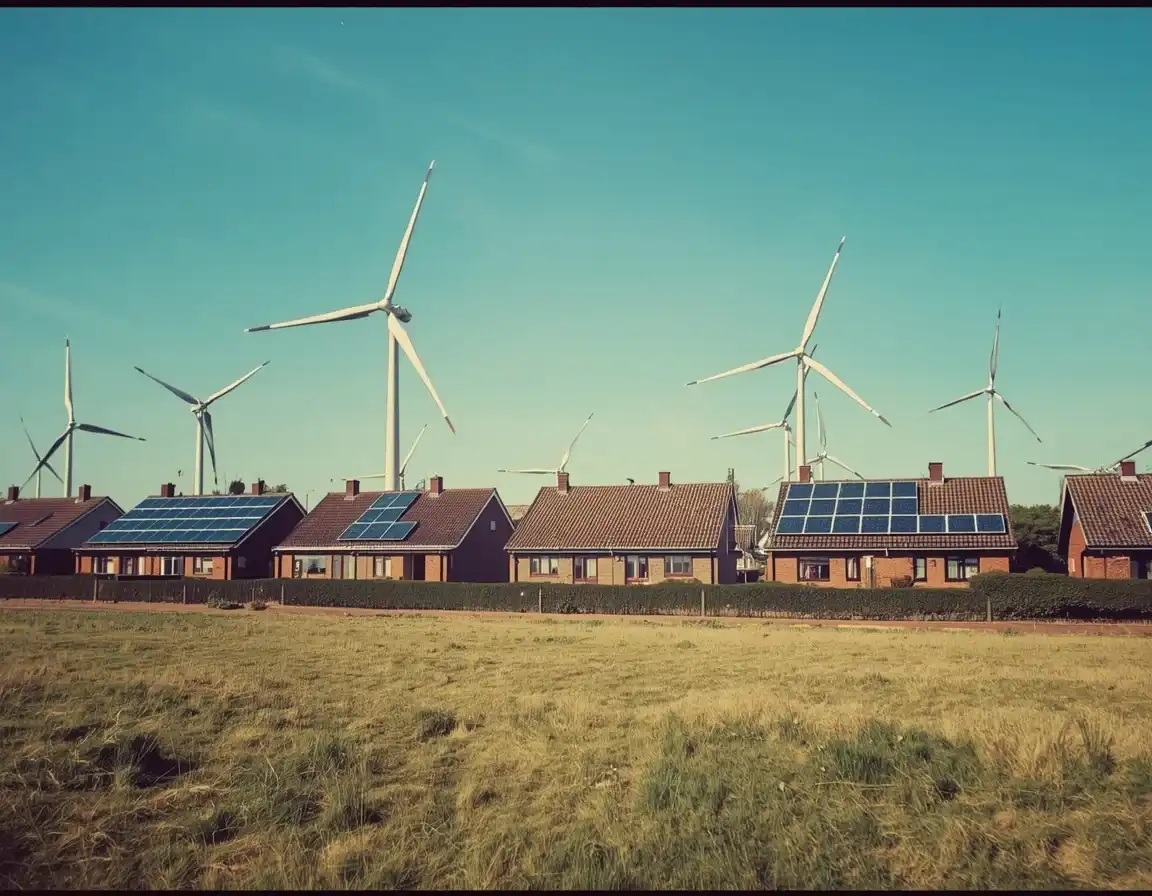
Solar Panel Plus Wind Turbine for UK Homes

Solar Panel Plus Wind Turbine for UK Homes: Does Pairing Them Actually Pay?
The short version
For most UK homes, solar on its own is the sensible buy. A wind turbine only earns its keep on an exposed rural plot, and even then a 5 to 6kW pole-mounted system costs roughly £23,500 to £35,000 and saves about £650 a year. Rooftop turbines in towns barely make anything. The pairing makes real sense off-grid, where wind covers the dark months solar can’t. Everywhere else, put the money into panels and a battery.
I get asked this a lot, usually by someone with a big garden and a windy hill behind it: why not stick a turbine next to the panels and be done with the bills? It’s a fair thought. The honest answer is that the pairing works for a small slice of UK homes and wastes money for most of the rest. Here’s how to tell which camp you’re in.
Why people pair solar with wind
Solar does its best work from April to September. Wind does more in autumn and winter, when your panels are barely trying. On paper, that’s a lovely fit.
Met Office researchers tested the idea on British weather data. Sunshine swings far more through the year than wind does, and windy days tend to be slightly cloudier, though only weakly. Adding solar always smoothed out the day-to-day swings in onshore wind output, and the steadiest mix across the year came out at roughly 70% solar to 30% wind. That’s a national result, not a shopping list for your roof. The authors warn you can’t rely on the effect alone, and east-coast winters have plenty of clear, windy days where the two overlap instead of offsetting.
What the numbers say in 2026
Here’s what each option costs installed and roughly what it makes. The turbines are pole-mounted, because that’s the only kind worth buying.
| System | Installed cost | Yearly output |
|---|---|---|
| 4kWp solar panels | £6,500–£8,500 | 3,000–3,500kWh |
| 1.5kW pole-mounted turbine | about £7,000 | 1,500–2,600kWh |
| 2.5kW pole-mounted turbine | about £12,500 | 3,000–4,400kWh |
| 5–6kW pole-mounted turbine | £23,500–£35,000 | 6,000–9,000kWh at a good site |
Per kilowatt, solar costs roughly £1,600 to £2,100 and a turbine £4,700 to £5,800. Turbines keep spinning after dark, which helps with self-use, but the Energy Saving Trust says a well-sited 6kW turbine saves around £650 a year. Even on the cheaper £23,500 price that’s about 36 years before servicing. Most sources put solar payback at roughly 8 to 13 years. My solar panel cost guide has the full breakdown.
The sites where wind earns its keep
Wind power rises with the cube of wind speed. A site averaging 6m/s has about 1.7 times the power in the wind of one averaging 5m/s, which is why a few extra metres of mast or a clear hilltop matter so much. The industry body’s rule of thumb is that 5m/s is the lower limit of viability, and you want smooth, unobstructed air, not the swirl behind trees and houses.
The Energy Saving Trust says turbines suit homes with enough space and steady wind, and are a poor fit for built-up or sheltered spots. Before you spend a penny, get a year of measured wind data from your exact spot. A postcode estimate isn’t enough.
What about rooftop turbines?
Skip them. The biggest UK field trial, the Warwick Wind Trials, tracked 26 building-mounted turbines for a year. They averaged 78kWh per site per year, a capacity factor of 0.85%. Only four of the 26 sites averaged above 5m/s. A few high-rise sites did far better, but those turbines were switched off after noise complaints.
The trial dates from 2009 and the turbine models have moved on, but I haven’t found a newer trial of that size. Turbulent air over rooftops hasn’t changed.
Planning rules
This is where most hybrid plans quietly fall over. In England, one standalone turbine can go up without planning permission, but only if every one of these is true, according to the Planning Portal:
- It meets the MCS planning standard (MCS 020) or equivalent.
- The highest point is no more than 11.1 metres, with at least 5 metres from the ground to the lowest blade tip.
- Every point of the turbine is at least its own overall height plus 10% from every boundary.
- The blade swept area is no more than 3.8 square metres.
- It’s the first turbine on the property, and there’s no air source heat pump already installed.
- It isn’t in the grounds of a listed building or on designated land such as a national park or AONB.
That 3.8m² limit is a rotor about 2.2 metres across, by my sums. Some 1kW kits on sale in the UK have rotors of 3.2 metres. So the permitted route mostly covers very small machines, and anything that would actually power a house needs a full application.
The Energy Saving Trust says Wales and Northern Ireland need planning permission, and Scotland has its own rules, so ask your council. In March 2026 the government consulted on a new permitted development right for small non-domestic turbines, aimed at farms and businesses. That doesn’t change the domestic position as far as I can see. My solar planning permission guide covers the panel side.
Grid connection, MCS and SEG
Turbines have their own MCS standard, MIS 3003, and the Smart Export Guarantee does cover wind in Great Britain. Ofgem says MCS certification is needed for installations up to 50kW, plus a metered export. So a certified turbine can earn export payments just like panels.
Rates are another story. Which? put the best no-strings SEG rate in spring 2026 at 6p per kWh, with higher rates tied to your import supplier. My SEG tariff comparison tracks the live numbers.
The bit people miss is the connection. Small generators up to 3.68kW per phase normally just notify the network operator within 28 days. But SSEN, for one, asks for prior approval where there’s more than one generator at a property. Solar plus wind is two generators. Ask your installer early, and check with your own network operator.
VAT and funding
Installing a wind turbine in a home in Great Britain is zero-rated for VAT until 31 March 2027, and HMRC’s guidance says it reverts to 5% from 1 April 2027 unless the government extends it. The relief covers the mounting pole, cables, battery and controllers when they’re part of the installation. Buying kit off the shelf with no installation is standard-rated.
Grants are thin. The Energy Saving Trust says no specific schemes fund turbines, though community-owned wind is a Great British Energy priority. The solar side has more options, so see my solar grants guide.
Who it actually suits
| Your situation | My verdict |
|---|---|
| Town or suburban home | Solar, plus a battery if you use power in the evening. Skip the turbine. |
| Rural, open, grid-connected, wind above 5m/s | Solar first. Add a turbine only after a year of measured wind data, and expect a long payback. One UK directory’s own sums give about 14.5 years for 1.5kW and 18.5 years for 2.5kW. |
| Off-grid, exposed, heavy winter use | A hybrid of solar, wind and battery earns its place. See my off-grid solar guide. |
| Listed building, national park or AONB | Expect a full planning application for the turbine. |
If you’re on the fence, here’s what I’d do. Fit the panels and a battery now, fix a wind logger on your best spot for a year, and let the data decide. A turbine you never bought can’t disappoint you.
FAQs
Can I have solar panels and a wind turbine on the same UK home?
Yes. Nothing stops you running both, and both can earn Smart Export Guarantee payments if the installation is MCS certified. The catches are planning permission for the turbine and the grid connection: some network operators ask for approval before you connect a second generator, rather than a simple notification afterwards.
Is a wind turbine worth it for an ordinary UK home?
Usually not. Rooftop turbines in built-up areas averaged just 78kWh a year per site in the biggest UK field trial, and a 5 to 6kW pole-mounted system costs roughly £23,500 to £35,000. A turbine only starts to make sense on an exposed rural plot with average wind speeds above about 5m/s.
Do I need planning permission for a wind turbine in England?
Often yes. One standalone turbine can be permitted development, but only if it meets the MCS planning standard, stays under 11.1 metres, has a blade swept area of no more than 3.8 square metres and sits well inside your boundary. A larger turbine, a second turbine, or a site in a national park or next to a listed building needs a full planning application.