
Solar on a Rental: Who Pays, Who Benefits, and Does It Stack Up?

Solar Panels on a Rental Property (UK 2026): Who Pays, Who Benefits, and Does It Stack Up?
Updated 28 September 2026 · Checked against Ofgem, HMRC and government sources · Written for England; Wales, Scotland and Northern Ireland differ on tenancy and EPC rules
On a UK rental, the landlord almost always pays for solar, and the tenant usually banks most of the daytime saving unless the tenancy deals with it upfront. That split incentive is why so few rentals have panels. In 2026 it can still stack up: landlords get SEG export income, a stronger EPC ahead of the EPC C-by-2030 deadline and 0% VAT until 31 March 2027; tenants get cheaper bills. Bills-included lets and HMOs have the best maths. Tenants can now use legal plug-in solar (up to 800W) instead of waiting on a landlord.
Here is the sentence that explains almost everything about solar on rented homes in Britain: the person who pays for the panels is rarely the person who saves the most on the bills. Well over a million UK homes have solar, but the private rented sector has a thinner slice, because landlords would be funding an asset whose biggest daily benefit lands on someone else’s electricity meter.
“Rarely” isn’t “never”, though, and 2026 changes the sums. The Renters’ Rights Act has rewritten how rent can rise, EPC C is now a confirmed deadline for landlords, the VAT relief has a hard end date and plug-in solar is finally legal. So let’s follow every pound and see which tenancy shapes actually work. Tenants: there’s a section for you too.
The split-incentive problem, in plain English
The landlord holds the capital, the roof and the consent. The tenant holds the electricity bill and the daytime occupancy pattern that decides how much solar is used on site rather than exported. Left unmanaged, that split kills deals both ways: a landlord sees £6,500 spent cutting someone else’s bills, and a tenant sees any solar-linked rent rise as their money funding a landlord’s asset. The fix isn’t persuasion, it’s allocation. Decide who owns each income stream and saving, write it down, and the “problem” becomes a clause.
Who pays: the four routes solar gets onto a rental
- Landlord funds, rent unchanged. Most common. The landlord owns the system and export income; the tenant enjoys cheaper daytime electricity as an unpriced perk. Payback leans on non-cash benefits.
- Landlord funds, higher rent set at a new letting. Since 1 May 2026 in England, a solar premium realistically comes through the advertised rent when you re-let, not a mid-tenancy step-up (see the rent rules below). Price it below the tenant’s expected saving and both sides gain.
- Bills-included lets and HMOs. The landlord already pays the electricity, so the split incentive vanishes and every saved unit lands with whoever funded the panels. This is where rental solar maths is strongest.
- Tenant-funded plug-in kit. No roof works, no capital from the landlord, and it leaves with the tenant. Our 800W balcony solar guide covers the rules.
The route to avoid is tenant-funded fixed panels repaid through a compulsory rent rise: the tenant carries capital risk on a property they don’t own and loses the fixtures on exit. If a landlord proposes it, route 4 is the better answer.
Who banks each pound
- Export income (SEG). Goes to whoever owns and registers the installation, so in routes 1 to 3 the landlord. Ofgem’s SEG rules tie the tariff to the generator, and the system must be MCS-certified with export metering (in practice a smart meter). Rates vary hugely: default tariffs can pay just 3-4p/kWh, open-to-all tariffs sit around 13p, import-tied ones around 12-16.5p and installer-tied exclusives reach 20-25p. Because the tenant, not the landlord, chooses the import supplier, an open-to-all tariff is usually the safe pick. Our SEG rate comparison tracks the ladder.
- Daytime bill savings. Follow the bill payer. In a bills-excluded let that’s the tenant: about £358 a year on a 4 kWp system at the 26.32p/kWh Ofgem price cap for 1 October to 31 December 2026. That cap resets every quarter, so treat it as a snapshot.
- EPC, value and voids. All landlord. Solar lifts the EPC and efficiency helps marketing, though hard evidence for a rent premium is patchy, so treat any premium as a bonus rather than the business case. The sales-side argument is in our house value guide.
- End-of-life value. Landlord, along with the replacement bill. Panels outlive most tenancies several times over; inverters don’t, so budget for one swap.
One paragraph in the tenancy agreement stating (a) who owns the system, (b) who receives export payments, (c) whether daytime generation is included in the rent, and (d) that the arrangement carries over when the tenant changes. If you plan to recharge tenants for generated electricity, take advice first: resale of electricity can fall under Ofgem’s supply and resale-price rules and needs proper metering.
Can a landlord raise rent because of solar? (England, 2026)
This is where older advice goes wrong. Since 1 May 2026, all assured tenancies in England are periodic, rent-review clauses have no effect, and a rise is only valid through a Section 13 notice (Form 4A) with two months’ notice, no more than once every 12 months. Tenants can challenge at the First-tier Tribunal, which can hold or reduce the rent to open-market level but cannot set it above what the landlord proposed. A “solar surcharge” written into the tenancy is therefore unenforceable as a step-up.
What still works is pricing efficiency into the advertised rent when you let the property, and only where comparable homes support it. The negotiation corridor is short: the premium should sit below the tenant’s expected annual saving, and the landlord’s total benefit (premium plus SEG) should repay the outlay within the period you expect to own the property. A 2% premium on a £1,050-a-month let is £252 a year, which is meaningful to payback, but it is an assumption, not a guarantee.
Does it stack up? Three 2026 scenarios, costed
Same house, same system: a 4 kWp array generating about 3,400 kWh a year, installed for roughly £6,500 (government-style average of about £1,600/kW; quotes typically run £6,000-£8,000 at 0% VAT). Import at 26.32p/kWh, export at a 13p open SEG tariff, 40% self-consumption without storage.
| Scenario | Landlord outlay | Landlord gains per year | Tenant gains per year | Landlord payback |
|---|---|---|---|---|
| A: Bills excluded, no premium | ~£6,500 | £265 (SEG only) | +£358 (daytime saving) | ~24 years on cash alone |
| B: Bills excluded, 2% premium (£252) | ~£6,500 | £517 (SEG + premium) | +£106 (saving minus premium) | ~12.6 years |
| C: Bills-included let / HMO | ~£6,500 | £623 (SEG + all bill savings) | £0 direct (bills were included) | ~10.4 years |
Landlord cash benefit per year, same ~£6,500 system. Scenario A isn’t necessarily a bad decision, but its return arrives as EPC compliance, value and voids rather than cash.
Rental solar rarely fails on technology; it fails on tenancy design. Scenario A is a landlord subsidising a tenant’s bills. Scenario C is the strongest cash case, and B works only if the premium is achievable and stays inside the tenant’s saving. Panels last 25 years or more, so even C repays well inside their life, but A on cash alone barely does.
What about a battery? A 5 kWh battery (roughly £3,000-£5,500 installed) can lift self-consumption from about 40% to 70-80%. But every extra unit you store earns you the gap between import (26.32p) and the export you give up (13p), so on these assumptions that is only about £160 a year, which rarely repays the cost by itself. It makes sense mainly with a time-of-use tariff or high export rates. See making money from home battery storage and the battery retrofit guide for the full price tables.
EPC C by 2030: does solar help landlords comply?
The government confirmed in January 2026 (Warm Homes Plan) that private rented homes in England and Wales must reach EPC C from 1 October 2030 for all tenancies, up from today’s E, with a £10,000 per-property spending cap and penalties of up to £30,000 per breach. Legislation is still to follow, and the EPC itself is being rebuilt on the Home Energy Model, now expected from the second half of 2027.
Under the new approach a home needs a fabric performance rating of C, plus a second metric: either the heating system or smart readiness. Solar PV with a smart meter counts towards smart readiness, which is why government’s own estimates expect landlords to fit hundreds of thousands of systems. Fabric comes first, though: solar won’t rescue a draughty, uninsulated house on its own. Homes that hold an EPC C on the current method before 1 October 2029 are expected to stay compliant until that certificate expires, subject to final rules. Our piece on whether landlords will be pushed towards solar under EPC reforms covers the detail.
0% VAT, ECO4 and grants
- 0% VAT until 31 March 2027, then 5%. Solar PV and batteries installed in residential homes in Great Britain are zero-rated, and that includes landlord-funded installs in rented homes. From 1 April 2027 the rate is due to return at 5%, not 20%, so the relief is worth about £325 on a £6,500 job (see the House of Commons Library briefing). The date of supply matters, not the date of the quote, and no extension has been signalled as of September 2026.
- ECO4 is winding down. It was due to end in March 2026 but was extended to 31 December 2026 with no successor obligation. Private-rented homes need the landlord’s consent and eligibility is means-tested and first come, first served. Check our ECO4 eligibility guide before promising a tenant free works.
- Warm Homes Local Grant. Delivered by councils, with rules that vary by area, and landlords are typically expected to contribute towards costs. Our Warm Homes grant guide separates what’s closed from what’s open.
If you’re the tenant instead
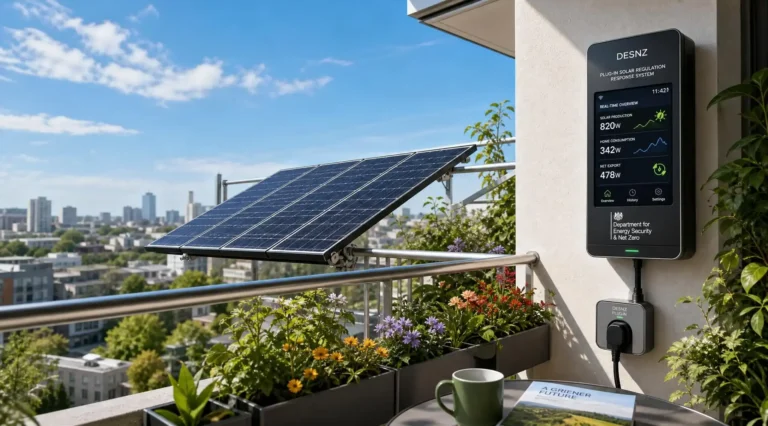
Fixed roof panels need your landlord’s written consent, and most tenancy agreements restrict alterations, so the realistic play is portable. Since 27 August 2026, certified plug-in kits up to 800W AC output can legally be plugged into a standard socket in Great Britain. Kits typically cost £300-£600, and savings are commonly put at roughly £70-£210 a year depending on sun and how much you’re home in the daytime. You’ll need to notify your network operator (G98), the kit can’t earn SEG, and you should still get your landlord’s written agreement, because mounting to a balcony or external wall is exactly what many tenancy clauses cover. It comes down cleanly when you move.
If your landlord proposes a solar-linked rent change, do one sum: your expected annual saving minus the proposed rise. Clearly positive? Fine. Marginal or negative? You’d be funding someone’s asset, and portable is the better pound. Our guides for renters going solar in 2026 and whether renters can get panels at all go deeper on consent and make-good obligations.
The small print that kills rental solar deals
- Alteration and roof covenants. The default barrier for tenants, and sometimes for landlords in leasehold or managed-estate properties.
- Fixtures versus chattels. State who owns the panels at tenancy end. Silence breeds deposit disputes.
- Insurance. Buildings cover and landlord policies expect notification of fixed electrical works.
- MCS certification. Required for SEG and most grants. No certificate, no export income, so verify the installer first.
- Access and maintenance. Landlords need contractual roof access for inspections and inverter swaps; tenants need notice periods that get honoured.
- Tax. SEG income is taxable, and landlords generally can’t claim capital allowances on solar in a residential letting. Confirm the treatment with an accountant.
Rental solar in 2026 is a contract-design question, not a moral one. Bills-included lets and HMOs should almost always get panels. Bills-excluded lets work when the premium is realistic and the tenancy is clear, and the EPC C deadline strengthens the case for landlords who need a second metric anyway. Tenants should stop waiting: a few hundred pounds of certified plug-in kit beats a long negotiation. The real loser is the landlord who lets the 31 March 2027 VAT deadline pass while the paperwork drags on.
FAQs
Who pays for solar panels on a rental property in the UK?
Almost always the landlord, because they own the roof and the system. The tenant usually banks the daytime bill saving unless the tenancy says otherwise. Exceptions are bills-included lets and HMOs, where the landlord pays the electricity and keeps every saving, and tenant-funded plug-in kits, which the tenant owns and takes with them.
Can a landlord claim SEG payments on solar installed at a rental property?
Yes. SEG follows the owner of an MCS-certified installation, so the landlord registers as the generator and receives the export payments. The income is taxable, so keep it in your property accounts and confirm the treatment with an accountant. Because the tenant controls the import supplier, an open-to-all SEG tariff is usually the safest choice.
Can a tenant install solar panels on a rented home?
Fixed roof panels need the landlord’s written permission and are usually a non-starter. Certified plug-in kits up to 800W have been legal in Great Britain since 27 August 2026, need no structural work and come down when you move, but you should still get your landlord’s written agreement first.
Does solar help a landlord meet EPC C by 2030?
It can. Government has confirmed EPC C for private rented homes in England and Wales from 1 October 2030. Under the new EPC metrics, fabric performance comes first, then either heating or smart readiness, and solar PV plus a smart meter counts towards smart readiness. Final legislation is still to come.
Can a landlord charge more rent because of solar panels?
In England, only within the normal rent rules. Since 1 May 2026 rent rises need a Section 13 notice, once a year, and tenants can challenge them at tribunal, which cannot set rent above the landlord’s proposal. Rent-review clauses have no effect, so any premium realistically comes when re-letting at an advertised rent.
Do landlords pay VAT on solar panels in 2026?
No, for qualifying installs at residential homes in Great Britain. Solar PV and batteries are zero-rated until 31 March 2027, then VAT returns at 5% (not 20%) unless government extends the relief. The rate depends on the date of supply, so a quote dated before the deadline is not enough.
Figures checked on 28 September 2026 against Ofgem’s price cap (26.32p/kWh electricity, 1 October to 31 December 2026), HMRC/House of Commons Library VAT guidance and the government’s Warm Homes Plan. Tariffs, grant rules and VAT treatment change often and depend on individual circumstances. This is general information, not legal, tax or financial advice: landlords should confirm VAT, tax and electricity-resale positions with an accountant, and tenants should check their tenancy agreement before buying equipment.