Solar on a Leasehold Flat

Leasehold & flats · Consent, covenants and workarounds
Solar on a Leasehold Flat: Getting Freeholder Consent (and What If They Refuse)
On most flat leases the roof belongs to the freeholder, so solar starts with a conversation, not a quote — and that’s still true even after planning rules eased in August 2026. Blocks of flats gained their own permitted development rights that month for compliant installations, which can remove the planning-application step entirely for a straightforward pitched-roof array. It does not remove the need for freeholder consent, which the government’s own guidance confirms is a separate requirement. Read your lease first: a qualified covenant gets you a reasonableness test, an absolute one doesn’t. A tidy consent pack — structural calc, MCS installer, insurance, reinstatement undertaking — answers most objections before they form. If they still refuse, you have routes: negotiate conditions, challenge an unreasonable refusal, or skip the roof entirely with a balcony kit. Here’s the process, costs included.
England’s permitted development rules for solar were updated, and for the first time blocks of flats got their own explicit provisions rather than being treated as “not a house, so apply for full permission.” A 12-month transitional period runs to 27 August 2027, during which either the old or new rules can be followed. This genuinely changes the planning side of flat solar for many buildings — but as you’ll see below, it changes nothing about needing your freeholder’s consent.
Why leasehold flips the solar question
On a house, solar is a building project. On a leasehold flat, it’s a negotiation — and that’s true whatever the planning rules say. In most flat leases your ownership stops at the internal skin: plaster, floors, ceilings. The roof, the exterior walls, the structure and the roof space are common parts, owned by the freeholder and held on trust for all the leaseholders. Bolting panels to someone else’s roof without permission is trespass and a breach of covenant, however sensible the project is and however light-touch the planning process has become.
Planning itself got easier for many flats in 2026. Permitted development rights for solar on a block of flats — sited within specific height, projection and location limits, and kept off any wooden wall, balcony or cladding for plug-in kit — no longer require a full application, following the Planning Portal’s 27 August 2026 update. Panels on a flat roof within a national park, AONB, conservation area or World Heritage Site still need prior approval from the council, and anything outside the size or siting limits, or on a listed building or scheduled monument, still needs full permission. My planning permission guide has the complete limits, including how conservation areas and listed buildings are treated.
None of that touches the lease. Planning permission and freeholder consent are two entirely separate systems — one is public law about the building’s impact on its surroundings, the other is private contract law about who’s allowed to touch someone else’s roof. The Planning Portal itself flags this explicitly: leaseholders still need permission from their landlord, freeholder or management company, regardless of what the planning rules allow. So the gate that actually stops most flat solar before a quote is ever drawn hasn’t moved. If you’re still weighing up whether flat solar is worth it at all, my guide for flat owners covers the feasibility side; here I’m dealing with consent, refusal, and the routes around both.
Read your lease before you ring anyone
Every lease is a one-off document, but alteration clauses cluster into a handful of types, and which one you’ve got decides your whole strategy. Dig yours out (or buy a copy from the Land Registry if you’ve mislaid it) and look for the covenants on alterations, exterior appearance, common parts and “licences to alter”.
| What your lease says | What it means in practice | Where that leaves you |
|---|---|---|
| Qualified covenant: “not to alter without the landlord’s consent, such consent not to be unreasonably withheld” | Consent required, but refusal must be reasonable | Strongest position. A well-evidenced application is hard to refuse lawfully |
| Qualified with conditions: consent plus payment of the landlord’s costs and a licence | Same as above, with a price tag attached | Normal and workable — budget for their surveyor and legal fees |
| Absolute prohibition: “not to alter or damage the exterior”, no consent mechanism | No built-in route to permission | Hardest case. Negotiation, lease variation, or a route that avoids the roof |
| Silent on alterations | Silence isn’t permission — common parts ownership still blocks roof works | Don’t assume. Treat it as a consent request anyway |
| Share of freehold, or a Right to Manage company in place | The decision is collective rather than one freeholder’s whim | Easiest route — but you must follow company articles and respect the other owners |
While you’re in the document, check three more things: whether the balcony (if you have one) is inside your demise, whether there’s a covenant against anything that changes the building’s appearance, and who insures the structure. Those three lines decide half of what follows.
The consent pack that actually gets a yes
Most refusals I’ve seen weren’t ideological. They were the freeholder or managing agent looking at a one-paragraph email from a leaseholder and thinking “no idea what this does to my roof, my insurance or my other leaseholders — refuse.” You fix that by arriving with answers before the questions. Here’s the pack I’d send:
- A specified system, not a wish. Panel layout, weights per square metre, mounting method, and an MCS-certified installer named on the paperwork. MCS matters twice here: it’s required for SEG export income, and it tells the freeholder the work meets a national standard.
- Structural evidence. A roof loading calculation from the installer or a structural engineer, confirming the covering and structure take the added dead and wind loads. On older blocks this is the single most persuasive page in the pack.
- Waterproofing and reinstatement. How penetrations are sealed, warranty terms, and a written undertaking to reinstate the roof at end of life — the kind of undertaking the Landlord and Tenant Act 1927 itself expressly allows a freeholder to require.
- Insurance positions. Your installer’s public liability certificate, plus confirmation of how the building policy treats the addition — see my solar insurance guide for the questions to ask the freeholder’s broker.
- Maintenance and access plan. Who cleans and inspects the array, how often, and how roof access will be coordinated with the managing agent without disrupting neighbours.
- Planning status. State plainly whether your install sits inside the August 2026 permitted development limits for blocks of flats, needs prior approval (flat roof on designated land), or needs full permission — and confirm which before you promise the freeholder a timeline. Surprising them with a planning refusal later destroys trust.
- Who pays for what. An explicit offer to cover the freeholder’s reasonable legal and surveyor costs in a licence to alter. Saying this in the first letter removes their favourite objection.
Send the pack to the managing agent and the freeholder simultaneously, in writing, and ask for acknowledgement. Consent conversations that live only in phone calls produce refusals that live only in memory — useless if you later need to show a tribunal what was actually said.
What freeholders actually worry about — and which worries are fair
Having sat on both sides of this table, here’s the honest list. Some concerns are legitimate risk management; some are inertia wearing a suit.
- Roof warranty and waterproofing. Fair. A new membrane or a manufacturer’s roof warranty can be voided by unapproved penetrations. Answer: non-penetrating ballasted or clamped systems where the roof allows, plus installer warranties in writing.
- Structural loading and wind uplift. Fair, and easily answered with calculations. Flat roofs in particular need ballast sizing done properly — my flat roof solar guide covers the method.
- Fire and building safety. Increasingly fair, and heavier in taller blocks. Buildings at least 18 metres tall or seven storeys or more, with two or more residential units, are “higher-risk buildings” under the Building Safety Act 2022 regime, and external alterations there sit inside its stricter oversight. Expect a slower, more technical process on those blocks.
- Insurance and liability. Fair but solvable: notification, certificates, and clarity on who carries what.
- Precedent and other leaseholders. Half fair. “If I say yes to you, I must say yes to everyone” is a real management concern — and also an opening to propose a building-wide policy or communal scheme instead of a one-off.
- Aesthetics and resale. Weak on its own as a refusal ground where the covenant is qualified, but worth pre-empting with a discreet layout on the least visible roof slope.
- “We’ve never allowed it.” Not a reason. It’s a habit.
Timelines and costs: what the paperwork adds
Budget for the consent process separately from the hardware. These are typical 2026 ranges I see in practice; your freeholder’s appetite for fees is the variable, and since August 2026 the planning line often drops out entirely for a compliant installation.
On time: a cooperative managing agent turns a licence around in four to eight weeks. A cautious one, or one that instructs a surveyor, runs to three or four months. If your install still needs planning — because it’s on designated land, exceeds the permitted development limits, or the building is listed — add eight to thirteen weeks for determination in England, longer if the officer wants amendments. None of this is a reason to abandon the project; it’s a reason to start the paperwork in autumn and install in spring, which is also, not coincidentally, the best month to install for catching the first full summer.
If they refuse: your options, in the order I’d try them
1. Get the reasons in writing
A refusal with no reasons is the weakest kind. Ask, politely, for the specific grounds and what evidence would address them. Half of “no” turns out to be “not like that” once someone has to write it down.
2. Offer conditions instead of arguing
Most refusals map onto one or two of the fair worries above. Counter with a licence to alter that includes reinstatement, cost undertakings, an inspection right for the freeholder’s surveyor, and proof of insurance. You’re not conceding; you’re pricing their risk at zero.
3. Check whether the refusal is even lawful
If your covenant is qualified — consent not to be unreasonably withheld — then section 19(2) of the Landlord and Tenant Act 1927 backs you: such covenants are deemed subject to a reasonableness proviso, and the landlord can only require payment of their reasonable costs and any compensation for damage, or a reasonable undertaking to reinstate. The First-tier Tribunal (Property Chamber) can declare a refusal unreasonable. Two warnings from experience: tribunals cost time and usually each side’s own costs, and an absolute prohibition gives you no reasonableness hook at all. Get lease-specific advice before spending a penny on this route.
4. Escalate the handling, not the argument
If a managing agent is stonewalling — no acknowledgements, no reasons, months of silence — their formal complaints procedure and, where relevant, their redress scheme are genuine leverage. Poor consent handling is a service failure, and agents hate paper trails.
5. Go collective
One leaseholder asking is a request; a majority proposing is a policy. Talk to your neighbours. A Right to Manage company or a collective enfranchisement claim changes who holds the pen permanently — and the Leasehold and Freehold Reform Act 2024 is meant to make buying your freehold collectively cheaper and easier, though commencement has been staggered, so check the current position before budgeting. This is the slow route and the only permanent one.
6. Do the walk-away maths
If your lease carries an absolute prohibition, your freeholder is uncontactable, and your block is a higher-risk building under the Building Safety Act regime, the consent route can cost more than the array ever returns. A £600 balcony kit saving £100 a year beats a £2,500 consent fight saving £400 a year that you might lose. Run both numbers before choosing your battle.
Routes that skip the freeholder’s yes
Three honest options, in descending order of simplicity.
- A balcony plug-in kit. If the balcony is inside your demise, a freestanding kit that fixes to nothing structural often needs no consent at all — subject to your lease’s appearance covenants, safety (nothing that could fall or be blown off, and nothing fixed to a wooden wall or balcony under the current planning rules), and your insurer. The rules are still maturing; my balcony solar guide and plug-in solar guide cover sizes, safety standards and what to expect back on the bill.
- Turn the refusal into a proposal. A freeholder who won’t let you use the roof may well listen to a business case for using it themselves: a communal array cutting the building’s own energy costs, with export income offsetting service charge. You move from applicant to author.
- Wait, collectively. Join or start the enfranchisement campaign. It’s years, not months — but it ends with the roof belonging to the people paying for the roof.
What doesn’t skip consent: ground-mounted panels in communal gardens, anything on shared roof terraces, and “temporary” frames bolted to common parts. All common parts, all consent, whatever the planning rules say. Don’t learn that from a demand letter.
Communal and building-wide solar: the better maths for most blocks
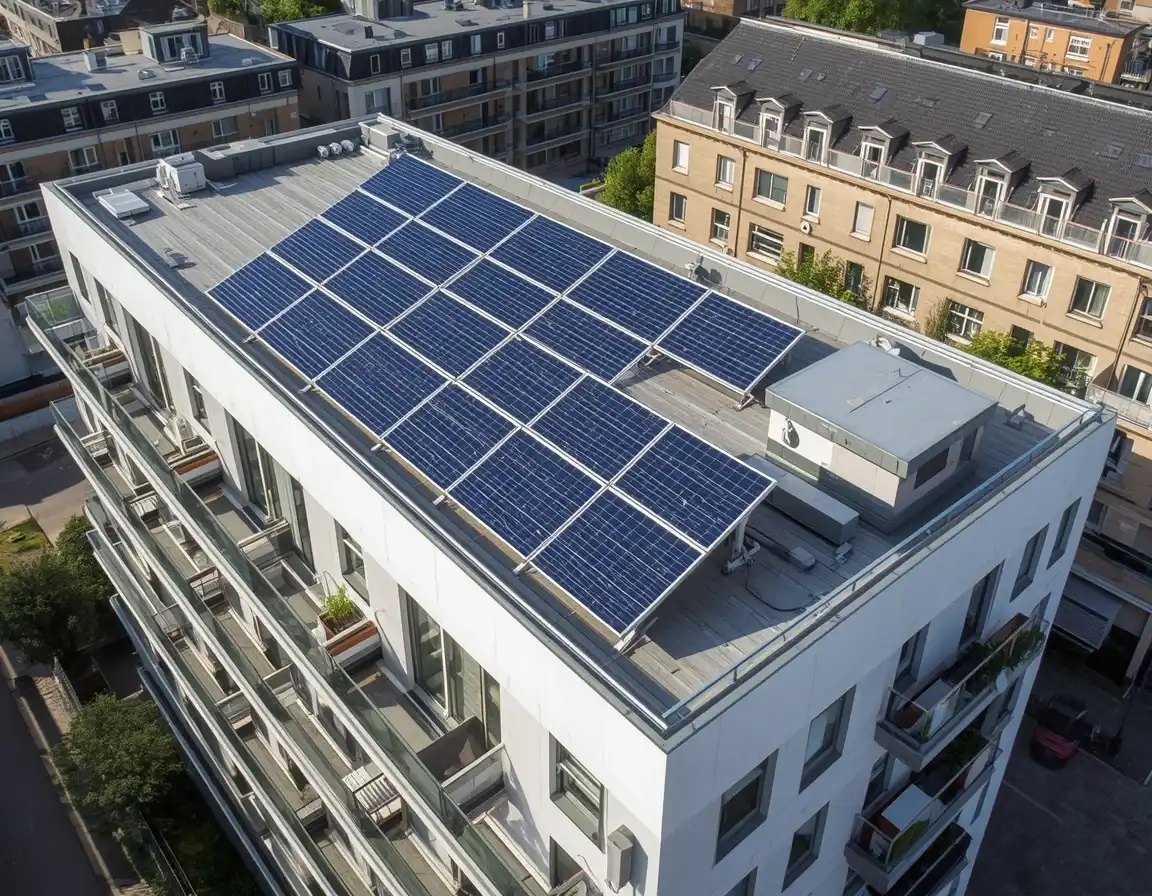
Here’s the thing nobody tells leaseholders: individually, flat solar is the hardest solar in Britain. Collectively, it’s some of the easiest. A single 15–25kWp array on a block roof costs roughly £24,000–£32,000 installed — far cheaper per kilowatt than ten separate attempts — and generates somewhere around 13,000–21,000 kWh a year. Lifts, communal lighting, corridor power and plant rooms soak up daytime generation at full retail value, and the surplus exports under SEG at whatever the going rate is — my SEG rate comparison tracks the spread, and the cost guide keeps the capital figures honest.
| Route | Freeholder consent? | Planning? | Typical yearly benefit | Best for |
|---|---|---|---|---|
| Own array on roof, licence to alter | Yes | Often none if within Aug 2026 PD limits; otherwise yes | £400–£450 (3kWp, own meter) | Qualified covenants, cooperative freeholder, share of freehold |
| Communal / building-wide array | Freeholder or RTM leads | Often none if within PD limits; prior approval or full permission on designated land or oversized arrays | £100–£200 per flat via service charge offset | Blocks with real communal loads and an active residents’ group |
| Balcony plug-in kit | Usually no (check demise & covenants) | Usually none if freestanding and not fixed to timber cladding | £90–£140 | Renters and leaseholders alike; portable on moving |
| Collective freehold, then roof array | You become the freeholder | Often none if within PD limits; otherwise yes | £400+ per participating flat | Buildings with the patience and the votes |
Two cautions on communal deals. First, write down who owns the export meter and how income is allocated before installation — see the FAQ below. Second, be wary of third-party “free” communal offers that take the export income for twenty years in exchange for the panels: they’re the rent-a-roof model wearing a block-of-flats costume, and my piece on free solar panels that can stop you selling explains exactly why that matters when flats change hands.
Communal schemes on residential blocks can qualify for the same 0% VAT treatment as domestic installs in Great Britain until 31 March 2027, and some funding schemes reach communal and low-income households — criteria shift often, so check my 2026 grants roundup against your building’s specifics before promising neighbours anything.
FAQs
Almost certainly not. In most flat leases the roof, exterior and structure are common parts owned by the freeholder, and your demise stops at the internal skin of your flat. Adding panels would be trespass and a breach of covenant, whatever planning rules apply. On planning specifically, blocks of flats gained their own permitted development rights on 27 August 2026 for compliant installations, so a full application isn’t always needed any more — but the Planning Portal is explicit that leaseholders still need permission from their landlord, freeholder or management company regardless. The one common exception is a balcony that falls inside your demise: a freestanding plug-in kit there may need no consent at all, subject to your lease’s rules on appearance and safety, and provided it isn’t fixed to a wooden wall, balcony or enclosure.
First, ask for the reasons in writing — refusal without reasons is hard to defend later. If your lease only allows alterations with consent that ‘is not to be unreasonably withheld’, section 19(2) of the Landlord and Tenant Act 1927 supports you, and the First-tier Tribunal (Property Chamber) can declare an unreasonable refusal. If the covenant is an absolute prohibition, your realistic options are negotiation, a reduced-scope proposal, a balcony system, or joining with neighbours to buy the freehold collectively. Get lease-specific advice before spending money on any tribunal route.
Whoever holds the export meter and the export agreement — usually the freeholder, the RTM company, or a residents’ company set up for the scheme. Individual flats cannot claim SEG on a communal array unless the paperwork says so. That’s why the best communal schemes write the benefit into the building’s accounts: export income offsetting service charge, or a documented allocation per participating flat. Agree it before installation, not after, and make sure the install is MCS-certified or there will be no export income to argue about.