Qcells Solar Panels UK Review (2026)

Qcells Solar Panels UK Review (2026): Q.TRON vs Q.PEAK, Prices & Verdict
The short version
Qcells Q.TRON is one of the safest mid-premium solar buys in the UK. Qcells is Korean-owned and regularly sits on BloombergNEF’s Tier 1 list, Q.TRON modules reach 22.5% efficiency, and they carry a 25-year product warranty plus a 25-year linear performance guarantee. A standard Jinko Tiger Neo gets 12 years. The catch is lineup confusion: older p-type Q.PEAK DUO panels (12-year product warranty) still turn up on quotes. This review covers the models, efficiencies, installed prices, warranty small print and how Qcells compares with Jinko, AIKO and LONGi.
Qcells is the boring answer in the best possible way: a South Korean manufacturer with deep pockets, consistent factory quality and a warranty backed by a major manufacturer rather than a small installer. That matters more than any efficiency decimal point.
But 2026 is an awkward moment to buy. The range is mid-transition from p-type PERC to n-type TOPCon, and some quotes still carry old Q.PEAK stock. The two families have different warranties (25 years on Q.TRON, 12 on Q.PEAK DUO), so the model code on your quote matters. Here’s what’s good, what’s overpriced and the wording I’d want on a quote before signing.
⚡ Qcells at a glance
Qcells belongs to South Korea’s Hanwha Group, so a warranty claim doesn’t depend on a small company surviving. The brand has been named a Kiwa PVEL Top Performer in nine annual module scorecards between 2016 and 2024, which is about as close to independent proof of factory consistency as this industry offers.
Most UK homeowners get Qcells through an MCS-certified installer rather than buying direct. That suits you, because the MCS certificate is also your route to Smart Export Guarantee payments. More in the installer section.
🔩 The 2026 UK lineup: Q.TRON vs Q.PEAK DUO
Two families matter for a domestic roof. Read the cell technology and warranty columns first, because they tell you most of what you need.
| Model family | Cell tech | Output | Max efficiency | Temp coeff. | Product warranty | Output at year 25 |
|---|---|---|---|---|---|---|
| Q.TRON BLK M-G2+ | n-type TOPCon, all-black | 405–440 Wp | 22.5% | −0.30%/°C | 25 yrs | ≥90.58% (0.33%/yr) |
| Q.PEAK DUO M-G11S | p-type PERC (older) | 400–420 Wp | 21.5% | −0.34%/°C | 12 yrs | ≥86% (0.5%/yr) |
The temperature coefficient is a quiet winner. On a 60°C July roof (35°C above test conditions), Q.TRON loses about 10.5% of its output against about 11.9% for the older PERC line. It’s a small gap on a UK roof, but it compounds over 25 years. You may also see Q.TRON XL-G2 on distributor sites. Those are 600 Wp+ bifacial modules for commercial and ground-mount jobs, not something a house roof gets quoted.
☀️ Real-world UK output: what Qcells delivers
Plan around roughly 850 to 1,050 kWh per kWp a year, depending on region, roof direction and shading. A 4 kWp Q.TRON array in central England typically generates about 3,500 to 4,200 kWh a year, a little less in the north and Scotland. That covers a good share of an average home’s electricity, with the surplus going to export, a battery or your hot water.
Orientation and shading move that number far more than the badge on the frame. A well-specified Qcells array on a shaded east roof loses to a budget panel on a clean south roof every time. Size the system first with our how many solar panels do I need guide, then argue about brands. Higher efficiency does mean fewer panels for the same kWp: about 9 or 10 Q.TRON panels make a 4 kWp system, which helps on tight roofs.
Qcells isn’t the efficiency leader. A standard Jinko Tiger Neo is roughly level with Q.TRON, while Tiger Neo 3.0, LONGi’s X10 and AIKO’s back-contact modules lead by one to two points. Qcells’ pitch is a long product warranty, consistent quality and a bankable manufacturer. Our best solar panels for UK homes roundup ranks the whole field.
💷 Qcells solar panel prices in the UK (2026)
Nobody sells you a bare Qcells panel; you buy a system. The ranges below are our UK benchmarks (England averages about £1,591 per kW), and a Q.TRON quote will usually sit in the middle to upper part of each range. All include 0% VAT in Great Britain, which runs until 31 March 2027 and returns at 5% from April 2027 (HMRC VAT notice 708/6).
| System size | Q.TRON BLK panels (~430 Wp) | Installed price range | Suits |
|---|---|---|---|
| 3 kWp | 7 | £4,000 – £5,500 | 1–2 bed homes, low usage |
| 4 kWp | 9–10 | £5,500 – £7,500 | The classic 3 bed semi |
| 5 kWp | 11–12 | £7,500 – £9,000 | 4 bed homes |
| 6 kWp | 13–14 | £8,500 – £11,500 | Larger homes, EV charging, heat pump |
A 5 kWh battery adds roughly £2,500 to £4,000 and a 10 kWh unit £4,000 to £6,000. Typical payback across UK systems is 8 to 12 years.
On the panel line, Qcells normally costs more than budget Tier 1 brands such as Jinko, which retails at about £70 to £100 a panel. Panels are only part of a quote, though, and installer overheads move the total far more than the module brand. Ask for the same system quoted with Q.TRON and with a budget Tier 1 panel. The difference on the total is what you’re really paying for the longer warranty. Compare against our UK solar panel cost guide and run your own roof through the solar panel calculator.
📜 Qcells warranty explained
There are two warranties. The product warranty covers manufacturing defects such as delamination, frame faults and junction box failures. The performance warranty covers output. On Q.TRON BLK M-G2+, Qcells’ European datasheet lists 25 years for both: at least 98.5% of rated power in year one, then no more than 0.33% degradation a year, leaving at least 90.58% at year 25. The older Q.PEAK DUO M-G11S gets 12 years of product cover and guarantees at least 86% at year 25.
Qcells’ datasheets say full terms follow the sales organisation in your country, so ask your installer for the UK warranty document for your exact model code. Claims normally go through the installer first, and your MCS paperwork is what makes the chain of evidence work. Keep the quote, datasheet, commissioning certificate and MCS certificate in one folder.
Extended product or workmanship cover bundled by an installer is the installer’s promise, not Qcells’. Judge it separately. Our solar panel warranty explainer shows what’s genuinely covered.
⚠️ The Q.PEAK DUO trap
Q.PEAK DUO is p-type PERC, the generation the industry is retiring for n-type TOPCon. Against Q.TRON on Qcells’ own datasheets, it has a 12-year product warranty instead of 25, 0.5% annual degradation instead of 0.33%, 86% at year 25 instead of 90.58%, and up to 21.5% efficiency instead of 22.5%. They’re fine panels. They aren’t 2026 panels.
TOPCon now costs close to PERC across Tier 1 brands, so there’s rarely a good reason to pay Q.TRON money for Q.PEAK. A properly discounted Q.PEAK can be defensible if you’ll sell within a few years, but get that 12-year warranty confirmed in writing.
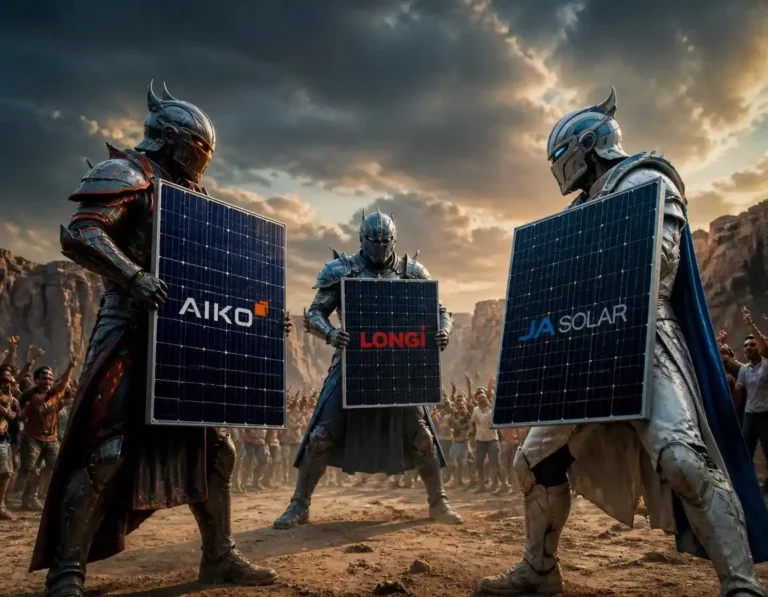
🥊 Qcells vs Jinko, AIKO and LONGi
The UK market is dominated by a handful of Tier 1 brands, and Qcells is one of the few not headquartered in China. Whether that matters depends on your priorities; see the next section.
| Panel | Cell tech | Max efficiency | Product warranty | Performance warranty |
|---|---|---|---|---|
| Qcells Q.TRON BLK M-G2+ | n-type TOPCon | 22.5% | 25 yrs | 25 yrs, ≥90.58% |
| Jinko Tiger Neo (54-cell) | n-type TOPCon | 22.3% | 12 yrs (25 on Tiger Neo 3.0) | 30 yrs, ≥87.4% |
| AIKO Neostar 3S+ | n-type back-contact | 24.4% | 25 yrs (15 on 3P) | 30 yrs |
| LONGi Hi-MO X10 | HPBC back-contact | 23.8% | 15 yrs | 30 yrs |
Jinko matches Qcells on efficiency at a lower price, which is why it dominates volume installs, but its standard warranty is half as long. AIKO costs 10–15% more than standard Tier 1 panels and is worth a look when roof space is tight. Qcells wins on things spreadsheets undervalue: brand continuity, a 25-year product warranty and a Korean manufacturing base some buyers want.
For head-to-head detail, read my Jinko review, AIKO review, AIKO vs LONGi vs JA Solar and the Jinko vs JA vs Trina comparison.
🚢 Where are Qcells panels made?
Qcells builds modules in its own factories in South Korea (Jincheon) and Malaysia (Cyberjaya), with Georgia plants serving the US. Modules sold in Europe typically come from the Korean or Malaysian lines, so check the datasheet and delivery note for your batch. That’s unusual in a market where about 68% of panels come from China, as we explain in why 68% of Britain’s solar panels come from China.
Two honest caveats. First, “made in Korea” or “made in Malaysia” doesn’t mean a China-free supply chain, because polysilicon, wafers and glass upstream can still originate there, and almost every non-Chinese brand has the same exposure. Second, the panel itself isn’t the security risk; the smart inverter and its app are. If origin matters to you for ethics, resale or planning reasons, it’s a fair thing to pay for. Our China guide puts the premium for non-Chinese brands at roughly £500 to £1,000+ on a 10-panel array. Ask the installer to confirm country of manufacture in writing.
🧰 Installers, inverters and export payments
Use an MCS-certified installer and check your exact panel model is on the MCS Certified Products directory. MCS certification is the gateway to the Smart Export Guarantee, which also needs a smart meter that records exports. MCS is moving to a redeveloped scheme by 31 March 2027, and consumer-code membership (RECC or HIES) becomes optional once an installer transitions, so ask which deposit-protection product backs your job. Our guides to what MCS certification means and how to choose a solar installer cover the checks.
Qcells modules pair with any mainstream string, hybrid or microinverter system. On a shaded or multi-orientation roof, microinverters or optimisers recover more energy than any brand upgrade; see our microinverter vs string inverter comparison. SEG rates run from a few pence to the mid-teens per kWh on standard fixed tariffs, so use the SEG income estimator before accepting your installer’s default.
🏁 My verdict
- You’ll stay 10+ years and want a 25-year product warranty from a mainstream TOPCon panel
- You want n-type Q.TRON with its −0.30%/°C temperature coefficient
- You need about 22% efficiency in an all-black finish
- Non-Chinese module assembly matters to you or to resale
- Your budget is tight: Jinko or Trina give near-identical kWh for less
- Roof space is limited: AIKO’s 24.4% back-contact modules fit more kWp per m²
- The quote is p-type Q.PEAK at n-type money
- You plan to sell within a few years, so the warranty premium won’t pay back
My working scorecard puts the Q.TRON range among the safest domestic choices in the UK for 2026. It isn’t the cheapest watt or the flashiest datasheet, but it has a 25-year product warranty from a manufacturer likely to be around to honour it. I’d put it on my own roof, provided the quote says Q.TRON and the installer holds MCS certification.
Specs come from Qcells’ European datasheets for Q.TRON BLK M-G2+ and Q.PEAK DUO M-G11S, rival figures from our own panel reviews, and prices from our UK cost guide. Always check the datasheet and warranty terms for your exact model.
❓ FAQs
Mostly no. Qcells modules sold in the UK are typically built in Hanwha Qcells’ own factories in South Korea and Malaysia, with US plants serving North America. Upstream materials such as polysilicon, wafers and glass can still come from China, as with almost every brand, so ask your installer to put the country of manufacture on the quote.
On Q.TRON BLK M-G2+ panels, Qcells’ European datasheet lists a 25-year product warranty and a 25-year linear performance warranty: at least 98.5% of rated power in year one, then no more than 0.33% degradation a year, leaving at least 90.58% at year 25. Older Q.PEAK DUO (p-type PERC) models carry a 12-year product warranty and guarantee at least 86% at year 25. Always get the UK warranty terms for your exact model in writing.
If you’ll stay in the house ten years or more, usually yes. Q.TRON’s 25-year product warranty is double the 12 years on a standard Jinko Tiger Neo, and Qcells has a strong bankability record. If you’re selling within a few years or working to a tight budget, a Tier 1 module from Jinko, JA or Trina will generate nearly the same electricity for less up front.