
Can Renters Get Solar Panels in the UK?

Can Renters Get Solar Panels in the UK? Here’s What Actually Works in 2026
Short version: yes, you can. It’s just a bit more fiddly than “stick some panels on the roof”, because it isn’t your roof.
I’ve gone through everything that’s changed this year — the new grants, the Warm Homes rules, and the government’s brand-new decision on plug-in solar — so you don’t have to. Some of it is genuinely good news. Some of it is still “coming soon”, and I’ll be straight with you about which is which.
The short answer
- Ask your landlord. Solar has become a much easier “yes” now that landlords face new minimum energy rules.
- Use a grant to make it free, or close to it, for whoever owns the property.
- Try Solar Together, a council-run group-buying scheme your landlord can register for.
- Fit a small plug-in kit yourself — though the rules for doing this legally are still being finished off, as of this month.
- No outdoor space at all? A battery-only setup or a community solar subscription still work.
Why renters have been left out of solar — and why 2026 is genuinely different
The basic problem has never really been technical. It’s ownership. Fixing anything to a building you’re renting, panels included, usually needs the landlord’s written consent, because it counts as an alteration under most tenancy agreements. Landlords, for their part, have had little reason to spend several thousand pounds on a system that mostly benefits whoever’s paying the electricity bill that month, which is you.
That stand-off is finally shifting, for three separate reasons that have all landed at once:
- New minimum energy standards are coming for every rented home. Landlords now have a real deadline to hit, and solar is one of the cheapest ways to hit it.
- Grants have got bigger. A fully funded solar install is now on the table for a lot more households than it used to be.
- Plug-in solar is inching towards being genuinely legal for the first time, which would let you generate your own power without touching the building at all.
None of this makes solar automatic for renters. But it makes the conversation with your landlord a lot less awkward than it was even twelve months ago, and it gives you more routes than “own a house” to actually get there.
Route 1: Getting your landlord to say yes to rooftop solar
This is still the option that gets you the biggest saving, because a full rooftop system generates far more electricity than anything you can plug into a socket. A typical 4kWp system costs somewhere around £7,000 fully installed, and saves an average household roughly £820 a year between lower bills and Smart Export Guarantee (SEG) payments for anything sent back to the grid, with SEG rates currently running at 4p to 15p per unit depending on the supplier. Payback usually lands somewhere between 8 and 12 years, and the panels typically come with a 25-year performance guarantee, so the maths works out comfortably even for a landlord who plans to keep the property for a while.
Common myth: “The Renters’ Rights Act forces my landlord to say yes”
You’ll see this claim on a lot of solar websites right now, and it isn’t quite accurate. The Renters’ Rights Act 2025 does contain specific, named protections, for example around keeping a pet, or making disability-related adaptations under the Equality Act 2010, where a landlord can’t unreasonably refuse. It doesn’t currently contain a general “can’t say no to energy improvements” clause covering solar. So a request to fit rooftop or wall-mounted panels still comes down to what your tenancy agreement says and how well you make the case, not a fixed legal test. Worth knowing before you go in expecting an automatic yes.
What has genuinely changed is the incentive on your landlord’s side. From 1 October 2030, private landlords in England will need every rented home to meet an EPC C rating (or hold a valid exemption), up from the current minimum of EPC E. They’ll be expected to spend up to £10,000 per property every ten years getting there, and solar is one of the more cost-effective ways to close that gap, alongside adding real value to the property. One widely cited estimate puts the uplift at around 6.2–6.8% on a typical 2–3 bedroom home, which works out to roughly £18,800 on a £280,000 property.
None of that guarantees a “yes”, but it’s a genuinely useful thing to mention. A short, polite written request that references the 2030 deadline, and offers to help find a grant that covers some or all of the cost (see the next section), tends to land a lot better than “can I have some solar panels, please”.
| System size | Cost without battery | Typical annual saving | Payback period |
|---|---|---|---|
| 3 kWp | ~£5,500 | ~£600 | 9–11 years |
| 4 kWp | ~£7,000 | ~£820 | 8–10 years |
| 5 kWp | ~£8,500 | ~£1,010 | 8–10 years |
| 6 kWp | ~£10,000 | ~£1,220 | 8–11 years |
Estimates only — actual costs and savings depend on roof orientation, location and how much electricity you use during the day. All qualifying residential installs benefit from 0% VAT until 31 March 2027.
Route 2: Let a grant cover it, so there’s less for your landlord to lose
A grant-funded install is the easiest “yes” you’ll ever get from a landlord, because it costs them little or nothing. A few schemes are genuinely live right now:
| Scheme | Who it’s for | What it covers | Runs until |
|---|---|---|---|
| ECO4 | Private tenants on qualifying benefits (Universal Credit, Pension Credit and similar), with landlord consent | Can fully fund solar, insulation and heating upgrades | Extended to 31 December 2026 |
| Warm Homes: Local Grant | Households with an EPC rating of D–G and income roughly under £36,000 (varies by council), England only | Up to £15,000 for solar, battery storage and insulation, plus a separate £15,000 pot for low-carbon heating | 31 March 2028 |
| Home Energy Scotland | Scottish households | Grants and loans of up to £7,500 towards solar and other upgrades | Ongoing |
| 0% VAT on solar | Any UK homeowner or landlord installing residential solar | Removes 5% VAT from the whole job — panels, battery and labour | 31 March 2027 |
Eligibility and funding pots vary by local authority, so it’s worth checking with your council directly as well as the national eligibility checker.
How the Warm Homes: Local Grant splits up
Up to £30,000 per household, in two separate pots
To check what’s available where you live, use the government’s Warm Homes: Local Grant eligibility checker, or have a look at our own solar panel grants hub for a fuller breakdown of what each scheme covers.
Route 3: Solar Together and other group-buying schemes
If your landlord is open to paying for solar but wants to keep costs down, Solar Together is worth flagging to them. It’s a group-buying scheme run by councils in partnership with a company called iChoosr: households in a participating area register their interest, installers compete in a reverse auction for the contract, and everyone who registered gets a personalised quote based on the winning bid. Typical savings run somewhere between 20% and 35% off a standalone quote, with no obligation to accept the offer once it arrives.
Renters can register too, as long as the property owner is happy to go ahead, which makes it a genuinely useful thing to bring to a landlord who’s on the fence about cost. Availability depends on whether your council is running a round at the time, so it’s worth checking your local authority’s website directly.
Route 4: Plug-in (“balcony”) solar — the honest legal status, right now
This is the option everyone’s been messaging me about, and it’s genuinely moved in the last few days, so let’s get the facts straight rather than the hype.
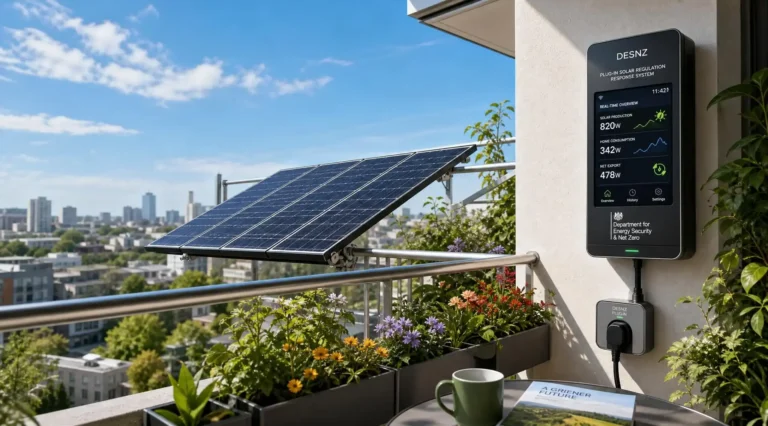
A plug-in solar kit is small: usually one or two panels, a microinverter that turns the panel’s DC output into AC electricity your home can use, and a lead ending in a standard UK plug. You mount the panels on a balcony rail, a garden fence or a flat roof, and, once the rules allow it, connect via an ordinary socket rather than a hardwired connection. No drilling, no scaffolding, and you take the whole thing with you when you move.
2026 timeline: how plug-in solar has actually progressed
Six milestones, from the first announcement to where things stand today
Here’s the plain-English version of where that leaves you. In its July response, the government backed a system capped at 800W of AC output, fed by up to 2,000W of solar panels, with one device allowed per household to begin with (a per-circuit allowance may follow once network rules are updated). Battery storage isn’t included in this first round, and major retailers, including Amazon, Lidl, B&Q and Currys, have already said they want to stock compliant kits once they exist.
What’s still missing is the actual law change. The Plugs and Sockets etc. (Safety) Regulations 1994 need amending before a UK plug can legally be used this way, that amendment still has to go through Parliament, and no kit can be sold as compliant until it’s tested against the safety specification and listed on the electricity network’s official register. No date has been confirmed for when that will happen. So, as things stand today, plugging a solar kit straight into a wall socket yourself isn’t yet a lawful way to connect one, however the product is marketed online.
What this means if you want to buy now
Basic kit hardware is already easy to find, from around £200 for a single small panel up to roughly £1,000–£2,000 for a fuller kit with a battery included. The compliant way to get one running today is still to have it connected by a competent, registered electrician on a proper fused connection, which also needs a quick notification to your local electricity network under the standard G98 process. Skipping that step to save on an electrician’s fee isn’t a risk worth taking with your home’s wiring.
| Kit | Typical cost | Estimated annual saving | Rough payback |
|---|---|---|---|
| Single 400W panel | From ~£200 | £70–£110 | 2–3 years |
| 800W kit (two panels) | ~£499–£999 | £150–£210 | 3–5 years |
| 800W kit with battery | From ~£925 | £175–£250 | 4–5 years |
Estimates based on a south-facing or near-south position. Actual savings depend on orientation, shading and how much of your electricity use happens during daylight hours.
Even once this is fully legal, renters and leaseholders are being advised, including by the government itself, to get their landlord or freeholder’s permission in writing before fitting anything, even a fully portable kit with no drilling involved. It costs nothing to send that email and it protects you if anyone ever queries it. For the fastest way to keep track of exactly when the legal green light finally lands, our breakdown of the government’s July response is kept updated as the remaining pieces fall into place, and you can also read the consultation and response documents directly on GOV.UK.
No outdoor space at all? Two more options
Battery-only, charged overnight
A portable power station charged on a cheap overnight electricity tariff, then run down during the day. No panels, no permissions needed from anyone, and it works even if you have zero outdoor space. Savings are smaller than a system with actual panels, but it’s genuinely a zero-permission option.
Community solar subscription
You subscribe to a share of a solar farm or community energy project, and the electricity it generates is credited against your bill instead of being installed at your home. No equipment, no landlord conversation, and availability depends on what’s running in your region.
Renting a flat specifically
Flats add an extra layer, because it’s often not just your landlord you need to convince. Roofs on blocks of flats are usually shared, so you’re also looking at a freeholder or a management company, and sometimes a majority vote from other leaseholders before anything goes near the roof. A ground-floor or south-facing balcony flat has a much simpler path than a mid-block flat with no private outside space. If that’s your situation, our dedicated guide to solar panels for flat owners walks through freeholder consent, shared-roof arrangements and what’s realistic for different flat layouts in more depth than we can cover here.
Every option, side by side
| Route | Landlord’s OK needed? | Roughly what it costs you | Takes it with you? |
|---|---|---|---|
| Landlord-funded rooftop | Yes, and they fund it | Usually nothing upfront | No, stays with the property |
| Grant-funded (ECO4 / Local Grant) | Yes, they need to agree to the works | Typically nothing, if eligible | No |
| Solar Together / group buy | Yes, they register and pay a discounted price | Nothing directly, unless negotiated | No |
| Plug-in solar kit | Best practice to notify in writing | ~£200–£2,000 for the kit | Yes, fully portable |
| Battery-only / community solar | Not needed | Varies, no fixed installation | Yes |
Quick FAQs
Can renters get solar panels in the UK?
Yes. You can ask your landlord to fund a rooftop system, use a grant such as ECO4 or the Warm Homes: Local Grant, join a Solar Together group-buying round, or fit a small plug-in solar kit on a balcony or in a garden. The rules for plugging a kit straight into a socket yourself are still being finalised in 2026, so it’s worth checking the current legal position before you buy one.
Do renters need their landlord’s permission to install solar panels?
Yes, in almost every case. Fixing anything to a rented property, panels included, counts as an alteration under most tenancy agreements, so you need written landlord consent first. Portable plug-in kits involve less structural work, but it’s still best practice, and what the government itself recommends, to tell your landlord or freeholder in writing before you fit one.
Is plug-in (balcony) solar legal for renters in the UK yet?
Not quite yet. The government published its response to the plug-in solar consultation in July 2026, backing an 800W system connected via a standard UK plug. But the actual law change and certified products both still need to be finalised, with no date confirmed, so a registered electrician remains the compliant way to connect a system for now.
Want the kit-by-kit detail once plug-in solar goes live? Our complete plug-in solar buying guide and renters hub are updated as soon as certified kits reach UK shelves. You can also work out your own numbers with our solar panel calculator, check what a grant could be worth using the grant & VAT savings checker, or, if your landlord’s ready to go ahead, find an MCS-certified installer near you.


One Comment