Commercial Solar Panel Finance & Capital Allowances for UK Businesses

The tax relief on offer is genuinely generous and the finance market has never been more competitive — but a lot of guides online still get the rules wrong. Here’s what’s actually true for 2026, in plain English.

I’ve read a lot of commercial solar guides while researching this one, and honestly, a surprising number of them get the tax side wrong. Several still say the 50% First Year Allowance runs out this March — it doesn’t. It was made a permanent part of the tax system back at the Autumn Statement 2023. If you’re a business owner or finance director weighing up rooftop solar, getting this right matters, because it can change your real first-year numbers by tens of thousands of pounds. So let’s go through exactly how the tax relief works in 2026, what your realistic finance options are, and where a few popular articles are quietly out of date.
🔑 The short version
Most UK businesses can deduct 100% of a commercial solar system’s cost from taxable profit in year one through the Annual Investment Allowance, up to £1 million. Anything above that gets a 50% First Year Allowance if you’re a company — permanent, not temporary. Rooftop solar is also exempt from business rates until 31 March 2035, and VAT-registered businesses can reclaim the 20% VAT charged on a commercial install. For financing, asset finance (hire purchase) is the most common route, because it lets you keep both ownership and the tax relief while spreading the cost over several years.
Why 2026 is actually a sensible year to make this call
Commercial electricity is still sitting at roughly 20p to 30p a unit depending on your tariff and usage profile, and nobody’s promising that comes down soon. The Bank of England held its base rate at 3.75% in June 2026, which feeds directly into what asset finance and green business loans cost — worth knowing before you start comparing quotes. On the policy side, the government committed at the Autumn Budget 2024 to keep the £1 million Annual Investment Allowance in place for the rest of this Parliament, so the main tax lever isn’t about to be pulled away from under you.
The commercial rooftop segment is also a genuinely active part of the UK solar market right now, alongside the residential boom you might have read about elsewhere. If you want the full breakdown of costs and payback times by building type, our commercial solar cost and payback guide covers that in detail — this article focuses squarely on the finance and tax side.
What does a commercial solar system actually cost in 2026?
Before the tax relief and financing conversation makes sense, you need a rough number to apply it to. Prices have settled down after a volatile few years, and — as with most trade purchases — the bigger the system, the cheaper each kilowatt-peak (kWp) gets.
| System size | Cost per kWp | Example total |
|---|---|---|
| Under 30 kWp — small shop or office | £900–£1,200 | £31,500 (30 kWp) |
| 30–100 kWp — medium warehouse | £750–£950 | £59,500 (70 kWp) |
| 100–250 kWp — large warehouse or factory | £700–£850 | £155,000 (200 kWp) |
| 250 kWp+ — big industrial roof | £660–£780 | from £165,000 (250 kWp) |
Figures exclude VAT. Commercial installs are charged the standard 20% rate — unlike homes, which get 0% VAT until March 2027 — but VAT-registered businesses simply reclaim it on their next return. If you’re working with a flat industrial roof, our flat roof solar cost guide covers the ballasting and mounting differences that affect price.
The three routes to tax relief — and the myth that won’t die
Here’s the bit that trips up even some accountants. Solar panels are classed by HMRC as “special rate” plant and machinery, because they have a useful life of 25 years or more. That single classification decides almost everything about how you claim relief on them.
Route 1: the Annual Investment Allowance (AIA)
The AIA is the workhorse for most commercial solar purchases. It lets any UK business — company, sole trader, or partnership — deduct 100% of qualifying plant and machinery costs from taxable profit in the year the expenditure is incurred, up to a limit of £1 million per year. Solar panels, inverters, mounting, cabling, and battery storage bought as part of the same project generally all qualify. Because most commercial rooftop systems cost well under £1 million, the AIA alone covers the entire spend for the vast majority of UK businesses.
Why solar doesn’t get “full expensing”
You’ll see plenty of marketing copy claiming solar qualifies for the headline-grabbing 100% “full expensing” scheme. It doesn’t, and this is worth being firm about. Full expensing only applies to main rate expenditure — kit that would otherwise sit in the 18% (dropping to 14% from April 2026) main pool. Because solar panels are long-life, special rate assets, they’re specifically excluded from full expensing. That doesn’t mean you lose out on 100% relief — it just means the AIA is doing that job instead, up to the £1 million ceiling.
Route 2: the 50% First Year Allowance
If your solar spend goes above the £1 million AIA limit in a single year — a large multi-site rollout, say, or a big project alongside other capital spending — the excess isn’t stuck on the slow track. Companies (though not sole traders or partnerships) can claim a 50% First Year Allowance on that remaining special rate expenditure, deducting half of it immediately, with the other half added to the special rate pool.
This is the detail so many articles get wrong. The 50% FYA for special rate assets was introduced alongside full expensing at Spring Budget 2023 and was originally due to expire on 31 March 2026. But it didn’t. At the Autumn Statement 2023, the Chancellor made both full expensing and the 50% FYA permanent. If you’ve read elsewhere that this relief is about to disappear, that source is out of date.
Route 3: the special rate pool (6% writing down allowance)
Whatever’s left after the AIA and any 50% FYA claim — or the full amount, if you’re a sole trader or partnership with spend above £1 million — goes into the special rate pool and is written down at 6% a year on a reducing balance. It’s the slowest route, which is exactly why most businesses structure their claim to use the AIA first.
| Relief | Rate | Who can claim | Worth knowing |
|---|---|---|---|
| Annual Investment Allowance | 100% (to £1m/yr) | Companies, sole traders, partnerships | Covers most commercial systems outright |
| 50% First Year Allowance | 50% of excess | Companies only | Permanent — not a temporary scheme |
| Special rate pool (WDA) | 6% per year | All business types | Reducing balance on whatever’s left |
| Full expensing | Not applicable | — | Main rate assets only — solar is excluded |
Year-one deduction and tax saved, by system size
Assuming full use of the AIA, then the 50% FYA on anything above £1 million, at the 25% main rate of Corporation Tax.
| System cost | Route used | Year-1 deduction | Tax saved (25%) | Tax saved (19%) |
|---|---|---|---|---|
| £50,000 | AIA (100%) | £50,000 | £12,500 | £9,500 |
| £150,000 | AIA (100%) | £150,000 | £37,500 | £28,500 |
| £400,000 | AIA (100%) | £400,000 | £100,000 | £76,000 |
| £1,000,000 | AIA (100%) | £1,000,000 | £250,000 | — |
| £1,500,000 | AIA (£1m) + 50% FYA (£250k of the £500k excess) | £1,250,000 | £312,500 | — |
The 19% small profits rate applies only where a company’s profits are £50,000 or less, with marginal relief up to £250,000 — unrealistic for the two largest examples here, hence the dash. Figures are illustrative; your actual saving depends on your profits, accounting period, and whether you have AIA headroom left after other capital spending in the same year. This isn’t tax advice — please check your specific position with your accountant.
Who can actually claim what
This is a distinction a lot of guides skate over, and it matters if you’re not a limited company.
| Business type | AIA (to £1m) | 50% FYA (above £1m) | 6% WDA (remainder) |
|---|---|---|---|
| Limited company (Corporation Tax) | Yes | Yes | Yes |
| Sole trader | Yes | No | Yes |
| Partnership (all individual members) | Yes | No | Yes |
In practice, this rarely bites — most commercial solar spend sits comfortably under the £1 million AIA limit regardless of business structure. But if you’re a sole trader or partnership planning a project above that threshold, or with other big capital purchases eating into your AIA the same year, the excess only gets the slower 6% writing down allowance. Worth flagging to your accountant early, since the timing of your spend can sometimes be shifted between accounting periods to make better use of your AIA headroom.
Business rates: the exemption a lot of sites describe wrong
This one’s a genuinely good deal, and it’s been running since the government scrapped the old, perverse rule that let solar panels increase your business rates bill. Eligible rooftop solar and battery storage plant and machinery gets 100% relief from business rates, meaning your installation doesn’t push up your property’s rateable value at all.
Here’s where a few articles slip up: this isn’t a rolling 10-year window that starts fresh whenever you install. It’s a fixed period — 1 April 2023 to 31 March 2035 — confirmed by the Commons Library and current government guidance on business rates reliefs. Install in 2026, and you get roughly nine years of the exemption left, not ten. Install closer to 2035 and there’s less runway. Either way, it’s a genuine, government-funded saving with no application process — it’s simply reflected when the Valuation Office Agency assesses your property.
From April 2026, the same 100% relief was extended specifically to cover new electric vehicle charge points and EV-only forecourts too, which is worth knowing if you’re planning solar and EV charging as one project.
VAT on commercial solar
Unlike residential installs — which sit at 0% VAT until 31 March 2027 — commercial solar is charged at the standard 20% rate. If your business is VAT-registered, you reclaim this in the normal way on your VAT return, and capital allowances are then calculated on the net-of-VAT cost. If you’re weighing up grants versus tax relief more broadly, our solar panel grants and funding round-up covers what’s available beyond the tax system, including the VAT position for different property types.
Five ways to actually pay for it
The tax relief is the same regardless of which finance route you pick, in most cases — but who gets to claim it depends entirely on who owns the system. That’s the single biggest factor to weigh up.

Buy outright (CapEx)
Pay the full cost from cash reserves. You own the system immediately, claim the full AIA or 50% FYA on 100% of the cost, and keep every pound of energy saving and SEG income from day one. It’s the best long-term return of any option, but it does tie up capital that some businesses would rather deploy elsewhere.
Asset finance (hire purchase)
A specialist lender pays the installer in full, and you repay over a fixed term — typically 3 to 10 years — at a fixed rate. Critically, you’re treated as the legal and tax owner from day one, so the full AIA or 50% FYA claim still applies even though you’re paying over time. Rates from mainstream asset finance lenders and specialist green energy lenders currently run at roughly 4% to 9% fixed APR, depending on your covenant and the lender, with deposits typically 0–20%. This tends to be the go-to option for UK businesses under about £500,000, because it combines ownership, tax relief, and manageable cash flow. Decisions are usually quicker than a bank term loan too — often a couple of weeks rather than a couple of months.
Green business loan
Several UK banks now run dedicated green lending desks for renewable energy projects, alongside specialist sustainable lenders. You own the asset and claim the allowance exactly as with a cash purchase, but spread repayments over a longer term — often 5 to 15 years — at rates broadly similar to or a little below asset finance, depending on your relationship with the bank and the size of the facility.
Finance or operating lease
The leasing company retains ownership and claims the capital allowance itself — not you. You pay a fixed rental for use of the system, which can suit businesses that want the arrangement kept off the balance sheet or have no appetite to claim the tax relief themselves (for example, if you’re not currently profitable enough to use it). You lose the allowance, but you also avoid tying up capital or taking on debt in the conventional sense.
Power Purchase Agreement (PPA)
A third-party provider funds, installs, owns, and maintains the system on your roof at no cost to you. In return, you agree to buy the electricity it generates at a fixed rate — typically 8p to 14p per kWh in 2026, well below most grid tariffs — for a term of 15 to 25 years. The provider claims the tax allowance, not you, and most PPAs need a minimum system size (commonly 50kWp+) plus a long enough remaining lease if you’re a tenant rather than the freeholder. It’s the option with the smallest long-term saving of the five, but the only one that needs no capital and no borrowing at all.
| Option | Upfront cost | Who owns it | Tax allowance | Typical term |
|---|---|---|---|---|
| Outright purchase | 100% now | You, immediately | You claim it in full | — |
| Asset finance (HP) | 0–20% deposit | You, immediately | You claim it in full | 3–10 yrs |
| Green business loan | 0–20% deposit | You, immediately | You claim it in full | 5–15 yrs |
| Finance/operating lease | £0 | Leasing company | Lessor claims it | 5–10 yrs |
| Power Purchase Agreement | £0 | PPA provider | Provider claims it | 15–25 yrs |
What 7 years of financing a £120,000 system really costs
Illustrative reducing-balance repayment totals. All three routes shown still qualify for the same year-one AIA tax relief — only leases and PPAs forfeit it.
If you’re weighing this up for a home rather than a business, the mechanics are different — our no-upfront-cost solar finance guide covers the residential grants, 0% installer deals, and the Warm Homes Plan in full.
Worked example: a 150kWp warehouse system
Numbers land better with a real scenario, so here’s a fairly typical one — a 150kWp rooftop array on a distribution warehouse with decent daytime electricity use.
| System cost (before VAT) | £120,000 |
| VAT at 20% (reclaimed by a VAT-registered business) | £24,000 |
| Year-1 AIA deduction (100%, within the £1m limit) | £120,000 |
| Corporation Tax saved at 25% | £30,000 |
| Net cost after Year-1 tax relief | £90,000 |
| Estimated annual generation | ~140,000 kWh |
| Self-consumed (70%) at 26p/kWh avoided cost | ~£25,500/yr |
| Exported (30%) via Smart Export Guarantee at 10p/kWh | ~£4,200/yr |
| Total annual saving | ~£29,700/yr |
| Simple payback (net cost ÷ annual saving) | ~3 years |
Illustrative figures based on typical 2026 UK installer pricing and mid-range self-consumption assumptions. Your own generation, usage split, and payback will vary by location, roof orientation, and operating hours.
Where the Year-1 financial benefit comes from
For the 150kWp example above — tax relief alone is worth roughly as much as a full year of self-consumption savings.
Smart Export Guarantee — a nice top-up, not the main event
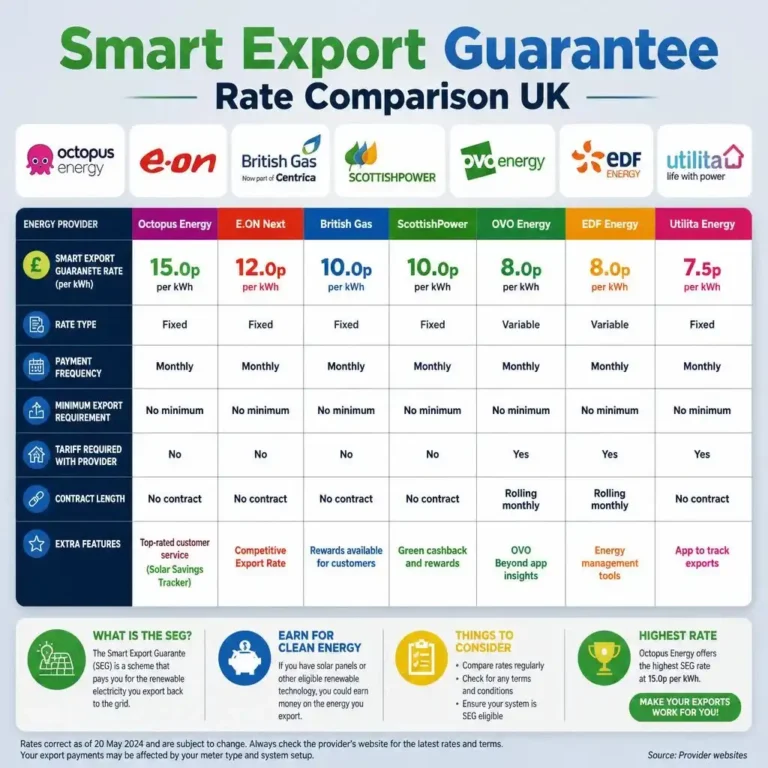
Once your installation is MCS-certified, you’re entitled to register for the Smart Export Guarantee (SEG), which requires any licensed supplier with 150,000-plus customers to pay you for electricity you export to the grid. Commercial export rates typically range from around 4p to 16p per kWh depending on supplier and tariff. It’s worth having — but self-consumption is nearly always the bigger prize, since the electricity you avoid buying (worth 20p-plus per kWh) is usually two to three times more valuable than the same unit exported. If you want to model your own numbers, SolarBriton’s SEG income estimator is a quick way to get a ballpark figure for your site.
Do you need planning permission?
Mostly, no. Since the government scrapped the old 1MW cap on permitted development for non-domestic rooftop solar in late 2023, most commercial rooftop installs go ahead without a planning application — provided the panels don’t project more than 200mm from the roof, the building isn’t listed, and it’s not on a conservation area frontage facing a road. Ground-mounted systems and larger, more complex sites can still trigger full planning requirements, so it’s always worth a quick check with your local planning authority before committing to a design.
Mistakes we keep seeing
Solar is a special rate asset, so full expensing doesn’t apply. Use the AIA (100% to £1m) instead — the end result is the same 100% relief, just via a different route.
It was made permanent at the Autumn Statement 2023, alongside full expensing. This is one of the most common outdated claims still doing the rounds.
It’s a fixed window — 1 April 2023 to 31 March 2035 — not a rolling period. Install later, and you get fewer years of it left.
Full expensing and the 50% FYA are company-only reliefs. Sole traders and partnerships get the AIA, then just the 6% writing down allowance on anything above it.
Your next steps
Size the system to your actual usage. Pull your half-hourly meter data if you have it, and use SolarBriton’s solar panel calculator to get a realistic starting estimate rather than a generic figure.
Get two or three quotes from MCS-certified installers. MCS certification is required for the Smart Export Guarantee, so don’t skip it. You can start with SolarBriton’s find an installer tool.
Check your VAT and AIA headroom. Confirm with your accountant that you have enough AIA left for the year, and use our VAT and grant savings checker to see what else might apply to your project.
Compare finance routes on an after-tax basis. Don’t just compare headline interest rates — factor in who claims the capital allowance under each option, since that’s often worth more than the difference in APR.
Plan for the long haul. A well-installed system should run for 25-plus years — our maintenance guide covers what upkeep actually looks like, and if battery storage is part of the plan, see our battery storage picks for 2026.
Common questions
Do commercial solar panels qualify for 100% tax relief in the UK?
Yes, but through the Annual Investment Allowance rather than full expensing. The AIA lets any UK business deduct 100% of a commercial solar system’s cost from taxable profit in the year of purchase, up to £1 million a year. Full expensing does not apply to solar because HMRC treats it as a special rate asset, not a main rate one. Companies spending above the £1 million AIA limit can claim a 50% First Year Allowance on the excess, which was made a permanent part of the tax system in 2023.
What’s the best way to finance commercial solar panels for a business?
It depends on your cash position and whether you want to own the asset. Asset finance (hire purchase) is the most popular route for UK businesses under around £500,000, because you’re treated as the owner from day one and can still claim the Annual Investment Allowance or 50% First Year Allowance, while spreading payments over 3 to 10 years. A Power Purchase Agreement suits businesses that want zero capital outlay in exchange for a longer 15 to 25 year commitment and no tax relief, since a third party owns the system.
Are commercial solar panels exempt from business rates in the UK?
Yes. Eligible rooftop solar panels and battery storage receive 100% business rates relief, meaning the installation does not increase a property’s rateable value. This runs from 1 April 2023 to 31 March 2035, a fixed window rather than a rolling 10-year period from your installation date, so a business installing in 2026 benefits from the remaining years up to 2035.
More reading on SolarBriton
Got a specific project in mind? The SolarBriton team is happy to point you in the right direction — get in touch and we’ll give you a straight answer.
This article is general information for UK businesses, current as of July 2026, and isn’t tax, legal or financial advice. Capital allowances, business rates reliefs and VAT rules depend on your specific circumstances and can change — always confirm your position with a qualified accountant and the latest gov.uk guidance before making a claim.