
Solar Panels Cost UK 2026

Thinking about getting solar panels in 2026? You’re definitely not the only one — UK solar installations have kept climbing, and prices have actually settled down compared with the rocky few years we had after 2022. We’ve gone through the latest MCS installation data, official government statistics, and real installer pricing to give you a proper, honest answer to “how much do solar panels cost in the UK right now?” No vague ranges pulled from thin air — every figure below comes from verified 2026 data, broken down by system size, region, and what you actually get for your money.
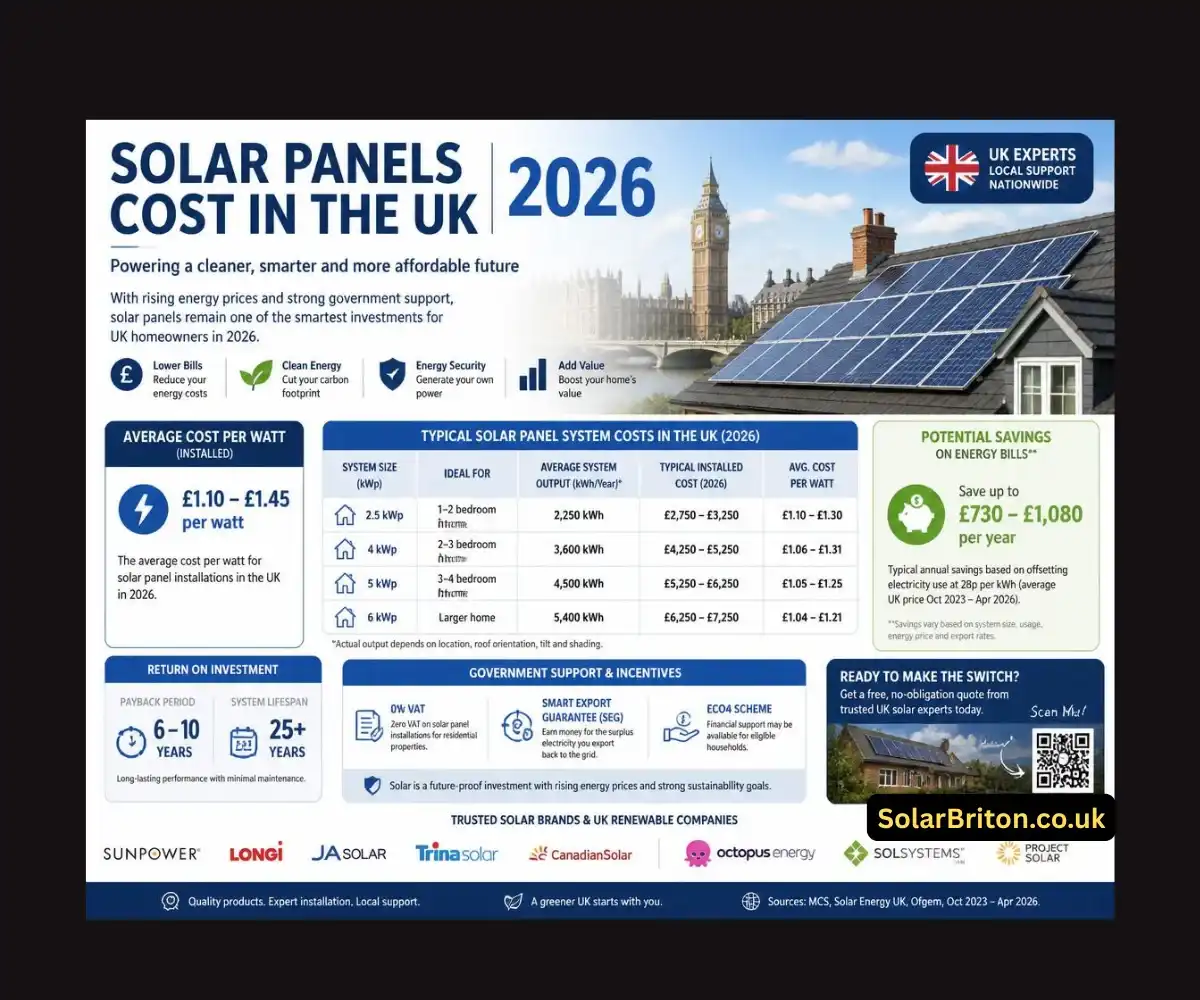
A typical 4kWp solar system costs £5,500–£7,500 fully installed in 2026 — around £1,591 per kW on average across England. Add a battery and you’re looking at £9,000–£11,500 for the whole package, with 0% VAT still applying until 31 March 2027.
Solar Panel Costs by System Size in 2026
Most UK quotes fall into one of four common sizes. The rule of thumb is roughly 1kWp for every 1,000kWh of electricity you use a year, but your roof space and shading matter too. Here’s what each size typically costs fully installed — panels, inverter, mounting, scaffolding and MCS certification all included.
| System Size | Panels | Typical Cost | Best For |
|---|---|---|---|
| 2–3 kWp | 6–8 | £4,000–£5,500 | 1–2 bed home |
| 4 kWp | 9–10 | £5,500–£7,500 | Most popular 3 bed home |
| 5 kWp | 11–12 | £7,500–£9,000 | 4 bed home |
| 6 kWp | 13–14 | £8,500–£11,500 | 4–5 bed / EV charger |
Based on MCS installation data and current installer pricing, England average. Panel counts assume modern 420–455W modules.
Why Bigger Systems Cost Less Per kW
The price per kW actually drops as systems get bigger, up to a point. A small 3kWp system can work out at £1,750 per kW or more, while an 8kWp system often lands closer to £1,250 per kW. The reason is simple: scaffolding, the site visit, the admin and the MCS paperwork cost roughly the same whether you’re fitting 6 panels or 16, so those fixed costs spread thinner as the system grows. It creeps back up slightly past 10kWp, mainly because systems that size often need a G99 application to the local network operator, which adds time and cost.
What’s Actually in the Price?
A typical £7,000 quote isn’t just “panels”. Roughly 45% goes on hardware — the panels, inverter and mounting brackets. Labour takes another 30%, since most installs need a two-person team for one to two days on the roof. The remaining 25% covers scaffolding, DNO notification, building regulations compliance and your MCS certificate — the paperwork that keeps you eligible for export payments later.
Solar Panel Costs Across the UK
Where you live changes the price more than you’d think. England’s average sits at £1,591 per kW, easing slightly to around £1,565 by April 2026. Wales is currently the cheapest part of mainland Britain at roughly £1,510 per kW, while Scotland runs a little higher at around £1,660. Northern Ireland is the cheapest of all four UK nations, averaging just £1,303 per kW. Within England, the North East is consistently the most affordable region, while London and the South East carry a 10–30% premium driven by higher installer labour costs.
| Nation / Region | Cost per kW | Notes |
|---|---|---|
| Northern Ireland | £1,303 | Cheapest in the UK |
| Wales | £1,510 | Cheapest in mainland GB |
| England (avg) | £1,591 | National benchmark |
| — North East England | Below avg | Most affordable English region |
| Scotland | £1,660 | Above England average |
| — London & South East | +10–30% | Highest labour costs in England |
Figures based on MCS regional cost data, March–May 2026.
Adding a Battery — What It Costs in 2026
Around 40% of new UK solar installs now include a battery, up from a quarter in 2024 — easy to see why, since storing your own solar power instead of exporting it for a few pence makes a real difference to your bill. A 5kWh battery typically adds £2,500–£4,000 to your install, while a larger 10kWh unit runs £4,000–£6,000. Add either at the same time as your panels and the whole system still qualifies for 0% VAT.
| Battery Size | Typical Add-on Cost | Good For |
|---|---|---|
| 5 kWh | £2,500–£4,000 | Evening top-up for an average home |
| 10 kWh | £4,000–£6,000 | Larger homes, EV owners, heat pumps |
0% VAT, the Smart Export Guarantee and Grants — What’s Real in 2026
Let’s clear up some confusion, because a lot of what’s shared online overstates this. There’s no direct government grant for installing solar panels in 2026 — the Feed-in Tariff closed back in 2019, and nothing has directly replaced it for most homeowners. What you do get is 0% VAT on solar and battery installations, saving roughly £1,000–£1,500 on a typical system, running until 31 March 2027, after which it returns to 5%.
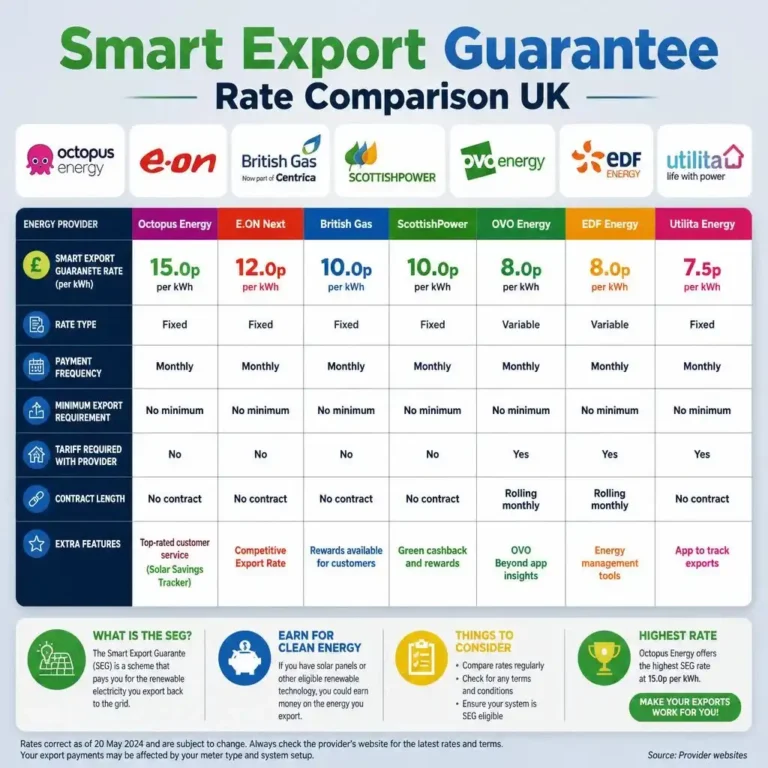
You’ll also be paid for electricity you export through the Smart Export Guarantee, with rates typically ranging from around 4p to 15p per kWh depending on your supplier and tariff — some specialist battery tariffs pay considerably more at peak times. If you’re on a low income or in a poorly insulated home (EPC band E, F or G), you may qualify for a fully funded system through ECO4, though solar makes up only a small share of what that scheme actually funds. For the full picture, the government publishes its own solar PV cost dataset on GOV.UK, which is where several of the figures in this guide come from.
How Long Until Solar Pays for Itself?
For most homes using a fair share of their own generation, payback typically lands somewhere between 8 and 12 years, though sunnier regions and well-chosen export tariffs can bring that down to 6–8 years. After that point, you’re looking at 13 to 17-plus years of genuinely cheap electricity, since panels commonly carry a 25-year performance warranty. A 4kWp system on an average England roof typically saves £400–£650 a year on bills alone, climbing to £500–£850 with export income and sensible battery use factored in.
Panel Technology Has Moved On
Two years ago, a 350W panel was considered strong. In 2026, 420–455W panels are standard, meaning a 4kWp system now needs just 9 or 10 panels instead of the 12–14 you’d have needed before. Leading brands installed across UK homes include JA Solar and Trina Solar at the value end, with premium options like SunPower Maxeon offering efficiency above 24% and warranties stretching to 40 years.
🔍 Getting a fair quote
Always get at least three quotes from MCS-certified installers — on the same street, quotes can vary by 30–40% depending on a company’s overheads and how busy they are. Check the installer’s MCS certificate is current, ask exactly what’s included (scaffolding, DNO fees, certification), and be wary of anyone quoting a price dramatically below or above the ranges in this guide without a clear reason why.
Our Take
Solar in the UK in 2026 is a mature, well-understood market — prices have steadied, panel technology keeps improving, and 0% VAT makes now a genuinely sensible time to install if your roof suits it. A typical 4kWp system costing £5,500–£7,500 will usually pay for itself within 8 to 12 years, then keep generating free electricity for well over a decade after that.
Solar Panel Costs UK — FAQs
How much do solar panels cost in the UK in 2026?
A typical 4kWp solar system costs £5,500–£7,500 fully installed in 2026, working out to around £1,591 per kW on average across England according to MCS data. Smaller 3kWp systems start from about £4,000, while larger 6kWp systems can reach £11,500.
How long do solar panels take to pay for themselves?
Most UK households see payback within 8 to 12 years, depending on how much of their own generation they use, their region’s sunshine levels, and their Smart Export Guarantee rate. Panels typically carry a 25-year warranty, so most of that lifespan is spent generating genuinely free electricity.
Is there a government grant for solar panels in 2026?
Not a direct one for most homeowners — the Feed-in Tariff closed in 2019. The main financial support available in 2026 is 0% VAT on installations until 31 March 2027 and the Smart Export Guarantee for exported electricity. Low-income households in poorly insulated homes may qualify for a fully funded system through ECO4.


6 Comments