
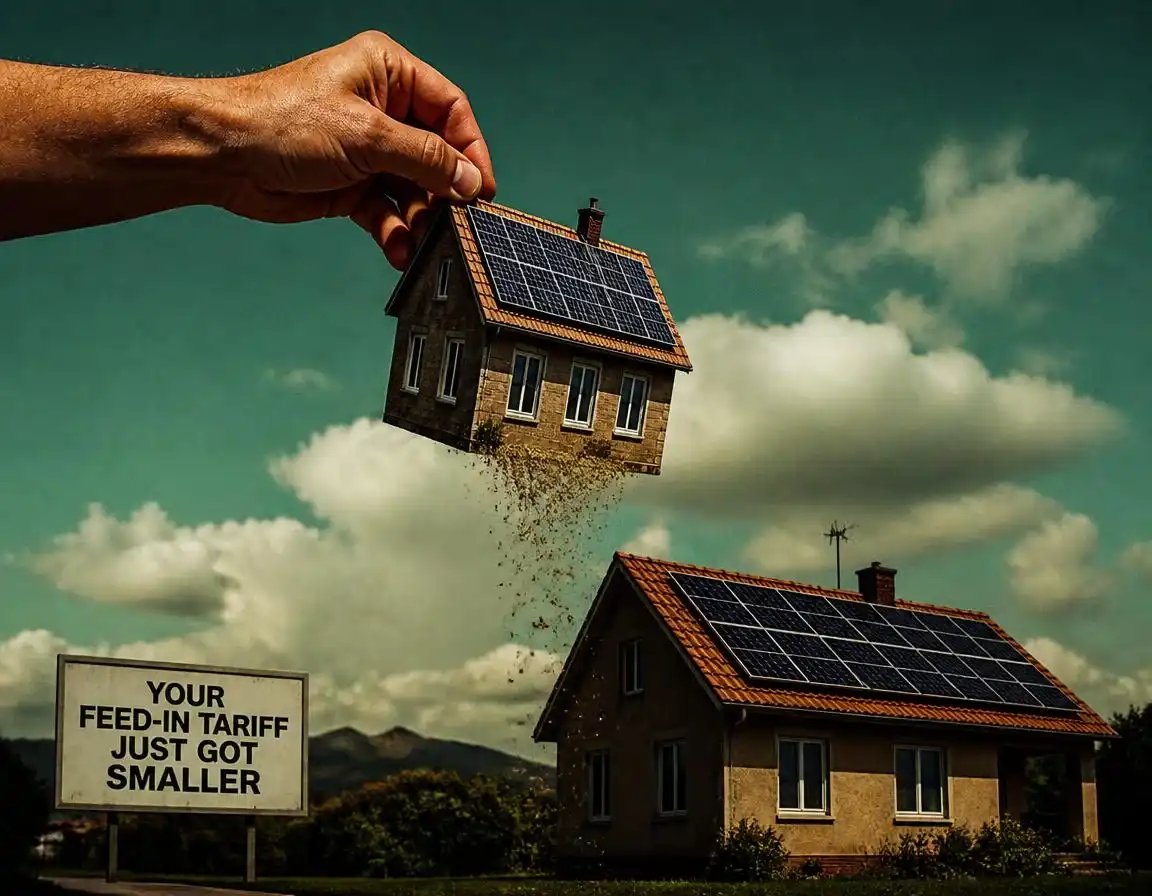
Your Feed-in Tariff Just Got Smaller

Feed-in Tariff 2026/27
Feed-in Tariff RPI to CPI switch: what changed and what it costs you
Figures checked on 19 September 2026 against Ofgem, DESNZ and Ofgem’s current price cap.
The short version
From 1 April 2026, Feed-in Tariff rises are worked out with CPI instead of RPI. Your rates haven’t been cut. This year’s uplift was 3.4% where RPI would have given about 4.2%, and payments still go up every April, just by less. The gap is roughly 0.8% of your FiT income in year one, and it compounds. On an early-adopter 2010 system that’s about £21 in year one and somewhere between £1,000 and £1,150 by the end of the agreement. The maths is below, along with the one part of your FiT income you can still change: export.
If your Feed-in Tariff statement arrived this spring and the increase looked smaller than you expected, you read it right. The Feed-in Tariff RPI to CPI switch means that from 1 April 2026 the yearly uplift on every FiT rate, generation and export, uses the Consumer Prices Index instead of the Retail Prices Index you signed up under. Same panels, same agreement, same payment dates. A different ruler measures the rise. This guide covers what changed, what it costs in pounds over the rest of your agreement, how to check your supplier got it right, and the part of your FiT income you can still move.
What changed on 1 April 2026
The Feed-in Tariff closed to new applicants on 31 March 2019, but it’s still paying out. DESNZ counts about 870,000 generators in Great Britain on the scheme, 829,000 of them domestic solar installations. When those households joined, their rates were set to rise every year with RPI for the length of the agreement: 25 years for solar PV accredited before 1 August 2012, 20 years after that.
That index link is what moved. Your base rate and your agreement length didn’t. The sequence went like this:
- 31 October 2025. DESNZ opens a consultation with two options: switch the index to CPI, or freeze rates at 2025/26 levels and realign with CPI gradually.
- 12 December 2025. The consultation closes with around 2,800 responses, about 2,600 of them from households with solar panels.
- 7 January 2026. A draft negative statutory instrument is laid in Parliament, moving Ofgem’s deadline for publishing the new rates from 1 February to 1 April 2026.
- 28 January 2026. The government confirms the CPI switch and drops the freeze. The change is made through a modification to supplier licence conditions.
- 23 March 2026. Ofgem publishes the 2026/27 tariff table (it calls this FiT Year 17), about seven weeks after its usual 1 February slot. Every relevant rate is uplifted by CPI at 3.4%.
- 1 April 2026. The new rates apply to your generation and export payments.
The freeze would have been worse. Rates would have stayed flat until a shadow CPI series caught up with RPI, which was expected to take until around the mid-2030s. Martin Lewis of MoneySavingExpert said many FiT households would be relieved the government chose the least-worst option on its table, and that a freeze would have broken the promise people signed up to. His full reaction is on MoneySavingExpert.
The government’s reasoning is that CPI is now its standard inflation measure, and it puts the saving on the FiT at about £600 million over ten years, or roughly £60 million a year (2024/25 prices). Most people who responded to the consultation disagreed that CPI is fairer. Its published response answers that there’s no contract between government and generators: your FiT agreement is with your supplier, and the index is set in legislation the government can amend. If you want the policy and legal backstory, including why this echoes the 2011 FiT court fight, it’s in our policy deep-dive on how we got here. This piece is about your money.
RPI vs CPI: two rulers, one of them shorter
Both indexes measure inflation, but they don’t measure it the same way. RPI includes housing costs that CPI leaves out, such as mortgage interest and council tax, and it averages prices with a formula that tends to give higher numbers. RPI lost its National Statistic status in 2013, and government contracts have been moving to CPI since. Contracts for Difference and the Capacity Market already index to it, so the FiT was one of the schemes left on RPI.
The two numbers behind this year’s uplift are the 12 months to December 2025: RPI 4.2%, CPI 3.4%, as Ofgem quoted both when the consultation opened. That 0.8-point gap is what landed on your April statement.
The April uplift, three ways
Percentage increase applied to FiT generation and export rates
Will the gap shrink?
Probably, from 2030. The UK Statistics Authority has confirmed that RPI will be brought into line with CPIH (CPI plus owner-occupiers’ housing costs) by 2030, which effectively ends the old RPI method. Some people who responded to the consultation argued that was a reason to wait rather than switch now. It’s also why the costings below show two cases: a 0.8-point gap that never closes, and one that halves to 0.4 points once RPI changes. The 0.4 is my own assumption for illustration, not an official figure.
What the smaller rise costs you, year by year
Take £1,000 of FiT income. Under the old link it would have become £1,042 this year. Under CPI it becomes £1,034. That’s an £8 gap you won’t spot on a quarterly statement. To get your own year-one figure, multiply last year’s total FiT income (generation plus export) by 0.008.
Indexation compounds, though. Next year’s rise applies to a slightly smaller base than it would have, and so does the one after. The annual gap widens every April until your agreement ends. Here’s the cumulative shortfall on that same £1,000, with CPI at 3.4% a year and RPI assumed to run 0.8 points above it:
Cumulative shortfall per £1,000 of FiT income
CPI path against the old RPI path, two cases for the size of the gap
So it’s a rounding error in year one and a real sum by the end. The percentage is identical for everyone, but the earliest adopters are on the highest rates, so they carry the biggest cash loss.
Work out your own gap
Use your April 2025 to March 2026 FiT income, generation plus export, from your statements. Results are illustrations, not a forecast.
Feed-in Tariff rates for 2026/27: three worked examples
Percentages are abstract and statements aren’t. These are 4kW solar systems in the higher energy-efficiency band, fitted to homes that were already occupied, generating 3,400kWh a year with export deemed at 50%. The rates start from Ofgem’s published 2025/26 figures with the 3.4% uplift applied. The last column shows what 4.2% would have paid.
| Installed | Generation rate 2025/26 | From 1 April 2026 (CPI +3.4%) | Under the old RPI link (+4.2%) |
|---|---|---|---|
| April 2010 to March 2011 | 74.37p/kWh | 76.90p/kWh | 77.49p/kWh |
| April to June 2015 | 20.38p/kWh | 21.07p/kWh | 21.24p/kWh |
| April 2018 to March 2019 | 5.65p/kWh | 5.84p/kWh | 5.89p/kWh |
Export rates rose the same 3.4%: 5.25p became 5.43p/kWh for systems finished before 1 August 2012, and 7.39p became 7.64p/kWh for systems from 1 August 2012. Rates for later systems changed quarterly, so your band may sit slightly off these lines. New figures are worked out from Ofgem’s 2025/26 rates and rounded to 0.01p; Ofgem’s table has the official number for your band.
Run the compounding to the end of each agreement and the totals look like this:
| Installed | Payment years left | Year-one gap | Gap by the end of the agreement |
|---|---|---|---|
| April 2010 to March 2011 (25-year) | about 9 | about £21 | £1,015 to £1,154 |
| April to June 2015 (20-year) | about 9 | about £7 | £317 to £361 |
| April 2018 to March 2019 (20-year) | about 12 | about £3 | £211 to £262 |
Generation plus deemed export, CPI at 3.4% a year. The lower figure assumes the RPI/CPI gap halves to 0.4 points from the April 2031 uplift; the higher figure keeps it at 0.8 points.
The 2018 systems have the most years left, yet lose the least, because their rate is about a thirteenth of the 2010 rate. Your own numbers will differ with your output, band and end date, but the pattern won’t.
How to check your licensee got it right
Your FiT payments come from your licensee, usually the energy supplier you registered with, and the new rates apply automatically. You don’t sign up for anything. It’s still worth five minutes on the first statement dated after 1 April 2026:
- Find your technology, system size and eligibility date in Ofgem’s FiT tariff table for 2026/27 and compare the p/kWh with your statement.
- Check the generation and export lines separately. Each should be about 3.4% above last year’s rate, allowing for rounding to 0.01p.
- If you’re on deemed export, confirm it’s still 50% of generation for solar PV. Nothing about that changed with the index.
- Your payment frequency and end date shouldn’t have moved either. Only the uplift index did.
- If a line is off, write to your licensee quoting your FiT reference and the table row you’re comparing against. Ofgem’s guidance for FiT generators explains your options if it isn’t fixed.
The export lever you still control
Your generation payments stay on the FiT for the whole agreement. Export is different. You can opt out of FiT export and take a Smart Export Guarantee (SEG) tariff for that side only, and your FiT generation payments carry on. What you can’t do is be paid both FiT export and SEG for the same electricity.
Three rules to know before you jump:
- SEG pays on metered export, so you need a smart or export meter. Deemed FiT export doesn’t need one.
- In practice suppliers apply a 12-month opt-in/opt-out rule, and once your export is metered you can’t go back to the deemed 50%.
- SEG rates are set by suppliers, not Ofgem, and they don’t rise with inflation every April the way FiT rates do.
The pull is the rate. FiT export pays 5.43p or 7.64p this year depending on your vintage. Here’s roughly where the alternatives sit in mid-September 2026:
| Export option | Typical rate | What you need |
|---|---|---|
| FiT export, systems finished before 1 August 2012 | 5.43p/kWh | Nothing. Deemed at 50% of generation |
| FiT export, systems from 1 August 2012 to March 2019 | 7.64p/kWh | Nothing. Deemed at 50% of generation |
| Open SEG tariffs (Fuse Energy around 13p, ScottishPower SmartGen around 6p) | 6–13p/kWh | A smart or export meter, no import switch |
| SEG tied to your electricity supply (EDF 15p, Ecotricity 16p, E.ON 13p, Octopus and British Gas 12p) | 12–16p/kWh | A smart meter and moving your electricity to that supplier |
| Time-of-use (Octopus Flux: about 29p from 4pm to 7pm, 10p daytime, 5p overnight) | 5–29p/kWh | A battery, Octopus as your supplier, and a daily battery schedule |
Rates move often. Headline offers of 18–25p need you to buy the solar and battery from that supplier, so they don’t apply to an existing FiT system. Our full SEG tariff ladder has the live list and the strings on each tariff.
A higher headline rate doesn’t settle it. The FiT pays deemed export on 50% of your generation whether or not you send that much to the grid, and SEG pays only on what you actually export. Ofgem’s annual reporting has put deemed export at roughly four-fifths of FiT export payments, so if you’ve never had an export meter, you’re in the majority. The number that decides it is your real export share. SEG pays more once you export above these levels:
| Your FiT export rate | SEG at 6p | SEG at 13p | SEG at 15p |
|---|---|---|---|
| 5.43p (finished before August 2012) | 45% | 21% | 18% |
| 7.64p (August 2012 to March 2019) | 64% | 29% | 26% |
Share of your generation you’d need to export for the SEG tariff to match deemed FiT export. It’s 50% of the FiT rate divided by the SEG rate.
To find your real share, check your inverter app or the export register on your smart meter over a full year, ideally with a decent solar monitoring setup. Then run the sums on your own volumes rather than anyone’s average.
The index switch is real money, but slow money, and there’s no lever left on it: it applies to every FiT generator in Great Britain. The levers that still move your income are export choice and self-consumption. Ofgem’s average price cap for October to December 2026 is 26.32p per kWh, so a unit you use at home saves you about 26p. That’s roughly twice what a good SEG tariff pays and three to five times what FiT export pays. Get those two right and the CPI gap is annoying, not serious.
What happens next April and beyond
Every April uplift is CPI-linked from now on. For 2027/28, Ofgem goes back to its normal timetable: rates published by 1 February 2027 and effective from 1 April. The rise will use CPI for the 12 months to December 2026, which the ONS publishes in January. FiT payments continue until 2039, when the last 20-year agreements signed in 2019 run out, so this index will be part of household income for the rest of the decade and beyond.
CPI is usually below RPI, but not always. In a year where CPI prints higher, your uplift would beat what the old link paid. The government expects the FiT change to save about £600 million over ten years, about £60 million a year, and the FiT is paid for through levies on everyone’s electricity bills, which is how it frames the change as fair to households who don’t have solar.
The quick recap, for when you have a statement in hand:
- Base rates and agreement lengths are untouched. Only the index behind your annual rise changed, from 1 April 2026.
- This year’s uplift was 3.4% (CPI), against about 4.2% under the old RPI link. The 0.8-point gap compounds every April.
- On £1,000 of FiT income that’s £8 in year one and between roughly £390 and £440 after nine years.
- Early adopters lose most in cash terms because their rates are far higher, even though the 2018 systems have more years left.
- You can move just the export side to a SEG tariff and keep your generation payments. Check your real export share first.
FAQs
Has my Feed-in Tariff payment gone down in 2026?
No. Your base generation and export rates haven’t been cut and your agreement length hasn’t changed. What changed on 1 April 2026 is the index used for the annual rise: CPI instead of RPI. This year’s uplift was 3.4%, against roughly 4.2% under the old RPI link. Payments still rise every April, just by less, and the gap compounds over the rest of your agreement.
How do I check my supplier applied the new Feed-in Tariff rate correctly?
Find your technology, size and eligibility date in Ofgem’s 2026/27 tariff table and compare the p/kWh with your first statement after 1 April 2026. Check generation and export separately: each should be about 3.4% above last year’s rate, allowing for rounding to 0.01p. If a line doesn’t match, write to your FiT licensee quoting your FiT reference and the table row.
Can I escape the smaller rises by moving to the Smart Export Guarantee?
Only on the export side. Your generation payments stay on the FiT and keep the CPI uplift. You can opt out of FiT export and take a Smart Export Guarantee tariff, but you can’t be paid both for the same electricity, you need a smart or export meter, and suppliers apply a 12-month opt-in/opt-out rule. Whether it pays depends on how much of your generation you actually export, compared with the 50% the FiT deems.
Will my Feed-in Tariff go up in April 2027?
Yes, by CPI for the 12 months to December 2026, which the ONS publishes in January. Ofgem’s normal 1 February publication deadline applies again for the 2027/28 rates, which start on 1 April 2027. Nobody can give you the percentage yet.
Is the switch from RPI to CPI a breach of my Feed-in Tariff agreement?
The government says no. Its position is that a FiT agreement is between you and your supplier, that the way rates are indexed is set in legislation, and that it can amend that legislation through the proper process. Many households who responded to the consultation disagreed and saw it as breaking the deal they signed. I’m not a lawyer, so if you’re thinking about a formal challenge, get proper legal advice.
Sources
- DESNZ: changes to inflation indexation in the Feed-in Tariffs scheme, government response
- Ofgem: Feed-in Tariff tariff table, 1 April 2026
- Ofgem: Feed-in Tariff changes for 2026
- Ofgem: Feed-in Tariffs for generators, including opting out of FiT export
- Ofgem: Smart Export Guarantee
- Ofgem: energy price cap, 1 October to 31 December 2026
- MoneySavingExpert: Feed-in Tariff CPI announcement, 28 January 2026



One Comment