Agrivoltaics on UK Farms

Agrivoltaics on UK Farms: Solar Panels & Sheep, the Honest 2026 Guide
Sheep grazing under panels, crops trialled beneath elevated arrays, SFI payments stacked on top of export income — this is the bit of the solar story that finally answers “but what about the fields?” Here’s what’s genuinely happening on British farms right now, with the numbers to back it up.
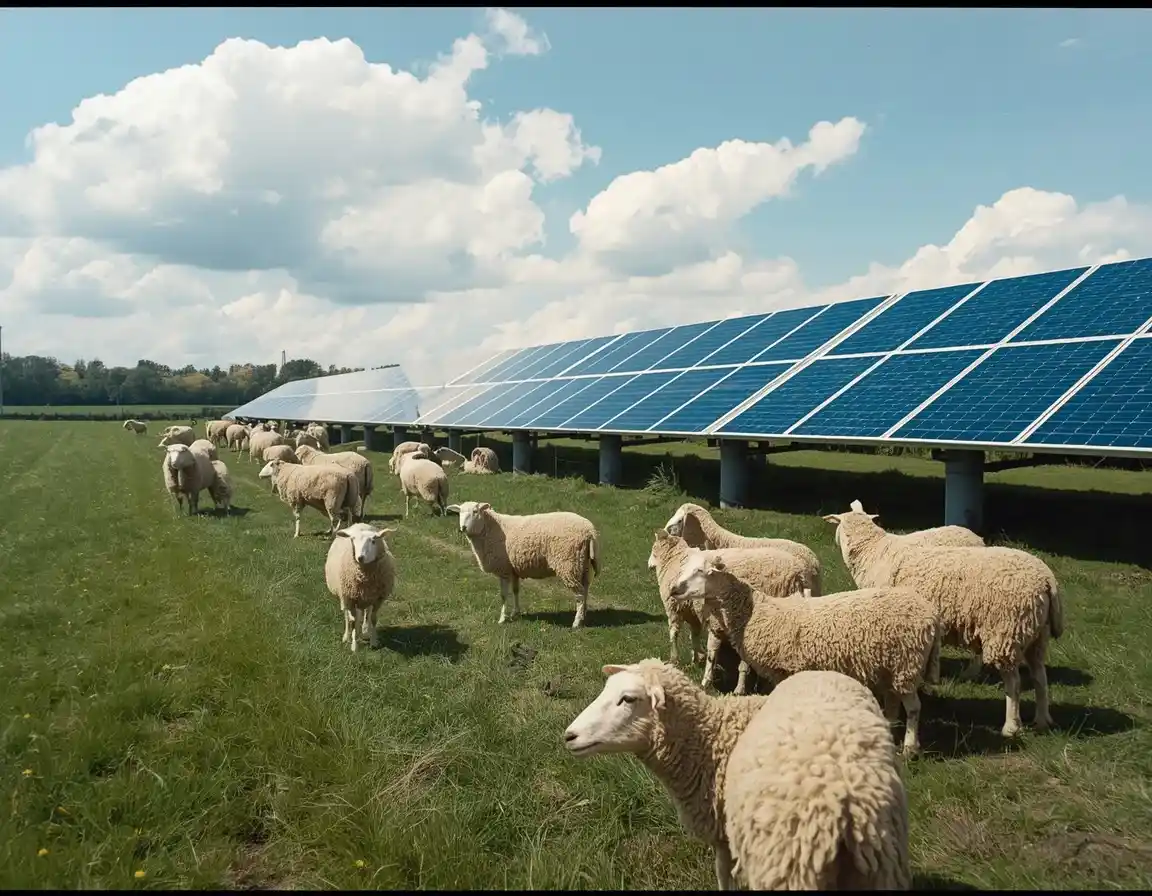
I’ve spent the best part of twenty years watching UK farmers get told what to think about solar — usually by people who’ve never mucked out a shed in their lives. So let me start with the bit that surprises people most on site visits: the best-run solar fields I walk aren’t dead ground. They’re full of sheep.
That pairing has a name now — agrivoltaics, or agri-PV if you prefer — and in 2026 it’s moved from conference-slide curiosity to genuine farm practice. Partly that’s policy: the government’s Solar Roadmap explicitly backs dual-use solar, and Defra’s first-ever Land Use Framework leans hard on “multifunctional land” as the way to square food, nature and clean power. Partly it’s simple economics: a solar lease pays several times what most acres earn under the plough.
This guide is my plain-English rundown of agrivoltaics on UK farms — solar and sheep first, because that’s the model that actually works here today, but also crops under elevated panels, the 2026 planning rulebook, and the full income stack. Where the evidence is solid, I’ll say so. Where it’s early, I’ll say that too.
🌾What agrivoltaics actually means on a UK farm
Not a solar farm with a bit of grass left over — a system designed from day one so the land keeps farming.
Proper agrivoltaics means the agricultural use is planned, not accidental. Panel height, row spacing, cabling and ground cover are all chosen so livestock or crops can carry on beneath the array. Done well, the same hectare produces electricity and food at once — researchers measure this with a “land equivalent ratio”, and well-designed dual-use systems routinely score above 1, with UK trial work suggesting overall land productivity gains of up to 73% versus splitting the two jobs across separate fields.
In the UK, three models dominate:
| Model | What it looks like | Best for | UK status, 2026 |
|---|---|---|---|
| Sheep grazing | Standard or slightly raised ground-mount, 0.8–1.2 m clearance, stock-proof fencing | Livestock farms, developer sites wanting genuine agricultural use | Established — the default UK model |
| Pollinator & wildflower cover | Native seed mix under and between rows, light grazing or annual cut | Sites needing Biodiversity Net Gain and SFI stacking | Common on new developments |
| Elevated crop arrays | Panels 2.5–4 m up, wider row spacing for machinery and light | Soft fruit, salad and leaf growers | Trial stage in the UK; established in France, Germany, Italy |
University of Sheffield modelling (announced Feb 2025, peer-reviewed and published in Applied Energy that spring) found well-sited UK agrivoltaics could meet the country’s entire electricity demand around four times over — roughly seven times the government’s 2030 solar target — without sacrificing a single hectare of farmland, with Cambridgeshire, Essex, Lincolnshire and the wider East and South East of England, ironically the heart of the solar-farm row, coming out as the optimal regions. A CMS law review counted around 15 commercial agrivoltaic projects already operating in the UK, most small at 1–5 MW. Early, yes. Imaginary, no.
And context matters here: ground-mounted solar covers roughly 0.1% of UK land today, and even the government’s most solar-heavy scenario keeps that under 0.6% of farmland by 2030. The fight was never really about acreage — it’s about which acres. Agrivoltaics is the industry’s answer to that question, and our piece on UK solar farms vs farmland covers the row in full.
🐑Why sheep are solar’s perfect partners
Cattle rub on the frames, pigs root the trenches, goats eat the cabling. Sheep just get on with it.
Sheep are the right size, the right temperament and the right diet for solar sites. They keep the grass short without a mower near the array, they leave cabling alone when it’s installed properly, and they actively benefit from the infrastructure: panels shade them in a heatwave, break the wind in winter, and the partial shade keeps the sward greener for longer in a dry spell. It’s one of the few situations where the livestock and the power station both come out ahead.
The industry is already scaling the idea. The Great North Road Solar and Biodiversity Park in Nottinghamshire, announced by developer Elements Green in December 2024, will graze a flock starting at around 4,000 sheep and growing to as many as 9,000 once lambing begins — on a 1 GW site the developer expects to bring online around 2027, saving a projected £5 million in mowing costs across its 40-year lifespan and cutting the flock’s own transport mileage by tens of thousands of miles a year because the animals graze closer to home. And it’s not just big future projects: Lincolnshire shepherd Hannah Thorogood, a first-generation farmer, started out with just 18 acres and 20 sheep — as much as she could afford — and has grown that to 250 acres and over 200 sheep by taking free grazing licences across a local solar operator’s land. That’s diversification working in the other direction — a livestock business built on solar land, not a solar business tolerating livestock.
On breeds, stick with hardy, low-stature types: Welsh Mules, Romney, Shetland and Suffolk crosses are the usual suspects. On numbers, the National Sheep Association puts typical stocking on productive grass at six to ten sheep per acre; expect a modest reduction on a solar site because the panel footprint and access gaps take some grazing out of play. Model it per site rather than trusting a national average.
A genuine grazing arrangement — your own flock or a neighbour’s on a licence — keeps the land in agricultural use. That single fact strengthens the planning case on better-grade land and keeps routes like SFI open. A field “with sheep in the brochure” but no actual grazing plan fools nobody at the LPA.
🚜Crops under panels: where UK trials stand
The continental model — panels on stilts, tractors underneath — is coming, but it’s early days here.
Elevated agrivoltaics, with panels 2.5 to 4 metres up, is well established in Germany, France and Italy, and the Sheffield work suggests UK-grown crops are viable under the right design. The catch is capital: raised, wider-spaced frames carry a 15–30% structural premium over standard ground-mount and fit fewer panels per acre — roughly 0.5–0.7 MW per hectare versus 0.8–1.0 for a solar-only layout. It only stacks up where the alternative is high-value cropping, not bare grazing land.
| Crop type | Verdict under panels |
|---|---|
| Grass & grazing swards | Excellent — the proven UK default |
| Soft fruit (raspberries, blackcurrants) | Promising in UK trials; partial shade suits several varieties |
| Salad, leaf & herb crops | Good — shade-tolerant and high value |
| Wildflower & pollinator mix | Strong for BNG and SFI stacking |
| Cereals & brassicas | Poor — sun-hungry; yields drop meaningfully |
My honest read: if you grow cereals, don’t wait for agrivoltaics to change your life. If you grow soft fruit or salad leaves, watch this space closely — and budget for the premium. For most livestock farms, the sheep model below the next sections is the one that pays today.
💷The money: what an acre earns each way
This is the whole story in one chart. Everything else is detail.
Typical 2026 solar leases run £850 to £1,300 per acre per year, index-linked, over 25 to 40 years, with no capital outlay, no crop risk and no weather to worry about. Compare that with arable margins of roughly £100–£250 an acre in a decent year — and 2025/26 hasn’t been a decent year for cereals — or £50–£150 from grazing. On marginal or awkward land, the lease isn’t a decision so much as a foregone conclusion.
Leases also aren’t necessarily goodbye to farming: sheep grazing under the panels is routine on large sites, the land keeps its agricultural classification, and decommissioning clauses return the field to full use at the end. If you’d rather keep the field entirely in hand, the own-it-yourself route stacks more income streams — more on that next — at the price of real capital and real management.
⚡SEG & the SFI income stack
Own the array and an agrivoltaic field pulls in three or four streams at once: electricity saved on the farm’s own daytime load, export income from the Smart Export Guarantee — commercial-scale export rates typically run from around 4p to 16.5p per kWh depending on supplier, well below the headline residential rates you’ll see quoted elsewhere (our SEG rate comparison covers the domestic side, and the SEG income estimator will model your own numbers) — plus the agricultural side beneath.
That agricultural side got more complicated, not just more generous, in 2026. SFI26 actually cut the payment rate on a few of the most popular actions — herbal leys dropped from £382/ha to £224/ha and winter bird food from £853/ha to £648/ha, for instance — while raising others, and it introduced two changes worth knowing before you plan a stack: agreements are now capped at £100,000 in total value per business (previously uncapped), and each farm business can hold only one SFI26 agreement at a time, running for three years rather than five. Within that cap, several actions still pair naturally with an array: flower-rich grass margins pay £798/ha, hedgerow management £13 per 100 m (one side), alongside grassland and soil actions on grazed sites. Rates and caps move with each scheme update, so check the live figures on gov.uk before you pencil anything in — but the principle still holds: the same hectare can pay for power and for habitat at the same time, up to that £100,000 ceiling.
A lease pays a fixed, low-risk rent and surrenders the generation value and most of the SFI stacking for decades. Owning the system captures all of it — at the cost of capital, consent work and management. Neither is wrong; they’re different appetites for risk.
🧾Grants, VAT & tax relief for farm solar in 2026
The support stack for the capital side is genuinely good right now. In England, the Improving Farm Productivity grant covers 25% of eligible solar PV costs, with grants running from £15,000 up to £100,000 per business for solar equipment specifically — that solar-only ceiling is worth being precise about, since it’s easy to mix it up with the fund’s separate £500,000 aggregate cap, which only comes into play if you’re also claiming under the same scheme’s robotic-and-automated-equipment grant alongside your solar application. Rounds open and close through the year, so check the current window on the gov.uk funding for farmers page. On top of that, the Annual Investment Allowance lets most farming businesses deduct 100% of the cost, up to £1 million, against taxable profit in year one. Companies spending beyond the AIA in a single year can also claim a permanent 50% first-year allowance on the excess — but that particular top-up is company-only; sole traders and partnerships, which cover a great many UK farm businesses, go straight to the slower 6% special-rate writing-down allowance on anything above their AIA. Our guide to commercial solar finance and capital allowances goes through the stacking in detail.
Two nuances most guides get wrong. First, the business-rates exemption for eligible solar plant runs from 1 April 2023 to 31 March 2035 — a fixed window, not a rolling ten years from your install date, so the clock is quietly ticking. Second, the famous 0% VAT rate is a domestic relief (currently to 31 March 2027); a commercial farm install is charged 20% — but a VAT-registered farming business reclaims it as input tax, so for most traders it’s a cash-flow blip, not a cost.
Rooftop farm solar still pays back fastest of all — typically a few years on a high-consumption unit like a dairy or poultry shed. If you’re weighing up ground-mount agrivoltaics, price the roofs first; our guide to solar panels for agricultural buildings has the current costs, and smaller domestic-scale ground mounts are covered in our ground-mounted cost guide.
🗺️Planning in 2026: BMV land, the 100MW threshold & the Land Use Framework
Three rule changes in eighteen months have quietly redrawn the map for farm-scale solar.
| Scale (England) | Who decides | Route |
|---|---|---|
| Under 100 MW | Local planning authority | Town and Country Planning Act 1990 |
| 100 MW and above | Secretary of State (DESNZ) | NSIP / Development Consent Order |
| Wales, up to 350 MW | Welsh Ministers / local authority | Devolved planning system |
Since 31 December 2025, the threshold at which solar becomes a Nationally Significant Infrastructure Project rose from 50MW to 100MW — pushing a whole band of medium schemes back into the local planning system, for better or worse. The land-quality rule hasn’t changed: Best and Most Versatile land (Grades 1, 2 and 3a) carries a strong presumption against solar, with Grade 3b and below generally acceptable.
Then, on 18 March 2026, Defra published England’s first Land Use Framework — estimating an extra 129,000 hectares of solar and wind land by 2035 (about 1% of England’s land area, or 2% of the UK’s farmed area, on the framework’s own figures) and betting heavily on multifunctional use: sheep under panels, wildflower strips, even peatland restoration beneath arrays. Updated Agricultural Land Classification maps, due later this year, will redraw exactly which fields count as BMV — and will be the next battleground in appeals.
Where does agrivoltaics fit? Squarely in the framework’s favour. A documented grazing or cropping plan answers the BMV objection; biodiversity ground cover helps deliver mandatory Biodiversity Net Gain; and national policy now names dual-use solar by name. Consent is never automatic on better land — but the evidence base has never been kinder. For the smaller-scale rules that affect garden and yard arrays, our planning permission guide has the permitted-development detail.
📐Designing a grazing-friendly array
The difference between “sheep-tolerant” and “sheep-designed” is in six details.
Set the clearance
0.8–1.2 m below the panel’s lower edge lets ewes move and graze between rows without rubbing frames.
Discipline the cables
Everything conduit-fixed to the frame or buried. Loose loops are exactly what curious stock damage.
Fence for stock, not just security
Stock-proof perimeter fencing, offset from the array, with gates positioned for handling and vet access.
Water away from the glass
Troughs and feeders sited in the access corridors, never under panel edges where drips and dung concentrate.
Pick the breed & stocking plan
Hardy, low-stature breeds; stock a touch lighter than open pasture and review sward condition seasonally.
Start the G99 early
Anything over ~3.68 kW per phase needs a G99 grid application to your DNO — allow 4–12 weeks before build.
⚖️The honest limitations
I’d be cheating you if this were all upside. Here’s the other side of the ledger, straight:
Elevated and wider-spaced designs cost 15–30% more in structure and fit fewer panels per acre. Stocking runs a little lighter than open pasture. Cereals and brassicas genuinely don’t work under panels. Payback is longer than rooftop farm solar, which remains the fastest money in agricultural energy. And a grazed array is still a managed array — someone checks fences, water and sward every week. Agrivoltaics is a strong addition to a farm business, not a substitute for running one.
❓Frequently asked questions
Yes — it’s the most proven form of UK agrivoltaics. Standard ground-mounted frames sit with roughly 0.8 to 1.2 metres of clearance below the panel’s lower edge, so ewes move and graze freely between the rows. Hardy, low-stature breeds such as Welsh Mules, Romney, Shetland and Suffolk crosses do best, and the panels double as shelter from sun, wind and driving rain. Stocking runs a little lighter than open pasture because the panel footprint takes some grazing out of play, but the land keeps producing lamb and wool while it generates power.
A leased solar field typically pays around £850 to £1,300 per acre per year in 2026, index-linked across a 25 to 40 year term — against roughly £100 to £250 an acre from arable cropping and £50 to £150 from livestock grazing. Owning the system yourself changes the picture again: you keep the electricity savings, the SEG export income and any stacked SFI payments, in return for the capital outlay. Either route comfortably out-earns conventional farming per acre, which is exactly why so many landowners keep saying yes.
Yes, almost always. Ground-mounted solar on agricultural land doesn’t fall under permitted development, so a full planning application is needed. Dual-use design genuinely helps the case: keeping the land in grazing or cropping answers the best and most versatile land objection, wildflower ground cover helps meet mandatory Biodiversity Net Gain, and schemes under 100MW are decided by your local council while anything at 100MW or above goes to the Secretary of State. On better-grade land, a credible, evidenced agricultural use plan is what wins consent.
Key sources: University of Sheffield / Applied Energy (Feb–May 2025); CMS Expert Guide to Agrivoltaics (2025); Defra Land Use Framework for England (March 2026); House of Commons Library, “Planning for solar farms”; The Infrastructure Planning (Onshore Wind and Solar Generation) Order 2025; gov.uk Improving Farm Productivity grant round-2 guidance; gov.uk Sustainable Farming Incentive 2026 (SFI26) action rates; National Sheep Association; Solar Power Portal (Dec 2024); The Guardian, via The Cool Down (solar grazing case studies); 2026 UK solar land-lease market data.