
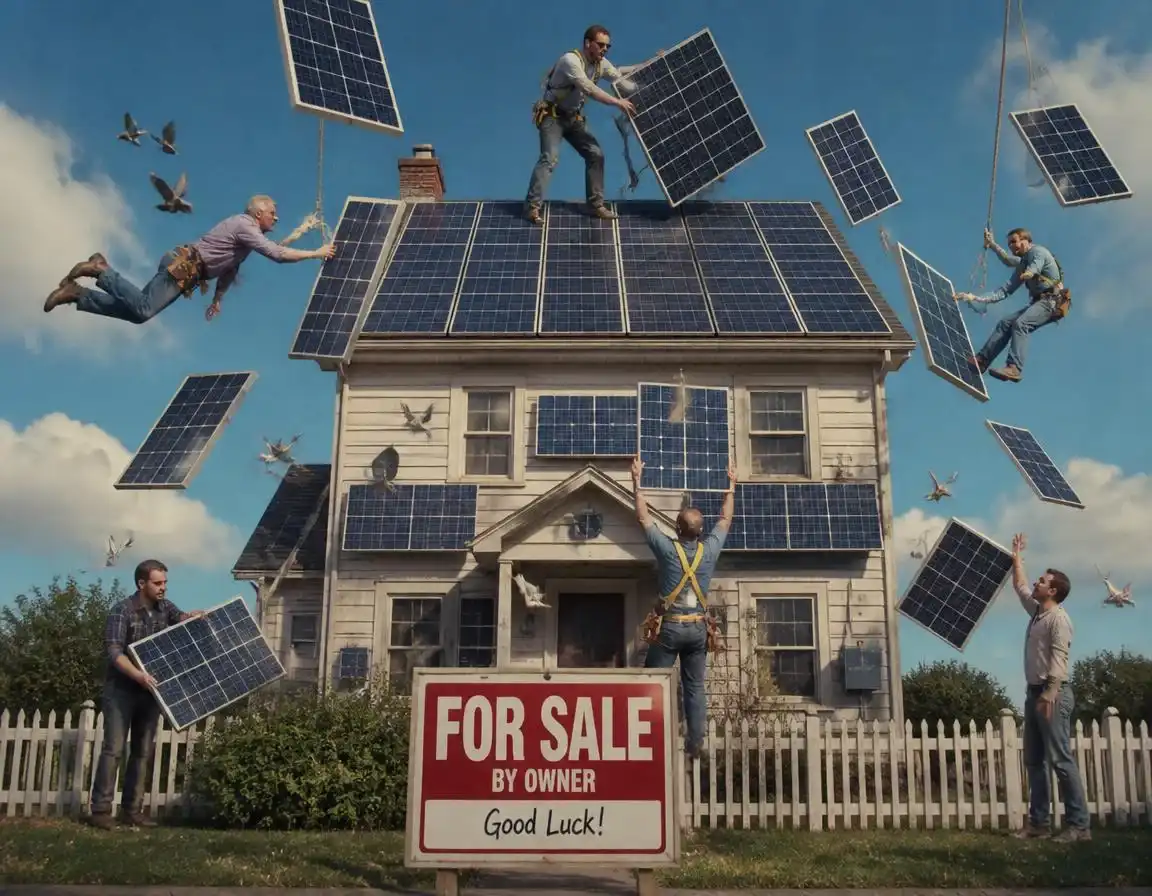
The ‘Free’ Solar Panels That Could Stop You Selling Your House

If someone offered you free solar panels sometime between 2010 and 2015 and you said yes, there’s a decent chance you signed away more than you realised. Here’s what “rent-a-roof” actually means for a sale or remortgage today, and exactly how to sort it.
What “Free Solar Panels” Actually Meant
For a good few years, “free solar panels” was a genuinely real offer on UK doorsteps, and it wasn’t a scam in the way we’d usually mean that word today. A company would fit a full solar system on your roof at no cost to you at all — no upfront payment, no loan, nothing. In return, you signed a lease, usually for 25 years, that let the company keep the roof space and, crucially, keep the generous Feed-in Tariff (FIT) payments the government was paying out at the time for every unit the panels generated. You got cheaper electricity; they got the subsidy income, which back then could genuinely be worth more than the system cost to install.
That lease is the whole story. It wasn’t a lease on your house — it was a lease on the airspace above your roof, and it got registered against your property’s title (at HM Land Registry in England and Wales, or the Land Register of Scotland north of the border), the same way any other lease would be. Which means it doesn’t go away when you decide to sell. It follows the house, exactly like a ground rent or a right of way would.
The date matters more than almost anything else here. This model was most active between 2010 and 2015. If your panels went in from around 2016 onwards, they’re very likely owned outright — the free-panels-for-your-FIT-income business had largely disappeared by then, once the subsidy rates that made it profitable were cut back.
2010: The Feed-in Tariff launches
Generous, government-guaranteed payments for solar electricity make “free panels in exchange for the subsidy” a viable business model for the first time.
2010–2015: Rent-a-roof booms
Companies including A Shade Greener, HomeSun and Engensa fit hundreds of thousands of free systems across the UK under 25-year roof leases.
2019: FIT closes to new applicants
The subsidy that made the model work shuts to new applications on 1 April 2019. The free-panel offers largely disappear — but the leases already signed keep running for years.
2020s–2026: The leases start biting
As those homes come up for sale, remortgage or probate, solicitors keep finding the same old lease clauses tripping up otherwise straightforward transactions.
Why It Can Actually Block a Sale
Owning your home outright doesn’t automatically mean owning everything attached to it. If there’s a registered lease over your roof space, your buyer’s mortgage lender needs to be satisfied that lease won’t cause them a problem if they ever had to repossess the property — because a lender can’t easily repossess and sell a house with someone else’s legal rights sitting over part of it.
Most UK lenders check roof-space leases against the UK Finance Mortgage Lenders’ Handbook. In plain terms, they want to see specific protections written into the lease, most importantly a clause confirming the solar company will remove the panels for free if the lender ever needs to repossess. Older leases, especially from the earliest rent-a-roof years, often don’t include this, simply because nobody was thinking about it at the time. No compliant clause, and a lender can refuse to lend on the property until it’s sorted — which is exactly the moment a sale grinds to a halt.
It isn’t just about selling. The same issue can catch you out remortgaging, taking out equity release, or even just trying to get a straightforward buildings insurance renewal that asks about “other parties with an interest in the property.”
What It Actually Costs to Fix
The good news: a problem lease is very rarely a dead end. It’s a fixable, if slightly annoying, bit of admin — and it’s worth knowing the real numbers before a solicitor drops them on you mid-sale.
| Route | Typical cost | Typical timescale |
|---|---|---|
| Deed of Variation (bring the lease up to lender standard) | £500+VAT solicitor fee, plus a separate £180–£250 admin fee from the solar company | 2–6 weeks |
| Switch to a different lender | No extra fee, but may mean a worse rate | Days to a few weeks |
| Buy the system outright | Varies hugely by provider and years remaining on the lease — can run into five figures | Depends on negotiation |
| Do nothing and hope | Free | Until it collapses your sale at the worst possible moment |
How to Check If You’re Affected
Even if you’re nowhere near selling, it’s worth ten minutes to check now rather than finding out mid-sale in three years’ time.
- 1
Pull your title register
In England and Wales, search your address at HM Land Registry. In Scotland, use the Land Register of Scotland via Registers of Scotland instead. A rent-a-roof arrangement usually shows up as a separate registered lease over the roof or airspace, with its own title number, dated to when the panels went in.
- 2
Dig out old paperwork
Look for a Feed-in Tariff statement or annual letter in a company’s name rather than yours — that’s the clearest sign the FIT income, and likely the panels themselves, belong to someone else.
- 3
Find out who holds the lease today
Some of the original installers sold their lease portfolios on to investment companies after fitting the panels. The current holder’s name should be on your title register even if it isn’t the company that originally knocked on your door.
- 4
Get it checked properly before you list
A conveyancing solicitor can review the lease against current lender requirements in advance, so any Deed of Variation is already sorted by the time a buyer’s mortgage application lands — rather than discovered halfway through one.
Check your own title for free (or close to it). If your property’s in England or Wales, HM Land Registry’s own service lets you search property and land information, including registered leases, directly — see GOV.UK: search for property information from HM Land Registry. In Scotland, the equivalent service is run by Registers of Scotland.
Is Today’s “Free Solar” the Same Risk? No — Here’s the Difference
Worth being clear about this, because the phrase “free solar panels” still gets used a lot in 2026, and it means something completely different now. Today’s genuinely free routes — ECO4 and the Warm Homes: Local Grant — are funded through your energy supplier or local council for eligible low-income households, and the panels become yours outright. There’s no roof lease, no third-party ownership, and no 25-year contract sitting on your title. Our full breakdown of what’s currently available is in our guide to free solar panels in the UK in 2026.
If you’re paying for your own system instead, the closest thing to a “free” perk left is 0% VAT on solar panels and batteries, running until 31 March 2027 — a straightforward discount, not a lease. For the full picture on grants and funding beyond that, see our UK solar grants guide.
The rule of thumb hasn’t changed. If a deal sounds free and someone else keeps an ongoing benefit from your roof in return, ask exactly what’s registered against your property before you sign anything. Our guide to spotting solar panel scams and checking MCS installer credentials covers what a legitimate offer looks like today.
Buying a House With Solar Already On the Roof?
Everything above works both ways. If you’re the one buying a home with existing solar panels, exactly the same ownership question applies to you, just from the other side of the table. Owned systems are a genuine selling point and can even nudge up the sale price — see our piece on whether solar panels increase house value. Leased ones need the same checks before you exchange. Our full guide to buying a house with solar panels in the UK walks through exactly what to ask for from the seller’s solicitor.
The Honest Summary
- “Free solar panels” from roughly 2010–2015 usually meant a 25-year roof lease, not a gift.
- That lease is registered against your property and follows the house when you sell.
- It can delay or block a sale or remortgage if it doesn’t meet your buyer’s lender’s requirements.
- Most cases are fixable with a Deed of Variation for a few hundred pounds — it just takes a few weeks, so check early.
- Today’s genuinely free routes (ECO4, Warm Homes: Local Grant) don’t carry this risk, since you own the panels outright.



3 Comments