
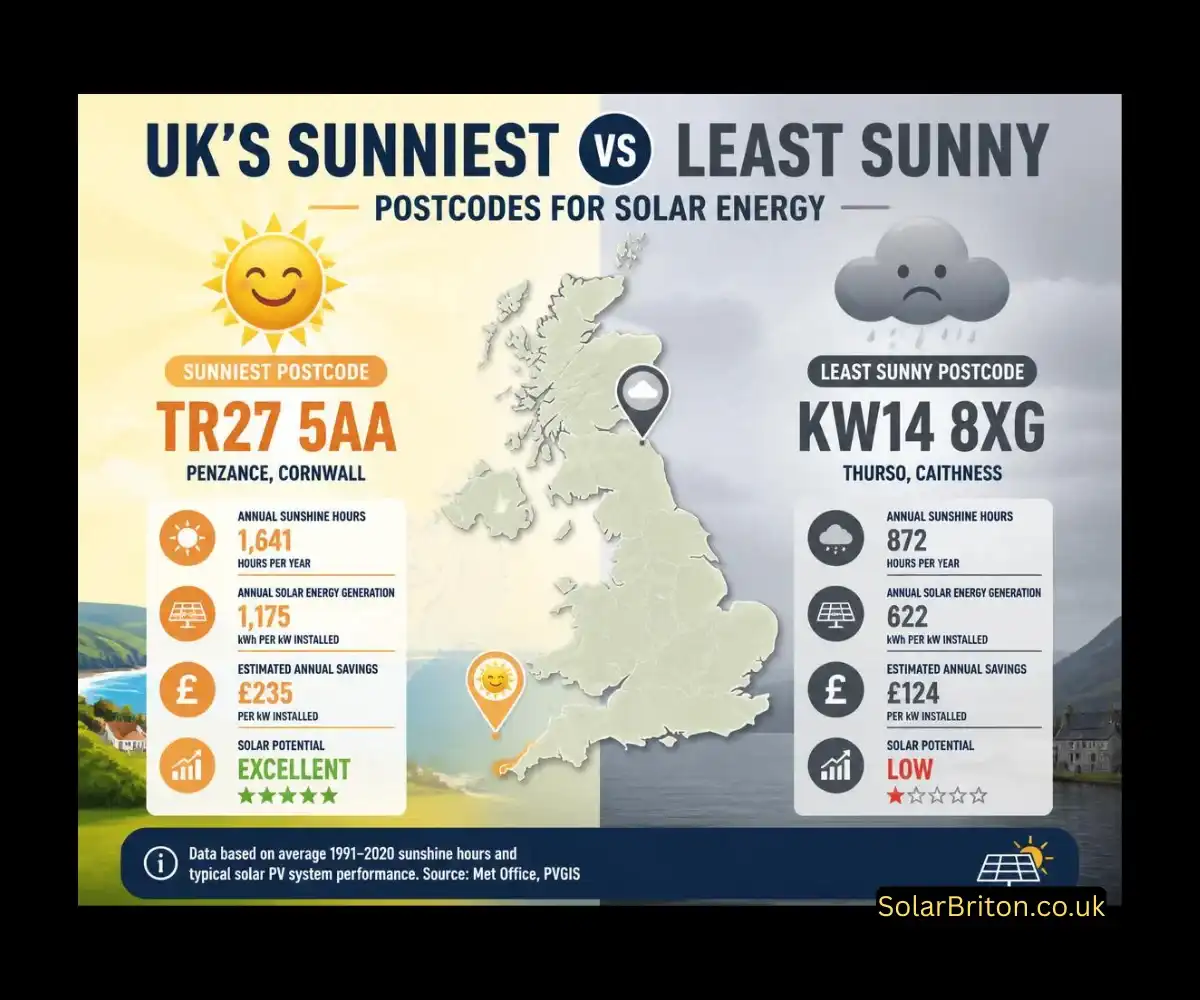
UK’s Sunniest vs Least Sunny Postcodes for Solar

Solar & UK sunshine data · 2026
The UK’s Sunniest vs Least Sunny Postcodes for Solar
I get asked “does my postcode actually get enough sun for solar?” more than almost anything else. So I pulled the official 30-year Met Office sunshine figures and turned them into an actual ranking, postcode by postcode — from the sunniest corner of the Isle of Wight right down to the Scottish Highlands.
The sunniest specific spot in the UK is Shanklin on the Isle of Wight (postcode PO37), averaging just over 5 hours of bright sunshine a day. Kent is the sunniest county on the mainland, led by Folkestone. At the other end, Inverness (IV) is the UK’s dullest city, and the Southern Uplands of Scotland are the least sunny region overall. But here’s the bit that actually matters for solar: the gap in real panel output between these places is nowhere near as dramatic as the sunshine-hours gap suggests, because panels run on daylight, not just bright direct sun.
The full ranking: UK’s sunniest postcodes
This is based on Met Office climate averages covering 1991 to 2020, the standard 30-year “climate normal” period used for this kind of comparison. Figures are average daily sunshine hours, converted to an approximate annual total.
| Rank | Location | Postcode area | Avg. daily sunshine | Approx. annual hours |
|---|---|---|---|---|
| 1 | Shanklin, Isle of Wight | PO37 | 5h 08m | ~1,875 |
| 2 | Folkestone, Kent | CT19/20 | 4h 47m | ~1,745 |
| 3 | Hastings, East Sussex | TN34/35 | 4h 46m | ~1,740 |
| 4 | Bognor Regis, West Sussex | PO21/22 | 4h 42m | ~1,715 |
| 5 | Southend area, Essex | SS | 4h 35m | ~1,675 |
| 6= | Suffolk coast (Ipswich/Lowestoft) | IP/NR | 4h 34m | ~1,665 |
| 6= | Dorset (Bournemouth/Weymouth) | BH/DT | 4h 34m | ~1,665 |
| 8 | Hampshire (Southampton) | SO | 4h 32m | ~1,655 |
| 9= | Surrey | GU/KT | 4h 29m | ~1,635 |
| 9= | Cornwall | TR/PL | 4h 29m | ~1,635 |
Postcode areas shown are the district(s) covering the town or headline location named in the underlying Met Office/press analysis, not an exact match to every postcode within a wider county.
| Notable mentions | Postcode area | Avg. daily sunshine | Why it matters |
|---|---|---|---|
| Bridlington, East Yorkshire | YO | 4h 16m | Best sunshine anywhere in the North of England |
| Barry, Wales | CF62/63 | 4h 28m | Wales’ sunniest spot, 11th in the full UK ranking |
| Dundee, Scotland | DD | 4h 01m | Scotland’s sunniest city |
| Least sunny | Postcode area | Avg. daily sunshine | Approx. annual hours |
|---|---|---|---|
| Inverness, Scotland | IV | 2h 53m | ~1,055 |
| Southern Uplands region, Scotland | — | Lowest sunshine of any UK region overall | |
Where does your area sit on the scale?
IV
DD
YO
TR
PO21
PO37
Positions are approximate, scaled between the UK’s least and most sunny recorded locations.
Sunshine hours aren’t the same as solar output
Here’s the bit that changes how you should actually read that ranking. “Sunshine hours” is a specific Met Office measurement of time when sunlight is strong and direct enough to be classed as bright sunshine. Solar panels don’t need that. They convert both direct sunlight and diffuse daylight, the soft light coming through cloud, into electricity. That’s exactly why places with fewer recorded “sunshine hours” still generate a genuinely useful amount of solar power across the year.
The honest takeaway: even a “least sunny” UK postcode is nowhere near a dealbreaker for solar. If you want the fuller picture on this exact point, our guides on whether solar is worth it in cloudy UK and the Manchester cloudy myth go through the numbers properly.
What this means region by region
We’ve written dedicated, deeper guides for several of the regions and cities that come up most in this ranking, worth a look if yours is one of them: Cornwall, Yorkshire, the North East, Cardiff & Swansea, and winter performance in Scotland. If you’re in a city with a reputation for grey skies, it’s also worth reading why Birmingham has England’s lowest solar adoption — the reasons turn out to have less to do with sunshine than you’d think.
How to actually check your own postcode
- 1
Use this ranking as a rough guide, not a verdict — your specific roof, orientation and shading matter more than which county you’re in.
- 2
Check your roof’s aspect and pitch, since a south-facing roof in a “less sunny” postcode will usually out-generate a poorly-angled roof in a sunnier one.
- 3
Work out how many panels you’d realistically need based on your usage, not just your location.
- 4
Ask any installer for a site-specific generation estimate rather than relying on regional averages alone.
Sunshine figures referenced here are drawn from Met Office climate statistics. You can read more about how the UK’s sunniest seasons have been tracked and recorded on the official Met Office news pages.
Quick questions, straight answers
Shanklin, in the PO37 postcode district on the Isle of Wight, is the sunniest specific location in the UK, averaging around 5 hours and 8 minutes of bright sunshine a day over the 1991-2020 Met Office climate period — the only part of the country to average more than 5 hours daily. On the mainland, Kent is the sunniest county overall, with Folkestone (CT19/CT20) its brightest town.
No. Solar panels generate electricity from daylight generally, not just direct bright sunshine, so even the UK’s cloudiest regions still produce a meaningful amount of power across the year. The gap in output between the sunniest and least sunny parts of the UK is real but modest, typically in the region of 10-20%, which is far smaller than the difference in headline “sunshine hours” between those same locations.
No, and this is one of the most common mix-ups. “Sunshine hours” is a Met Office measurement of time when sunlight is strong enough to be classed as bright, direct sunshine. Solar panels convert both direct and diffuse (cloudy-sky) daylight into electricity, so a location can have relatively low recorded sunshine hours and still generate solid solar output across the year.
The short version: yes, the Isle of Wight genuinely gets more sun than Inverness — but no UK postcode is too dull for solar to make sense. Most of the country sits comfortably in the 1,100-1,600 sunshine-hour range, and the sunniest coastal pockets push higher still, while even the dullest spots generate a solid, usable amount of power year-round.



One Comment