Micro Inverter vs String Inverter UK

Not sure which solar inverter technology to go for? I’ve broken down the real costs, the shading science, the warranties, and what MCS-certified installers across the UK actually recommend — so you can make the right call for your specific roof.

If you’re in the process of getting solar quotes, you’ve probably already noticed that different installers recommend different inverter types — and some won’t even explain why. The micro inverter vs string inverter debate genuinely matters for how much electricity your system generates and how much it costs over 25 years. But the right answer isn’t the same for every home.
I want to cut through the noise here. The truth is that for most clean, south-facing UK roofs, a string inverter is perfectly fine — and paying a premium for microinverters on a simple roof is a common and unnecessary mistake. On the other hand, if your roof has chimneys, dormers, trees, or panels facing multiple directions, microinverters can genuinely earn back their extra cost through improved generation. The roof decides — not a blanket rule.
Here’s everything you need to know to make the right call.
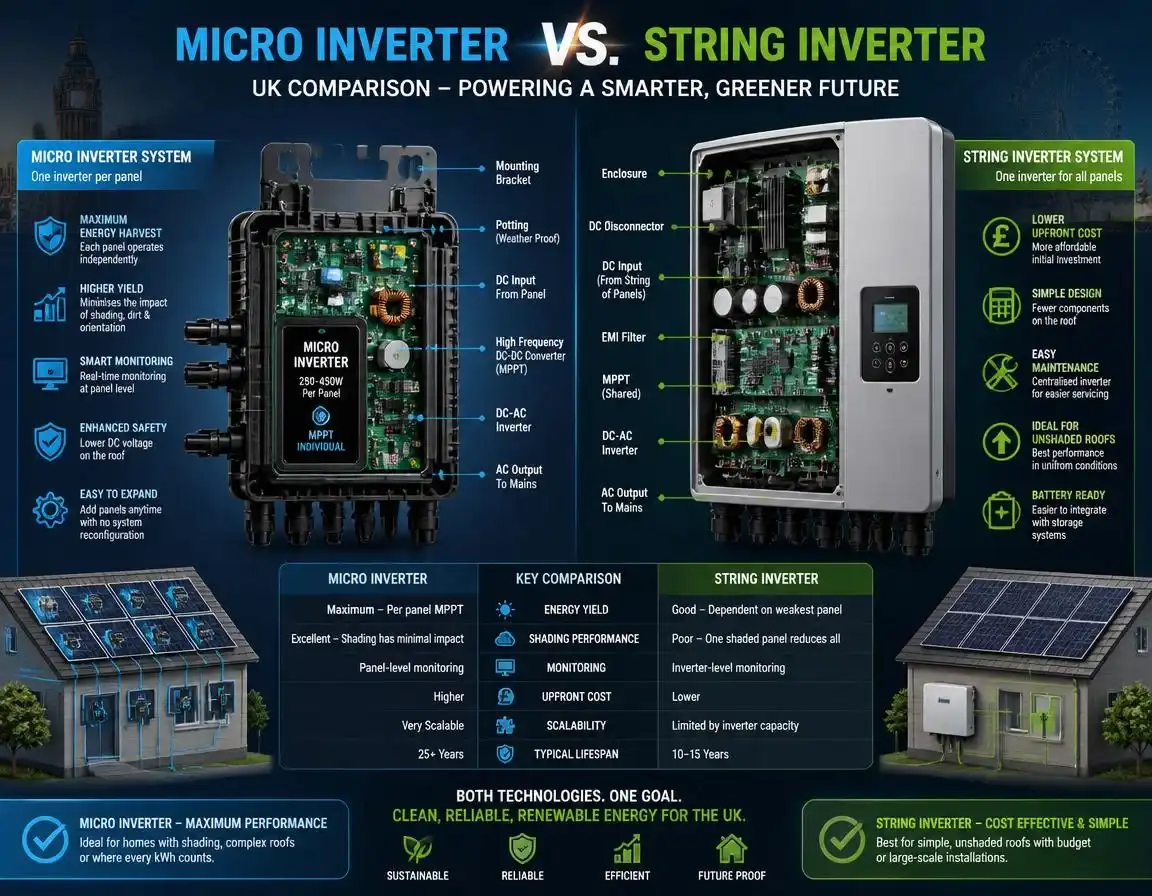
String Inverter vs Microinverter: How Each One Works
Both types do the same essential job: they convert the DC electricity your solar panels generate into the AC electricity your home actually uses. The difference is where that conversion happens, and that one distinction drives nearly every other difference between them.
String Inverter
Panels are wired together in a “string” and connected to a single central unit, usually wall-mounted in your garage, loft, or utility room. One box handles the conversion for your entire array.
- One central unit handles all panels
- Cheapest and simplest technology
- Easy to service — wall-mounted access
- Shading on one panel reduces output of entire string
- Hybrid variants add battery management in one box
- Warranty: typically 5–12 years
Microinverter
A small inverter is attached directly behind each individual solar panel on the roof. Every panel converts DC to AC independently, and the AC output is sent down a single cable to your consumer unit.
- One inverter per panel — each works independently
- Shade on one panel cannot affect the rest
- Panel-by-panel monitoring in real time
- Higher upfront cost, more units on the roof
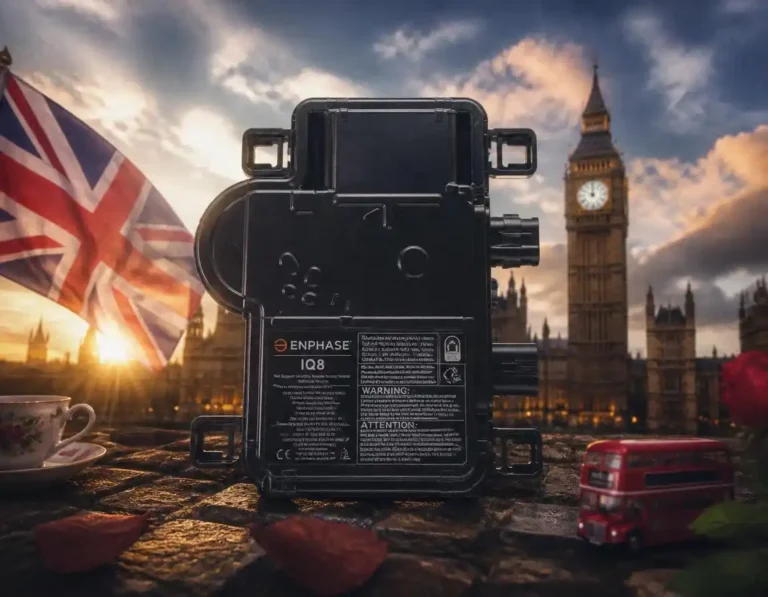
- 25-year warranty (Enphase IQ8) matches panel life
- No single point of failure for the whole system
⚠️ The “string effect” explained: With a string inverter, panels in series share the same current. Think of it like Christmas lights — if one bulb dims, the whole string dims. A single shaded panel can drag down the output of every panel connected to the same string. This is the core reason microinverters exist.
Check out our full range of solar inverters for UK homes if you want to compare specific string, hybrid and microinverter models once you’ve settled on a type.
Micro Inverter vs String Inverter — Full UK Comparison 2026
| Feature | String Inverter | DC Optimisers + String | Microinverter (Enphase IQ8) |
|---|---|---|---|
| How it works | Central conversion unit | Panel-level optimisation + central inverter | Panel-level DC-to-AC conversion |
| Unit cost (10-panel system) | £700–£1,200 | £1,400–£2,000 | £1,400–£2,000+ |
| Shading performance | Poor — entire string affected | Excellent — panel independent | Excellent — fully independent |
| Panel monitoring | System-level only | Panel-by-panel (SolarEdge app) | Panel-by-panel (Enphase Enlighten) |
| Battery integration | Easy (hybrid variant) | Good (SolarEdge Home Battery) | Complex — needs Enphase battery or extra kit |
| Warranty (equipment) | 5–12 years | Optimisers: 25yr; Inverter: 12yr | 25 years — industry-leading |
| Single point of failure? | Yes — whole system goes down | Yes — central inverter still fails | No — one panel affected only |
| Safety (DC voltage) | High-voltage DC on roof wiring | High-voltage DC on roof wiring | Low-voltage only — AC from panel |
| Roof flexibility | Limited — same string orientation only | High — any orientation | Maximum — panels on any pitch/direction |
| Servicing access | Easy — wall-mounted | Mixed — central inverter easy, optimisers on roof | Roof access required for every unit |
| Replacement at year 10–15 | Likely needed (£600–£1,500) | Central inverter may need replacing | Not required — 25-year warranty covers it |
| Best for | Clean, unshaded roof — one orientation | Partially shaded or mixed-orientation roofs | Complex/heavily shaded roofs, maximum resilience |
The Shading Problem — Why It Matters So Much in the UK

This is where the inverter debate gets genuinely important for UK homeowners. In the UK, where weather changes quickly and shading from trees, chimneys, dormers, or nearby buildings is very common, your inverter choice can significantly affect how much energy you generate over the full lifetime of the system.
Research cited by the National Renewable Energy Laboratory (NREL) shows that microinverter architectures can yield 5–25% more energy than string inverters on partially shaded arrays or roofs with mixed orientations. That range is wide because the gain depends entirely on how much shading your specific roof experiences. For a completely clean south-facing roof with zero shading, a microinverter provides essentially zero benefit over a quality string inverter — you’re simply paying more for nothing.
The key question every installer should answer at your survey: does your roof have meaningful shading between 9am and 4pm? If yes, per-panel electronics — either SolarEdge DC optimisers or full Enphase microinverters — are worth serious consideration. If no, save the money and put it towards a home battery instead.
☁️ Annual Energy Generation — String vs Microinverter (UK Roof Scenarios)
Heavily shaded roof (chimney + tree)
Heavily shaded roof (chimney + tree)
Heavily shaded roof (chimney + tree)
Clean south-facing roof, no shading
Clean south-facing roof, no shading
Indicative estimates for a 4kWp 10-panel system in central England. Shaded scenario assumes 20% of panels affected 4hrs/day. Sources: NREL research, SolarPanelsNetwork.com (May 2026), Eco Approach (April 2026).
How Much Do They Cost in the UK? 2026 Prices
Individual microinverters cost £60–£120 each in 2026. A typical 10-panel system needs £600–£1,200 in microinverter hardware alone, and installation labour adds £600–£900 due to roof-level wiring complexity. Budget string inverters from Solis or Growatt, by contrast, cost £500–£800 for a 5kW unit. The gap is real — but the full picture over 25 years is more nuanced than the upfront figures suggest.
- Budget (Solis/Growatt): £500–£800, 5-yr warranty
- Mid-range (Fronius/SMA): £1,200–£1,800, 12-yr warranty
- Hybrid variant: add £200–£400 for battery-ready
- Mid-life replacement at yr 10–15: ~£600–£1,500
- Optimiser warranty: 25 years
- Central inverter warranty: 12 years
- Central inverter still may need replacing at yr 12
- Best balance of shading performance & battery integration
- 25-year warranty — no mid-life replacement needed
- Saves £600–£1,500 in replacement costs vs string
- Extra install labour cost for roof-level wiring
- Battery integration requires Enphase battery or extra kit
💷 Lifetime Inverter Cost Over 25 Years — String vs Microinverter (UK, 2026)
Lifetime cost includes purchase + one inverter replacement for string/SolarEdge systems at year 10–15 (£600–£1,500 replacement + labour). Enphase IQ8 carries a 25-year warranty — no replacement. Estimates based on 2026 UK prices from SolarPanelsFunded.co.uk, photovoltaics.co.uk.
Warranty Comparison — The Figures That Really Matter
Inverters are the most failure-prone component of a solar system. Capacitors and switching electronics work hard, and 10–15 years is the typical reliable life of a string inverter. Planning a replacement at around year 12 is sensible budgeting — it typically costs £600–£1,500 for supply and fit. Enphase microinverters are the exception at 25 years standard — no warranty extension needed and no replacement required during the panels’ lifetime.
Source: photovoltaics.co.uk, solarinfo.uk, Solar Panels Network (2026). Always check the specific model warranty rather than brand-level figures.
The Third Option Most Articles Don’t Mention DC Optimisers

The micro vs string framing is actually a bit of a false choice — because the option that many UK installers fit most on shaded or complex roofs is neither. SolarEdge DC power optimisers give you panel-level independence (like microinverters) while keeping a central inverter on the wall (like a string system). Each panel still has a small unit attached, but it only optimises the DC output rather than converting to AC on the roof.
The practical upside: you get the shading tolerance and panel-level monitoring of microinverters, but the central inverter is wall-mounted and far easier to service. Battery integration is also simpler. The trade-off is that you still have a central inverter that may need replacing at year 12, whereas with full microinverters, the 25-year warranty covers you for the system’s entire life. For most UK residential installations on unshaded roofs, a string inverter with power optimisers offers the best balance of cost, performance, and serviceability.
Check out our guide to adding a battery to existing solar panels for the inverter compatibility checks that decide whether you can go AC-coupled or need a hybrid inverter swap.
Which Inverter Is Right for Your UK Home?
Honestly, this is the most important section. The answer is almost always determined by one thing: your roof. Here’s a clear decision framework based on what MCS-certified UK installers actually recommend in 2026:
| Your Situation | Recommended Type | Best UK Brand(s) 2026 | Why |
|---|---|---|---|
| Clean south-facing roof, no shading, want a battery | Hybrid String Inverter | Solis, Huawei, Fronius GEN24 | Best value, battery-ready from day one, no premium wasted |
| Clean roof, no shading, no battery plans | Basic String Inverter | Solis 5G, Growatt, SMA Sunny Boy | Cheapest option — simple, reliable, does the job perfectly |
| Partially shaded roof (one chimney/tree) | DC Optimisers + String | SolarEdge Home Hub + optimisers | Panel independence without full microinverter premium; easy battery add-on |
| Heavily shaded / multiple roof orientations | Microinverter | Enphase IQ8+ / IQ8M | Maximum panel independence; 10–25% more generation; 25-yr warranty |
| Want longest warranty, no mid-life replacement | Microinverter | Enphase IQ8+ / IQ8M | 25-year warranty matches panel life — true fit and forget |
| Roof expansion likely in future | Microinverter | Enphase IQ8+ | Each new panel simply gets its own microinverter — no string redesign |
| Commercial or large ground-mounted | String / Hybrid (3-phase) | Huawei SUN2000, Fronius Symo | Large arrays where string design eliminates shading issues cost-effectively |
⚡ The 2026 UK installer default: For most UK homes in 2026, a hybrid inverter is the safest default — it costs only £200–£300 more than a basic string inverter, supports battery storage from day one, and handles both G98 (under 3.68kW) and G99 (over 3.68kW) grid connections. Choose microinverters only when your roof genuinely needs them.
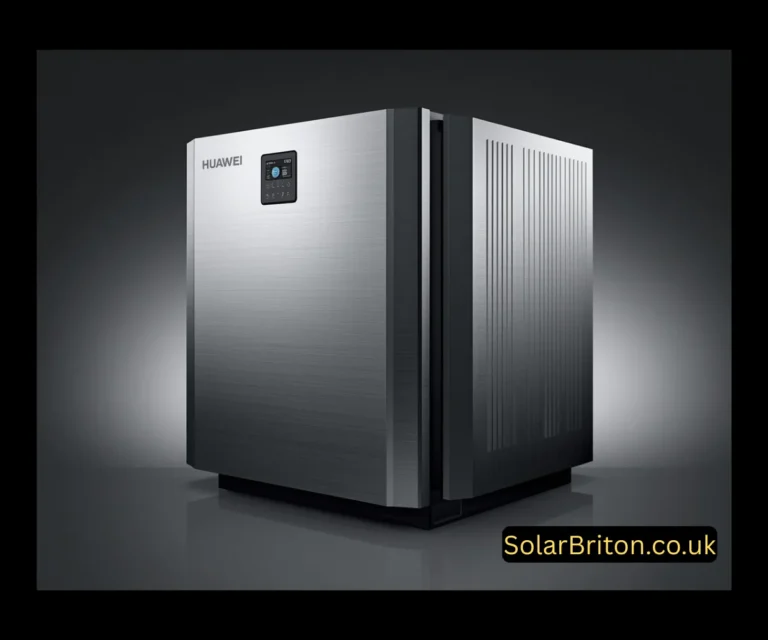
Check out our Huawei SUN2000 inverter review for the full spec sheet and the latest UK availability update before you shortlist it.
Quick Pros & Cons Summary
✅ String Inverter — Pros
- Lowest upfront cost (£500–£1,200 unit)
- Simplest installation — one wall-mounted unit
- Easy to service and replace
- Hybrid variants add battery management in one box
- Perfectly matched to clean, unshaded south-facing roofs
- G98/G99 compliant — supported by all MCS installers
⚠️ String Inverter — Cons
- Shading on one panel reduces whole string output
- Single point of failure — system down if unit fails
- High-voltage DC wiring running across roof
- Only system-level monitoring, not per-panel
- Mid-life replacement needed at year 10–15 (£600–£1,500)
✅ Microinverter — Pros
- No single point of failure — shade affects one panel only
- 25-year warranty — no mid-life replacement needed
- Real-time panel-by-panel monitoring via app
- Maximum flexibility for mixed-orientation roofs
- Low-voltage DC only — improved roof safety
- Easy future expansion — just add a panel and inverter
⚠️ Microinverter — Cons
- Higher upfront cost — ~£140/panel (Enphase IQ8)
- More units on roof — more failure points long-term
- Roof access required to service or replace a unit
- Complicates battery integration — often requires Enphase battery
- No benefit on clean, unshaded roofs — you pay a premium for nothing
Inverter Type & the Smart Export Guarantee
Whichever inverter type you choose, it needs to be MCS-certified and installed by an MCS-certified installer before you can register for the Smart Export Guarantee (SEG) — the government scheme that pays you for every unit of surplus electricity you export to the grid. Rates vary a lot by supplier, so see our SEG tariff comparison for the current best options. String inverters, microinverters, and DC optimiser systems are all eligible for SEG registration, provided the installation meets MCS standards.
Final Verdict — String or Microinverter for Your UK Home?
After going through all of this, the honest conclusion is that most UK homeowners don’t need microinverters — a quality hybrid string inverter is the smarter choice for a clean, well-oriented roof, and will perform identically for a lower upfront cost. But on a shaded roof, microinverters or SolarEdge DC optimisers can make a meaningful difference to your annual generation — and that difference pays back the premium over time.
The one area where microinverters genuinely stand out for everyone, regardless of shading, is the 25-year warranty. A 14-panel microinverter system costs £1,800–£2,500 installed in 2026, but no replacement costs accrue over 25 years — compared to string systems costing £1,400–£2,200 plus £600–£1,000 replacement expenses, totalling £2,000–£3,200 over the same period. Over a full system lifetime, microinverters are sometimes the cheaper option — even before you factor in shading gains.
⭐ Our Verdict
Clean, unshaded south-facing roof → go hybrid string (Solis or Huawei). Save the microinverter premium and put it towards a battery. Shaded or complex roof with multiple orientations → go Enphase IQ8 microinverters or SolarEdge optimisers. The 10–25% generation gain on a difficult roof makes the premium worthwhile. And if long-term warranty peace of mind matters most to you, the Enphase 25-year guarantee is genuinely hard to argue with — it’s the closest thing to fit-and-forget in the inverter market.

11 Comments