
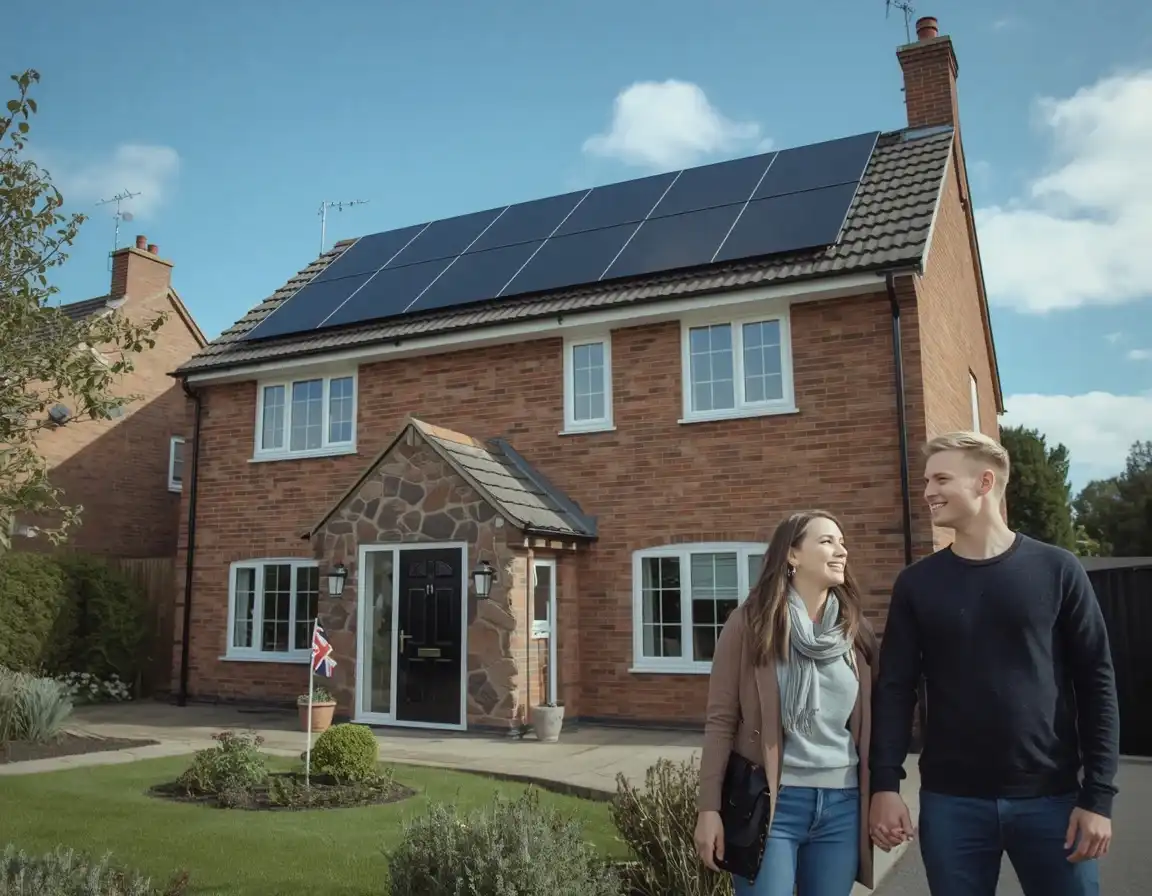
Buying a House with Solar Panels in the UK

Got your eye on a property that already has solar on the roof? Before you exchange contracts, here’s everything you need to know — from mortgage checks to earning money from the grid in 2026.
If you’re viewing a property that already has solar panels fitted on the roof, you’re in a pretty enviable position. With the UK energy price cap set to rise another 13% in July 2026 and over 1.8 million UK homes now running on solar, a house with panels already installed can mean meaningfully lower bills, a better EPC rating, and a tidy bit of extra income on the side. That said, there are a few key things you need to check before you exchange contracts. Get them right, and a solar-equipped home can be one of the smartest purchases you make this year.
Why a Solar Home Is an Attractive Buy Right Now
Solar homes have shifted from niche to normal. A 2026 E.ON-commissioned survey found that 75% of Brits would prefer to buy a new build with solar panels rather than without, and that attitude is now filtering into the wider resale market. Below is a quick summary of what buying a solar-equipped property can actually mean for your pocket.
| Benefit | What It Means for You | Typical 2026 Figures |
|---|---|---|
| 💰 Lower electricity bills | Generate free energy during daylight hours | £500–£1,400/year saved |
| 📈 Higher property value | Owned solar adds a measurable premium at resale | +2% to +6% uplift |
| ⚡ EPC rating boost | Typically improves by at least one full band | e.g. D → C, or C → B |
| 💸 SEG export income | Earn money for surplus electricity sent to the grid | £100–£400/year |
| 🔋 Battery storage bonus | Store daytime generation for evening use | Savings rise to £1,000–£1,400/yr |
| 🌱 Lower carbon footprint | Typical system offsets ~1–1.5 tonnes CO₂/year | ≈ planting 30 trees annually |
And there’s a practical perk that’s easy to overlook: because the panels are already in place, you skip the typical upfront cost of £5,000–£8,100 for a new installation. That saving more than offsets most negotiating leverage a seller might try to use.
The Most Important Question: Are the Panels Owned or Leased?
This is the question your solicitor should ask on day one — and the answer changes everything. Solar panels fitted before roughly 2015 were sometimes installed under rent-a-roof schemes, where a third-party company put panels up for free and kept the Feed-in Tariff income in return. If those lease agreements are still active, they follow the house — meaning you could unwittingly inherit a 25-year contract with a solar company you’ve never heard of.
| Factor | Panels Owned Outright ✅ | Leased / Rent-a-Roof ⚠️ |
|---|---|---|
| Mortgage approval | Generally no issue | Some lenders will refuse |
| Effect on property value | Adds 2–6% uplift | Can complicate or reduce value |
| SEG export income | Yours to keep | May belong to the solar company |
| Maintenance responsibility | Falls to you | Often covered by the lease |
| Conveyancing complexity | Low | Solicitor review is essential |
| Sale process if you re-sell | Straightforward | Risk of delays or buyer drop-off |
If the panels were installed after 2016, they’re almost certainly owned outright — the rent-a-roof model largely disappeared when the old Feed-in Tariff rates dropped. Still, always get written confirmation. For post-2016 owned systems, the MCS certificate, inverter warranty, and any Smart Export Guarantee contract should transfer cleanly to you as the new owner.
Your Pre-Purchase Solar Due Diligence Checklist
Before you reach exchange, make sure you’ve received and reviewed the following. Think of it as your solar buyer’s checklist — and don’t be shy about chasing the seller for documentation.
-
MCS Certificate. The installation must be certified by the Microgeneration Certification Scheme. Without it, you can’t register for Smart Export Guarantee payments, and the system won’t qualify for most government incentives.
-
Ownership documentation. Ask for written proof that the seller owns the panels outright — not leased to a third party. Your conveyancer should check for any charge, lease, or rights of access granted to an installation company.
-
Warranties — panels and inverter separately. Panels typically carry a 25-year performance warranty and a 5–10-year product warranty. The inverter is a separate piece of kit that often needs replacing at the 10–15-year mark, so check how much life remains on both.
-
FIT or SEG contract status. If the seller was receiving Feed-in Tariff payments (the old export scheme, closed to new applicants in March 2019 but existing contracts still run for 20–25 years), find out whether those payments can be reassigned to you via Ofgem. For the current Smart Export Guarantee, note which supplier and tariff they’re on — and at what rate.
-
Annual generation data. Ask for real generation figures from the past year or two. This tells you how much free electricity you can realistically expect, and lets you calculate genuine savings based on your own household usage.
-
Battery storage. Does the system include a home battery? A battery lifts the proportion of solar energy you actually use yourself from roughly 45% to 75–80%, which meaningfully boosts your savings and reduces what you export at lower SEG rates.
EPC Ratings, Property Value, and Green Mortgages
A solar PV system typically lifts a property’s EPC by at least one full band — and that single step can have a ripple effect on your mortgage rate, sale speed, and asking price if you later sell. Moving from EPC D to C, for example, boosts a property’s value by around 3% on average, according to a Rightmove study of 300,000 homes.
EPC Bands — Typical Solar Impact & 2026 Significance (You can check a property’s official EPC on the GOV.UK EPC Register).
Source: Standard Assessment Procedure (SAP) banding thresholds, DESNZ. A typical 4kWp south-facing system adds 6–10 SAP points on average.
Broadly, research shows that owned solar panels add £7,000–£21,000 to the value of a typical UK home. The mortgage angle matters too: with over 90 green mortgage products now available from major UK lenders, a high EPC can save you money on your borrowing, not just your energy bills. The government’s January 2026 consultation also confirmed that all privately rented homes in England and Wales must reach EPC C by October 2030 — meaning a solar-equipped home is already ahead of upcoming regulatory requirements.
The Financial Picture: What You Can Realistically Save and Earn
Assuming the panels are owned outright and in reasonable condition, here’s what a typical 4kW system means for your finances in 2026 — based on current Ofgem price cap rates of around 27.7p per kWh.
Annual Financial Value — Typical 4kWp Owned Solar System (South-Facing, 2026)
Figures are estimates based on typical UK average household usage and 2026 price cap unit rate. Actual savings vary by usage pattern, roof orientation, and tariff.
The Smart Export Guarantee (SEG) is the mechanism behind that export income. Any electricity the panels generate that you don’t use yourself gets sold back to the National Grid — and your energy supplier pays you for every unit. Rates in 2026 range from 1p to 30p per kWh depending on your supplier and tariff type. The best available fixed rate right now is E.ON Next Export Exclusive at 16.5p/kWh. You can switch your SEG supplier at any time without exit fees, so it’s always worth shopping around shortly after you move in.
Government Schemes Worth Knowing About in 2026
When you take on a solar-equipped home, you step into an existing ecosystem of UK government support. Even if the panels are already fitted, understanding these schemes means you know exactly what you can claim, transfer, or benefit from on day one.
| Scheme | What It Offers | Status |
|---|---|---|
| Smart Export Guarantee (SEG) | Paid for surplus electricity exported to the grid; 1–30p/kWh | Active ✅ |
| 0% VAT on solar installations | Zero VAT on panels, battery storage, and labour | Until March 2027 |
| ECO4 Scheme | Free solar for eligible low-income households (EPC D–G) | Until December 2026 |
| Warm Homes Plan | £15bn plan with 0% interest loans for solar & batteries; launched Jan 2026 | Rolling out ✅ |
| Feed-in Tariff (FIT) | Older export scheme; closed to new applicants March 2019 | Closed (existing contracts valid) |
Official Government Guidance
For full details on the Smart Export Guarantee — including eligibility criteria, how to register as a new homeowner with an existing solar system, and your rights around export payments — visit the official guidance at GOV.UK: Smart Export Guarantee. If you’re on a low income, you can also check your eligibility for the GOV.UK ECO4 Scheme.
Thinking of Upgrading Your Solar Setup?
If you’ve just moved in and want to add battery storage or upgrade your existing inverter, our team can help maximise your savings.
Get a Free Quote TodayFrequently Asked Questions
Do solar panels add value to a house in the UK?
Yes, and quite meaningfully. Research consistently shows that owned solar panels add between 2% and 6% to a UK property’s value. On a £350,000 home, that’s a potential uplift of £7,000–£21,000. Solar panels also improve a property’s EPC rating by at least one band, making the home more attractive to buyers and eligible for better green mortgage rates from over 90 UK lenders.
Can I get a mortgage on a house with solar panels in the UK?
If the solar panels are owned outright by the seller, getting a mortgage is generally straightforward — the vast majority of UK lenders have no issue. If the panels are leased under an old rent-a-roof agreement, some mortgage lenders may be reluctant to lend, as a third party holds rights over the property’s roof. Always instruct your solicitor to clarify ownership and check that any installation meets MCS certification and Council of Mortgage Lenders (CML) guidelines before you proceed.
What is the Smart Export Guarantee and do I inherit it when buying a solar home?
The Smart Export Guarantee (SEG) is a UK government-backed scheme requiring licensed electricity suppliers to pay homeowners for surplus solar electricity exported to the National Grid. Rates in 2026 range from 1p to 30p per kWh. When you buy a house with solar panels, existing SEG contracts can typically be transferred to you after completion — you’ll need to contact the energy supplier to update the account details. You can also switch to a better-paying SEG tariff at any time with no exit fees, so it’s worth comparing rates as soon as you’ve moved in.



2 Comments