
Solar Panels on Listed Buildings UK: What You Need to Know in 2026


Solar Panels on Listed Buildings UK: What You Need to Know in 2026
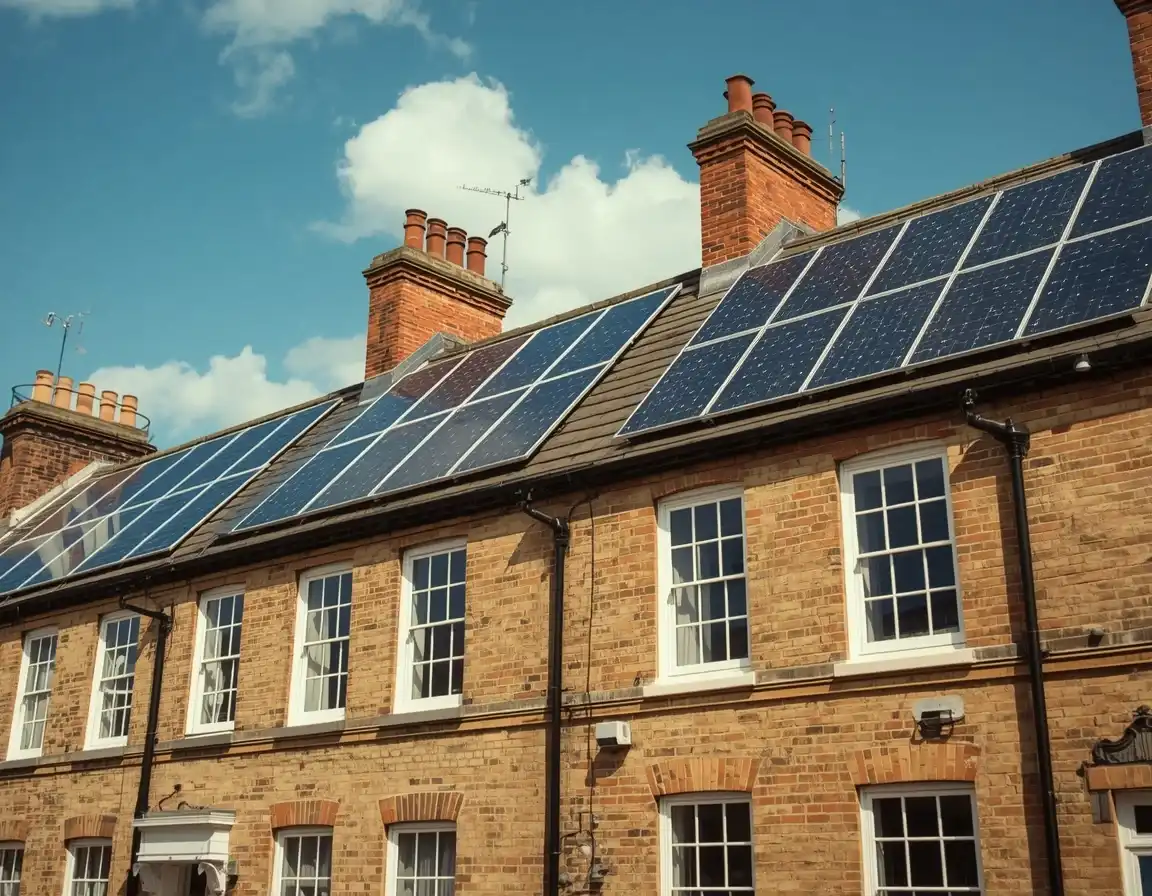
Yes, it’s possible. More listed buildings are going solar in 2026 than ever before — but the process is nothing like a standard installation. Here’s the honest picture, from consent through to costs.
Owning a listed building in the UK puts you in rare company — there are around 434,500 listed structures across England, Scotland, Wales, and Northern Ireland combined. It also puts you in a familiar spot whenever you want to make improvements: extra permissions, extra scrutiny, and a planning system built to protect what makes your building special. Going solar is no exception. But 2026 is genuinely the best year yet to consider it. Consents are being granted more readily, technology has caught up with heritage sensitivities, and the financial case has never been stronger.
The short answer: Yes, you can install solar panels on a listed building in the UK. But unlike most UK homes — where solar is straightforward Permitted Development — listed buildings work to a completely different set of rules. Historic England formally urged local planning authorities in November 2023 to approve solar on heritage properties unless it causes genuine unacceptable harm. Approvals have been climbing steadily since, and in 2026 the mood is more supportive than at any previous point.
Your Building’s Grade Changes Everything
Your listing grade is the single most important factor in determining what is achievable with solar. There are three grades in England and Wales — with equivalent tiers in Scotland (Category A, B, C) and Northern Ireland (Grade A through B2). In England, Grade II accounts for around 92% of all listed buildings and is where the vast majority of successful solar applications happen. Not sure which grade applies to your property? You can check for free using Historic England’s National Heritage List for England search tool.
| Grade | What It Means | Share of Listed Buildings | Solar Approval Rate (2026) | Practical Outlook |
|---|---|---|---|---|
| Grade I | Of exceptional interest — highest protection | ~2% | 18–25% | Very restricted; only non-visible installations considered |
| Grade II* | Particularly important, more than special interest | ~6% | 30–40% | Possible on hidden slopes with a strong, expert design argument |
| Grade II | Of special interest — by far the most common grade | ~92% | 45–60% | Most achievable — good technology choices make a real difference |
Rates reflect all submitted applications across all technology types. Well-prepared applications targeting a rear or hidden slope with sympathetic technology consistently achieve outcomes at the stronger end of these ranges. Source: industry data, 2025–2026.
The approval rates above cover all submitted applications — including poorly prepared ones and proposals that were never going to succeed. A genuinely well-prepared application on the right roof slope with the right technology consistently lands at the stronger end of those figures. Grade I isn’t hopeless either; it just means the design brief needs to be considerably tighter.
What Permissions Do You Actually Need?
This is the key difference from a standard UK home. For most residential solar installations, Permitted Development rights allow you to proceed without any planning application at all. That exemption simply does not apply to listed buildings — regardless of grade. You need Listed Building Consent (LBC) from your local planning authority before any work begins. Depending on circumstances, you may also need full planning permission alongside it, particularly if your property sits within a conservation area.
The LBC application is free in most cases and takes eight to twelve weeks to process. Complex cases involving Grade I or II* buildings can run longer if the conservation officer requests design revisions. Installing solar panels on a listed building without consent is a criminal offence. Your local authority can require removal at your own expense — and can pursue prosecution.
Don’t assume forgiveness is easier than permission. It very much isn’t. Enforcement notices on listed buildings are taken seriously, and the cost of removing an unlawful installation — plus any legal fees — far outweighs the cost of doing it properly from the start.
Pre-application consultation is the single most valuable step you can take. Book a meeting with your local conservation officer before submitting anything formally. This typically costs £200–£500 and gives you written guidance on what is and isn’t likely to be accepted — before you spend money on detailed drawings or planning fees. For Grade I and II* buildings, also contact Historic England’s free regional advice service at the same stage.
📝 What Your LBC Application Needs
- Completed Listed Building Consent form (via Planning Portal)
- Detailed drawings showing the proposed installation
- A design and access statement explaining your approach
- A heritage impact statement for Grade I and II* buildings
- Photographs of the existing roof and elevations
- Reversibility statement — confirming no permanent damage to the fabric
- Installer details and proposed equipment specifications
Six Things That Give Your Application the Best Chance
Based on successful applications across the UK in 2025 and 2026, these factors consistently make the difference between approval and refusal:
- 1Target a rear or non-principal roof slope Panels that cannot be seen from a public road or the building’s main elevation remove the visual impact argument almost entirely. Visibility is the single biggest factor in most applications.
- 2Choose in-roof mounting over conventional on-roof frames In-roof systems sit flush with the roof plane rather than projecting above it. Heritage officers view this far more favourably — and it substantially reduces the visual disruption to the roofscape.
- 3Specify matte-black panels Reflective panels attract objections. Matte-black units are significantly less visually disruptive and are specifically recommended by heritage consultants for listed building applications across all grades.
- 4Demonstrate reversibility clearly A core test for Listed Building Consent is whether the building can be returned to its original condition without lasting damage to its historic fabric. Make this explicit in your application with clear fixing details.
- 5Commission a heritage planning consultant before you apply A professionally prepared heritage statement makes a measurable difference to outcomes, particularly for Grade I and II* applications. The upfront cost is a fraction of what a failed application and resubmission costs.
- 6Consider ground-mounted alternatives If the building’s roof presents real difficulties, a system installed in the grounds or garden of the listed property often receives a considerably warmer reception from planning officers — and can be just as productive.
Choosing the Right Solar Technology for a Listed Building
What you specify signals how seriously you have engaged with the building’s character — and planning officers notice. Not all solar technology carries the same weight in a heritage context.
| Technology | Visual Profile | Heritage Acceptability | Cost vs Standard Panels | Best Used When |
|---|---|---|---|---|
| Standard PV panels (on-roof) | Higher projection from roof | Acceptable on rear/hidden slopes only | Baseline | Hidden rear slopes; Grade II; budget-led projects |
| In-roof integrated PV | Flush with roof plane | Well received across all grades | +15–25% | Where projection is likely to be an issue; Grade II* applications |
| Solar roof tiles / slates | Replaces existing roof covering | Lowest visual impact but Historic England notes they don’t always convincingly replicate traditional materials on prominent slopes | +80–120% | Roof replacement already due; conservation areas; Grade I where roof must change anyway |
| Ground-mounted systems | No impact on building itself | Generally well received, subject to siting and landscape impact | Varies by site | Where roof installation is refused or impractical; large curtilages |
On solar tiles: Historic England’s official guidance (updated July 2024) notes that solar slates “do not usually convincingly replicate the look of traditional slates” and “would not be suitable for prominent roof slopes where panels would also be unacceptable.” They remain the best visual option on less prominent slopes — but they are not an automatic heritage-friendly solution for all situations.
What Does It Cost — and Is It Worth It?
Installing solar on a listed building costs more than on a standard home — primarily because of heritage consultancy, pre-application fees, and the likelihood of specifying more sympathetic technology. Here’s what to expect in 2026.
The 0% VAT on solar panels and battery storage applies equally to listed buildings — saving up to £2,400 on a full system with battery — and runs until at least March 2027. The Smart Export Guarantee, ECO4 (closing December 2026), and the Warm Homes Plan are also all available to listed building owners on exactly the same terms as standard homes. You are not excluded from any mainstream UK solar incentive scheme.
The Bottom Line for 2026
Going solar on a listed building is slower and costs more than on a standard home — but it is entirely achievable, particularly at Grade II. Book your pre-application consultation early, choose technology that genuinely respects the building’s character, target a rear or non-prominent roof slope, and use an MCS-certified installer with verifiable heritage experience. The financial return once you are up and running is identical to any other property.
Frequently Asked Questions
Here are the questions we get asked most often about solar panels on listed buildings in the UK. If yours isn’t covered, drop us a line at support@solarbriton.co.uk — we’re happy to help.
Sources: Historic England solar PV guidance (updated 2023–2024); GPDO Part 14, Schedule 2 (as amended); MCS installer benchmark data April–June 2026 (see our installer guide); Ofgem Q2 2026 price cap (24.67p/kWh); DESNZ 2024 grid carbon factor. Approval rate data: industry surveys 2025–2026. This article is for general information only and does not constitute planning or legal advice. Always consult your local planning authority and an MCS-certified installer before proceeding. Verify installer credentials at mcscertified.com.

3 Comments