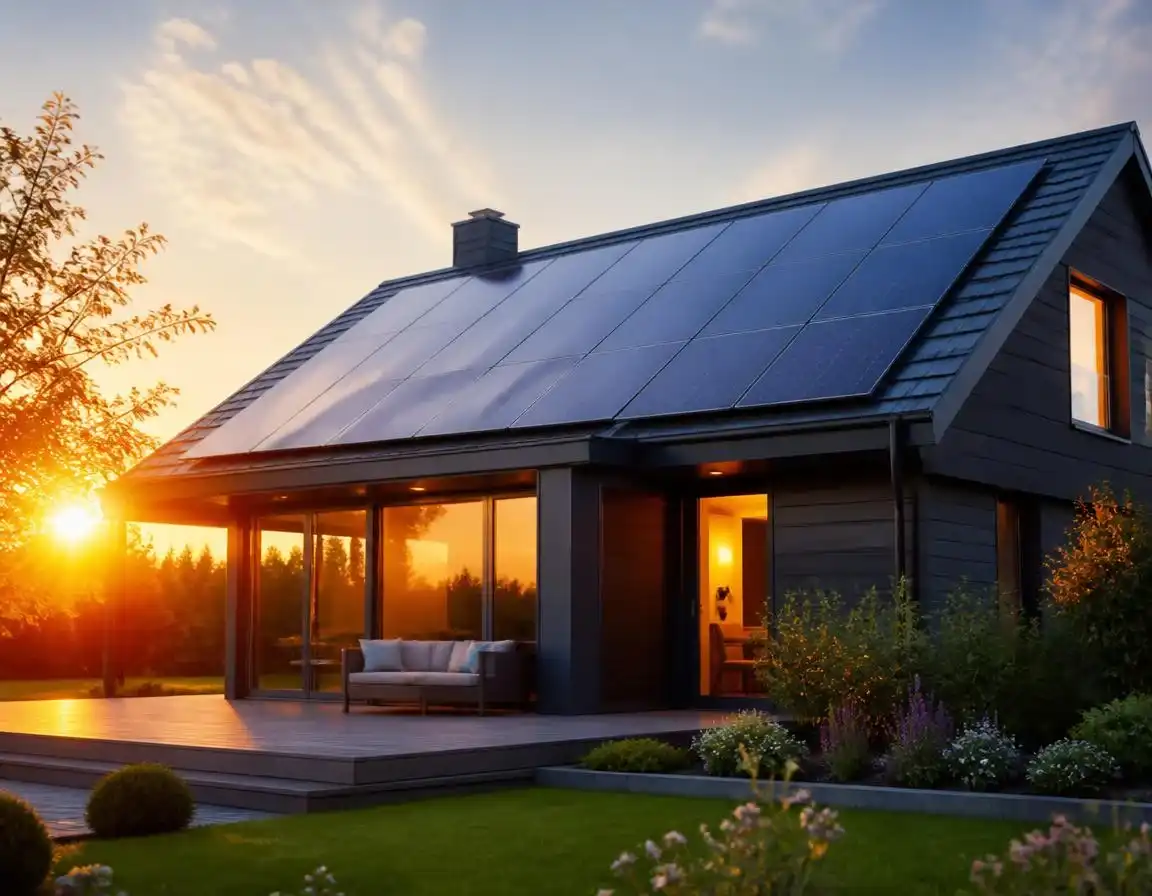
The Future Homes Standard and Your New Home

The Future Homes Standard and Your New Home: What the 2027 Solar Rule Means for Buyers
The short version
From 2027, most new homes in England will be built to the Future Homes Standard: solar panels on the roof, a heat pump instead of a gas boiler, and fabric strict enough to cut running costs sharply. Buyers get a home that exports as well as consumes — but array sizes vary, SEG registration is your job, and transition rules mean some "2027" plots escape the rules entirely. Check the paperwork, not the brochure.
Every housebuilder brochure in the country now has a paragraph about the Future Homes Standard, and almost all of them explain it to planners rather than to the people signing reservation agreements. I've spent twenty years around UK solar and heating regulation, so here's the buyer's version: what the 2027 solar rule actually puts on your roof, what it does to your bills and your paperwork, and the two traps — tiny arrays and transition dates — that catch almost everyone out.
What the Future Homes Standard actually is
Strip away the consultancy language and the Future Homes Standard (FHS) is a rewrite of the Building Regulations for England that requires new homes to be, in the government's phrase, "zero-carbon ready": far better insulation and airtightness, low-carbon heating instead of fossil-fuel boilers, and — the bit that matters here — solar photovoltaic panels as a standard fit on most new dwellings. The target is a 75–80% cut in carbon emissions compared with homes built under the current Part L rules, which were themselves uplifted in June 2022.
Two scope notes before we go further. The FHS is an England policy: Scotland, Wales and Northern Ireland set their own building standards, and Scotland's New Build Heat Standard already bans fossil-fuel heating in most new homes without mandating solar. And the FHS is not a subsidy or a grant — it's a minimum specification. Nothing is paid to you; instead, the kit arrives as part of the house you're buying, which is precisely why the handover paperwork matters so much.
The road to 2027, in six lines
| When | What happened | Why it matters to you |
|---|---|---|
| 2019 | Future Homes Standard announced, originally aimed at 2025 | Sets the direction: no more fossil-fuel-heated new builds |
| June 2022 | Part L uplift lands as the interim step | The rules most new builds on sale today were approved under |
| 2023–2025 | Repeated delays and redesign amid builder cost protests | Explains why "2025" promises became "2027" reality |
| 2025 | Consultation proposes mandatory solar PV on most new homes, plus heat pumps or heat networks as standard | The "2027 solar rule" is born |
| 2026 | Consultation response and commencement regulations worked through | Final commencement date, exemptions and transition rules confirmed here |
| 2027 | Solar requirement signalled to apply to new Building Regulations applications | With a grace-period tail for sites already registered |
The dates after 2025 are the government's signalled plan rather than carved stone, so treat 2027 as the working assumption and check the commencement regulations when your plot's paperwork arrives. The direction of travel, though, has survived three governments and a pandemic: new homes get solar and heat pumps, eventually everywhere.
What must actually be fitted
As proposed, the standard requires solar PV on the roofs of most new homes, with limited exemptions where generation is genuinely impractical — heavily shaded roofs, some conservation-area constraints, and plots where the roof area is too small to matter. Heating must come from low-carbon sources: heat pumps or heat networks in place of gas boilers, backed by fabric standards tight enough that the heat pump runs cheaply. Overheating measures come along too, because a very airtight home with big south glazing needs summer thinking as well as winter.
On cost, the argument runs both ways. Government impact work has put the additional build cost in the low thousands per home, recovered over years through lower running costs; the housebuilder lobby argues for materially higher numbers. Either way, you won't see it as a line item. It arrives inside the plot price — which is exactly why you should insist on seeing the certificates, warranties and design documents for kit you've effectively already paid for.
🏴 One-line UK map
England: FHS with mandatory solar from 2027 as proposed. Scotland: New Build Heat Standard already bans fossil-fuel heating in most new homes, but solar isn't compulsory. Wales and Northern Ireland: separate building-regulation regimes, no equivalent solar mandate at the time of writing. If your purchase is north or west of the border, this article is context, not your rulebook.
The transition trap: why some "2027" homes won't have solar
Building Regulations changes in England have always switched on by application date, not completion date. A plot whose full plans or building notice were approved before commencement is built to the old rules, and developers with large registered sites historically get a grace period to work through them. That's how Part L changes have worked for decades, and nothing in the FHS proposals suggests 2027 will break the pattern.
The practical consequence for buyers is counter-intuitive: a home completed in 2027 or even 2028 may legally be a pre-FHS home with no solar and a gas boiler, while a neighbour's plot approved a month later ships with panels and a heat pump. Developers also have a long-standing habit of rushing registrations ahead of rule changes, so expect a surge of "approved under current regulations" plots as 2027 approaches.
⚠️ The three questions that expose it
Ask the developer, in writing: which version of Part L was this plot's Building Regulations application approved under? Was the application submitted before or after the FHS commencement date? And if the home is pre-FHS, is solar offered as an optional extra — and at what price? A sales team that can't answer the first question is telling you everything about how the marketing suite handles the second.
The handover pack checklist
When your FHS home completes, the solar and heating kit should arrive with a paper trail. Here's what I'd refuse to complete without:
| Document | Why you need it |
|---|---|
| MCS certificate for the solar installation | Without it you cannot register for Smart Export Guarantee payments, ever |
| DNO notification reference (G98/G99) | Proof the array was legally connected to the local network |
| Panel and inverter warranties, registered | Manufacturer warranties often need registration within weeks of commissioning |
| Inverter location, isolators and monitoring logins | You'll want these for any future service, upgrade or fault-finding |
| Heat pump commissioning sheet and warranty | Heat pump warranties are long but conditional on correct commissioning |
| EPC showing the as-built rating | Your honest baseline for fabric, heating and projected bills |
| Written confirmation the solar is owned outright | If a third party owns the array or its export income, that's a lease, not a feature |
That last line deserves a paragraph of its own. Some developers partner with solar subscription or lease providers, so the panels on your brand-new roof may belong to a fund with a 25-year interest registered against your title. It's the old rent-a-roof model wearing a new-build costume, and it can complicate remortgages and sales for decades. If any document mentions a roof lease, airspace agreement or third-party export entitlement, stop and read our guide to the 'free' solar panels that can stop you selling your house before you sign anything.
Bills, SEG and resale: where the money actually lands
An FHS home generates and exports, which means you become a small power station with admin duties. SEG registration is your job, not the developer's: pick a supplier, present the MCS certificate and MPAN, and have a smart meter capable of half-hourly export readings. The tariff you choose matters enormously. Current open, no-strings export tariffs start from as little as 3p/kWh, while the best fixed and customer-tied deals reach up to around 32p/kWh — our 2026 ranking of the best SEG tariff rates has the live table.
What 1,500 kWh of annual exports earns by tariff type
Rate range from our own 2026 SEG tariff comparison. A modest 2–3 kWp developer array on a well-used home can export well over 1,500 kWh a year, so the gap between lazy and diligent tariff choice is real money.
On the bill side, the combination of tight fabric, a heat pump and your own generation is where the FHS earns its keep: daytime generation covers household load and hot-water top-ups, and exports pay for the surplus. With import prices sitting in the mid-to-high twenties pence per kWh in 2026, every self-consumed unit is worth roughly four to five times what the same unit earns exported — which is the argument for running dishwashers, washing machines and EV charging in daylight hours, exactly as we explain in our payback period guide.
Resale is the quieter win. Owned solar now reads as a feature rather than a complication: over 2 million UK homes have it, and a 2026 E.ON-commissioned survey found three-quarters of Brits would rather buy a new build with panels than without. For anyone buying to let, the direction of travel is blunter still — privately rented homes in England and Wales are headed for a minimum EPC C by October 2030, and an FHS home starts life comfortably ahead of that line. Our guide to buying a house with solar panels covers the checks from the other side of the table.
When the array is too small — and what upgrading costs
Here's the complaint I expect to hear most from 2027 onwards: "my new build came with six panels and a heat pump, and it's not enough." Minimum-spec compliance produces minimum-spec arrays, and a 1.5–2 kWp roof on a four-bedroom house with an EV will feel thin by year two. The good news is that FHS homes are usually easier and cheaper to upgrade than older stock, because the fabric, wiring routes and often the inverter headroom are already modern.
- Add panels where roof space and the DNO notification allow — extending an existing array is routine work for MCS installers.
- Fit microinverters or optimisers if shading or mixed roof planes are wasting part of the array.
- Add a battery to lift self-consumption from roughly half your generation to around four-fifths, typically for £3,000–£5,000 installed.
- Time it inside the VAT window. Domestic solar and battery installation carries 0% VAT until 31 March 2027 under the government's VAT energy-saving materials relief, reverting to 5% afterwards. On a £4,000 battery that's hundreds of pounds for choosing your quarter wisely — our grants and VAT guide tracks the current position.
✅ The buyer's version of due diligence, in one line
Before you reserve: get the Part L approval date, the proposed array size in kWp, the MCS certificate commitment and the heating specification in writing. Four numbers and one certificate turn the Future Homes Standard from a brochure slogan into something you can actually hold a developer to.
Frequently asked questions
Will every new home built from 2027 have solar panels?
Most, not every one. The Future Homes Standard as proposed puts solar PV on the roof of most new homes in England, with limited exemptions where generation is genuinely impractical — heavily shaded roofs, some conservation constraints, and very small plots. And because Building Regulations changes apply by application date with grace periods for already-registered sites, plenty of homes completed in 2027 and 2028 will still be built to the old rules.
I'm buying a new build now — will it meet the Future Homes Standard?
Probably not, and that isn't the developer cutting corners. The standard bites on Building Regulations applications made after commencement, so homes on sale today were approved under the current Part L rules. Ask the seller or developer which version of Part L the plot was approved under, and check the EPC: it tells you more about fabric and heating than any brochure does.
The developer's solar array looks small. Can I add to it later?
Usually yes. Roof space permitting, panels can be added, or microinverters and optimisers can squeeze more from a shaded array, and a battery lifts the share of generation you use yourself from around half to about four-fifths. The catch is timing: domestic solar and battery work carries 0% VAT until 31 March 2027, then reverts to 5%, so upgrading inside that window saves real money.
The Future Homes Standard is the first time in my career that regulation has pushed the thing I've been recommending for twenty years — a solar roof and honest heating — into the default specification. Buyers who treat it as paperwork rather than marketing will get the full benefit: a home that costs less to run, exports for profit, and sells easier when the time comes. The ones who only read the brochure will get six panels, a confused heat pump setting and a vague sense of having missed something. Be the first kind.