
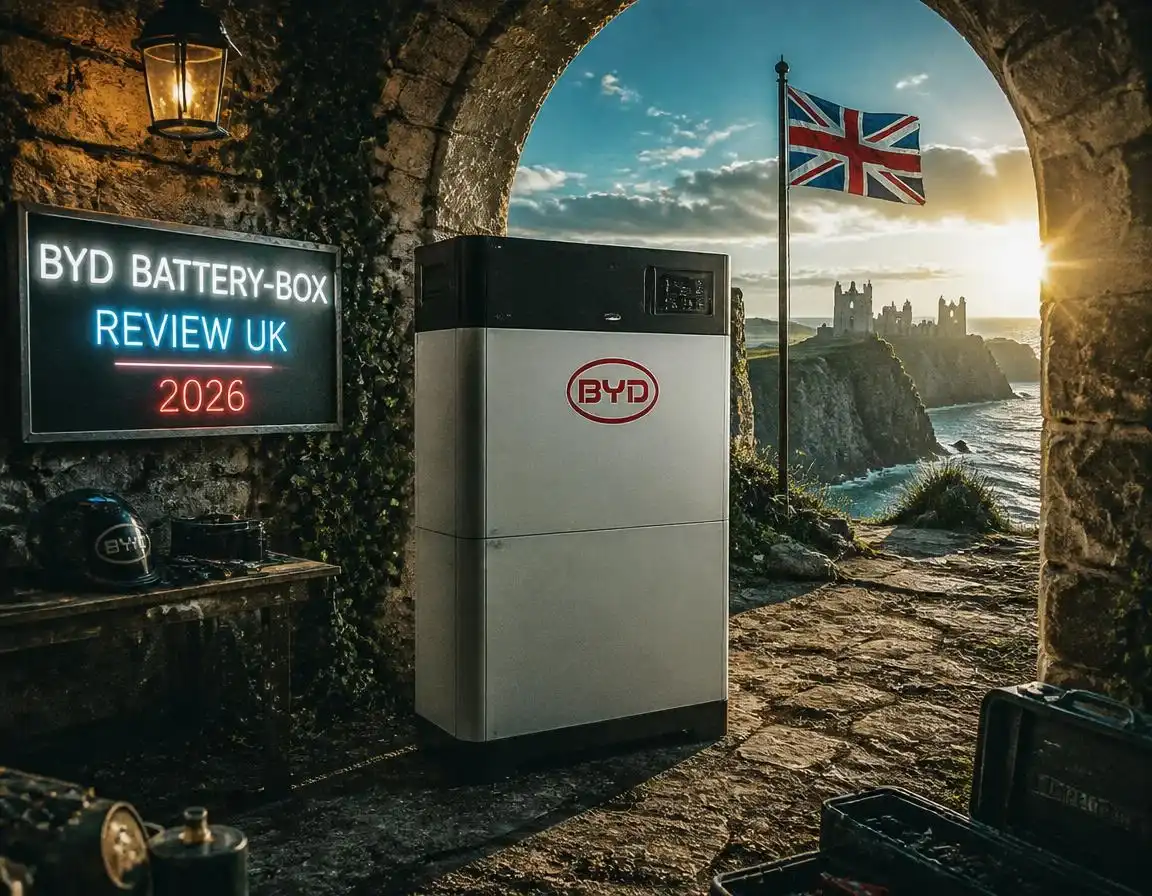
BYD Battery-Box Review UK (2026)

BYD Battery-Box Review UK (2026): HVS, HVM & HVE — Real Prices, Honest Verdict
The modular tower that installers keep recommending — but the warranty small print deserves a proper look before you sign. I’ve pulled the datasheets, the UK quotes and the throughput maths into one plain-English review.
Our verdict 4.2 / 5 ★★★★★Brilliant hardware, baseline warranty
Let me be straight with you. The BYD Battery-Box is one of the most flexible home batteries you can put on a UK wall or garage floor — modular, cobalt-free lithium iron phosphate (LFP), happy to sit outside in the rain (IP55), and it pairs with more hybrid inverters than almost any rival. Installers love it because they can size it in 2.56 kWh steps instead of forcing you into a 13.5 kWh slab.
But two things stop it being a five-star buy. First, there’s no inverter inside the box, so your whole experience — app, backup, tariff smarts — depends on which inverter it’s paired with. Second, the warranty is the industry baseline: 10 years, 6,000 cycles, 60% retained capacity, with a throughput cap we’ll unpack below. Tesla promises 70% with unlimited cycles for comparison.
Hardware: superb. Paperwork: average. That’s the review in one sentence.
Our scoring, out of 5. Overall: 4.2 / 5 — a top-tier battery you should buy with your eyes open on the warranty.
HVS vs HVM vs HVE — which one is which?
BYD sells the Battery-Box as stackable modules on a base, with a control unit (BMU/BCU) on top. The two established UK ranges are the HVS and HVM, and a newer all-in-one, the HVE, launched for European markets in 2025 with BYD’s own Power-Box inverter built in.
| Range | Module size | Stack sizes | Max setup | Best for |
|---|---|---|---|---|
| HVS | 2.56 kWh | 2–5 modules · 5.1–12.8 kWh | 3 towers parallel = 38.4 kWh | Most UK homes; the sweet spot is 7.7–10.2 kWh |
| HVM | 2.76 kWh | 3–8 modules · 8.3–22.1 kWh | 3 towers parallel = 66.2 kWh | Big homes, EVs, heat pumps, light commercial |
| HVE | 4.29 / 6.45 kWh versions | Up to 4 modules per tower · 6.4–23.6 kWh | 3 towers parallel ≈ 71 kWh | New installs wanting a single-vendor bundle |
Two rules to remember: you can’t mix HVS and HVM modules in one tower, and parallel towers must be identical. One more worth flagging on the HVE specifically: BYD backs it with a longer 15-year warranty term rather than the 10 years that applies to HVS and HVM, so don’t assume the warranty section further down applies unchanged across the whole range. If you think you’ll expand later, tell your installer now — the base, cabling and inverter sizing all depend on it.
Specs that actually matter (and what they mean)
| Spec | HVS (per tower) | HVM (per tower) | Why you care |
|---|---|---|---|
| Usable energy | 5.12–12.8 kWh | 8.28–22.08 kWh | 100% of rated — no hidden “buffer” games |
| Max output current | 25 A (peak 50 A / 5 s) | 50 A (peak 75 A / 5 s) | Roughly 5–12 kW continuous on HVS, 7.7–20.5 kW rated on HVM — genuinely high power |
| Chemistry | Lithium iron phosphate, cobalt-free | The safest mainstream home-battery chemistry | |
| Round-trip efficiency | ≥96% | Less energy lost per cycle than most 48V stacks | |
| Weather rating | IP55, −10°C to +50°C | Fine outdoors under cover; charging derates below +5°C (the BMS heater manages cold starts) | |
| Size & weight | Up to 1.41 m, 205 kg | Up to 2.11 m, 319 kg | Measure the wall or floor space — an 8-module HVM is taller than most doorways |
| Safety certs | VDE 2510-50, IEC 62619, UN38.3 | The certificates UK installers and insurers like to see | |
The headline here is power. A full HVS 12.8 tower sits at 512 V nominal, so even at a modest 25 A it can push around 12 kW continuously. That’s why BYDs cope happily with homes running an EV charger, an induction hob and a heat pump at once — something cheaper 48V batteries visibly strain at. Our battery fire safety guide explains why LFP plus these certifications makes the IP55 towers a natural fit for the locations the 2026 rules actually favour — a garage or bolted to an exterior wall — rather than tucked into a sealed cupboard or anywhere near an escape route.
Inverter compatibility: the honest list
The Battery-Box is a battery only — no inverter, no app of its own. Your monitoring, backup behaviour and tariff tricks all come from the inverter it’s bolted to. On BYD’s tested high-voltage list you’ll find the usual UK suspects: Fronius GEN24 Plus, SMA Sunny Tripower Storage, Sungrow SH-RT series and GoodWe’s ET/EH hybrids (GoodWe was actually the first brand certified for the HVM).
Now the bit most glossy reviews skip: Victron’s own compatibility page states its inverters do not work with the HVS/HVM high-voltage range — Victron pairs with BYD’s older low-voltage boxes instead. If an off-grid installer quotes you “Victron plus BYD”, ask exactly which BYD model they mean, in writing. And if you’re retrofitting onto an existing inverter, our retrofit battery guide walks through the AC vs DC-coupled decision before you spend anything.
⚠️ Golden rule: get the exact battery + inverter pairing confirmed against BYD’s current compatible-inverter list before you pay a deposit. “It’ll talk to it, probably” is not a sentence you want after parting with £6,000.
Real-world performance in a UK home
On a British roof, the Battery-Box behaves like the sensible engineer’s choice. Round-trip efficiency of 96%+ means if you store 10 kWh of midday sun, you get around 9.6 kWh back — a point or two better than most 48V stacks, and over a decade that’s real money. The high-voltage series connection is why: less current, less heat, less waste.
Cold snaps matter less than forum drama suggests. Charging derates between −10°C and +5°C, but the BMS warms the cells first, so a January morning costs you a little charging speed, not a dead battery. What you won’t get is a BYD-branded app or a built-in backup changeover — that’s your inverter’s job. Pair it with a Fronius GEN24 Plus and you get proper backup; pair it with a basic hybrid and you don’t. Same battery, two different products in practice.
On savings: a 10 kWh BYD behind a 4 kW array typically lifts self-consumption from around 40% to 75–80%, and on a time-of-use tariff like Octopus Intelligent Flux — where peak exports have hit 32p/kWh in our SEG tariff ladder — that’s the difference between a battery that saves you £250 a year and one that saves you £500+.
BYD Battery-Box UK installed prices
I pulled real 2026 UK quotes for battery-only retrofits (reusing a compatible hybrid inverter) and full new battery + inverter packages. Spread is wide, so here’s the honest band — all at 0% VAT:
| System | Usable kWh | Installed price (2026) | Notes |
|---|---|---|---|
| HVS 5.1 | 5.12 | £3,500 – £5,500 | Battery-only retrofit at the low end |
| HVS 7.7 | 7.68 | £4,500 – £6,500 | The popular 3-bed size |
| HVS 10.2 | 10.24 | £5,500 – £7,500 | Sweet spot for EV owners |
| HVS 12.8 | 12.8 | £6,500 – £8,500 | Add a new hybrid inverter: +£1,000–£1,800 |
| HVM 16.6 | 16.56 | £8,000 – £10,000 | Heat pump + EV territory |
| HVM 22.1 | 22.08 | £9,500 – £12,000 | Check floor loading & space first |
That works out at roughly £550–£650 per usable kWh installed for a mid-size HVS — competitive against a Tesla Powerwall 3 at £7,499–£10,500 for 13.5 kWh, and pricier per kWh than budget 48V stacks, which is the trade for the power output and modularity.
Rough installed £ per usable kWh, mid-size systems, 0% VAT — our working from 2026 UK quotes, not manufacturer list prices.
BYD vs Tesla vs the budget stacks
| BYD HVS 10.2 | BYD HVM 16.6 | Tesla Powerwall 3 | |
|---|---|---|---|
| Usable capacity | 10.24 kWh | 16.56 kWh | 13.5 kWh |
| Continuous power | ~10 kW | ~15.4 kW | 11.5 kW |
| Inverter | Separate hybrid needed | Built in (saves £800–£1,200) | |
| Round-trip efficiency | ≥96% | ≥96% | 97.5% |
| Warranty retention | 60% · 6,000 cycles | 60% · 6,000 cycles | 70% · unlimited cycles |
| Expandable? | Yes, modules + 3 towers | Yes, to 66.2 kWh | Extra packs only |
| Typical installed (2026) | £5,500–£7,500 | £8,000–£10,000 | £7,499–£10,500 |
Where does that leave the rest? Fox ESS and Pylontech stacks remain the value picks — see our Fox ESS H3 review — and GivEnergy, once the value favourite, entered administration in 2026, so we’re not recommending new GivEnergy kit until that story resolves. The fuller brand-by-brand picture is in our Best Solar Battery UK 2026 guide, and the Powerwall numbers above come straight from our Tesla Powerwall 3 cost breakdown.
What we love
- 100% usable LFP capacity — what it says on the tin
- Modular in 2.56/2.76 kWh steps; expand to 38.4–66.2 kWh
- High continuous power (up to 20 kW rated on HVM)
- IP55 — genuinely fine outdoors under a cover
- Wide HV inverter compatibility: Fronius, SMA, Sungrow, GoodWe
- Strong safety certs; faulty module can be replaced individually
What niggles
- No built-in inverter or app — experience depends on the pairing
- Warranty is baseline: 60% retention vs Tesla’s 70%
- Throughput cap can bite heavy cyclers (below)
- Must register within 3 months or risk the warranty
- HVS/HVM can’t mix; towers in parallel must be identical
- Big HVM stacks are heavy and over 2 m tall
The warranty small print, in plain English
For the established HVS and HVM ranges, BYD warrants the Battery-Box for 10 years or 6,000 cycles, guaranteeing at least 60% retained capacity — and, like most battery warranties, it also sets a minimum throughput energy cap. For an HVS 12.8 that cap is around 38.5 MWh of lifetime throughput, per BYD’s current limited warranty documentation.
Here’s why that number matters more than the “10 years” headline. A full daily cycle of a 12.8 kWh battery moves about 12.8 kWh through it. Do that every day and you hit the 38.5 MWh cap in a little over 8 years — before the 10-year clock runs out. Now, most UK homes don’t fully cycle daily (winter rarely fills the box), so in normal solar-plus-home use you’ll usually hit the 10 years first. But if you’re planning aggressive tariff arbitrage or export trading — cycling hard every single day — the throughput cap is the clause that ends the party early. If that’s your plan, also read how home batteries earn via virtual power plants before you commit.
And the boring line that causes most denied claims: register the battery within 3 months of installation. Ask your installer for the registration confirmation email, and keep it with your MCS certificate.
Installing, 0% VAT and the MCS bit
Installation is a one-to-two-day job for a decent crew, and the money side is genuinely kind right now: 0% VAT applies to home battery storage until 31 March 2027 under HMRC’s VAT Notice 708/6 — worth roughly £700–£1,600 on typical systems, applied automatically by legit installers. After that date the rate is expected to return to 5%, so the clock is real.
One thing to raise with your installer before the survey: since 15 April 2026, home batteries have their own chapter in the UK wiring regulations (BS 7671 Amendment 4, Chapter 57), working alongside PAS 63100:2024, and full compliance is compulsory for new installs from 15 October 2026. In practice that rules out lofts, bedrooms and escape routes, and asks for at least a metre of clearance from doors and windows outdoors. The BYD’s IP55 rating and outdoor tolerance make it a natural fit for the locations the rules actually favour — an external wall mount, a fire-separated garage or a garden enclosure — so ask your installer to confirm the siting in writing.
Use an MCS-certified installer regardless: it protects your insurance, your warranty position and any grant eligibility, and it’s the difference between a pairing that’s been checked against BYD’s compatibility list and one that’s been guessed. If your existing inverter is old, ask whether DC-coupling the BYD to a new hybrid beats an AC-coupled retrofit — we crunch that exact choice in the retrofit guide.
The bottom line
Buy the BYD Battery-Box if: you want to start modest and expand later, you run high-demand kit (EV, heat pump, induction), your installer is pairing it with a proven HV hybrid like a Fronius GEN24 Plus or SMA Sunny Tripower Storage, and you’ll keep the registration paperwork tidy.
Look elsewhere if: you want one box, one app and one warranty to deal with (that’s the Tesla Powerwall 3’s party trick), you need the absolute cheapest kWh per pound (budget 48V stacks), or you plan hardcore daily arbitrage and want unlimited cycles on paper.
Either way, get three quotes, get the pairing in writing, and enjoy the sun when it eventually shows up.
BYD Battery-Box: your questions
Is the BYD Battery-Box worth buying in the UK in 2026?
Yes, if your installer pairs it with a compatible high-voltage hybrid inverter such as a Fronius GEN24 Plus, SMA Sunny Tripower Storage, Sungrow SH-RT or GoodWe ET. You get 100% usable lithium iron phosphate capacity, IP55 outdoor rating and genuine modularity at around £550–£650 per usable kWh installed. The weak spot is the warranty: 10 years and 60% capacity retention is only industry baseline, where a Tesla Powerwall 3 promises 70% with unlimited cycles.
Can I add more BYD modules to my Battery-Box later?
Yes, and that is the best trick. An HVS tower takes two to five 2.56 kWh modules and an HVM tower three to eight 2.76 kWh modules, and you can parallel up to three identical towers for 38.4 kWh (HVS) or 66.2 kWh (HVM). You cannot mix HVS and HVM modules in one tower, and it is sensible to add modules within the first year or two so ages and firmware match — check with your installer first.
Do I need a special inverter for the BYD Battery-Box?
You need a compatible high-voltage hybrid inverter — the Battery-Box has no inverter built in, unlike a Tesla Powerwall 3. BYD’s tested list includes Fronius GEN24 Plus, SMA Sunny Tripower Storage, Sungrow SH-RT and GoodWe ET/EH series, while Victron’s own compatibility page says its units do not work with the HVS/HVM high-voltage range. Always get the exact pairing confirmed in writing before you pay a deposit.




One Comment