
AIKO Solar Panels Review UK 2026

AIKO Solar Panels Review UK 2026: Are They Worth The Premium?
AIKO solar panels are currently the most efficient residential panels you can buy in the UK — hitting up to 24.4% efficiency with their ABC (All Back Contact) technology. But they cost 10-15% more than standard Tier 1 panels. I’ve spoken to MCS installers, crunched the numbers, and tested the claims to help you decide if AIKO is worth it for your roof.
What Are AIKO Solar Panels?
AIKO Solar is a Chinese manufacturer that’s been making waves in the UK market since 2022-2023. They’re not just another me-too panel brand — AIKO holds multiple world efficiency records and uses genuinely different technology from most competitors.
What sets them apart is their ABC (All Back Contact) cell design. While most solar panels have metal busbars running across the front surface (those silver lines you can see), AIKO moves all the electrical contacts to the back of the cell. This means more of the panel’s surface area actually generates electricity.
AIKO achieved BloombergNEF Tier 1 status in 2024 and has scaled rapidly to over 20GW annual shipments. They’re publicly listed on the Shanghai Stock Exchange (their dedicated solar cell manufacturing business was built out from 2016) and financially stable — important when you’re buying into a 30-year warranty.
Want to understand how AIKO compares to other top brands? Check out our Best Solar Panels for UK Homes 2026 guide, or read our detailed Jinko Solar Panels Review to see how they stack up against the market’s most popular choice.
ABC Technology Explained
Let me break down what ABC actually means and why it matters for your UK home:
N-Type Silicon
AIKO uses N-type silicon cells rather than the older P-type technology. N-type has better voltage characteristics and lower degradation rates. It also performs slightly better in low-light conditions — relevant for those grey UK winter days.
All Back Contact (ABC)
This is where AIKO gets clever. By moving all electrical contacts to the rear of the cell, they eliminate the shading effect of front-side busbars. The entire front surface is active silicon, capturing more sunlight. The result is module efficiency of 23.6-24.4% — significantly higher than the 20.5-22.5% you get from standard TOPCon panels.
Amorphous Silicon Passivation
AIKO adds an amorphous silicon layer that reduces electron recombination, improving performance in diffuse light conditions. This matters in the UK where overcast skies dominate much of the year.
The combination of these technologies means AIKO panels generate more electricity per square metre than almost any other residential panel available in the UK. If roof space is tight, that’s valuable.
Technical Specifications
| Specification | AIKO Neostar 3S+ | AIKO Neostar 3P |
|---|---|---|
| Power Output | 460-490W | 480W |
| Module Efficiency | Up to 24.4% | 24.3% |
| Cell Technology | N-Type ABC | N-Type ABC |
| Dimensions | 1,762 × 1,134 × 30mm | 1,762 × 1,134 × 30mm |
| Weight | 24.2kg | 24.2kg |
| Temperature Coefficient | -0.26%/°C | -0.26%/°C |
| Product Warranty | 25 years | 15 years |
| Performance Warranty | 30 years | 30 years |
| Annual Degradation | ≤0.35% | ≤0.35% |
The Neostar 3S+ is the premium model with a 25-year product warranty, while the 3P offers similar performance with a 15-year product warranty. Both have the same 30-year performance warranty guaranteeing 84.8-88.85% output retention. (You may see AIKO’s warranty summarised elsewhere on this site as a flat 15 years — that’s the entry-level 3P figure; the 3S+ genuinely gets 25.)
AIKO Pricing & Value Analysis
Here’s what AIKO panels actually cost in the UK right now:
For a typical 6kWp installation (around 12-14 panels), you’re looking at a supply-cost premium of roughly £250-£450 compared to a budget Tier 1 brand like Jinko, based on the per-panel prices above — not the eye-watering gap you might assume. Labour is comparable across all brands, so that premium is almost entirely down to the panels themselves.
Is The Premium Worth It?
Let’s do the maths. An AIKO 480W panel versus a standard 440W panel gives you about 9% more power in the same physical space. On an 8-panel system, that’s an extra 120-180 kWh per year — worth £36-£54 annually at current electricity prices.
Over 25 years, that’s £900-£1,350 in additional value. Plus you get the benefit of lower degradation (0.35% vs 0.6% annually), which compounds over time. If roof space is genuinely constrained, the upgrade pays back.
Remember that solar panel installations currently benefit from 0% VAT until 31 March 2027. After that date, VAT returns to 5%. If you’re considering AIKO or any premium panels, there’s a financial incentive to act before April 2027.
Warranty & Longevity
AIKO’s warranty package is genuinely industry-leading:
For comparison, standard PERC panels typically guarantee 80% output at year 25 with 0.6% annual degradation. AIKO’s lower degradation rate means better long-term performance.
That said, I need to be honest: a 30-year corporate warranty anywhere in solar should be treated with appropriate scepticism. No one can predict what a company looks like in 2056. AIKO is financially stable now — its dedicated solar business dates to 2016, it’s publicly listed, and it’s profitable — but that’s no guarantee. This is why choosing an established MCS-certified installer matters as much as the panel brand. Many installers offer their own performance guarantees separate from the manufacturer warranty.
Real-World Performance in UK Conditions
Low-Light Performance
UK winters involve substantial diffuse irradiance. AIKO’s amorphous silicon passivation performs well in low-light conditions. The gap with standard TOPCon panels narrows in ideal conditions but widens slightly from October to February. You’ll see the benefit during those grey winter months.
Temperature Performance
AIKO’s temperature coefficient of -0.26%/°C compares favourably with standard panels at -0.34%/°C. On a hot UK summer day when panels reach 60°C (35°C above standard test conditions), AIKO loses about 8.4% efficiency versus 11.9% for standard panels — roughly 3.5% more output.
Ironically, you’re already generating more electricity than you can use on those hot summer days, so this advantage matters less than the winter performance.
Shade Tolerance
The N-Type ABC cell structure handles partial shading better than P-type at the panel level. It’s not a replacement for panel-level optimisation (like SolarEdge) on genuinely shaded roofs, but it does soften the loss on roofs with intermittent shading.
If your roof has significant shading issues, read our guide on Micro Inverter vs String Inverter to understand when you need panel-level optimisation versus when AIKO’s natural shade tolerance is sufficient.
When AIKO Makes Sense (And When It Doesn’t)
- Roof space is genuinely constrained and you need maximum kWp per m²
- You want the best possible aesthetics (no visible busbars, uniform black appearance)
- You’re planning long-term ownership (30+ years) where lower degradation compounds
- You’re building a premium specification throughout (premium inverter, battery, panels)
- You have a complex roof where fewer, higher-wattage panels simplify the install
- You have adequate roof space — adding cheaper panels delivers more total kWp
- Budget is a factor — the same money on battery storage often delivers better ROI
- You’re focused on quick payback — the panel premium typically takes 15-30 years to repay
- You’re installing on a large commercial roof where total system cost per kWh matters most
- Your roof has severe shading — you need SolarEdge optimisers regardless of panel choice
AIKO vs The Competition
| Panel Brand | Efficiency | Technology | Price/Panel | Warranty | Best For |
|---|---|---|---|---|---|
| AIKO Neostar | 24.0-24.4% | N-Type ABC | £90-£130 | 30 years | Small roofs, max efficiency |
| LONGi Hi-MO X10 | 23.8% | N-Type HPBC | £80-£100 | 30 years | Best overall value |
| Jinko Tiger Neo | 22.5% | N-Type TOPCon | £70-£100 | 12 years | Budget Tier 1 |
| REC Alpha Pure-RX | 23.5% | HJT Bifacial | £120-£160 | 25 years | Shaded roofs |
| SunPower Maxeon | 24.1% | IBC | £150-£200+ | 40 years | Premium heritage choice |
AIKO sits in an interesting position — not quite as expensive as SunPower Maxeon, but pricier than the mainstream Tier 1 brands. The efficiency is genuinely class-leading, though LONGi Hi-MO X10 comes close at 23.8%.
For most homeowners with adequate roof space, LONGi or Jinko offers better value. But if you’re trying to maximise output on a small or complex roof, AIKO’s extra efficiency per square metre is genuinely valuable.
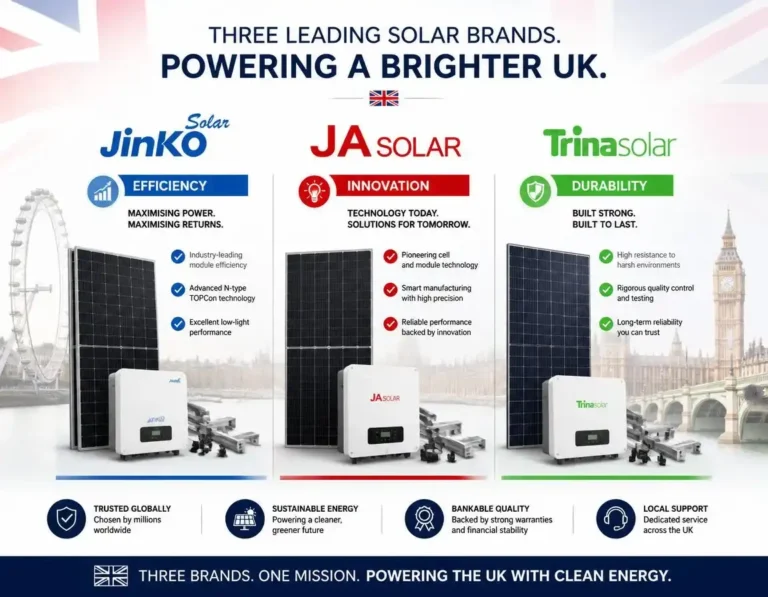
See how AIKO stacks up against other top brands in our detailed comparisons: Jinko vs JA Solar vs Trina or check out our complete guide to the best solar panels in 2026.
Final Verdict: Are AIKO Panels Worth It?
AIKO panels are genuinely impressive technology — the highest efficiency residential panels available in the UK with a best-in-class 30-year warranty. The ABC back-contact design isn’t just marketing; it delivers real performance benefits.
But here’s the thing: impressive technology doesn’t automatically mean the right choice for your roof. For most UK homes with adequate roof space, you’ll get better value from LONGi or Jinko panels and spend the savings on a bigger battery or EV charger.
AIKO makes sense when: roof space is the binding constraint, aesthetics are paramount, or you’re building a premium specification throughout. In those cases, the 10-15% premium is justified.
Frequently Asked Questions
AIKO panels are worth it when roof space is genuinely constrained — you can fit 10-12% more capacity on the same roof area compared to standard panels. They’re also worth it for premium installations where aesthetics matter (no visible busbars) and for long-term owners planning to stay 30+ years. However, if you have adequate roof space, adding cheaper panels like Jinko or LONGi usually delivers better value for money.
AIKO Neostar panels come with a 30-year performance warranty and either a 15 or 25-year product warranty depending on the model. The performance guarantee is industry-leading: panels retain at least 84.8-88.85% of original output after 30 years, with an annual degradation rate of just 0.35% after the first year.
AIKO panels achieve 23.6-24.4% module efficiency, making them the most efficient residential solar panels available in the UK in 2026. This compares to 20.5-22.5% for standard TOPCon panels from Jinko or JA Solar, and 23.8% for LONGi Hi-MO X10. The efficiency comes from AIKO’s ABC (All Back Contact) technology, which eliminates front-side busbars.
Whether you’re considering AIKO or other premium panels, always get at least 3 quotes from MCS-certified installers. Use our Find an Installer tool to locate accredited professionals in your area, and don’t forget to check our Solar Panels Cost UK 2026 guide to ensure you’re getting a fair price.


One Comment