
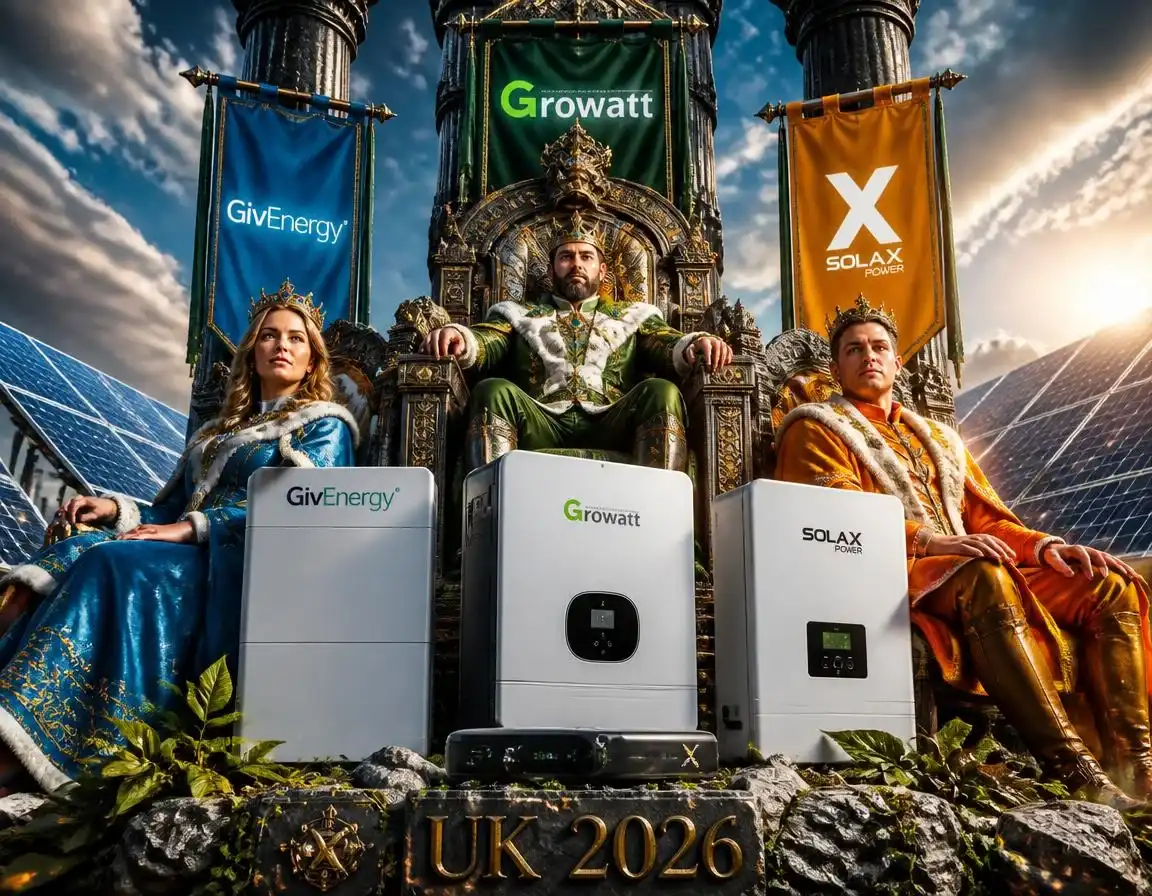
Growatt vs GivEnergy vs SolaX UK 2026: The Honest Verdict – Claude DOne

Growatt vs GivEnergy vs SolaX UK 2026: The Honest Verdict
Three brands dominate UK hybrid inverter and battery quotes — but one of them has gone into administration since you last priced things up. Here’s my no-nonsense comparison, with real 2026 prices, warranty small print and app scores.
📋 Jump to a section
⚡The 30-Second Verdict
If you only read one box on this page, make it these three cards. Everything after this is the evidence.
Growatt
The cheapest route to a decent hybrid system, with 10-year battery cover on the ARK range and UK inverter warranty cards that often read 10 years as standard. The ShinePhone app is the weak spot — but at this price, most owners forgive it.
SolaX
The X1 Hybrid G4 fixed the old firmware gripes, adds proper EPS blackout backup and 200% panel oversizing. Pair it with a Triple Power battery and the inverter warranty doubles to 10 years for free. Slightly pricier, noticeably smarter.
GivEnergy
Still the best app in the business and the hardware keeps working perfectly — but since 9 April 2026 the company can no longer honour its famous 12-year warranty. Keep yours if you own one; don’t buy one new right now.
🥊At a Glance: The Big Three
Every figure below checked against manufacturer warranty documents and current UK installer pricing, August 2026.
| Feature | Growatt | SolaX | GivEnergy |
|---|---|---|---|
| Headquarters | Shenzhen, China | Hangzhou, China (UK support hub) | Newcastle-under-Lyme, UK |
| 2026 trading status | Trading normally | Trading normally | In administration since 9 April 2026 |
| Go-to hybrid inverter | SPH 3–6 kW | X1 Hybrid G4 3–6 kW | Gen 3 hybrid 3.6–6 kW |
| Battery range | ARK HV/LV, 2.56–25.6 kWh stackable | Triple Power T-BAT, 5.8–23.2 kWh | 5.2 / 8.2 / 9.5 kWh + 13.5 kWh All-in-One |
| Battery warranty | 10 years | 10 years | 12 years — currently unenforceable |
| Inverter warranty (UK) | Up to 10 yrs standard, paid ext. to 20 | 5 yrs, free 10 yrs with SolaX battery | 5 yrs — currently unenforceable |
| Monitoring app | ShinePhone (functional, dated) | SolaXCloud (solid) | GivEnergy app (still live, best-in-class) |
| Typical 5–6 kWh battery add-on, installed | £2,500–£3,500 | £3,000–£4,000 | Not recommended for new buyers |
| Best for | Tight budgets & retrofits | Blackout backup & tidy tech | Existing owners only |
Battery add-on prices sit inside the £2,500–£4,000 range we report for 5 kWh systems across the site — Growatt at the keener end, SolaX mid-range.
⚡Inverters Head-to-Head
The inverter is the brain of your system, and this is where the Growatt vs SolaX fight is genuinely close. Growatt’s SPH hybrid series runs at up to around 97.6% efficiency, with its string inverters touching 98%+ — respectable numbers that match anything in the price bracket. SolaX’s X1 Hybrid G4 quotes 97.6% max efficiency, lets you oversize your panels to 200% of the inverter rating (handy on UK roofs where we squeeze in extra panels), and includes built-in EPS emergency backup that keeps your sockets alive in a cut.
GivEnergy’s hybrid was never the flashiest on paper, but it earned its fame as the retrofit king: happy to bolt onto an existing system of any brand without ripping anything out. If that’s your situation with another inverter already on the wall, our guide to adding a battery to existing solar panels covers exactly that job.
A hybrid inverter does four jobs at once: converts solar, charges the battery, powers the home and exports the surplus. All three brands do it — the differences live in the details below.
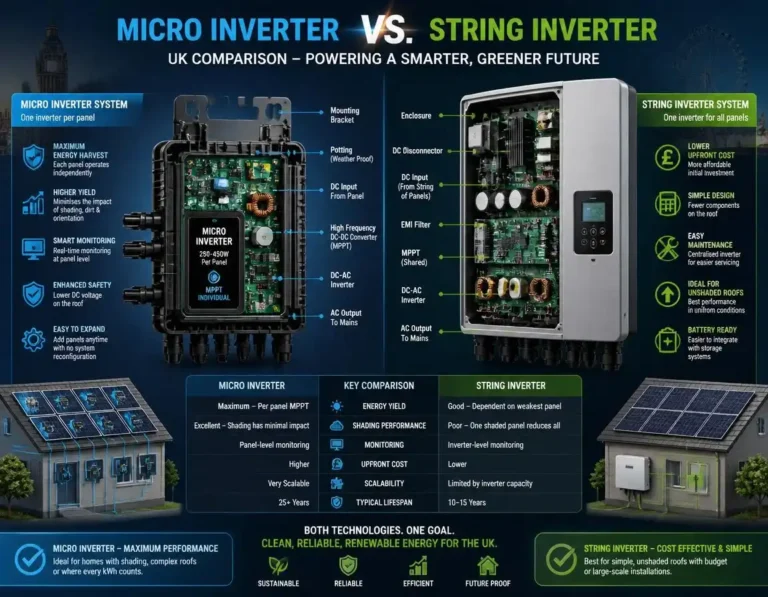
Not sure you need a hybrid at all? If your quote is panels-only, read our micro inverter vs string inverter comparison first — it changes which of these three brands even makes sense for you.
🔋Batteries, Prices & Warranties
This is the round that decides the fight, because the battery is the expensive bit. All three brands use LiFePO₄ chemistry — the safe, long-life stuff — so the real differentiators are warranty length, stacking flexibility and what happens if the company behind it wobbles.
| Popular model | Usable capacity | Warranty | Typical installed price (2026) |
|---|---|---|---|
| Growatt ARK 2.5H-A1 (HV, stackable) | 2.56 kWh per module, stack to ~10 kWh | 10 years | £2,500–£3,500 for a ~5 kWh bank |
| Growatt ARK 2.5L-A1 (48V LV) | 2.56–25.6 kWh | 10 years | From ~£2,500 |
| SolaX T-BAT-H-5.8 (Triple Power) | 5.8 kWh, expandable to 23.2 kWh | 10 years | £3,000–£4,000 |
| GivEnergy 5.2 kWh (AC-coupled) | 5.2 kWh | 12 yrs — unenforceable | No new installs recommended |
| GivEnergy All-in-One 13.5 kWh | 13.5 kWh | 12 yrs — unenforceable | No new installs recommended |
Installed prices include fitting and VAT at 0%. Larger 10 kWh setups run £4,000–£6,000 across the market.
🛡 Battery warranty, years
*On paper. Striped bar = warranty currently unenforceable after administration.
💷 Typical installed price, ~5–6 kWh
GivEnergy stock has effectively left the new-install market since April 2026.
Warranty small print worth knowing: Growatt warranty extensions must be registered within two years of installation, and SolaX’s free 10-year inverter upgrade only applies when the inverter is bundled with a SolaX battery. Miss the paperwork and you’ve quietly bought a 5-year product. Our solar warranty guide explains exactly what these documents should promise you.
📱Monitoring Apps: The Daily Driver
You’ll stare at this app more than you’ll stare at your boiler, so it matters. Here’s my honest scoring after living with all three:
⭐ Solar Briton app score (out of 10)
GivEnergy’s app is the irony of 2026: the company collapsed, yet its software — run by a separate software business that didn’t go under — remains the gold standard, with octopus-style tariff integration and granular control. SolaXCloud is clean, quick and reliable, if a touch corporate. Growatt’s ShinePhone gets the job done but feels a generation old: slow loads, clunky graphs, and a beta app that half the user base isn’t sure about yet.
App nerds (you know who you are) will enjoy our full round-up of the best solar monitoring apps in 2026, and if smart export tricks are your thing, pair any of these with our Octopus Flux vs Cosy Octopus comparison.
🚨The GivEnergy Administration: What Changed in 2026
You can’t compare these three brands honestly without addressing the elephant in the garage. Here’s the verified sequence of events:
Before this, GivEnergy was the UK’s favourite battery brand: British-made, 12-year warranty, that brilliant app. It’s why our GivEnergy battery review scored it so highly on hardware, and that same review has the full, current detail on what the administration means if you already own one. The kit itself hasn’t got worse — batteries are self-contained and keep charging and discharging without any server in the loop.
The brutal truth for new buyers: a 12-year warranty from a company in administration is a souvenir, not a promise. If you’re mid-quote for GivEnergy kit, pause and re-quote with Growatt, SolaX, FoxESS or Tesla instead. If you’ve already paid, Section 75 credit-card protection may apply, ask your card provider directly.
Already own GivEnergy? Don’t panic-swap it. The hardware works, the app works, and your installer’s workmanship warranty plus your consumer rights are still very much alive. Our solar warranty guide covers what to do if your original installer is no longer around either.
💷2026 UK Prices: Where Do These Brands Land?
Keeping this consistent with the numbers we track across the site: a typical 4 kWp solar system costs £5,500–£7,500 fully installed in 2026, and adding a battery takes the whole package to roughly £9,000–£11,500. A 5 kWh battery on its own adds £2,500–£4,000, while 10 kWh runs £4,000–£6,000. If you’ve seen a quote well north of that for a modest system, our look at what MCS data really shows about 4kW pricing is worth reading before you sign anything.
Within those bands, Growatt quotes cluster at the cheaper end — it’s the brand installers reach for when your budget is firm — while SolaX sits mid-range, a few hundred quid more for the smarter hybrid and tidier app. For context at the top of the market, a Tesla Powerwall 3 lands around £8,500–£10,500 on its own, which is why these two value brands keep winning UK roofs.
And remember the two big windfalls: 0% VAT on solar and batteries until 31 March 2027 (worth £1,000+ on a typical system), and export income through the Smart Export Guarantee, typically 3–32p per kWh depending on your supplier. That combo keeps payback periods in the 7–12 year zone for most homes.
🏆The Verdict: Who Should Buy What
There’s no universal winner — there’s a right answer for your house. Pick your persona:
💷 The budget-first retrofitter
You want the fastest payback, a 10-year battery warranty and an installer on every high street who knows the kit. You can live with a so-so app. Growatt, every day of the week.
🔌 The blackout-worrier with a smart home
You want EPS backup when the grid fails, maximum panel oversizing on a shady roof, and an app that doesn’t make you sigh. Worth the small premium over Growatt.
🫶 The loyal current owner
Keep it, love it, register every fault with your installer in writing while rights still exist. And when you expand, read our guide to adding batteries to existing panels — mixing brands is usually fine.
🤔 The comparison shopper
Shortlist all three against Tesla and Huawei using our best solar battery UK 2026 guide, then let your installer’s aftercare — not the brochure — break the tie.
🔧Installer & Safety Checks (Boring, But Saves Thousands)
A mediocre brand fitted brilliantly beats a brilliant brand fitted badly. Only use MCS-certified installers — here’s what the MCS badge actually means — and ask them which brand they stock spare parts for. A battery is a 10+ year relationship; you want the person who fits it to still answer the phone in 2031.
Two quick safety homework links before you sign anything: our home battery fire-safety checklist (where it should sit, what your fuse board needs) and, if you’re also sizing the array, our guide to solar battery storage in the UK. And if earning from your battery appeals, see how owners make money from home battery storage on flexible tariffs.
🇬🇧VAT, SEG & the Official Rules in 2026
The Government’s VAT relief on energy-saving products keeps solar and battery installs at 0% VAT until 31 March 2027, after which it reverts to 5% — the full rules live in HMRC Notice 708/6. On the export side, the Smart Export Guarantee, overseen by Ofgem, is what pays you for surplus power, currently ranging from around 3p to as high as 32p per kWh depending on supplier and tariff, and it’s why an MCS certificate isn’t optional paperwork, it’s your ticket to getting paid.
Rule of thumb: 0% VAT + a 5–10 kWh battery + a decent export tariff typically shaves 1–3 years off the standard 7–12 year payback we see across UK homes in 2026.

One Comment