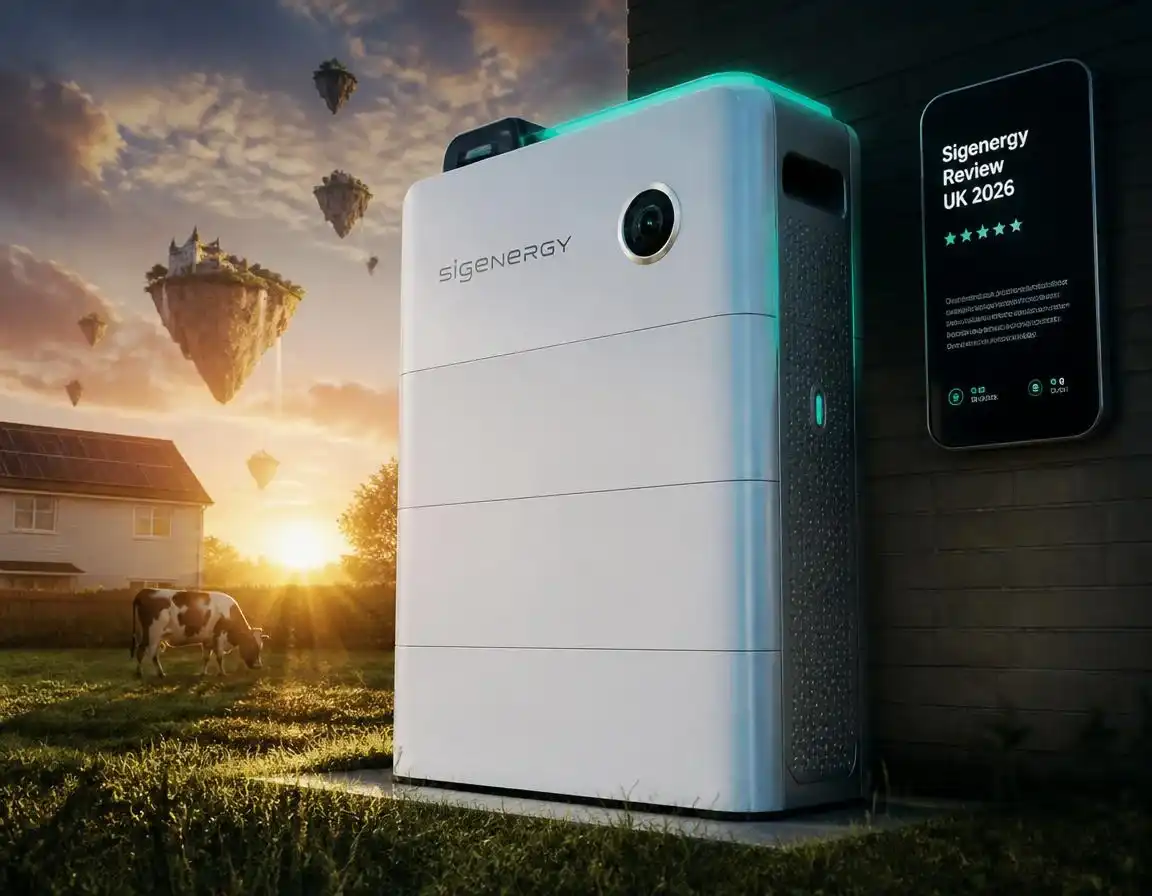
Sigenergy Review UK 2026

Sigenergy Review UK 2026: SigenStor Specs, Real Prices & Honest Verdict
Let me tell you what keeps happening in my inbox. Someone sends over two battery quotes — one Tesla, one Sigenergy — and asks why the Sigenergy one is either £2,000 cheaper or £3,000 dearer, depending on the week and the installer. The honest answer is that nobody online explains what SigenStor actually is before pricing it, so the quotes scatter all over the place. I've spent twenty years around UK solar,and Sigenergy is the most interesting new name on British walls — and the most inconsistently quoted.So here's my full 2026 verdict: the real kit, the real prices, the app, the warranty, and the one regulation change this year that quietly suits SigenStor better than most rivals.
🧩 What SigenStor actually is — one tower, five jobs
Most "hybrid" systems are a hybrid inverter plus a battery from the same brand. Sigenergy went further: SigenStor is a stack of modules that click together like building blocks. At the top sits a hybrid inverter (3–6 kW on single phase, the size that fits ordinary UK homes), below it you stack 5 kWh or 8 kWh LFP battery modules, and the same tower can take a DC-coupled EV charger and a backup controller. Solar, storage, EV charging, blackout protection and the energy-management brain in one 70 cm-wide column.
Why should you care? Because it changes how you buy. You can start with, say, 8 kWh and a 5 kW inverter, then clip on more battery modules later without new inverters, new mounting or a second app. The battery side scales from about 6 kWh usable right up to 54 kWh in a single stack, and parallel stacks go far beyond anything a house needs — this platform genuinely spans a semi in Leeds and a barn in the Borders.
💷 What Sigenergy costs installed in the UK in 2026
Here's where the internet lets you down: half the "Sigenergy price guides" quote battery-only retrofits, half quote full solar-plus-EV packages, and then act surprised that the numbers disagree by £6,000. Split the market properly and the scatter collapses into something sensible. Every figure below includes the 0% VAT that runs on UK home solar and battery installs until 31 March 2027 — on an £7,000 job that's roughly £1,400 you simply don't pay, and the official rules sit in HMRC'sVAT Notice 708/6if you fancy the small print.
| Configuration | Typical installed cost(2026) | Best for |
|---|---|---|
| Entry stack,~5–8 kWh(battery-only retrofit) | £4,500–£6,500 | Flat-shifting on a smart tariff,small homes |
| Family stack,~10–16 kWh(battery-only) | £6,000–£8,000 | 3–4 bed homes with solar |
| Full package:solar+~10 kWh+bidirectional EV charger | £10,000–£13,000 | New systems,EV households |
Mid-points of current UK MCS installer quotes;battery-only ranges cross-checked against myretrofit battery cost guide.
Read those three rows side by side and you'll spot why one installer quoted my reader £5,800 and another £12,400 for "the same" Sigenergy system — they weren't selling the same system at all.Battery-only,the SigenStor sits in the same bracket as a two-box Fox ESS stack;the full tower-with-everything package is a premium purchase and should be judged against Tesla's solar-plus-Powerwall numbers instead.
⚙️ Real-world performance: efficiency, winter and the app
The inverter module peaks at 97.8% efficiency, and owner data from UK installs shows the usual real-world pattern: a point or two off the brochure in the middle of a British January. Round-trip through the battery lands around 90–92%, which is a whisker behind Tesla's 97.5%headline figure and,on a typical bill,worth perhaps £15–£25 a year.Not a deciding factor.
Winter behaviour is more interesting.The modules condition themselves before charging in cold weather — not as aggressively as Fox's heated EP5 boxes, in my reading of owner reports, but without the cold-morning lockouts cheaper brands suffer. Where SigenStor genuinely shines is roofs that don't face one neat direction:the inverter's generous PV oversizing headroom (up to roughly double its AC rating on single phase) means you can hang panels east, west and south and let the electronics argue it out.
Then the app, because you'll live with it for a decade.The mySigen app does AI-flavoured optimisation of charging and dispatch and,in my scoring of every major monitoring app this year,it lands at a respectable 7 out of 10 — ahead of FoxESS Cloud,behind Enphase and mySolarEdge.Newer platform,smaller UK install base,occasional firmware-growing-pains;if you're a Home Assistant type, that's your escape hatch anyway.My fullmonitoring app comparisonhas the league table.
Share of your solar generation you actually use yourself
Self-consumption uplift mirrors what UK owners report for 9–13 kWh retrofits:the tariff is what turns a good battery into a great one.
⚡ Backup power and the V2L trick nobody else does
If blackout-proofing is why you're here, SigenStor is one of the very few systems I'd shortlist.The backup switchover is specified at 0 ms on the load side — UPS-grade,meaning the boiler,the Wi-Fi and the freezer simply never notice the grid has gone.That's a different league from the dedicated-circuit EPS add-ons most mid-tier brands offer, and it matches what I've said in myTesla Powerwall 3 cost reviewabout whole-home backup being a genuine Tesla strength.Here,it's a Sigenergy strength too.
Now the party piece. The DC EV charger module is bidirectional — up to 25 kW of two-way flow — so with a compatible car, your EV becomes another battery in the stack: vehicle-to-home when the sun's down,vehicle-to-load for the odd job.No other mainstream UK home system bundles this natively.One reality check before you get excited:the UK's tariff landscape for feeding power back is still embryonic — there's exactly one domestic V2G tariff you can actually join today(Octopus Power Pack),and I've covered its quirks in my V2G guide. You'd be buying the capability slightly ahead of the market.That's either foresight or wasted money, depending how long you keep the house.
🏠 The 2026 siting rules — and why IP66 matters
One thing almost every Sigenergy review online misses: the rulebook changed under your feet this year. Since 15 April 2026, home batteries sit under their own chapter of the wiring regulations (BS 7671 Amendment 4, Chapter 57), with full compliance compulsory for new installs from 15 October 2026. In plain English: no lofts, no bedrooms, no escape routes, at least a metre of clearance from doors and windows outdoors, and proper ventilation wherever it lives.
This is where SigenStor's IP66 rating quietly earns money.A weatherproof tower mounted on an external wall or in a garden enclosure is exactly the location the new rules prefer,with no indoor ventilation conversation at all.Garage installs remain fine too,with the right detection.Mybattery fire-safety guidehas every location,clearance and paperwork requirement in detail — and whatever brand you choose,get Chapter 57 and PAS 63100:2024 compliance in writing,and tell your insurer before the install,not after.
🛡️ Warranty,support and the who-still-exists question
Ten years on the SigenStor hardware,guaranteeing at least 70%of rated capacity at the end — market-standard on paper,and after GivEnergy's administration this April, "on paper" is doing heavy lifting in this sector. A warranty is only as good as the company — and the installer — behind it in year six.
Here I have to be straight with you: Sigenergy's own review pages show a recurring complaint pattern about slow manufacturer email responses and support leaning heavily on installers.That's not unusual for a young brand scaling fast, but it shapes my practical advice: choose an MCS-certified installer who answers the phone, register the warranty on day one, and keep the paperwork. Remember too that MCS certification belongs to your installation, not the hardware — it's the installer's MCS certificate that keeps you eligible for SEG tariffs, so check it the way I describe in my GivEnergy review, which is now required reading on why manufacturer balance sheets matter.
🆚 Head-to-head: SigenStor vs the 2026 field
| Feature | Sigenergy SigenStor | Tesla Powerwall 3 | Fox ESS (H1/H3 + EP5s) |
|---|---|---|---|
| Usable capacity | ~6–54 kWh (modular) | 13.5 kWh (single unit) | ≈4.7–9.3 kWh per stack |
| Chemistry | LFP ✓ | LFP ✓ | LFP ✓ |
| Warranty (active?) | 10 yrs ✓ | 10 yrs ✓ | 10 yrs ✓ |
| Installed cost (typical) | £6,000–£8,000 | £7,499–£10,500 | £5,500–£7,000 |
| Whole-home backup | Yes — 0 ms, built-in | Yes, built-in | No — EPS circuits only |
| Bidirectional EV charging | Yes — native DC V2H/V2L | No | No |
| Cold-weather charging | Self-conditioning | Self-heating ✓ | Heated modules ✓ |
| Octopus Flux | Compatible ✓ | Native ✓ | Approved ✓ |
| App polish | Good (7/10) | Excellent | Functional, laggy at times |
The pattern: Fox wins the opening quote, Tesla wins the software and the simplest life, and Sigenergy wins on flexibility — the widest modular range, the best backup spec here, and the only native bidirectional EV charging. For the Fox and Tesla detail, my Fox ESS H3 review and the Tesla cost review above have the full workings.
📊 The per-kWh truth
Installed cost per usable kWh, typical 2026 quotes
Mid-point of current UK installer quotes, 0% VAT included. Lower is better.
Read that chart twice, because it's the heart of this review.Once you compare like for like — a mid-size SigenStor stack against Tesla's single 13.5 kWh unit — the per-kWh gap everyone argues about basically disappears; the three mainstream contenders sit within £30 of each other. What you're actually choosing between is shape,not price:one big Tesla box,a grow-as-you-go Fox stack,or a Sigenergy tower that can swallow your car's battery too. And on the savings side, the game hasn't changed:at the current Ofgem cap of roughly 24.5–25p/kWh,every stored unit replacing an evening import saves about four times what it earns exported on a basic SEG tariff.MySEG rate laddershows how wide the export gap is — with a Flux-compatible battery like this one,you're aiming for the 32p rungs, not the 4p ones. On solar plus a smart tariff, I'd expect 6–9 years' payback — inside the warranty, where it should be.
✅ The verdict: who should buy Sigenergy in 2026?
Buy it if you…
- Want to start smaller and stack more battery later without re-engineering
- Genuinely value blackout proofing — 0 ms backup is the real thing
- Drive (or plan to drive) a V2H-compatible EV
- Have a messy, multi-direction roof that needs generous PV oversizing
- Need an outdoor battery — IP66 loves the new siting rules
Skip it if you…
- Want the smoothest app and the deepest UK support bench (that's Tesla)
- Need the absolute lowest entry quote(that's Fox, one EP5 at a time)
- Want heated modules for a freezing unheated garage
- Expect premium resale cachet — Sigenergy is still building its UK name
- Don't have,and won't get, solar — the maths needs it
Score it how you like; here's mine.Hardware:9/10 — a genuinely complete 5-in-1 platform with UPS-grade backup and LFP cells.Value:8/10 — per-kWh it's in the pack with Tesla and Fox, and modularity adds real option value. Software: 7/10 — good, not Enphase-good. Support: 6/10 — the hardware's reputation currently outruns the manufacturer's front line, so pick your installer like you'll need them in year five.Because you might.That caveat worn visibly on the sleeve,SigenStor is my pick for EV-owning,grow-a-system households in 2026 — and the one I'd most like to see again in a year's time.
❓ Frequently asked questions
How much does a Sigenergy SigenStor system cost installed in the UK in 2026?
Is the Sigenergy SigenStor better than a Tesla Powerwall 3?
How long is the Sigenergy warranty and what does it cover?
How I put this review together.I cross-referenced current Sigenergy SigenStor datasheets(inverter,battery,DC charger modules)against UK distributor price lists and installed quotes from MCS-certified installers,owner reports on UK forums and Trustpilot,Ofgem's 2026 price-cap data, HMRC's VAT Notice 708/6,and SolarBriton's own Tesla Powerwall, Fox ESS and GivEnergy reviews for cross-checked competitor pricing. Savings and self-consumption figures are mid-range estimates for a typical 3–4 bed home with 4 kW of solar; your roof, tariff and habits will move them. Prices verified September 2026 and include 0% VAT.