
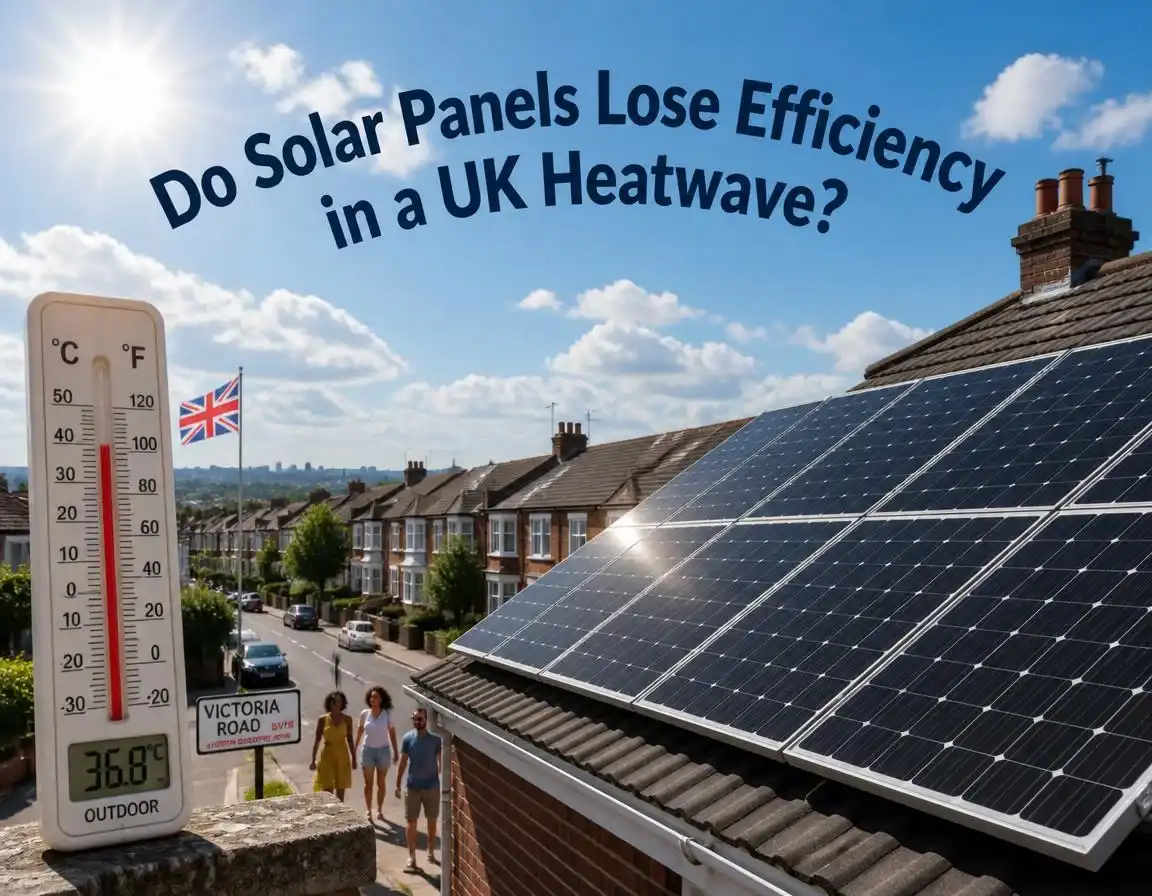
Do Solar Panels Lose Efficiency in a UK Heatwave?

Do Solar Panels Lose Efficiency in a UK Heatwave?
Short answer: a little, yes. Longer answer: not nearly enough to matter, and 2026 just proved it in the most dramatic way possible. Here’s what’s actually happening on your roof when the mercury climbs, backed by real UK generation data from this year’s run of record-breaking heatwaves.
The short version
Solar panels lose a small amount of output as they heat up past 25°C, typically 0.3–0.4% for every degree, thanks to something called the temperature coefficient. On a proper UK heatwave day, that might mean your panels run at 90–93% of their rated output rather than 100%. It’s real, but it’s nowhere near enough to explain why solar “struggles” in summer, and despite three separate heatwaves in 2026, UK solar generation hit its highest level ever recorded.
I get asked this every summer, usually the day after the news runs a story about a heatwave. People assume that if solar panels don’t like heat, then the hottest days of the year must be the worst for generation. It’s a fair guess, but it’s the wrong one. Sunlight and heat aren’t the same thing, and once you separate the two, the whole picture makes a lot more sense.
Sunlight, not heat, is what actually generates power
A solar panel converts photons hitting the cell into electricity. It doesn’t need heat to do that, it needs light. In fact, panels are tested and rated in laboratories at a fairly cool 25°C, called Standard Test Conditions (STC). That’s the number on the spec sheet you’ll see quoted in every quote you get. The problem is that a black glass panel sitting in direct sun for eight hours doesn’t stay at a cool 25°C, and that’s where the small efficiency dip comes from.
The temperature coefficient, explained properly
Every panel has a spec called the temperature coefficient, usually written as a percentage per °C. It tells you how much power output drops for every degree the panel’s temperature rises above that 25°C test point. Most panels fitted on UK roofs today sit somewhere between -0.29% and -0.40% per °C, and newer N-type cell technology tends to sit at the lower, better end of that range.
Output as a share of rated capacity, based on a typical -0.35%/°C coefficient. 60°C is a realistic panel surface temperature on a hot, still UK summer day, not the air temperature.
| Cell technology | Typical temperature coefficient | What it means in practice |
|---|---|---|
| Older mono/poly PERC | -0.38% to -0.45%/°C | Budget-tier, most heat-sensitive of current technologies |
| Standard mono PERC | around -0.35%/°C | The most common panel fitted on UK homes today |
| N-type TOPCon | -0.29% to -0.34%/°C | Increasingly the default on new 2026 installs |
| Premium N-type / HJT | -0.24% to -0.27%/°C | Best-in-class heat tolerance, usually a higher upfront cost |
If you’re comparing quotes, it’s worth asking what technology is being fitted rather than just the headline efficiency percentage, since a slightly lower-efficiency panel with a better temperature coefficient can genuinely out-earn a flashier one on a warm south-facing roof. Our Jinko vs JA Solar vs Trina Solar comparison and best solar panels for UK homes guide both go into the specific numbers for the panels installers are actually fitting this year.
Your roof gets far hotter than the weather forecast
Here’s the detail that trips most people up: the temperature coefficient is based on the panel’s own temperature, not the air temperature on the forecast. A dark glass surface sitting in direct sun absorbs heat far faster than it loses it, so on a calm, sunny day the panel can run 20°C or more hotter than the air around it. That means even a fairly ordinary 30°C day can push panel temperatures past 50°C, and a proper heatwave can take them close to 60–65°C.
🌡️ Even the UK’s hottest day on record wasn’t a problem
The UK’s official temperature record still stands at 40.3°C, recorded at Coningsby, Lincolnshire on 19 July 2022. Even allowing for panels running 20–25°C hotter than that air temperature, you’re looking at surface temperatures in the low 60s°C, comfortably below the 85°C most panels are rated to withstand. There’s no evidence of UK heatwaves causing panels to shut down or fail from heat alone.
2026 delivered three separate heatwaves and the warmest spring on record. Solar generation kept climbing anyway.
The year solar answered the question for good
2026 turned out to be the real-world stress test nobody could have planned better. By mid-July, the UK had already recorded more days above 30°C than the whole of 1976, and spring 2026 was the warmest on record for England and Wales. If heat genuinely crippled solar output, this was the year it would have shown up in the numbers. It didn’t.
Peak half-hourly UK solar generation. Source: Ember Energy analysis of National Grid ESO data, 2026.
National solar generation broke its half-hourly peak generation record eleven times in the first six months of 2026 alone, the most in a single year since 2016, hitting over 16GW for the first time ever. During the first days of the late-June heatwave, which landed right on the summer solstice, a typical UK home with rooftop solar generated around 15kWh a day, enough to run a full-house air conditioning setup for over five hours completely free. Across the UK’s 1.9 million solar homes, that’s roughly the equivalent of 10 million hours of solar-powered cooling on a single heatwave day.
None of that happens if heat genuinely knocked out solar performance. What’s really going on is straightforward: yes, each panel runs a few percent below its rated output at peak heat, but a UK heatwave also means long, cloudless days with far more total sunlight hours than a normal British summer week. The small hourly dip gets completely swamped by the extra daylight. Add in that 2025 was already a record year for new solar installs, with over 253,500 domestic systems fitted, and 2026 running even further ahead, and you’ve got more panels catching more sun for longer, heat coefficient and all.
What about your solar battery in a heatwave?
Batteries handle heat differently to panels, and it’s worth a quick word here since so many UK homes are adding storage. Lithium iron phosphate (LFP) batteries, now the standard chemistry fitted in the UK, are considerably more thermally stable than older lithium-ion chemistries and generally cope fine with a UK summer. The bigger factor is where the unit is mounted: a battery baking in direct sun inside an unventilated garage will run hotter and work its internal management system harder than one in a shaded, ventilated spot. For the full rundown on placement, clearance and what the current fire safety rules actually require, our solar battery fire safety guide covers it in detail, and our best solar battery guide breaks down which current models use LFP chemistry.
Does repeated heat shorten a panel’s life?
This is a fair question, and it’s a different one from day-to-day efficiency. Panels do go through thermal cycling, expanding slightly as they heat and contracting as they cool, day after day, year after year. Manufacturers test for exactly this under IEC 61215, which requires panels to survive 200 repeated heat cycles without meaningful damage before they’re even certified for sale. It’s why most reputable panels still carry a 25-year linear power warranty regardless of climate, guaranteeing a set minimum output all the way through. Our guide on how long solar panels actually last in the UK covers degradation rates in full, and if you’ve noticed your panels looking a bit duller than they used to, our piece on solar panel yellowing explains when that’s cosmetic and when it’s worth a call to your installer.
Do you need to do anything differently in summer?
Honestly, not much. A well-installed UK system is built with heat in mind as standard. A few things are worth knowing, though.
Check the ventilation gap behind your panels
A proper air gap between the panel and the roof lets heat escape rather than build up, and it’s standard on any competent UK install.
Keep an eye on your monitoring app
A small dip in output on the hottest afternoons is completely normal. Our guide to the best UK monitoring apps shows you what typical seasonal patterns should actually look like.
Don’t panic about your inverter
Inverters also derate slightly in extreme heat as a built-in safety feature. It’s worth checking whether yours is a string or micro inverter, since the two handle heat and shading differently.
Keep the area around ground or wall-mounted kit clear
Don’t stack anything against an inverter or battery enclosure. Airflow matters more in summer than any other season.
Check your warranty terms
Confirm your panel and inverter warranty covers performance as well as parts, so a hot summer’s output is never something you’re paying to fix.
Common questions
How much efficiency do solar panels actually lose in extreme heat?
Most panels have a temperature coefficient of around -0.3% to -0.4% per °C above 25°C. On a hot UK roof reaching 50°C, that works out to roughly 8–9% below the panel’s rated output, not the dramatic collapse people often assume.
Can a UK heatwave damage or shut down solar panels?
No. Panels are rated to operate safely up to 85°C, and even the UK’s hottest recorded day, 40.3°C at Coningsby in July 2022, doesn’t push panel surface temperatures anywhere near that limit. You’ll see a small dip in output, not damage or a shutdown.
Do UK solar panels still generate well overall during a heatwave?
Yes, and 2026 proved it. Despite three separate heatwaves and the UK’s warmest spring on record, national solar generation hit a new peak of over 16GW and broke the half-hourly generation record eleven times in the first half of the year alone, because longer, clearer days outweigh the small heat-related dip.



One Comment