
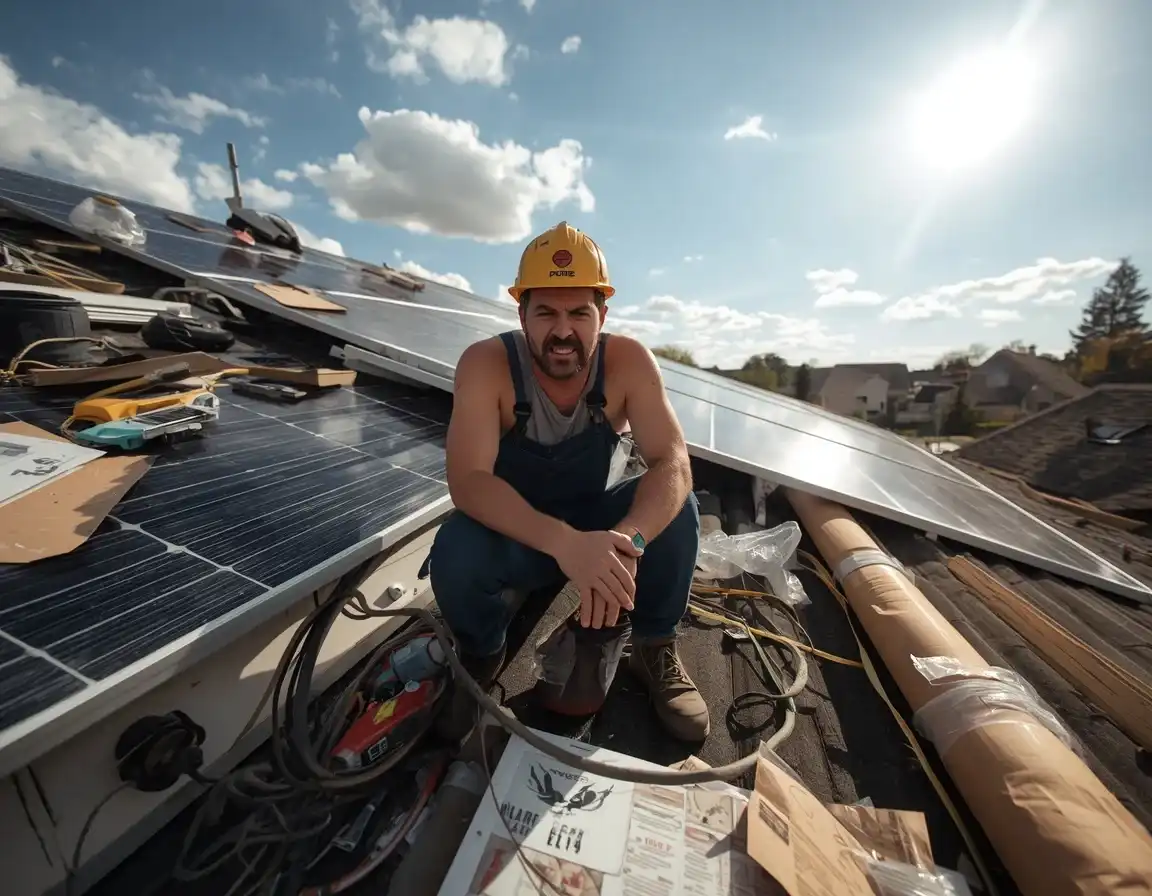
Solar Installer Gone Bust Mid-Install?

Solar Installer Gone Bust Mid-Install? Here’s Exactly What To Do
Half a roof of panels, an installer who’s stopped answering the phone, and a knot in your stomach. Here’s the calm, step-by-step plan — who to call first, how your payment method changes everything, and how to get the job finished.

Right, first things first — take a breath. I know that’s easier said than done when there’s scaffolding up, half your roof is stripped back, and the number you’ve been calling all week just rings out. But this situation is far more common than most people realise, and it’s genuinely fixable in the vast majority of cases.
UK company insolvencies have been running at a little over 50 per 10,000 companies a year recently, and construction and installation trades are consistently among the hardest hit. Solar isn’t immune — the sector had a huge surge in demand from 2022 onwards, and a fair few smaller installers who scaled up too quickly have since run into cash-flow trouble. It’s happened to well-known names too, not just small outfits, so please don’t feel embarrassed or like you should have spotted it coming.
This guide walks through exactly what to do, in order, starting with the two things you need to check within the next 24 hours. I’ll also show you how the way you paid changes your options quite dramatically — it’s the single biggest factor in how this plays out for you.
🧭 The short version
- Stop paying anything further, even if you’re being chased for the next instalment.
- Check the company’s status for free on Companies House — administration and liquidation aren’t the same thing.
- Work out how you paid — credit card, finance, debit card or bank transfer — because this decides almost everything else.
- Dig out your paperwork and check for an Insurance-Backed Guarantee (IBG) certificate from HIES, RECC or TrustMark.
- Get a second MCS-certified installer out to survey what’s been done and quote to finish it safely.
Work out exactly what’s happened
“Gone bust” gets used for a few genuinely different situations, and which one you’re dealing with changes your next move. Here’s the quick version of each:
| Status | What it actually means | Can they still finish your job? |
|---|---|---|
| Administration | An insolvency practitioner has taken control to try to rescue the business or sell it on. Trading may continue for a while. | Sometimes — worth asking the administrator directly |
| Liquidation (CVL) | The company has stopped trading for good and its assets are being sold off to pay creditors. | No — you’ll need a new installer |
| Dissolved / struck off | The company has been formally removed from the register, often after a period of inactivity. | No — the company no longer legally exists |
| Just gone quiet | Still technically active on Companies House, but not answering calls or emails. | Unclear — give it 5–7 working days of written contact attempts before assuming the worst |
You can check any of this for free in about two minutes on the Companies House register — search the company name, and if it’s insolvent, the page will name the appointed administrator or liquidator along with their contact details.
Your first 48 hours
Do these roughly in order. None of them take long, and getting the first two done fast genuinely makes a difference.
Stop any further payment
Don’t send the next instalment “just in case,” even if someone claiming to work there is chasing you for it. If a payment has already left your account and the work won’t be completed, that’s part of your claim, not a debt you still owe.
Check Companies House
Confirms which of the four situations above you’re in, and gives you the administrator or liquidator’s contact details if there is one.
Gather every scrap of paperwork
Contract, deposit receipt, invoices, any IBG or warranty certificate, and proof of how you paid. Photograph it all and store copies somewhere other than your inbox.
Photograph the current state of the roof
Exposed felt, loose cabling, half-fitted rails — get clear photos now, both for insurance purposes and as evidence for whoever finishes the job.
Call your home insurer if the roof is exposed
An unfinished roof isn’t just an inconvenience — flag it so you’re covered if weather gets in while you sort out a completion date.
Work out how you paid
This is the big one — it decides which of the routes in the next section actually apply to you.
How you paid decides what happens next
This genuinely is the single biggest factor. Here’s the four routes at a glance, then the full detail below.
Credit card
Any amount, even a deposit
Strongly protectedFinance / BNPL
Taken out from 15 Jul 2026
Now protectedDebit card
No legal right, but ask anyway
Chargeback onlyCash / bank transfer
No card protection at all
Weakest position| How you paid | Your protection | How to claim | What you can typically recover |
|---|---|---|---|
| Credit card (any part of the payment) | Section 75, Consumer Credit Act 1974 | Write to your card provider quoting “Section 75 claim” — not the retailer | The full contract price (£100–£30,000), even if only the deposit went on the card |
| Finance / “buy now, pay later” taken out on or after 15 July 2026 | Now FCA-regulated (Deferred Payment Credit rules) with Section 75-style cover | Contact the lender directly, then the Financial Ombudsman Service if refused | Similar protection to a credit card claim |
| Finance / BNPL agreement taken out before 15 July 2026 | Was unregulated at the time — check your specific agreement’s terms | Contact the lender; escalate to the Financial Ombudsman Service if you believe you were misled | Varies — no automatic Section 75 right for pre-regulation agreements |
| Debit card | No legal protection — but card schemes offer chargeback | Ask your bank to “raise a chargeback,” usually within 120 days of payment | Not guaranteed — this is a scheme rule, not statutory law |
| Cash or bank transfer with no IBG | None — you’re an unsecured creditor | Register a creditor claim via GOV.UK, sent to the administrator/liquidator | Low — you’re near the back of a long queue behind secured creditors |
Worth knowing: Section 75 covers the full price even if you only put a small deposit on the card and paid the rest by bank transfer — the wording of the Act treats the card provider as jointly liable for the whole contract, not just the bit that touched the card.
Do you have an Insurance-Backed Guarantee?
An Insurance-Backed Guarantee (IBG) is separate from your card or bank — it’s a policy your installer should have taken out on your behalf, and crucially, the claim goes to the insurer, not the installer. That means it keeps working even after the company itself has vanished. Dig through your paperwork for a certificate with an insurer’s name on it before assuming you have no protection at all.
| Scheme | Deposit protection | Protection window | Where to claim |
|---|---|---|---|
| HIES | Up to 25% of contract value, capped at £5,000 | 120 days | hies.org.uk |
| RECC via QANW | Deposit and stage payments | 35 days | Insurer named on your certificate |
| RECC via CPA / Ark / Peacock | Deposit and stage payments | 120+ days | Insurer named on your certificate |
| TrustMark-registered installer | Minimum 2-year IBG required on all domestic work | Set by the underwriting insurer | Check your TrustMark paperwork |
Claims under an IBG are usually repair-led rather than cash payouts — the insurer arranges for another installer to put things right rather than writing you a cheque. That’s still a genuinely good outcome if you’re staring at an unfinished roof.
What’s changing with MCS certification in 2026 and 2027
The MCS scheme itself is mid-redevelopment. Historically, every MCS-certified installer had to belong to a consumer code (RECC or HIES), and that membership was what carried the IBG requirement. Under the redeveloped scheme — which all MCS installers must move onto by 31 March 2027 — consumer code membership is no longer automatically mandatory. Instead, installers buy an MCS-approved financial protection product directly for each job. In practice this means the exact protection on offer can now vary more between installers than it used to, so it’s genuinely worth reading our guide to what MCS certification actually covers if you’re choosing a new installer to finish the job.
Your equipment warranty probably isn’t affected
This trips people up because it feels counterintuitive, but it’s true: your panel, inverter and battery warranties are issued by the manufacturer, not your installer. Provided the installation was properly registered, these keep running exactly as before — you claim directly with the manufacturer, completely independent of what’s happened to the company that fitted them.
| Component | Typical warranty length | Affected by installer insolvency? |
|---|---|---|
| Solar panels (product) | 10–25 years | No |
| Inverter | 5–15 years | No |
| Battery | 10 years, typically | No |
| Installer’s own workmanship guarantee | Usually 2–10 years | Yes — unless IBG-backed |
Our full breakdown of what UK solar warranties actually cover goes through each layer in more detail if you want to check exactly what applies to your system.
One honest caveat: manufacturer warranties are strong, but not bulletproof — the manufacturer itself has to keep trading too. In April 2026, battery and inverter brand GivEnergy entered administration and its administrator confirmed hardware warranties would no longer be honoured directly by the company. It’s a useful reminder to choose established brands with a genuine UK service network, not just the cheapest kit on the quote.
Finding someone to finish the job
Any MCS-certified installer can take over an unfinished or “orphaned” system — this is a genuinely normal piece of work for established local installers, not an unusual favour.
A couple of practical things to expect: the new installer will usually charge for the survey and may need to redesign parts of the system to their own standards before they’ll put their name to it — that’s normal, not a red flag. And if your original installer never registered the system on the MCS database, this has to happen before you can register for Smart Export Guarantee payments, so it’s worth asking about explicitly.
If you’re also weighing up how long a fresh install should reasonably take, our guide to realistic UK solar install timelines is a useful sense-check when you’re comparing quotes to finish the job.

A few real UK examples from the last year
Not to alarm you further — quite the opposite. These show that when it happens, there’s an established, working process for sorting it out.
GivEnergy Ltd
The battery and hybrid inverter manufacturer entered administration, with all staff made redundant. Installed systems keep working — the hardware doesn’t need GivEnergy’s servers to run — but the manufacturer confirmed it would no longer honour hardware warranties directly, leaving installers to pick up support.
Solar Plants Ltd, Sheffield
This HIES-accredited installer entered liquidation. Because customers held a HIES-backed Insurance-Backed Guarantee, affected homeowners were able to claim their workmanship cover directly through the HIES consumer protection scheme rather than losing it entirely.
Warma UK
A heat pump and solar grants installer entered administration, part of a wider pattern of smaller renewables firms struggling with cash flow after the post-2022 demand surge outpaced what some businesses could sustainably scale to meet.
Was your install grant-funded?
If your job was part of ECO4, a Boiler Upgrade Scheme voucher, or a council-run Warm Homes scheme, contact the scheme administrator or your local authority as well as following the steps above. Grant-funded work sometimes has to be completed by a specifically approved installer for the funding to remain valid, so it’s worth checking before you simply hire whoever’s available. Our 2026 guide to solar panel grants lists the current schemes and who runs each one if you need to track down the right contact.
How to protect yourself before you sign a contract
- Cap your deposit at 25%. It’s not a coincidence this matches HIES’s own protection ceiling — it’s roughly the industry’s own sense of a sensible limit.
- Pay at least part on a credit card, even if most of it goes by bank transfer or finance. It’s the strongest legal protection available and costs you nothing extra to use.
- Get the IBG in writing before you sign, and ask specifically who underwrites it — HIES, RECC and TrustMark all publish how to verify a certificate is genuine.
- Check Companies House first. How long has the company actually been trading, and are its accounts filed and up to date?
- Hold back the final balance until the MCS certificate for your specific installation has actually been issued, not just promised.
- Be wary of prices that feel too good to be true. Unsustainably cheap quotes are one of the clearest early signs of a business that’s cutting corners to survive. Our guide to solar panel scam red flags covers the sales-pressure tactics worth watching for too.
If you’re comparing finance options for a new install and want to understand exactly where Section 75-style protection does and doesn’t apply, our guides to solar panel finance in the UK and no-upfront-cost finance options both go through this in more depth. And if a quote you’ve received looks unusually high, our piece on what MCS’s own pricing data actually shows is a useful reality check before you commit.
Frequently asked questions
Can I get my money back if my solar installer goes bust?
It depends how you paid. If you put any part of the cost — even just the deposit — on a credit card and the total price was between £100 and £30,000, Section 75 makes your card provider jointly liable, so you can claim the full amount back from them. Finance or “buy now, pay later” agreements taken out on or after 15 July 2026 now carry similar protection under new FCA rules. If your installer offered an Insurance-Backed Guarantee through HIES, RECC or TrustMark, you can claim through the insurer instead. Without any of these, you’ll need to register as an unsecured creditor via GOV.UK, though there’s no guarantee of getting anything back.
What happens to my solar panel warranty if the installer stops trading?
Your manufacturer warranties on the panels, inverter and battery are usually separate from the installer and remain valid — you claim these directly with the manufacturer. The installer’s own workmanship guarantee normally ends when the company stops trading, unless it was backed by an Insurance-Backed Guarantee, in which case you claim through the named insurer instead of the installer itself.
Who finishes my solar installation if the company goes into administration?
Any other MCS-certified installer can take over and complete or re-survey an unfinished job — use the official MCS “Find an Installer” tool to search by postcode. If your original installer never registered the system on the MCS database, the new installer will usually need to do this before you can register for Smart Export Guarantee payments.



4 Comments