
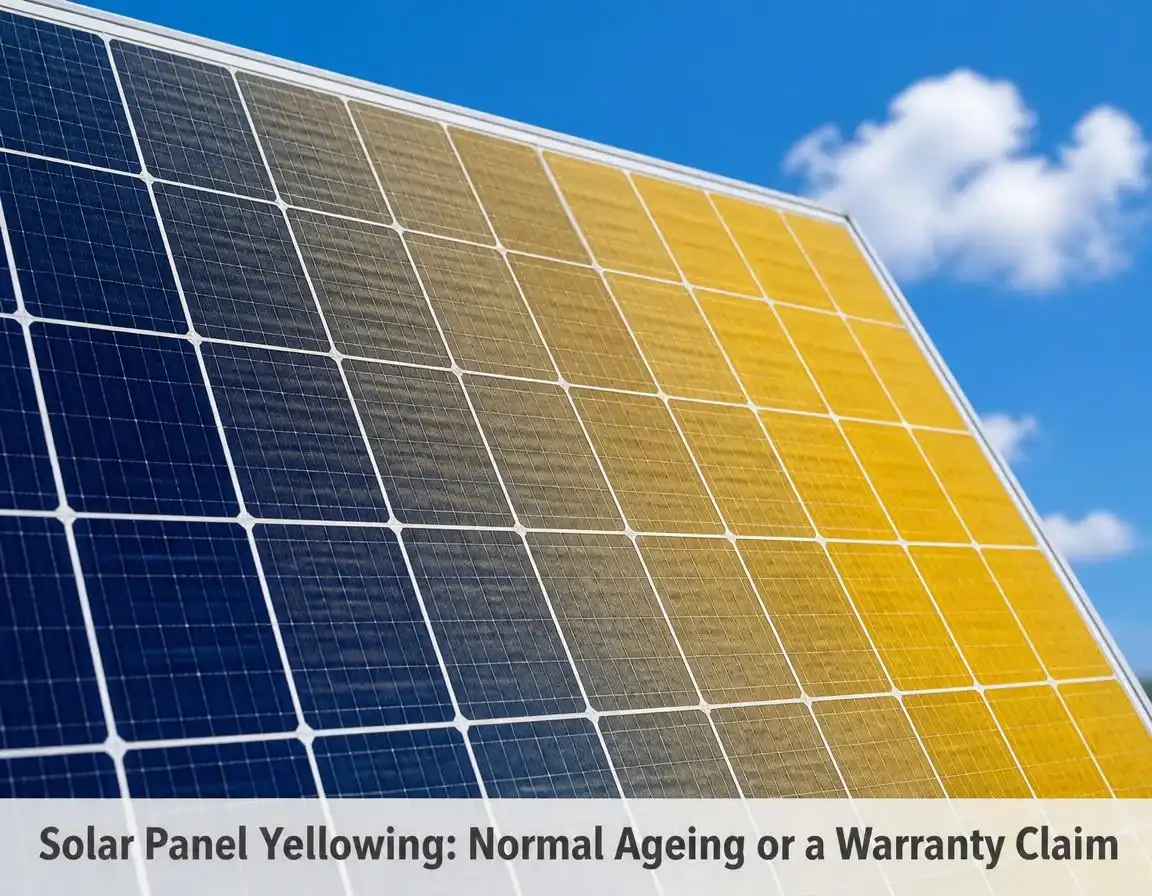
Solar Panel Yellowing

Solar Panel Yellowing: Normal Ageing or a Warranty Claim?

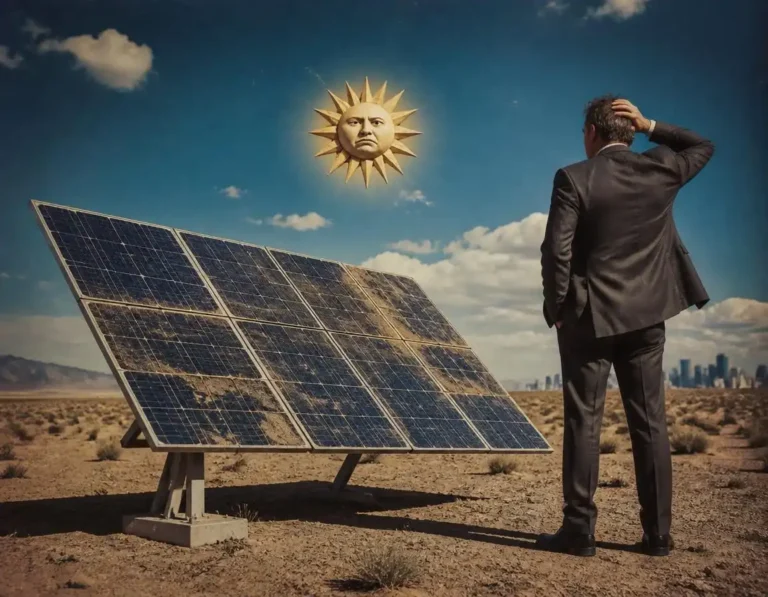
Been up a ladder recently and noticed your panels aren’t quite the crisp blue-black they were on installation day? Maybe there’s a faint amber tint creeping in, or a patch that looks a shade darker than the rest. Before you panic, or worse, ignore it for five years, let’s actually work out what’s going on. Some yellowing is completely normal. Some of it genuinely isn’t. Here’s how to tell which one you’re looking at.
What’s Actually Turning Yellow?
It’s not the glass, and it’s not the silicon cell itself. The bit that discolours is a thin plastic layer called EVA (ethylene-vinyl acetate), sandwiched between the glass and the cells to bond everything together and keep moisture out. Over years of UV exposure and heat, EVA can slowly change colour, from clear, to a faint straw yellow, to amber, and in older or lower-quality panels, eventually brown.
This happens through two related processes: the EVA’s UV-stabilising additives gradually break down, and a chemical reaction called deacetylation releases compounds that tint the material. Every panel with EVA encapsulant will do this eventually. The real question isn’t whether it happens, it’s how fast, and whether it’s happening at a rate your panel’s warranty actually allows for.
Is This Normal? The Honest Answer
Mostly, yes, if it’s mild and it’s taken years to appear. Slight, even yellowing that develops gradually over 8 to 15 years is a well-documented, expected part of how EVA ages in sunlight, and on its own it’s rarely worth chasing a warranty claim over. What actually matters for your wallet is whether your panel’s real-world output has dropped more than the manufacturer promised it would.
✅ Probably just normal ageing
- Even, uniform colour change across the whole panel
- Developed gradually over many years, not suddenly
- Output roughly matches the panel’s stated degradation curve
- No cracking, bubbling, or delamination visible
- Panel is 8+ years old
⚠️ Worth a warranty conversation
- Patchy, blotchy, or localised discolouration
- Appeared early, within the first few years of use
- Noticeable output drop beyond the warranty curve
- Bubbling, cloudiness, or the laminate peeling apart (delamination)
- Brown or purple-tinted patches rather than an even amber tone
Degradation Isn’t the Same for Every Panel Type
Worth knowing before you compare your panels to a friend’s or a forum post: different cell technologies age at genuinely different rates, and this affects how much yellowing you should expect to see over time.
Illustrative figures based on published manufacturer degradation curves for common panel technologies. Your specific panel’s datasheet is the definitive source.
Most panels sold in the UK in 2026, including the N-type TOPCon panels from brands like Jinko and JA Solar that now dominate the market, degrade more slowly and tend to hold their appearance better than the older P-type PERC panels that were standard a few years ago. If you’re currently choosing new panels rather than diagnosing existing ones, our piece on why it’s worth avoiding P-type PERC panels in 2026 covers this in more depth.
The Real Test: Check Your Output, Not Just the Colour
Here’s the thing that actually settles the argument. Every panel comes with a performance warranty, typically guaranteeing something like 98% output in year one, dropping in a straight line to around 84–87% by year 25. Colour is cosmetic on its own. What you actually want to compare is your real, monitored output against that promised curve.
If your monitoring app shows generation that’s meaningfully below what the curve promises for your panel’s age, that’s a genuine performance shortfall, and it’s covered regardless of how the panel looks. If your output is tracking close to the curve and the panel’s just gone a bit amber, you’re looking at cosmetic ageing, not a fault. If you’re not currently checking this, our guide to solar panel monitoring systems covers how to actually see this data rather than guessing.
Product Warranty vs Performance Warranty: Know the Difference
This trips a lot of people up, and it’s worth getting straight before you contact anyone. Panels typically carry two separate warranties, and discolouration can fall under either, or neither, depending on severity.
| Warranty type | Typical length (2026) | Covers |
|---|---|---|
| Product / workmanship warranty | 10–25 years | Manufacturing defects, premature delamination, frame or junction box faults |
| Performance warranty | 25–30 years | Guaranteed minimum power output over time, regardless of appearance |
Current tier-1 brands, including several featured in our own top panels comparison, now commonly offer 25 to 30 year performance warranties. Always check your specific panel’s datasheet, as terms vary by manufacturer.
Genuinely severe, early, or defect-driven discolouration, especially alongside bubbling or delamination, usually falls under the product warranty as a manufacturing fault. Mild, gradual cosmetic yellowing with output still tracking the curve generally isn’t something either warranty is designed to cover, because it isn’t actually a fault.
Your UK Consumer Rights Go Further Than the Manufacturer Warranty
Here’s something worth knowing that most solar guides skip entirely. In the UK, you have statutory legal rights under the Consumer Rights Act 2015 that exist completely separately from whatever warranty your manufacturer offers. Goods have to be of satisfactory quality, fit for purpose, and match their description. If your panels developed a genuine fault well before you’d reasonably expect it, given the price paid and the installer’s own claims, you may have a claim against the retailer or installer directly, not just the manufacturer, for up to six years in England and Wales (five in Scotland) from the date of purchase.
How to Actually Make a Claim
- Photograph the issue properly — clear, dated photos of the discolouration, ideally showing the whole panel and any close-up detail of patchiness or bubbling.
- Pull your monitoring data — export or screenshot your generation history so you can compare actual output against the manufacturer’s warranted curve for your panel’s age.
- Check your paperwork — find your MCS certificate, installation date, and both warranty documents (product and performance) before contacting anyone.
- Go to your installer first, not the manufacturer directly, since most manufacturer warranties are administered through the original installer, and RECC-accredited installers have a formal complaints process if things stall.
Frequently Asked Questions
Is it normal for solar panels to turn yellow?
Yes, to some degree. The EVA layer that bonds and protects the solar cells naturally yellows over years of UV exposure, and mild, even discolouration developing gradually over 8 to 15 years is a well-documented, expected part of how panels age. It becomes a concern when it’s severe, patchy, appears early, or comes with a real drop in output beyond what the panel’s performance warranty allows for.
Does yellowing mean my solar panels are losing power?
Not necessarily. Colour change is largely cosmetic on its own. What actually matters is whether your monitored output has dropped more than your panel’s performance warranty curve allows, typically a gradual decline to around 84 to 87% of original output by year 25 for tier-1 panels. Checking your monitoring data against that curve is a far more reliable test than judging by colour alone.
Can I claim on my warranty for yellow solar panels?
It depends on severity and cause. Severe, early, or patchy discolouration, especially alongside bubbling or delamination, often falls under the manufacturer’s product warranty as a defect. Mild, gradual, even yellowing with output still tracking the warranty curve usually doesn’t qualify, since it isn’t actually a fault. In the UK, you also have separate statutory rights under the Consumer Rights Act 2015 for up to six years, independent of the manufacturer’s own warranty terms.
This article is for general information only and covers typical UK solar panel warranty structures and consumer protections as of August 2026. It is not legal advice. Warranty terms vary significantly by manufacturer and installer, always check your own panel’s datasheet and installation contract for the specific terms that apply to you, and seek independent advice for a formal dispute.


One Comment