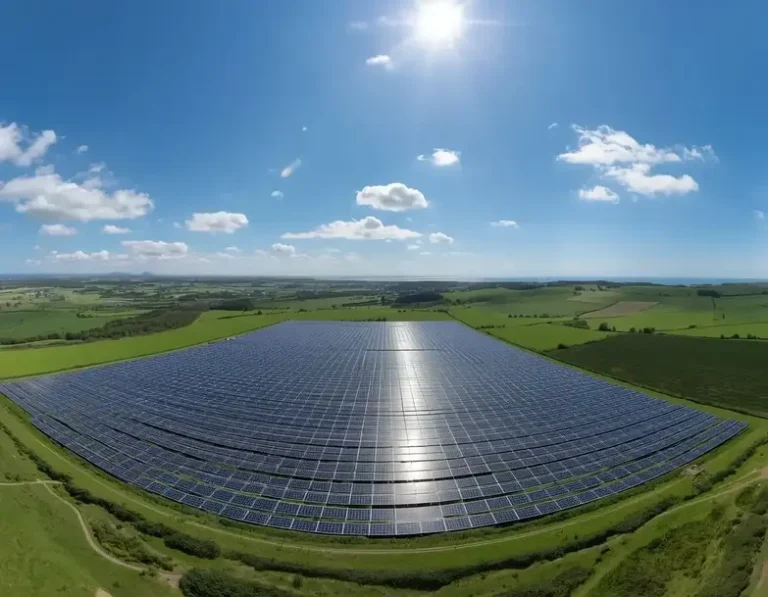
Solar Panels in Bristol & the South West

More sunshine than Manchester, Sheffield or Glasgow, a council that’s actively pushing for it, and some of the fastest payback times in England. Here’s the honest breakdown for 2026.
Why Bristol and the South West Do So Well for Solar
Bristol sits at around 51.45°N, which puts it further south than Birmingham, Derby or Nottingham. Combine that with its position on the south-west coast and you get somewhere between 1,540 and 1,660 sunshine hours a year, depending on exactly which part of the city you’re in — a good 15% above the UK’s national average of roughly 1,400 hours. The city also receives approximately 1,253 kWh of solar irradiance per square metre annually, which is the measure that actually determines how much electricity your panels will produce.
Cooler coastal air helps too. Solar panels are actually slightly more efficient in bright, cool conditions than in intense heat, so Bristol’s Bristol Channel-moderated climate works in your favour rather than against it. The result is a 4kWp system here generating somewhere between 3,850 and 4,320 kWh a year — noticeably more than the same system would produce in Manchester or Sheffield, and broadly on par with what you’d see in South East England.
If you’re comparing Bristol to the country’s absolute top performer, our Solar Panels in Cornwall guide covers the UK’s single sunniest county in detail — useful context, even if you’re not planning to move house for better solar yield.
How Much Do Solar Panels Cost in Bristol in 2026?
Prices in Bristol sit broadly in line with the national picture, with a modest premium reflecting slightly higher labour costs and, in places, the complexity of the city’s older housing stock.
| System Size | Without Battery | With Battery | Annual Saving (est.) | Payback Period |
|---|---|---|---|---|
| 4 kWp (8–10 panels) | £5,800–£8,500 | £10,500–£14,000 | £680–£980 | 6–10 yrs |
| 6 kWp (12–14 panels) | £9,000–£12,000 | £13,000–£17,000 | £950–£1,300 | 7–10 yrs |
Prices fully installed including panels, inverter, mounting, scaffolding and MCS certification, at 0% VAT. Annual savings combine electricity bill reductions (around £600–£780) with Smart Export Guarantee income (£80–£200). Figures are estimates — actual costs vary by roof type, property age and installer.
Want a number tailored to your own roof?
Rather than working from averages, our Solar Panel Calculator gives you a personalised estimate based on your postcode, roof size and electricity usage — it takes about two minutes.
Bristol vs the Rest of the South West
Bristol isn’t the only strong performer in the region. Bath, Taunton, Exeter and Weston-super-Mare all share a similar sunshine advantage, though each has its own local quirks worth knowing before you get quotes.
| Location | Solar Advantage | Local Consideration |
|---|---|---|
| Bristol | 1,600 hrs/yr, strong council support | 30+ conservation areas — check before you survey |
| Bath | Similar sunshine to Bristol | World Heritage status — extensive conservation rules on Georgian & Victorian stock |
| Taunton | Among the highest solar generation per household in the UK in 2025 | Somerset’s rural housing stock suits larger ground-mount options too |
| Weston-super-Mare | One of the sunniest towns in the UK | Coastal salt exposure — ask installers about marine-grade mounting |
| Exeter | Strong South West sunshine levels | Devon’s mixed housing stock — mostly straightforward permitted development |
Do You Need Planning Permission in Bristol?
For most Bristol homes, no. Solar panel installations fall under Permitted Development rules, meaning you don’t need planning permission as long as the panels don’t protrude more than 200mm from the roof surface. That covers the vast majority of standard installations across the city’s suburbs.
Where it gets more involved is inside one of Bristol’s 30-plus conservation areas — Clifton, Redcliffe and King Street are the best-known examples — or on a listed building. In these cases, you’ll need to apply to Bristol City Council for consent before any panels go up. It’s not a dealbreaker; plenty of conservation-area homes do get approval, particularly for rear-facing roof slopes that aren’t visible from the street. It just means budgeting a bit more time before installation.
Check before you book a survey
Bristol City Council publishes guidance on solar panels and planning rules for residents directly on its website — worth a quick look if you’re in or near a conservation area. See Bristol City Council’s solar panels guidance before booking any quotes.
Grants, VAT and Financial Support Available Right Now
Bristol homeowners have access to the same national schemes available across England, and the region’s strong solar yield makes them go further here than in less sunny parts of the country.
- 0% VAT — all qualifying residential solar and battery installations in Great Britain carry 0% VAT until March 2027, saving roughly £1,300 on a typical Bristol install.
- Warm Homes: Local Grant — up to £15,000 for eligible households with an EPC rating of D to G, covering solar panels and battery storage as part of a wider energy upgrade.
- Smart Export Guarantee (SEG) — earn 4p to 15p per kWh for surplus electricity you export, provided your installation is MCS-certified and you have a smart meter.
Because Bristol’s panels generate more electricity per kWp than most of the country, the same grant or VAT saving delivers more value here — you’re getting more energy out of every pound of support.
Should You Add a Battery in Bristol?
Without a battery, a solar-only system in Bristol typically achieves self-consumption of 35–45% — meaning you use a bit over a third of what you generate, and export the rest. Add a battery, most commonly a 9.5kWh unit costing an extra £3,500–£7,000, and that self-consumption rate jumps to 70–95%, adding a further £350–£550 a year in savings on top of solar alone.
Given Bristol’s above-average generation, batteries tend to pay for themselves a little faster here than in less sunny parts of the UK, simply because there’s more surplus daytime electricity to capture and use in the evening.
If you want to explore battery options, inverter compatibility, or whether an off-grid setup makes sense for a rural South West property, our Solar Battery and Off-Grid Solar Systems categories cover both in plain English.
How Many Bristol Homes Already Have Solar?
As of mid-2025 government data, around 9,576 homes in Bristol had installed solar panels — about 4.6% of households. That’s slightly below the UK average of roughly 5.5–5.7%, which is a little surprising given how strong the city’s solar case is, and likely reflects Bristol’s higher proportion of leasehold flats and terraced housing compared to more rural counties. If you’re weighing up a first-time install, you’re not following a crowd that’s already saturated the market — there’s still plenty of room, and plenty of reason, to go solar in 2026.
Solar Panels in Bristol: Your Questions Answered
Is Solar Worth It in Bristol and the South West?
Based on the numbers, yes — Bristol has one of the strongest solar cases of any major English city, with a 6–10 year payback that beats most of the Midlands and the north comfortably. The main thing to check before you book a survey is whether your property sits inside one of the city’s conservation areas, since that’s the one local factor that can slow things down.
Next step: work out your own numbers with our Solar Panel Calculator, check your grant eligibility with the UK Solar Grant & VAT Savings Checker, or head straight to Find an Installer to get quotes from MCS-certified companies in the South West. New to all this? Our Beginner’s Guide is a good place to start.