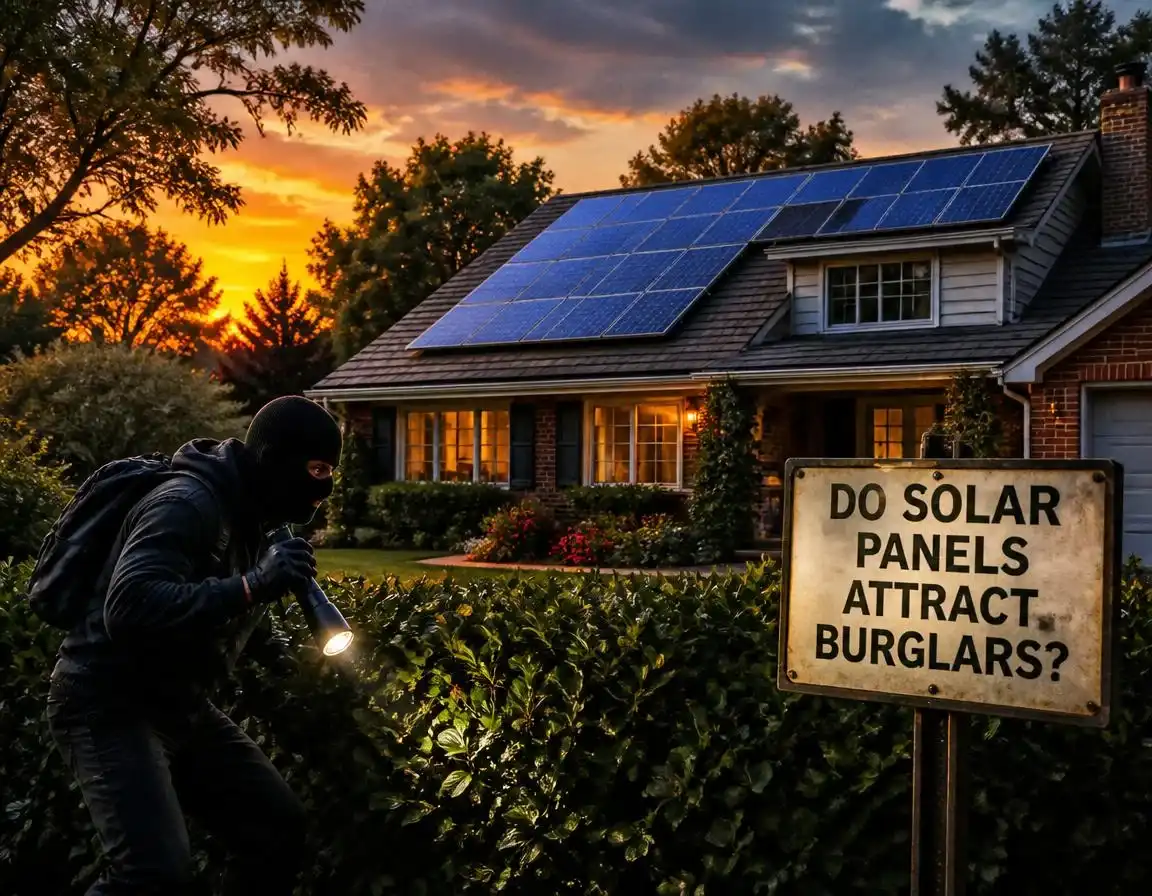
Do Solar Panels Attract Burglars?

Do Solar Panels Attract Burglars? The Honest UK Answer for 2026
A neighbour told a reader of mine that fitting solar would “paint a target on his house.” He asked me whether it was true — so I went and dug through UK police data, insurer claims and real theft cases. Here’s what’s actually happening, and the cheap fixes that genuinely protect your panels.

- No — panels don’t make your home a burglar magnet. UK solar crime is concentrated on remote solar farms and unattended commercial sites, not occupied houses.
- The things thieves actually want are copper cabling and inverters — the panels themselves are bulky, bolted down and hard to resell.
- Theft from an occupied UK rooftop is genuinely rare, and a handful of cheap deterrents (most under £50) shrink the risk even further.
- Roof-mounted panels are usually covered by buildings insurance — once you’ve declared them. Skip that call and you could void the whole policy.
☀️The short, honest answer
Let’s rip the plaster off straight away: no, solar panels don’t attract burglars to your home. There’s no UK crime data showing that burglars pick houses because of what’s on the roof. Burglars are opportunists — they want a quick, quiet way in and small, grabbable valuables: jewellery, cash, keys, electronics. A panel bolted two storeys up, weighing 20kg+ a pop and needing a ladder plus specialist tools to unclamp, is about as far from a grab-and-go target as you can get.
So why the scary headlines? Because solar crime is real and rising — it’s just happening somewhere else. UK police recorded a 93% rise in solar-related crime reports between 2021 and 2022, and security analysts now describe the UK as in a “peak period” of increasingly industrialised solar theft. But look at where those crimes happen and the picture changes completely: unmanned solar farms, remote ground-mounted arrays and building sites — not lived-in family homes.
Think of it this way. A burglar sizing up your street is looking at doors, windows and whether anyone’s in. Your panels are barely on the checklist — and if anything, a tidy solar setup signals a home that’s invested in, occupied and probably kitted out with the kind of alarms and cameras they don’t fancy.
📊What the UK crime data actually shows
Here’s the single most useful way to think about solar panel theft in the UK: where your system sits matters more than anything else. The chart below shows the relative risk profile that falls out of police reporting and security-industry data between 2021 and 2026.
The numbers behind it are dramatic, and every one of them is worth knowing before you worry about your own roof. In 2023, an estimated 75,000–100,000 panels were stolen from a single Northumberland solar farm in one organised operation. West Mercia Police separately recovered 550 stolen panels worth over £100,000 from a Worcestershire farm. Between January and August 2024 alone, more than 750km of copper cable was stripped from UK solar sites. Earthing cable alone accounted for 43% of all recorded solar farm thefts between January 2022 and September 2024, with total losses across that period estimated at £7.1 million, according to crime intelligence firm DeterTech.
Every single one of those cases involves the same profile: remote, unattended, kilometres of exposed copper, nobody living on site. An occupied house with roof-mounted panels is a completely different crime scene — and criminals know it.
🗓️ UK solar crime: the 2021–2026 timeline
UK police record a 93% rise in solar-related crime reports as panel and copper prices climb.
An estimated 75,000–100,000 panels vanish from one Northumberland solar farm; West Mercia Police recover 550 panels worth £100,000+.
750km+ of copper cable stolen from UK solar sites — cabling, not panels, remains the main prize.
Earthing cable makes up 43% of all solar farm thefts in this period, totalling an estimated £7.1 million in losses; crime intelligence firm DeterTech describes the UK as entering a “peak period” of industrialised solar crime, with repeat targeting of previously-hit sites.
More than 2 million UK homes have solar. Domestic rooftop theft remains rare, and police-backed bodies like Secured by Design publish dedicated solar security guidance aimed at farms and commercial sites.
🎯What thieves actually want (it’s rarely your panels)
This surprises most people: the panels are usually the least attractive thing on your roof. They’re bulky, serial-numbered, increasingly forensic-marked, and awkward to shift quietly. The real prizes are smaller, faster to strip and easier to sell on.
Copper cabling
Strips in seconds, untraceable, sells instantly on the scrap market. A single ground-mounted row can hold over a kilometre of it. This is what’s driving the farm crime wave.
Inverters
Industrial inverters cost £3,000–£10,000+ to replace and are often mounted somewhere accessible — a garage wall or an outside enclosure. On a home, this is your number-one thing to lock away.
Batteries & portable kits
Home batteries (£3,500–£8,000) and plug-in or balcony kits left within reach are the newest targets — valuable, portable and in growing demand on resale sites.
The panels themselves — least wanted
Heavy, bolted with tamper-resistant fixings, need a ladder or scaffolding to reach, and hard to resell without raising questions. On an occupied house, they’re simply not worth a burglar’s time. If you’re comparing panel types, our micro inverter vs string inverter guide also covers how the two differ on security exposure.
🏚️When a home IS at risk — the honest exceptions
I don’t want to lull you into a false sense of security, because there are a handful of situations where a domestic system genuinely moves up the risk chart. If any of these sounds like you, take the protection section below a bit more seriously:
New-builds & empty homes
Homes left unoccupied for weeks — new builds, probate houses, long holidays — are the domestic exception. From 24 March 2027, new homes in England must include solar under the Future Homes Standard, so building sites will hold more panels worth protecting.
Ground-mounted garden arrays
Panels at waist height in a garden or field are far easier to unbolt and load than a roof array. Great for output, but they need real security — our ground-mounted solar cost guide covers what to budget.
Plug-in & balcony kits
Portable panels and plug-in solar kits are, well, portable. Left on a balcony or in a shed, they’re a grab-and-go item — treat them like a bike, not like a roof.
Farms & rural outbuildings
Barns, stables and farm arrays sit in exactly the profile criminals favour: valuable kit, low footfall. If that’s you, our agricultural buildings solar guide is the companion read.
Scaffolding left up
A ladder or scaffold left against the wall after install hands thieves the one thing they lack — easy roof access. Get it removed promptly.
Long seasonal absences
Second homes empty all winter. A monitoring app plus a neighbourly eye makes a big difference — more on both below.
🔒9 deterrents that actually work (with real UK costs)
None of this needs a fortune. Most of the best solar security in the UK costs less than a family meal out, and several of the most effective measures are free. Police crime-prevention thinking — the same logic behind the official Secured by Design initiative — is all about making your place slower, noisier and riskier than the next one.
| # | Deterrent | Typical UK cost (2026) | Deterrent power | Best for |
|---|---|---|---|---|
| 1 | Anti-tamper / locking fixings — roof bolts that need a specialist tool to undo | £20–£60 | ★★★★ | Roof panels |
| 2 | Lock the inverter away — garage, indoors or a locked enclosure, never an open exterior wall | £0–£400 | ★★★★★ | Every system |
| 3 | Forensic marking + warning sticker (e.g. SmartWater) — traces kit back to you and deters visibly | £20–£40 | ★★★★ | Panels, inverter, battery |
| 4 | Record serial numbers + dated photos — makes resale harder and claims faster | Free | ★★★ | Every system |
| 5 | Visible CCTV or camera doorbell — visible cameras are a proven deterrent per the College of Policing | £60–£500 | ★★★★ | Driveway, garage, ground-mount |
| 6 | Motion-sensor security lighting — thieves hate light almost as much as noise | £30–£80 | ★★★ | Side gates, garages |
| 7 | Generation monitoring alerts — a sudden output drop is often your first theft alarm | Free–£150 | ★★★ | Every system |
| 8 | Neighbourhood Watch / good neighbours — the original alarm system | Free | ★★★ | Any home |
| 9 | Declare panels on your insurance — the financial safety net behind all of the above | £25–£50/yr | ★★★★★ | Every system |
On monitoring — this one’s underrated. A decent setup pings your phone when output falls off a cliff for no weather reason, which is exactly what a cut cable or missing panel looks like. Our solar monitoring system guide and best solar monitoring apps for 2026 round-up cover the options, and folding a 30-second visual check into your normal solar maintenance routine costs nothing at all.
🛡️The 5-minute insurance check that saves thousands
Here’s the part that catches people out more than any burglar: your panels are usually covered — but only if you told your insurer they were there. Most UK insurers treat roof-mounted panels as part of the building, like roof tiles or a chimney, so theft and vandalism normally fall under standard buildings insurance once declared. Installing solar is a material change to your property, and not declaring it can give an insurer grounds to reject a claim entirely — sometimes even an unrelated one.
| Your setup | Usually covered? | What to do |
|---|---|---|
| Roof-mounted panels (declared) | ✔ Yes — buildings insurance | Update your rebuild value (e.g. add your £6,100–£8,500 system cost) |
| Roof-mounted panels (not declared) | ⚠️ At risk — claim can be refused | Five-minute phone call to your insurer, today |
| Ground-mounted array | ⚠️ Often not, as standard | Specialist renewable cover, typically £70–£120/yr |
| Plug-in / balcony kit | ⚠️ Contents insurance, if at all | Check single-item limits; store indoors when away |
| Inverter & battery | ⚠️ Varies — some policies apply sub-limits | Ask specifically; batteries cost £3,500–£8,000 to replace |
Adding panels to an existing home policy typically costs around £25–£50 a year; a specialist standalone policy runs £70–£120. Set against £200–£400 to replace a single damaged panel — or £6,100–£14,000+ for a whole uninsured system — it’s one of the best-value calls you’ll make all year. Our Solar Panel Insurance UK 2026 guide goes into the small print properly.
🚨If the worst happens: your first 24 hours
❓Frequently asked questions
Do solar panels make my home more likely to be burgled?
Does home insurance cover solar panel theft in the UK?
How can I stop thieves stealing my solar panels?
📚Keep exploring on SolarBriton
Bottom line: solar panels don’t turn your home into a target — the crime wave you read about is an organised, rural, solar-farm problem, not a burglar-at-your-door one. Declare your panels, lock the inverter, fit tamper-proof bolts, and your setup is about as un-burglar-friendly as anything on your property. Sleep easy. 😴