
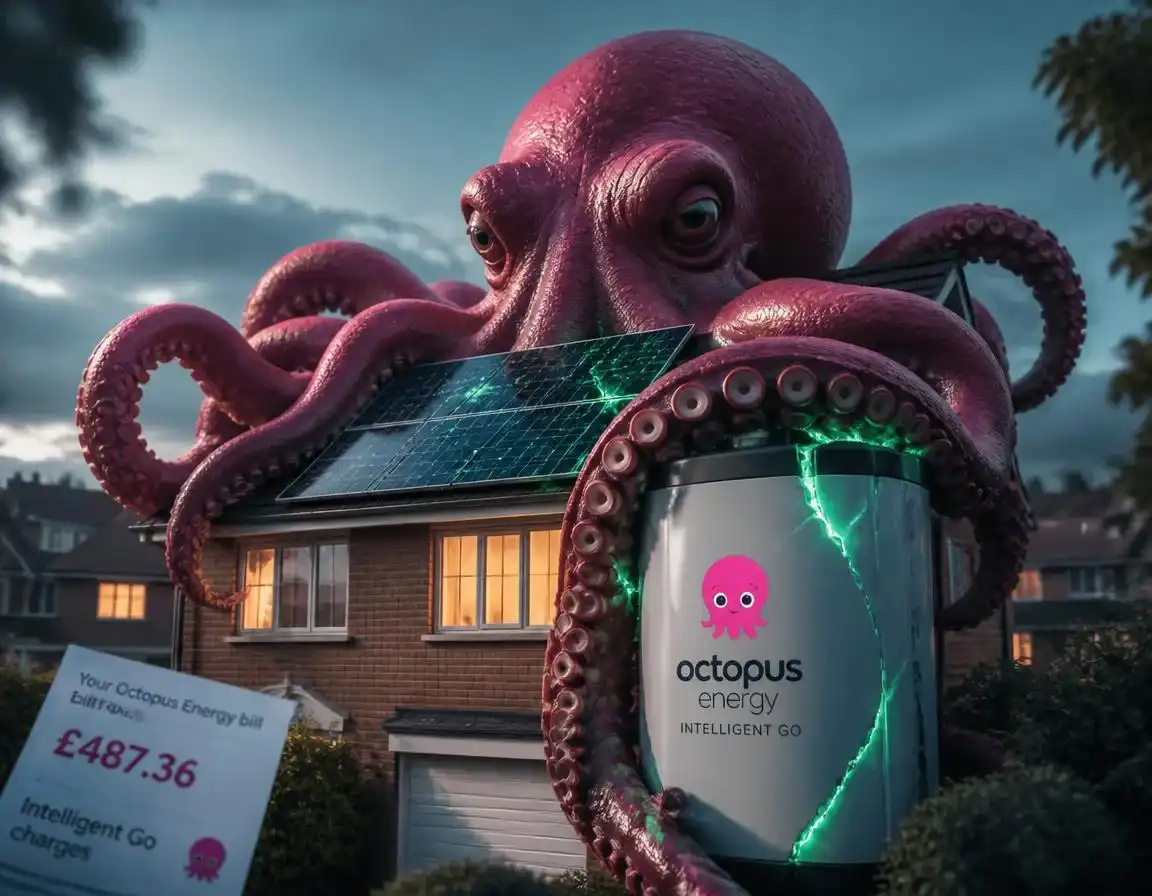
Is Octopus Energy Draining Your Solar Battery?

I’ve spent the last few weeks digging through tariff small print, forum threads and my own monitoring app to answer one question readers keep emailing me about: is your “smart” tariff quietly eating your stored solar? Here’s everything I found, in plain English.

Rooftop solar at dusk — exactly the stored power a smart tariff should be protecting, not spending.
⚡ Quick answer (the 30-second version)
Yes — it genuinely can. Intelligent Octopus Go is a brilliant deal for the car (around 7.5p/kWh off-peak versus the 26.11p/kWh price cap from 1 July 2026). But in solar-plus-battery homes, three things keep going wrong: the battery discharges your stored solar into the EV, smart schedules drift outside the cheap window, and every extra cycle wears out a battery you paid for. None of this is a conspiracy — Octopus even documents the drain on its own help pages — but the cost lands on your bill, not theirs. Below: the mechanics, the money, and the fixes.
What is Intelligent Octopus Go, exactly?
Think of it as Octopus Go’s clever cousin. Instead of a fixed 4–5 hour cheap window (plain Octopus Go gives you off-peak at around 9p/kWh), Intelligent Go hands the scheduling to Octopus’s Kraken software: you tell it when the car needs to be ready, and it picks the cheapest, greenest slots — officially a 6-hour off-peak window, roughly 23:30–05:30, at around 7.5p/kWh depending on region. On paper, that’s a fantastic deal, and for EV-only homes it usually is.
The catch starts the moment a home battery enters the picture, because the algorithm now shares a house with a second brain — your battery’s own management system — and the two don’t always agree on who pays for what.
| Detail | Intelligent Octopus Go (2026) | Plain Octopus Go |
|---|---|---|
| Off-peak rate | ~7.5p/kWh (region dependent) | ~9p/kWh fixed |
| Cheap window | Smart 6 hrs (≈23:30–05:30), slots can move | Fixed window, you choose |
| Who controls charging | Octopus’s algorithm | You |
| Works with solar + battery? | Yes — but needs correct wiring (see below) | Yes, battery-friendly by default |
| Best for | EV + flexible homes | Solar + battery homes that like certainty |
The three ways your stored solar quietly leaks away
🔋 The drain, animated: stored solar flowing into the car
Fig. 1 — When the charger sits on the battery side of your wiring, the battery treats the car like a kettle and feeds it your midday solar.
1. The battery feeds the car (the classic drain)
Your battery can’t tell the difference between “house using power” and “car using power”. So when Intelligent Go starts a smart charge session, the battery politely discharges your stored solar into the car. Octopus’s own help article — “My Intelligent Octopus Go charge has drained my home battery” — admits this happens and suggests “blinding” the battery to the charger, i.e. wiring or CT-clamping the charger on the grid side so the battery can’t see it. If your installer didn’t do that, you’re donating 26p solar to a 7.5p charge.
2. Smart slots that wander
The algorithm sometimes schedules top-ups outside the cheap window, or splits sessions around it. Forum threads from myenergi, FoxESS and SpeakEV users are full of 05:30–07:00 “extra hours” that quietly charge part of the car at peak rates. You signed up for cheap power; the small print signed you up for the algorithm’s opinion.
3. Wear and tear you pay for, flexibility they profit from
Every unplanned cycle chews through a battery that cost you £4,000–£6,500 for a 10 kWh system. Meanwhile, aggregated home batteries earn real money in balancing markets — something I’ve covered in my guide to getting paid by Tesla, Octopus or Axle to share your battery. The loophole? When you opt into a VPP, you’re paid for that flexibility. When the drain happens by accident, the wear is yours and the benefit is nobody’s but the grid’s.
What the drain really costs in 2026 (worked example)
Let me put real numbers on it. A 10 kWh battery at ~£5,000 installed, warrantied for roughly 6,000 cycles, works out at about 8p/kWh of lifespan wear per cycle — my working figure, but it’s the honest way to price “free” battery energy.
| Line item | Calculation | Cost |
|---|---|---|
| Evening power you now buy back at cap rate | 5 kWh × 26.11p | £1.31 |
| Extra battery wear (hidden cost) | 5 kWh × ~8p | £0.40 |
| What the car charge would have cost at off-peak | 5 kWh × 7.5p | −£0.38 |
| Net loss per drain event | — | ≈ £1.33 |
💸 Estimated hidden cost per year by drain frequency
Fig. 2 — SolarBriton worked example, August 2026. Your mileage varies with system size and tariff, but the direction is always the same.
Success rate vs failure rate: what real households report
To be completely fair: most people on Intelligent Go are quietly winning. A car charged at ~7.5p instead of 26.11p is worth £300–£500 a year on its own, and the tariff’s savings claims generally hold up for EV-first homes. The trouble concentrates in one group — solar-plus-battery homes with certain charger wiring (Zappi and Ohme setups come up again and again). Scanning public threads on the myenergi, FoxESS and SpeakEV forums, my indicative read is roughly:
Fig. 3 — Indicative SolarBriton read of public UK forum threads, August 2026. Directional, not a scientific survey.
Two more honest footnotes. One: the loopholes run both ways — some users gamed “ready by” times so hard that Ohme and Octopus have been closing them down (from 27 Feb, Ohme ready times were restricted to 04:00–11:00, and a 6-hour daily cap on discounted power is being introduced). Two: when a battery brand collapses — as GivEnergy did in April 2026 — warranty questions get awkward, which makes unpaid wear-and-tear even more annoying.
How to stop Octopus draining your solar battery (7 fixes that work)
Blind the battery to the charger
The proper fix: have an electrician move the EV charger’s CT clamp or wiring to the grid side, so the battery can’t see the car as home load. Octopus recommends exactly this.
Set a reserve floor
Most battery apps let you set a minimum state of charge. A 20–30% floor means a drain is annoying, never catastrophic.
Switch off smart control on the device
In the Octopus app, disabling “Smart Control” for that device hands scheduling back to the car/charger’s own timer.
Match the battery charge window
Force the battery to charge during the same cheap window so it tops up alongside the car instead of fighting it.
Watch it for one fortnight
Use a decent solar monitoring app and compare two weeks of bills. Data beats vibes.
Check your export rate
If you’re exporting on a basic default SEG rate instead of something like Outgoing Octopus’s 12p, every leaked kWh hurts twice. Compare in my best SEG tariff rates guide.
Know your warranty throughput
Read what your warranty actually covers — many cap total energy throughput, so extra algorithm cycles can matter. My warranty guide explains the small print.
Should you leave Intelligent Go? Better setups for solar + battery homes
If your wiring can’t be fixed and the app battles continue, you have options. Plain Octopus Go (fixed ~9p window, you stay in control) is the battery-friendly default. Cosy Octopus suits heat-pump homes, and my Flux vs Cosy Octopus comparison breaks that down. The gold standard for batteries, Octopus Flux / Intelligent Flux (up to ~29–32p peak export), has been paused to new customers since March 2026 — details in my Octopus export tariff guide — so existing members should think very hard before leaving it. And if you’re still weighing up whether a battery is worth it at all, start with adding a battery to existing solar panels and my roundup of how to make money from home battery storage.
Your rights: what the regulator actually says
A few things are genuinely on your side. Export payments sit under the GOV.UK Smart Export Guarantee rules, overseen by Ofgem, so your exported solar must be paid and metered correctly regardless of import tariff. Ofgem also polices how suppliers run flexibility services — the principle being that handing over control of your battery should be something you choose and get paid for, not something that happens by accident at your expense. If your battery is being discharged to the grid or into your car against your settings, that’s a complaint worth raising with your supplier in writing, with your half-hourly export data attached.
🧭 My honest verdict
Intelligent Go isn’t a scam — it’s a genuinely cheap EV tariff with a design flaw for solar-battery homes. The “loophole” is simply this: the algorithm gets discretion, and you carry the risk. Fix the wiring, set a reserve floor, and monitor for a fortnight. If the drain stops, stay and enjoy the 7.5p charging. If it doesn’t, move to a tariff where you hold the remote — your battery’s 6,000 cycles are worth far more in your evening than in Octopus’s algorithm.
Frequently asked questions
Can Octopus Intelligent Go really drain my solar battery into my EV?
How much could the Intelligent Go battery drain cost a UK home in 2026?
How do I stop Octopus draining my solar battery?
All rates and caps checked August 2026: Ofgem price cap 26.11p/kWh (from 1 July 2026), Outgoing Octopus 12p/kWh, Octopus Go ~9p off-peak, Intelligent Go ~7.5p off-peak (region dependent). Worked examples and the forum-sentiment chart are SolarBriton estimates to show the direction of travel — always check your own half-hourly data before switching. 0% VAT on home battery installations runs until 31 March 2027.