
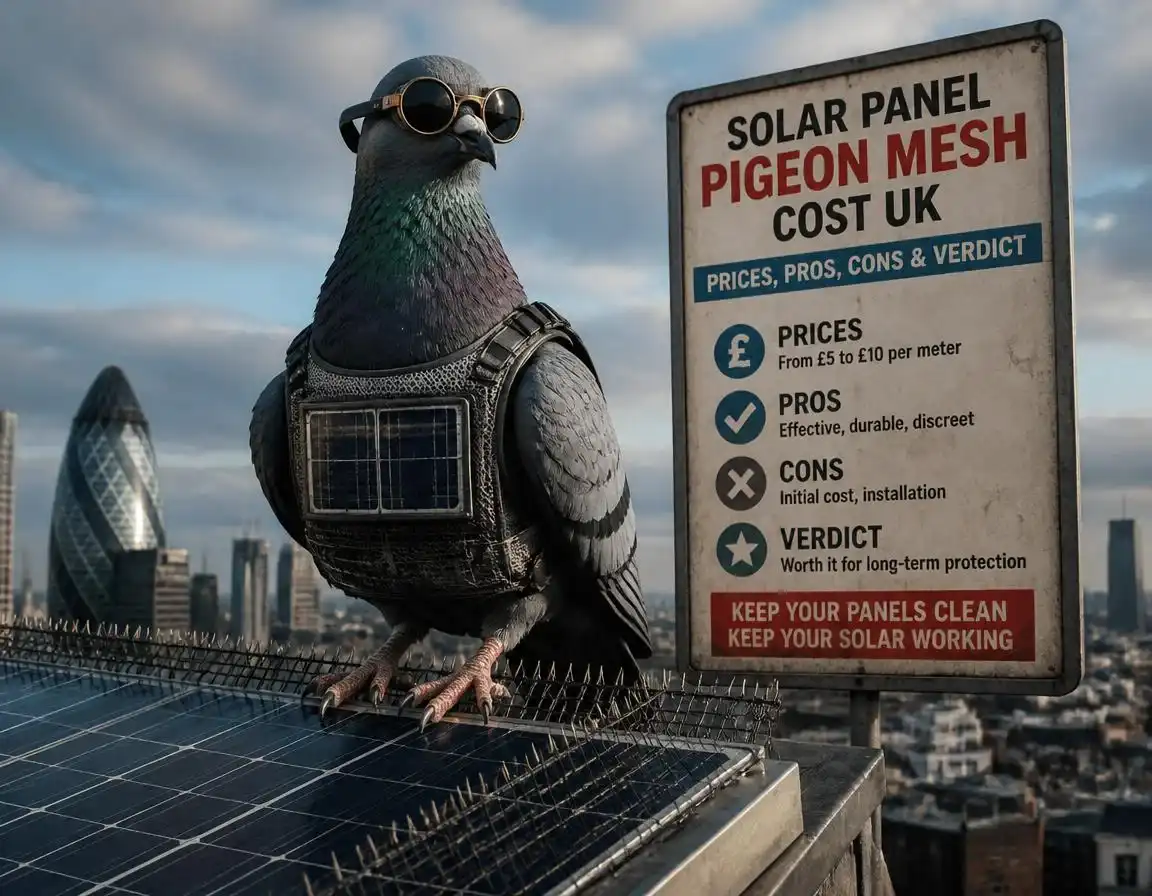
Solar Panel Pigeon Mesh Cost UK 2026

Solar Panel Pigeon Mesh Cost UK 2026: Prices, Pros, Cons & Verdict
Pigeons have discovered your panels are the perfect flat-free housing with a sun terrace. Here’s exactly what stopping them costs in 2026 — and whether it’s worth it.
Why pigeons love your panels (and what it’s costing you)
Picture it from a pigeon’s point of view: a dry, sheltered ledge, out of the wind, above the ground, with a warm panel overhead. It’s not a nuisance to them — it’s prime real estate. The trouble is what they bring with them:
- Output loss: a single dropping on one panel can cut that panel’s output by up to 30% on a string-inverter system, and severe bird soiling can shave up to 35% off a badly affected array — because one shaded cell drags the whole string down.
- Acidic droppings: pigeon guano is corrosive. Left sitting, it etches coatings and corrodes connectors and cabling under the panels.
- Fire risk: dry twigs, straw and feathers piled next to live DC cabling is exactly the combination you don’t want on your roof.
- Blocked gutters & noise: nesting debris washes straight into your gutters, and a resident pair will coo at 5am with total confidence.
- Warranty gap: output loss from dirt and bird mess is not something panel warranties cover, as we explain in our guide to what solar warranties actually cover.
Your panels are a £5,000–£10,000 asset, so this isn’t a cosmetic problem. It’s one we now flag in our annual solar maintenance checklist — and mesh is the one-off fix.
Solar panel pigeon mesh cost UK: the 2026 price table
| Option | Typical UK price (2026) | Best for |
|---|---|---|
| DIY mesh kit (30m roll + fixing clips) | £60–£150 | Single-storey, safe ladder access, confident hands |
| Fitted during a new solar install | £200–£400 | Anyone buying panels now — scaffolding is already up |
| Professional retrofit (typical 3-bed, 10–14 panels) | £300–£700 | Most UK homes — includes nest/debris removal |
| Large arrays, steep or high roofs | £700–£1,000+ | 16+ panels, three-storey, complex roof lines |
| Scaffolding / access equipment (if needed) | +£200–£400 | Jobs that can’t be done from ladders safely |
| Guano clean afterwards (if not included) | £60–£180 per clean | Same ballpark as a standard professional solar clean |
The chart that settles the DIY vs pro debate
One summer of pigeon residence can mean repeated £60–£180 cleans plus corroded connectors — the red bar is the bill mesh prevents.
What moves your quote up or down? The perimeter length (count the exposed sides, not the panels), roof height and access, the mesh type you choose, whether old nesting and guano needs removing, and who’s nesting — gulls need heavier-gauge mesh than pigeons and usually a licensed contractor.
Mesh types compared: stainless, coated, plastic or solid skirting
| Type | Typical lifespan | Failure risk | Honest notes |
|---|---|---|---|
| Stainless steel mesh (black PVC-coated) | 10–25 yrs | Very low | The trade standard. Rigid, rust-proof, near-invisible from the ground. Use grade 316 if you’re within a kilometre of the coast — see our coastal property guide. |
| Galvanised mesh, PVC-coated | 5–10 yrs | Low–medium | The budget metal option. Fine inland; coating can chip at cut edges and rust eventually creeps in. |
| Plastic / nylon mesh | 1–3 yrs | High | UV turns it brittle, pigeons peck through it, and it sags. False economy — you’ll pay twice. |
| Solid aluminium skirting | 10–20 yrs | Low, but check | Smartest looking, but it must be designed for solar so airflow and panel temperatures aren’t affected — and confirm in writing it won’t touch your warranty. |
How installation actually works (and the law bit)
A proper job takes a pro 2–4 hours and never touches your panel glass or drills into the frames. The mesh hooks onto the panel edge with purpose-made clips, tensioned so there’s no gap a determined pigeon can push through.
Advantages vs disadvantages — the honest split
✅ Advantages
- One-off cost — stainless mesh keeps working for 10–25 years.
- Protects output: no more 30% hits from a single dropping.
- Protects cabling and connectors from corrosive guano and pecking.
- Removes the dry-nesting fire risk next to live DC wiring.
- Stops gutter blockages and the 5am cooing club.
- Clip-fix systems don’t void panel warranties when installed correctly.
- Keeps the system looking tidy — which matters if you ever sell, as we cover in do solar panels increase house value?
❌ Disadvantages
- Upfront cost of £300–£700 stings if you weren’t expecting it.
- Cheap plastic mesh fails in 1–3 years and looks tired fast.
- Glued or drilled fittings can void warranties — the exact thing you’re trying to protect.
- Solid skirting can affect airflow if it’s not solar-specific.
- Mesh makes lifting panels slightly fiddlier for future maintenance.
- Can’t be fitted legally while an active nest is in residence.
Success rate vs failure rate: what the trade sees
There’s no national statistic for this, so here’s the honest picture from UK installer feedback and trade forums: clip-fixed stainless mesh, covering the full perimeter, is treated as a permanent fix — most installers report almost no call-backs on it. The failures they do get called back for trace back to the same handful of mistakes:
| What goes wrong | Why it fails | How quickly |
|---|---|---|
| Plastic / nylon mesh | UV brittleness, sagging, pigeons peck through | 1–3 years |
| Glue-only fixing | Adhesive gives up in freeze–thaw cycles; can void warranty | 1–4 years |
| Gaps at corners / ends | Pigeons squeeze through any gap over ~2cm and re-nest inside | First season |
| Mesh too shallow | Birds push the bottom edge up and walk straight in | First season |
| Drilled frames | Water ingress + voided panel warranty — a repair, not a fix | Immediate risk |
| Clip-fixed stainless, full perimeter | Nothing to degrade except the roof itself; birds simply move on | 10–25 yrs service |
DIY or professional — our verdict
DIY is genuinely fine if your panels are single-storey, you can work safely from the ground or a properly footed ladder, and you use stainless mesh with the correct clips. It’s a careful half-day, not a technical job. Go professional if you’re two-storey or higher, if there’s existing nesting to clear, or if your quote includes scaffolding anyway — and remember the pro price usually includes the guano clean you’d otherwise pay £60–£180 for separately. Either route, the rules are the same: no drilling, no glue on frames, no gaps, no active nests. And if a quote feels off, run the trader past our 7 red flags for solar scams first.
Our 2026 recommendations (the short version)
Frequently asked questions
How much does solar panel pigeon mesh cost in the UK in 2026?
A professional clip-fixed job typically costs £300–£700 for a standard home with 10–14 panels, rising towards £1,000+ for large arrays or scaffold-heavy roofs. Fitted during a new install it’s usually £200–£400, and a DIY stainless kit runs £60–£150.
Does pigeon mesh damage solar panels or void the warranty?
Not when it’s clip-fixed to the frame with no drilling and no glue on the glass — that method leaves the panels untouched. Drilling frames, gluing fittings or pressure-washing are the things that void warranties, so get the method confirmed in writing.
Is it illegal to remove pigeons nesting under solar panels?
If the nest is active, yes — the Wildlife and Countryside Act 1981 protects it until the chicks fledge. That’s why mesh goes on outside the March–August nesting window, or after a licensed professional has confirmed the nest is empty.
Sources & method: 2026 UK installer quotes and trade price guides (bird-proofing specialists, pest-control trade bodies), UK solar installer case-study data on soiling losses, Wildlife and Countryside Act 1981 (legislation.gov.uk), HSE working-at-height guidance, and SolarBriton’s own 2026 maintenance, cleaning and warranty guides for cross-checked figures.



2 Comments