
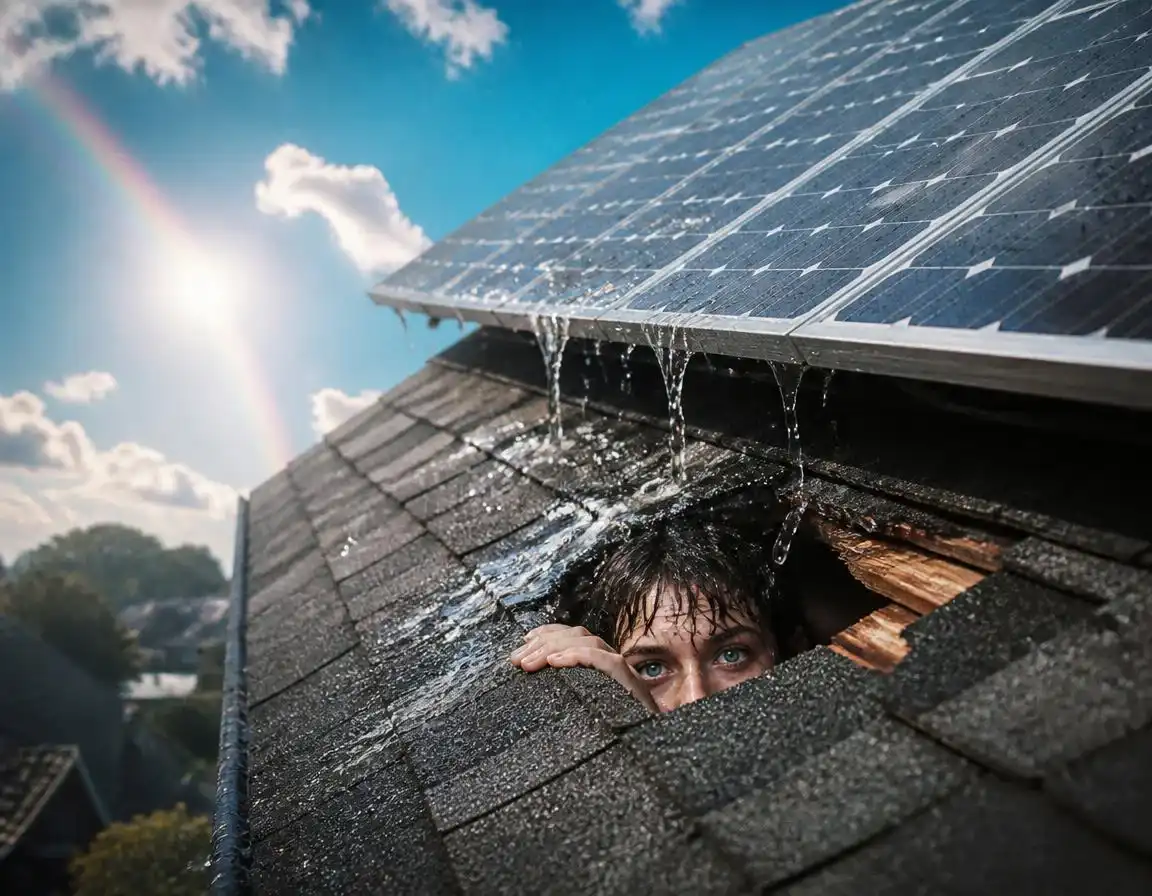
Do Solar Panels Cause Roof Leaks? Claude ready

Do Solar Panels Cause Roof Leaks? The Honest UK Answer for 2026
I’ve heard this worry a thousand times — “I’d love solar, but I’m not having holes drilled in a perfectly good roof.” Fair enough. So let’s settle it properly, with real UK mounting practice, not marketing fluff.
The quick answer (yes, it’s good news)
No — solar panels don’t cause roof leaks when they’re installed properly on a sound roof. A certified install leaves your roof as weathertight as it was before, and in some ways better protected. Nearly every leak blamed on solar traces back to one of two things: shoddy workmanship by a non-certified installer, or a roof that was already on its last legs before anyone picked up a drill.
How panels actually attach to a UK roof
Here’s the bit most people picture wrong. Panels aren’t glued on, and they don’t hang off your tiles. On a typical pitched roof — concrete tile, clay or slate — the system works like this:
Stainless-steel roof hooks are screwed into your rafters (the solid timber frame, not the tiles). A tile is carefully lifted or trimmed at each hook point, and the hook slips through the gap. Aluminium rails bolt onto the hooks, and the panels clamp onto the rails. A typical 4kW system — around 8 to 12 panels — uses roughly four fixings per panel, so perhaps 40 small penetrations in total. And here’s the crucial part: every single one gets a flashing or sealed collar, with the tile re-bedded over the top so rain still runs over the roof, never into it.
Done like that, the penetration is behind the weathering line of the roof. It’s the same principle roofers have used for decades on chimney flashings and Velux windows. This is also why a properly mounted array shrugs off British weather — I’ve covered what happens to panels in lightning strikes and major storms if you’re curious how tough these things are.
When leaks DO happen, what’s actually going on?
Leaks after solar are rare, but they’re not imaginary. When MCS- and NAPIT-certified installers investigate them, they almost always find one of these four culprits:
| Usual suspect | How it happens | How a good installer rules it out |
|---|---|---|
| Rushed sealing at hook points | Cheap sealant skipped or smeared on as an afterthought; driven rain finds its way in | Correct flashing or butyl collar at every penetration, torque-checked and photographed |
| Cracked or shifted tiles | Heavy boots on old, brittle tiles during the install — a crack hidden under a panel is hard to spot later | Walk boards, careful footing, and any cracked tile swapped the same day |
| Wrong mounting kit for the roof | Slate hooks on clay tiles, tile hooks on slate — every roof type needs its own hardware | Roof-specific hardware chosen at survey, not improvised on the day |
| A roof that was already tired | Perished chimney flashing or worn mortar finally gives up — the solar gets the blame | An honest pre-install survey that says “re-roof first” when that’s the truth |
Notice the pattern? Not one of these is “the solar panels leaked”. They’re all workmanship or pre-existing roof issues — which is exactly why the installer you choose matters more than the panels you buy. It’s also why I keep banging on about what MCS certification actually means in 2026, and why a too-good-to-be-true quote usually is (here are the 7 red flags of a solar scam).
Leak risk by mounting method
Not all installs touch the roof the same way. Here’s my honest risk rating for each approach you’ll meet in the UK:
Roof type guide: what works, what needs care, what’s a no-go
| Roof type | Leak risk when done properly | What a decent installer does differently |
|---|---|---|
| Concrete tile | Very low | Standard hooks and seals; the easiest UK roof to work on |
| Clay tile | Low | Tile-specific hooks; spare tiles on the van for same-day swaps |
| Slate | Low–medium | Slate hooks or flashing plates; extra patience on older, brittle slates — common on Victorian terraces |
| Flat (felt / EPDM / rubber) | Near zero | Ballasted frames held by weight — no holes drilled at all |
| Metal / standing seam | Near zero | Clamps grip the seams; zero penetrations |
| Asbestos cement | Don’t drill | Drilling is banned under the Control of Asbestos Regulations 2012 — re-roof first; see HSE asbestos guidance |
| Thatch | No-go | Fire risk and no suitable mounting system exists — not feasible, full stop |
On the paperwork side, most UK homes don’t need planning permission for panels — they fall under permitted development as long as panels stay below the ridge and protrude no more than 200mm, with slightly looser rules for flat roofs since late 2023. The government’s permitted development guidance and the Planning Portal’s roof advice spell out the limits; listed buildings and conservation areas are the usual exceptions (we’ve covered listed building rules and planning permission in depth).
The leak-proof install checklist
Steal this. It’s the exact list I’d use for my own mum:
Survey the roof before the sales pitch
Age, tile condition, rafters, loft check for existing damp. If the roof needs replacing within ~5–10 years, re-roof first — panels last 30–40 years and you don’t want them lifted mid-life.
Check the badge, not the brochure
Verify the firm on the MCS register and/or TrustMark (the government-endorsed scheme) before paying a penny.
Ask: “which mounting system for my exact tiles?”
You want a roof-type-specific answer — slate hooks, tile replacements, seam clamps or ballast. “It’s all the same, love” is a walk-away answer.
Get the workmanship warranty in writing
Commonly 5–10 years from the installer directly, and on top of that, MCS’s redeveloped 2026 scheme requires a separate insurance-backed protection product running at least 6 years — so you’re covered even if the firm folds. More in our warranty guide.
Full scaffolding, not ladders and hope
Proper access means careful feet, fewer cracked tiles, and a safer job. Scaffolding is included in honest quotes — see what a fair price looks like in our 2026 cost guide.
Demand a photo log of every seal
Photos of each flashing and collar before tiles go back over. Thirty seconds per fixing, priceless if a drip ever appears.
MCS certificate + tell your insurer
Your MCS certificate should typically arrive within 14 days of commissioning under the current scheme — a window that’s moving to 30 days as installers complete the transition to MCS’s redeveloped 2026 rules. You’ll need it for export tariffs and future house sales. Then notify your home insurer; most cover solar as standard but want it on record. Our insurance guide has the details.
“Help — there’s a drip!” What to do if your roof leaks after solar
- Photograph everything, date it The drip, the stain, the loft side, the roof outside. Evidence wins warranty claims.
- Call your installer first If the install caused it, their workmanship warranty makes the repair their problem — at their cost, not yours.
- Unresponsive or gone bust? Escalate through MCS using your certificate, and claim on the insurance-backed guarantee. That’s precisely what it exists for.
- Dispute over who caused it? An independent roofing surveyor can settle whether it’s install damage or a pre-existing fault.
- Still stuck? Use your home insurance route Particularly for storm-related or pre-existing leaks the installer warranty won’t touch.
And if you’re buying a home that already has panels, a leak check is part of the homework — our guide to buying a house with solar panels shows you exactly what to ask for (MCS certificate, warranties, photo log).
The bonus nobody mentions: panels protect your roof
Here’s a lovely twist — the roof area under your panels often ages slower than the exposed bits. The array shades the tiles from baking UV in July, hammers of horizontal rain in January, and frost cycles all year round. Weight-wise, a panel is roughly 20–25kg spread across its frame — a fraction of the snow load UK roofs are already built to shrug off. Keep an eye on gutters and debris as part of a simple annual maintenance routine, and the roof-and-solar partnership quietly looks after itself.
The verdict
So, do solar panels cause roof leaks? The panels don’t — bad installs do. On a sound roof, with the right mounting kit, sealed flashings at every fixing and an MCS-certified team, your roof stays exactly as watertight as it was before, while quietly generating for 30–40 years. The entire risk of this topic boils down to one decision: who you let on your roof. Choose that well and the only thing dripping will be your energy bills.
Frequently asked questions
Do solar panels cause roof leaks?
Not when they’re installed properly on a sound roof. Panels sit on rails held by sealed, flashed fixings, and a correct install leaves your roof as weathertight as it was before. Almost every leak traced back to solar turns out to be poor workmanship or a roof that was already tired — not the panels themselves.
Who pays if my roof leaks after solar installation?
If the install caused the leak, your installer pays — that’s exactly what their workmanship warranty (commonly 5–10 years) is for. MCS-certified firms must also carry a separate insurance-backed protection product (at least 6 years under the redeveloped 2026 scheme), so you’re protected even if the company goes bust.
Can I put solar panels on an old roof?
Usually yes, as long as the roof is structurally sound. The rule of thumb: if your roof will need replacing within the next 5–10 years, re-roof first. Panels realistically last 30–40 years, and paying to remove and refit them mid-life just to re-roof costs far more than doing the roof first.




One Comment