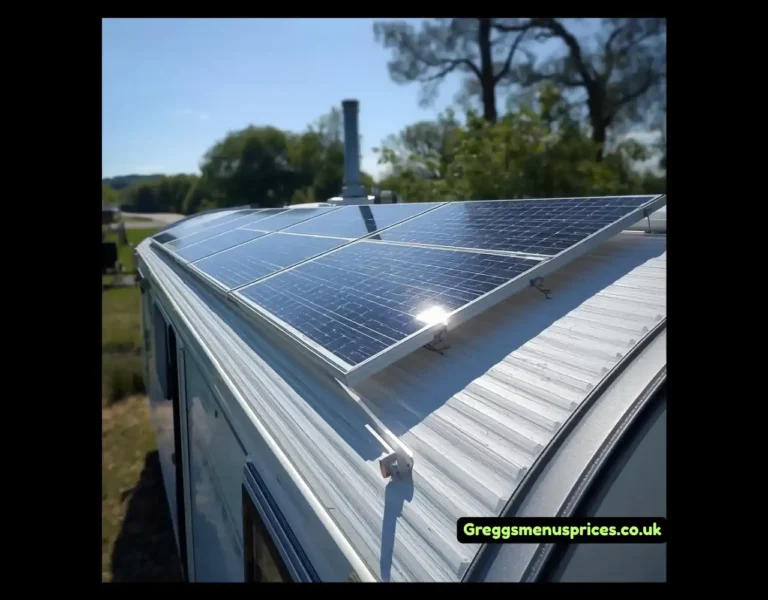
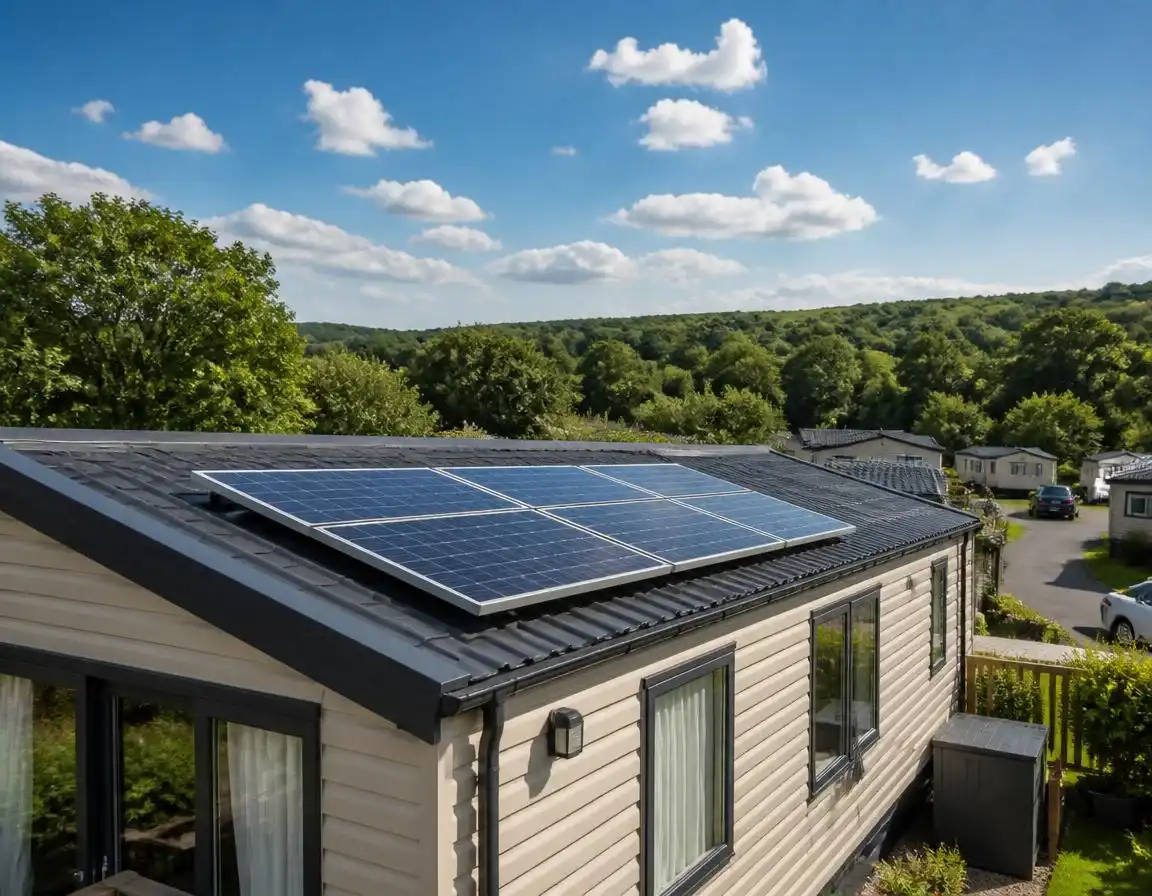
Solar Panels for Static Caravans & Park Homes UK

Solar Panels for Static Caravans & Park Homes UK: The Real 2026 Picture
These two get lumped together constantly, but they’re not really the same question at all — and which one you’ve got changes the price, the VAT rate, and what’s actually possible.

I get this question a lot, usually phrased something like “can I put solar on my caravan” — and my first question back is always the same: is it a static caravan you holiday in, or a park home you actually live in? It sounds like a technicality. It isn’t. It decides whether you’re buying a £150 portable panel or a proper grid-tied system, and whether you pay VAT at 0% or the full 20%.
So let’s untangle the two properly, then go through what solar actually looks like for each — costs, VAT, planning, and whether you can earn anything back from the grid.
Static caravan or park home — which do you actually have?
Both are legally “caravans” under the Caravan Sites Act, which is exactly why the confusion happens. But in practice they’re built to different standards and used completely differently:
| Detail | Static caravan | Park home |
|---|---|---|
| Built to | EN 1647 (leisure standard) | BS 3632 (residential standard, closer to a bungalow) |
| Intended use | Holidays only — not a permanent home | Permanent, year-round residence |
| Legal protection | None under the Mobile Homes Act | Protected under the Mobile Homes Act 1983 |
| Typical site | Seasonal holiday park, often closed part of the year | Residential park home site, open year-round |
| Ownership model | You own the caravan, pay site/pitch fees | You own the home, pay a pitch fee for the land |
If you’re not sure which you’ve got, check your site licence and your park agreement — a genuine park home site will say so explicitly, since residential status has to be licensed by the local council. GOV.UK has a clear breakdown of what site owners and residents are each entitled to on park (mobile) homes: your rights and obligations.
Why this decides your VAT rate
Here’s the bit that actually catches people out. Solar installations on residential accommodation qualify for 0% VAT in the UK — the same relief a normal house gets. But “residential accommodation” has a specific meaning, and it hinges entirely on permanent use, not on what the building looks like.

Park homes and static caravans used as someone’s actual, permanent home both qualify for 0% VAT on solar, in the same way a house does. A static caravan that’s purely a holiday retreat on a seasonal leisure park almost certainly doesn’t qualify, because it isn’t “residential accommodation” in HMRC’s terms — it’s leisure use. This is exactly the same distinction that trips people up over VAT on the site fees themselves, so it’s not a solar-specific quirk.
My honest advice: don’t assume either way. Get your installer to confirm the VAT rate in writing before you sign anything, referencing GOV.UK’s VAT Notice 708/6 on energy-saving materials. If you want to double check what you personally qualify for beyond just VAT, SolarBriton’s own UK Solar Grant & VAT Savings Checker is a genuinely useful first stop.
Two very different solar setups
Because of everything above, “solar for a caravan” really splits into two completely different projects:
Small, portable, off-grid
- Suitcase, foldable, or fixed panel kits, typically 40W-150W
- Charges a 12V leisure battery through an MPPT controller
- No export connection, no meter, no SEG
- Usually standard-rated for VAT
- No planning question at all — it’s your own kit on your own caravan
Proper grid-tied system
- Roof-mounted array, typically 2-4kWp — smaller than a house, same technology
- MCS-certified installer required for any grant or export payment
- Can qualify for 0% VAT and SEG on the same terms as a house
- G98 grid connection notification applies above certain sizes, same as houses
- Governed by your site licence and pitch agreement, not planning permission

If you’re leaning towards the bigger, off-grid end for a static caravan — a proper 600-800W kit with a decent leisure battery bank rather than a single small panel — it’s worth reading SolarBriton’s dedicated off-grid solar systems guide first, since sizing and battery choice matter more than panel wattage alone. There’s also a whole motorhomes section covering the same underlying 12V technology, which crosses over neatly with static caravan setups.
Can you actually earn money back?
Only realistically if you’re in the park home / grid-tied category. The Smart Export Guarantee pays you for electricity you send back to the grid, but that requires a proper meter, an export connection, and an MCS-certified installation — none of which a small off-grid caravan kit has. For a park home with a full system, SEG works exactly as it would for a house.
Check current rates with SolarBriton’s SEG Income Estimator, and compare suppliers properly using the Best SEG Tariff Rates 2026 guide before signing up with whoever your installer suggests first. Full rules on how SEG works are on GOV.UK’s Smart Export Guarantee page.
Planning permission — it’s not what you’d think
If you’ve read anything about solar and houses, you’ll know most roof-mounted arrays count as permitted development. That entire framework is built around houses — technically, “dwellinghouses” — and doesn’t map onto a caravan in the same way, whether it’s a holiday static or a permanent park home.
What actually governs adding solar to a caravan is your site licence (issued by the local council to the site owner under the Caravan Sites and Control of Development Act 1960) and your individual pitch agreement. In practice, that means asking your site owner or park operator for written permission before you fit anything — not checking permitted development rights, which mostly don’t apply here at all. For the house-specific rules, for comparison, SolarBriton’s own Solar Panel Planning Permission guide covers that separate framework in full.
Thinking about adding a bit more, later?
A few things worth knowing if your static caravan or park home solar setup might grow over time:
- Battery storage — even a modest leisure battery bank changes what’s realistic for running appliances off-grid. SolarBriton’s Best Solar Battery UK 2026 guide is written with house-sized batteries in mind, but the underlying buying advice (cycle life, depth of discharge, warranty) applies just as much to a smaller leisure setup.
- Warranty — always check what’s actually covered before you buy, especially with cheaper portable kits sold online. SolarBriton’s Solar Panel Warranty guide explains what a genuine warranty should include.
- Plug-in solar — from 27 August 2026, a new DIY route lets households plug a capped 800W solar setup straight into a standard socket, no rewiring required. It’s aimed at flats and balconies rather than caravans specifically, but the underlying technology suits a caravan’s standard hookup socket well. It’s not SEG-eligible under current rules. Full detail is in SolarBriton’s BSI Plug-In Solar Standard tracker and the Balcony Solar UK 2026 guide.
- Watch for cold callers — park home and caravan residents are a known target for pushy solar sales visits. SolarBriton’s Solar Panel Scams: 7 Red Flags is worth five minutes before you agree to anything on the doorstep.
My honest take
If you’ve got a holiday static caravan, keep it simple: a portable or fixed 12V kit with a leisure battery does the job for lights, a fridge, and charging devices, without any of the VAT, SEG or planning complexity above. If you’ve got a park home you actually live in, treat it like the small house it effectively is — get an MCS-certified installer, confirm your VAT rate in writing, and check your site licence before anything goes on the roof. The two setups look similar from the outside. They really aren’t the same project.
Not sure what size system would actually suit your park home? SolarBriton’s Solar Panel Calculator is free to use, and when you’re ready to get quotes, the Find an MCS-Certified Installer tool is a quick way to compare a few before committing.
Frequently asked questions
Do static caravans and park homes get 0% VAT on solar panels?
It depends on whether the caravan counts as a permanent home. Park homes and static caravans used as a place of permanent habitation on a residential site both qualify for 0% VAT on solar installation, the same relief a house gets. A static caravan used purely as a holiday home on a seasonal leisure park is very unlikely to qualify, since it isn’t residential accommodation in HMRC’s eyes. Always get this confirmed in writing by your installer before you commit, since the VAT rate changes the total price significantly.
Can I get Smart Export Guarantee (SEG) payments from a caravan or park home?
Realistically, only if you have a proper grid-tied system with its own electricity meter and MCS-certified installation, which describes most park homes. A small portable or 12V off-grid kit on a holiday static caravan has no export connection and cannot earn SEG payments. If your park home has a full inverter-based system, it can qualify for SEG on exactly the same terms as a house.
Do I need planning permission for solar panels on a static caravan or park home?
Usually not in the way homeowners think of it. The permitted development rules that apply to houses don’t apply to caravans in the same way, because a caravan isn’t a dwellinghouse under planning law. What actually governs your solar install is your park’s site licence conditions and your individual pitch agreement with the site owner, so the real first step is asking your site owner or park operator for written permission rather than checking permitted development rights.