
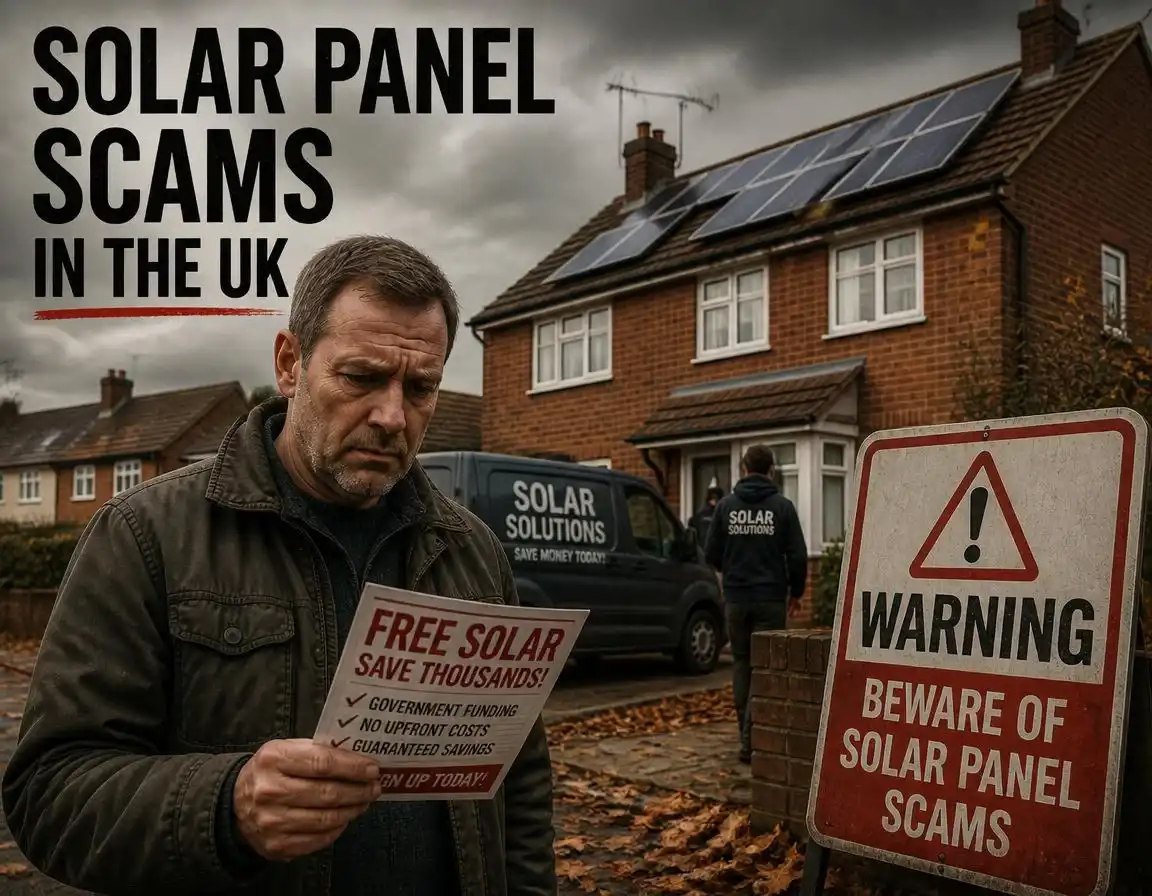
Solar Panel Scams in the UK: 7 Red Flags

Solar Briton · Consumer Protection Guide · Updated for 2026
Solar Panel Scams in the UK: 7 Red Flags and How to Protect Yourself in 2026
Solar panels are one of the more reliable home upgrades you can make in Britain right now — but the same growth that’s pulled solar into the mainstream has also pulled in a fair few rogue traders. Solar panel scams UK-wide tend to follow a similar script: a letter that looks official, a caller warning your “warranty” is about to lapse, a salesperson who won’t leave until you’ve signed something. None of this means solar itself is a bad idea. It just means it pays to know how to avoid rogue solar installers before anyone gets near your roof.
Below are the seven warning signs we see most often, three quick checks that confirm an installer is genuinely who they claim to be, and exactly what to do if you think you’ve already been caught out by solar panel mis-selling.
Check out Solar panels grants uk
The 7 red flags of a solar panel scam
Genuine solar companies don’t need any of the tactics below. Spot even one of these and it’s worth slowing right down.
The “government refund” letter or call
Letters and cold calls claiming you’re owed a government grant, refund, or a boosted export payment are almost never genuine. Schemes such as the Smart Export Guarantee are applied for directly, not offered door to door. In 2025, the Insolvency Service shut down a firm that had taken more than £3 million this way, much of it from pensioners.
“Today only” pricing
A genuine quote doesn’t expire at midnight. Same-day discounts and countdown pressure exist to stop you comparing prices or checking the company out first. A reputable installer is happy to leave you a written quote and let you think it over.
Payback figures built on rosy assumptions
Some quotes quietly assume high energy inflation, generous export rates, and near-total use of every unit generated, all to shrink the “payback period” on paper. The Competition and Markets Authority has specifically warned installers against advertising savings or payback claims without showing the assumptions behind them. Always ask what’s baked in.
Illustrative example only — your actual payback depends on your usage, tariff and system size. Ask any installer to show their working.
Fake MCS “inspection” or warranty calls
MCS has publicly warned about scammers texting or calling to say your “solar warranty has expired”, then pushing a paid maintenance visit. MCS does not cold call. If you’re unsure, hang up and contact your original installer, or check mcscertified.com directly.
No written contract before a deposit
If you’re asked for money before you’ve seen a fixed-price written quote and contract, stop there. A properly protected deposit, through a scheme like HIES, is refundable and insured if the installer goes out of business before work starts.
They can’t produce an MCS number
A genuine installer gives you their MCS certification number without hesitation, and it checks out on the official Find an Installer register. Hesitation, or a number that doesn’t match the company, is a serious warning sign.
Leasing deals and “free panel” small print
Some “free panel” offers are actually long leases that hand ownership of your roof space to someone else, restrict how you can sell your home, or eat into the export income you’d otherwise keep. Free isn’t automatically a bargain — read what you’re signing away.
Check out how many solar panels are required in the U.K.
How to check an installer is legitimate
Three checks, done before you sign anything, catch almost every rogue trader. None of them cost money and all three take a few minutes.
Check MCS certification
Search the installer on mcscertified.com’s Find an Installer tool and confirm the certificate is active and specifically covers solar PV, not just heat pumps.
Check consumer code membership
Look them up with RECC or HIES — both are Chartered Trading Standards Institute-approved codes offering deposit protection and free, independent dispute resolution.
Check Companies House
Search the company name on Companies House. A live registration, a proper filing history, and a registered address that isn’t a virtual mailbox are good signs.
At a glance, here’s what tends to separate a legitimate installer from a rogue one:
| What to check | Legitimate installer | Rogue trader |
|---|---|---|
| Quote | Written, fixed-price, no expiry pressure | Verbal, “today only”, or vanishes if you ask for time |
| MCS number | Given freely, checks out on mcscertified.com | Vague, unverifiable, or heat pumps only |
| Deposit | Small, protected by a RECC/HIES scheme | Large upfront sum, no protection mentioned |
| Contact details | Landline, registered office, reviews spread over time | Mobile only, no fixed address, reviews all from one week |
| Cooling-off period | Clearly explained, 14 days | Rushed past, ignored, or denied |
Our Find an Installer page only lists companies that pass these checks, and our Beginner’s Guide has a fuller walkthrough in its Choosing a Solar Installer section if you want the longer version.
What to do if you think you’ve already been mis-sold a system
If you’re reading this because you’ve already signed something you regret, you have more options than you might think. Work through these three in order.
Trading Standards
Report it via the Citizens Advice consumer helpline on 0808 223 1133. They log it with your local Trading Standards team, who can investigate and act against the business — even where they can’t get your money back directly.
Action Fraud
If money changed hands under false pretences, report it to Action Fraud on 0300 123 2040. In Scotland, contact Police Scotland on 101 instead.
RECC or HIES dispute resolution
If your installer is RECC-registered, new complaints now go through Green Homes Dispute Resolution, RECC’s approved partner since January 2026. HIES members offer their own free mediation and ombudsman route.
And if you’re still within 14 days of signing, you may simply be able to cancel — no reason required.
Why whole-house retrofit quality is under the microscope
Solar sits alongside a much bigger UK retrofit industry that’s had a difficult year. A National Audit Office investigation published in 2025 found that as many as 98% of external wall insulation jobs installed under the ECO4 and Great British Insulation schemes fell short of the required PAS 2035 standard, leaving tens of thousands of homes at risk of damp and structural damage. The Public Accounts Committee described the oversight system as failing “systemically” in early 2026. ECO closed to new obligations in March 2026, and government is now consulting on tougher, more independent oversight for whole-house retrofit work under the Warm Homes Plan.
It isn’t a solar-specific scandal — but it’s a useful reminder that a government-backed scheme name is never, on its own, a guarantee of quality.
None of this is a reason to avoid solar. It remains one of the most reliable ways to cut your electricity bills over the long run, and the great majority of UK installers do honest, competent work. It’s simply a reason to slow down, verify before you sign, and lean on resources built to check the details rather than take a salesperson’s word for it.
Frequently asked questions
Is a “government refund” letter about my solar panels ever genuine?
Almost never. Genuine government schemes, such as export tariffs, are applied for directly through official channels — they are not offered by post, text or cold call. Treat any unsolicited refund or grant offer as a red flag and verify it independently before responding.
How can I check if a solar installer is MCS certified?
Search the company on the official MCS Find an Installer tool at mcscertified.com and confirm the certification is active and specifically covers solar PV, not just heat pumps. This takes about two minutes and should always be done before you sign anything.
What’s the first thing I should do if I think I’ve been mis-sold a solar system?
Report it to Trading Standards via the Citizens Advice consumer helpline on 0808 223 1133, and to Action Fraud if money was taken under false pretences. If your installer is RECC or HIES registered, you also have free access to their dispute resolution service.


9 Comments