Are Solar Panels Mandatory on New Builds?

Are Solar Panels Mandatory on New Builds? The 2027 Rules Explained
The short version
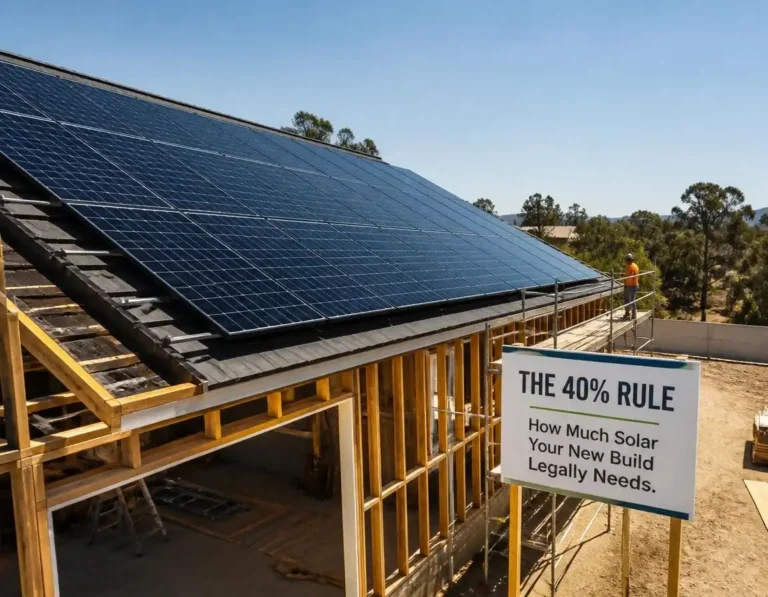
Effectively yes, for most new homes in England and Wales. Wales starts on 4 March 2027 and England on 24 March 2027. English homes must include an on-site renewable electricity system, and the government’s benchmark is solar panels covering 40% of the ground-floor area, which is about 3.7 kWp on a typical three-bed house.
Homes whose building control application goes in before 24 March 2027 can follow the old rules if work starts by 24 March 2028. Scotland and Northern Ireland have no solar mandate. Tall buildings and roofs that can’t produce about 720 kWh a year are exempt.
Until March 2026, every answer to whether solar panels are mandatory on new-build homes came with a caveat: proposed, expected, likely. That changed on 24 March 2026, when the government published its response to the Future Homes and Buildings Standards consultation, laid the legislation and issued the final guidance on the same day. This page sets out what is now law, where, from when, and what it means if you are buying, building or just checking. Every date and figure was checked against the government documents listed under Sources.
What the rule says
In England the legal duty is a new Building Regulations requirement, known as L3. Whenever a new home, or a building containing homes, is built, it must include a system for renewable electricity generation. The system can be on the building or within its grounds. It has to make electricity available to the residents and produce a reasonable output given the design of the building and its surroundings.
The 40% figure comes from the statutory guidance, Approved Document L (Volume 1, 2026 edition). It says the requirement is met if panels covering the equivalent of 40% of each dwelling’s ground-floor area are installed, although other methods are allowed. In practice that means rooftop solar on almost every new house. The government itself says solar will go on most new homes rather than all of them, because of the exemptions described below.
Two more points are worth knowing. The solar requirement stands on its own, so a developer can’t offset missing panels with extra insulation. And it sits alongside a carbon target: new homes must emit at least 75% less carbon on average than homes built to 2013 standards, which is why heat pumps are becoming the default heating.
Today, on 28 September 2026, the rules are made but not yet in force. Homes that start work before the transition ends can still be built to Part L 2021, which has applied in England since 15 June 2022.
Timeline: from the 2019 announcement to March 2028
| When | What happened | Why it matters |
|---|---|---|
| 2019 | Future Homes Standard announced | Promise of zero-carbon-ready new homes, originally aimed at 2025 |
| 15 Jun 2022 | Part L 2021 uplift takes effect in England | New homes expected to emit about 31% less carbon than under the 2013 rules; many developers add solar to comply |
| Dec 2023 to Mar 2024 | Future Homes and Buildings Standards consultation | Government asked how solar should be required and what the standard should look like |
| Feb to Mar 2026 | Wales confirms its regulations | New Part L requirement for on-site renewable electricity, starting 4 March 2027 |
| 24 Mar 2026 | England: consultation response, regulations laid, Approved Documents L and F published, ministerial statement made | Solar becomes a standalone legal requirement (L3) and all dates are confirmed |
| 4 Mar 2027 | Wales: requirement starts | First UK nation to require on-site renewable electricity on new buildings |
| 24 Mar 2027 | England: new rules start for most building work | Building control applications submitted from this date must meet the new standard |
| 24 Sep 2027 | England: start date for higher-risk building work | Blocks of flats of this type are largely exempt from the solar rule |
| 24 Mar 2028 | England: transition ends | Work must have started on the relevant building by this date to use the older Part L |
The market moved first. Solar Energy UK figures put 42% of new English homes built in Q4 2024 with panels, up from 13% a year earlier, and MCS data showed new builds made up about 35% of certified solar installations in the first half of 2025. Many of those systems were compliance-sized arrays of 2 to 4 kWp, chosen to hit a carbon target rather than to suit the household. The 2026 rules are designed to end that.
How many solar panels a new build needs: the 40% formula
The benchmark starts from floor area, not roof area, and takes two steps. Multiply the dwelling’s ground-floor area by 0.4 to get the panel area. Then multiply the panel area by 0.22 kWp per square metre, the efficiency figure used in the government’s Approved Document L guidance, to get the minimum system size. Ground-floor area means the footprint of the ground floor, not the total floor space, so a two-storey house with 85 m² in total has a ground floor of about 42.5 m².
| Ground-floor area | Panel area (40%) | Minimum system | Approx. 400 W panels | Relative size |
|---|---|---|---|---|
| 35 m² | 14 m² | 3.1 kWp | 8 | |
| 42.5 m² (typical three-bed, 85 m² in total) | 17 m² | 3.7 kWp | 9 to 10 | |
| 50 m² | 20 m² | 4.4 kWp | 11 | |
| 60 m² | 24 m² | 5.3 kWp | 13 | |
| 70 m² | 28 m² | 6.2 kWp | 15 to 16 |
Ground-floor area × 0.4 × 0.22 kWp/m². Panel counts are rounded and assume 400 W modules.
Compliance-sized systems on 2026 new builds are commonly 2 to 4 kWp. The minimum for a typical house therefore sits at the top of that range, and larger detached plots go above it.
Two practical limits apply. First, the regulations also expect the system to suit the site and the available network, and GOV.UK’s Approved Document L FAQ says a system sized for the site and infrastructure may differ from the 40% calculation. On a weak rural network, a smaller or export-limited array can be reasonable.
Second, grid paperwork depends on inverter size, not panel size. Inverter capacity up to 3.68 kW per phase can be notified to the network operator after installation (the G98 route). Anything above that needs a G99 application approved before connection, and any battery inverter counts towards the same limit. A 4.4 kWp array can stay on the simpler G98 route if it is paired with an inverter limited to 3.68 kW, which is common practice.
Exemptions and the transition: which new builds escape
The requirement is broad but not absolute. England’s guidance and regulations recognise these cases:
- Tall buildings. Buildings with a storey at least 18 m above ground level that contain homes are exempt. This matches the height test for higher-risk buildings.
- Too little usable roof. If the available roof space can’t produce about 720 kWh a year, which is less than two panels’ worth, no panels are needed. Where some panels fit but not 40%, a smaller array is acceptable.
- Design features. The guidance gives examples, such as dormers, rooflights and shading, where lower coverage is reasonable. The government has said it doesn’t want roofs redesigned just to maximise panels.
- Off-site supply. The requirement doesn’t apply if equivalent renewable output comes from a directly connected system that is not on the building or in its grounds.
The transition is the other route around the rule, and the one that causes most confusion. For most building work, the old Part L can still be used if the building control documents (an initial notice, full plans or a building notice) are submitted by 24 March 2027 and construction starts on the relevant building by 24 March 2028. Large sites still building under the 2010 rules must also start their remaining homes by 24 March 2028. For higher-risk buildings the changes start on 24 September 2027, and a valid Gateway 2 application submitted before then allows completion under the 2021 rules.
Because the test is when the application went in and when work starts, not when the home is finished, a house completed in late 2027 or 2028 may legally have no panels, while a neighbour on a later application has a 3.7 kWp array.
Three questions to ask a developer in 2026 and 2027
Marketing suites often say “Future Homes Standard compliant” while compliance is still voluntary. Ask: when was the Building Regulations application submitted, which version of Part L was the plot assessed under, and what is the array size in kWp? A developer who can’t answer all three can’t tell you what you are buying.
Solar rules on new builds in England, Wales, Scotland and Northern Ireland
| Nation | Solar requirement on new homes? | Starts | Notes |
|---|---|---|---|
| England | Yes, effectively (requirement L3, with a 40% ground-floor benchmark) | 24 Mar 2027 | Transition for applications submitted by 24 Mar 2027 with work started by 24 Mar 2028. Conversions are unchanged for now. |
| Wales | Yes, effectively (new Part L requirement for on-site renewable electricity) | 4 Mar 2027 | First in the UK. Applies to new homes and non-domestic buildings where construction hasn’t started by that date. The same 720 kWh limit applies. |
| Scotland | No | Not applicable | Zero direct emissions heating has been required in new buildings since April 2024. Solar can help meet energy standards but isn’t required. |
| Northern Ireland | No mandate announced | Not applicable | Separate building regulations. Solar on new homes remains market-driven. |
Building regulations are devolved, so England’s date and wording don’t carry across the border. The Smart Export Guarantee, which pays you for surplus electricity, is also narrower than most people assume: it covers Great Britain (England, Scotland and Wales) only. Northern Ireland has separate export arrangements, so a new-build owner there should ask their supplier what export payment is on offer.
Is a battery or heat pump mandatory on a new build too?
A battery is not. The standards require on-site renewable electricity and low-carbon heating, not storage. Adding a battery during construction usually costs less than retrofitting one later, and it is worth pricing, but whether it pays back depends on your tariff and how much power you use after dark.
A heat pump is not named in the law either, and there is no outright ban on gas boilers. The carbon target is set so tightly that gas and oil boilers can’t realistically meet it, so heat pumps or heat networks become the default for homes built under the new rules. In Scotland the New Build Heat Standard already requires zero direct emissions heating.
Cost, savings and VAT
Nobody sends you a separate invoice for the mandate. The cost is built into the price of the home. The government’s impact assessment puts the extra build cost of the whole standard, covering heat pump, solar, better fabric and ventilation, at about £4,350 per home on average in 2025 prices, so solar is only part of that figure. Housebuilders raised concerns about capital cost during the consultation, especially for smaller firms.
For the household, the government says solar on new homes could save families hundreds of pounds a year. As a rough guide, a 4 kWp array on a decent roof generates 3,000 to 3,400 kWh a year. If you use half of it at 24.5p per kWh (the unit rate used in our buyer’s guide to solar panels on new-build homes) and export the rest at 12p to 15p, that is roughly £550 to £670 a year. Roof orientation, shading, how much you are home in the daytime and your export tariff all move that number.
VAT works differently for new and existing homes. Solar built into a new dwelling is usually zero-rated as part of the construction, so the mandated array carries no VAT. If you own an older home and are considering a retrofit, the 0% VAT rate on solar and battery installation is scheduled to end on 31 March 2027 and return to 5% from 1 April 2027, unless the government extends it. Our grants and VAT guide tracks the current position.
What new-build buyers should check
Start with the three developer questions in the exemptions section, then work through these five points.
Get the MCS certificate in writing
SEG suppliers normally require an MCS-certified installation, or a recognised equivalent, plus a smart meter that records half-hourly export. Developer-fitted arrays aren’t automatically certified, so ask before you exchange contracts, not after you move in. Our new-build solar guide puts this at the top of its checklist.Check who owns the array
If a third party owns the panels or their export income, you have bought a roof lease along with the house. The same trap caught buyers in the rent-a-roof era, and the ‘free’ panels that can stop you selling explains how those leases bite at resale.Compare the array with how you will live
Homes built before 2027 often carry compliance kits, not household-sized systems. If you plan to add an EV charger or a heat pump, plan the extension early. Our guide to extending an undersized new-build array covers inverter headroom, the 3.68 kW G98 limit and the order of the paperwork.Read the planning conditions
Some developments remove permitted development rights to keep roofs uniform, which can complicate later additions. Check the planning decision notice before you buy. The general rules are in our planning permission guide.Register your own export tariff
The developer’s default export arrangement, if there is one, may not suit you. SEG rates run from about 3p to 32p per kWh, and the best offers often come with conditions, such as buying your electricity from that supplier or owning a battery. Compare live figures in our SEG rate comparison.
The buyer’s position from 2027
Solar is already common on new homes, and adding a battery at build stage is usually cheaper than retrofitting one. For a home built under the new rules, the worst case is a solar roof sized to a published benchmark rather than to a marketing spreadsheet. The checks above make sure your house is on the right side of that line.
Sources
We checked every date and figure on this page against the documents below on 28 September 2026. Where secondary sources disagreed, we followed the government text.
- The Future Homes and Buildings Standards: consultation response (MHCLG, March 2026)
- Written ministerial statement HCWS1445 (UK Parliament, 24 March 2026)
- Approved Document L: Energy and greenhouse gas emissions, 2026 edition (GOV.UK)
- Approved Document L frequently asked questions (GOV.UK)
- Wales to mandate rooftop solar power (Solar Energy UK), covering the Building etc. (Amendment) (Wales) Regulations 2026 and Welsh Government Circular WGC 003/2026
- Smart Export Guarantee (Ofgem)
- VAT on solar panels and other energy-saving materials (House of Commons Library)
Frequently asked questions
Are solar panels mandatory on new builds in the UK?
In England, effectively yes for most new homes. From 24 March 2027, new homes must include an on-site renewable electricity system, and the government’s guidance treats solar panels covering 40% of the dwelling’s ground-floor area as the benchmark. Wales has a similar requirement from 4 March 2027. Scotland and Northern Ireland have no solar mandate. Tall buildings and sites that can’t generate a reasonable amount are exempt.
When do solar panels become mandatory on new builds?
Wales starts on 4 March 2027. England starts on 24 March 2027 for most building work and on 24 September 2027 for higher-risk buildings, which are largely exempt from the solar requirement. In England, homes whose building control documents are submitted by 24 March 2027 can follow the old rules if construction starts by 24 March 2028.
How many solar panels does a new build need?
The benchmark is panels covering 40% of the ground-floor area, at 0.22 kWp per square metre. A typical two-storey three-bed house with a 42.5 m² ground floor needs about 17 m² of panels, which is roughly 3.7 kWp or nine to ten 400 W modules. A 50 m² ground floor needs about 4.4 kWp. Where shading, roof shape or network limits make that impractical, a smaller array can be acceptable.
Do all new homes need solar panels?
No. The requirement doesn’t apply to buildings with a storey at least 18 m above ground, and if the available roof space can’t produce about 720 kWh a year, which is less than two panels’ worth, no panels are needed. Design features such as dormers, rooflights and shading can justify fewer panels than the 40% benchmark. The rule also doesn’t apply where a directly connected off-site renewable system provides equivalent output.
Are solar panels mandatory on new builds in Wales, Scotland and Northern Ireland?
Wales: effectively yes, from 4 March 2027, for buildings where construction hasn’t started by that date. Scotland: no solar mandate, although zero direct emissions heating has been required in new buildings since April 2024. Northern Ireland: no mandate has been announced, and it sets its own building regulations.
Will my new build have solar panels if it completes in 2027 or 2028?
Not necessarily. England’s new rules depend on when the Building Regulations application was submitted and when work starts, not on the completion date. If the application went in before 24 March 2027 and work starts by 24 March 2028, the home can be built to the earlier standard. Ask the developer for the application date and the Part L version used.
Is a battery mandatory on a new build?
No. The standards require on-site renewable electricity and low-carbon heating, not storage. A battery is an optional extra that usually costs less to add during construction than to retrofit later, but whether it pays back depends on your tariff and how much power you use in the evening.
Are gas boilers banned in new builds?
There is no outright ban written into law, but the carbon targets in the 2026 standard can’t realistically be met with gas or oil boilers, so heat pumps or heat networks become the default for homes built under the new rules. Scotland’s New Build Heat Standard already requires zero direct emissions heating.
Do existing homes have to add solar panels?
No. The requirement applies when a new dwelling is built, not to existing homes. The government has also said standards for conversions, known as material change of use, are not changing yet.
So the answer is yes for most new homes in England and Wales, with dates, exemptions and a transition that matter more than the headline. Ask when the building control application went in, check the certificate, and the solar roof you were going to pay for anyway will be one you can actually use.