Solar Panel Snow & Ice Damage in the UK

Solar Panel Snow & Ice Damage in the UK: The Honest 2026 Answer
Twenty years of UK solar design tells me the weather isn’t what hurts panels — it’s what we do to them in January. Here’s the real risk maths, the load ratings, and the clearing rules that keep warranties alive.
Last updated: 3 September 2026 · UK figures, £ and kWh
'/%3E%3Ccircle cx='1020' cy='100' r='46' fill='%23f7c96b'/%3E%3Cg fill='%23fff'%3E%3Cellipse cx='240' cy='80' rx='80' ry='16'/%3E%3Cellipse cx='300' cy='62' rx='50' ry='12'/%3E%3Cellipse cx='700' cy='60' rx='70' ry='14'/%3E%3C/g%3E%3Cg fill='%23fff'%3E%3Ccircle cx='120' cy='150' r='4'/%3E%3Ccircle cx='420' cy='120' r='3'/%3E%3Ccircle cx='560' cy='180' r='4'/%3E%3Ccircle cx='860' cy='150' r='3'/%3E%3Ccircle cx='980' cy='220' r='4'/%3E%3Ccircle cx='180' cy='260' r='3'/%3E%3Ccircle cx='1120' cy='180' r='3'/%3E%3C/g%3E%3Crect y='440' width='1200' height='120' fill='%23eef4f8'/%3E%3Cg fill='%23fff'%3E%3Cellipse cx='200' cy='450' rx='180' ry='18'/%3E%3Cellipse cx='900' cy='460' rx='220' ry='20'/%3E%3C/g%3E%3Cg%3E%3Crect x='330' y='270' width='280' height='180' fill='%23e8d9c3'/%3E%3Cpolygon points='310,270 470,160 630,270' fill='%235b6b7c'/%3E%3Crect x='445' y='330' width='52' height='120' fill='%2312365f'/%3E%3Crect x='355' y='300' width='55' height='55' fill='%23fff'/%3E%3Crect x='530' y='300' width='55' height='55' fill='%23fff'/%3E%3Crect x='520' y='172' width='14' height='46' fill='%238a5a44'/%3E%3C/g%3E%3Cpath d='M310 270 470 160 630 270' stroke='%23fff' stroke-width='14' fill='none' stroke-linecap='round'/%3E%3Cg transform='rotate(26 470 215)'%3E%3Crect x='380' y='192' width='180' height='68' rx='6' fill='url(%23p)'/%3E%3Cg stroke='%236cc4de' stroke-width='3'%3E%3Cpath d='M380 214h180M380 236h180M425 192v68M470 192v68M515 192v68'/%3E%3C/g%3E%3Crect x='380' y='182' width='180' height='14' rx='7' fill='%23fff'/%3E%3C/g%3E%3Cg stroke='%23bfe0f2' stroke-width='6' stroke-linecap='round'%3E%3Cpath d='M600 272v26M575 272v18M625 272v22'/%3E%3C/g%3E%3Cpath d='M560 250q60 40 40 90' stroke='%23fff' stroke-width='10' fill='none' stroke-linecap='round'/%3E%3Cg fill='%23fff' stroke='%23bfe0f2' stroke-width='2'%3E%3Cpath d='M150 380l6 14 14 6-14 6-6 14-6-14-14-6 14-6z'/%3E%3Cpath d='M1050 330l5 12 12 5-12 5-5 12-5-12-12-5 12-5z'/%3E%3C/g%3E%3C/svg%3E)
💶The quick answer
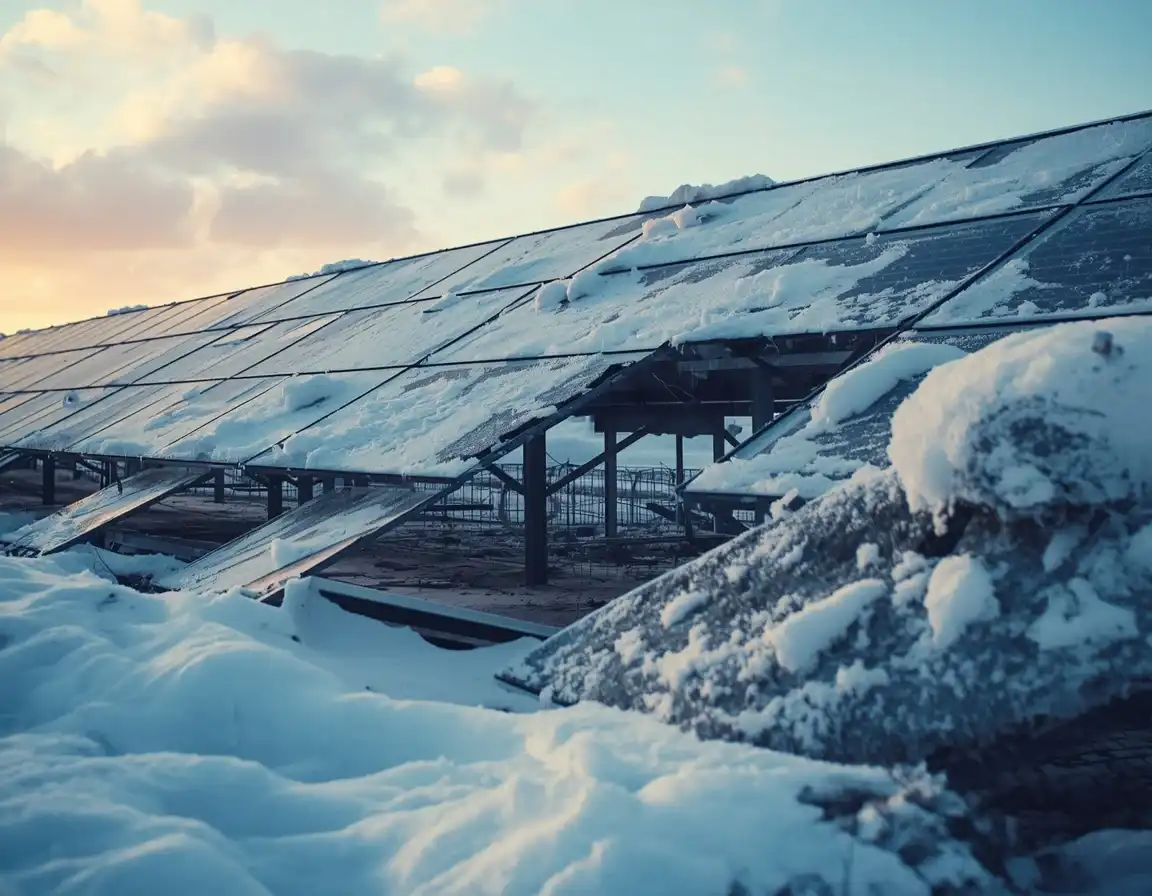
Snow and ice almost never damage a properly installed UK solar panel — modules carry snow-load ratings of 5,400 Pa (about 550 kg per m²), several times anything a British winter realistically piles on them. The damage I actually see each January is self-inflicted: scratched glass from scrapers, thermal-shock cracks from hot water, and freeze-thaw leaks at poorly fitted mountings. Leave the snow alone, or clear it gently from the ground.
Every cold snap brings the same two questions: “will the snow break my panels?” and “should I be up there clearing them?” After twenty years designing UK solar, my answer to the first is a near-certain no, and to the second an equally near-certain no — with a couple of sensible exceptions. Let me walk you through the actual engineering, the money, and the small print, because the gap between folklore and fact on this topic is wider than the gap between my January and July generation figures.
🌨️What snow and ice actually do to your panels
Four things happen when snow lands on a UK array, and only one of them matters much:
1. Covered panels pause. A fully blanketed panel generates essentially nothing while it’s covered. That’s it — no damage, just a pause. 2. It usually slides off. Panels are glass, tilted at roof pitch, and dark — they warm in daylight and shed snow within hours on most pitched UK roofs, faster the steeper the tilt. 3. Cold is a friend. Solar cells run more efficiently when cool — roughly +0.5% for every degree below 25°C — and modern monocrystalline panels are rated down to –40°C, so a UK cold snap is comfortably inside their comfort zone. 4. The money barely moves. December to February is only around a tenth of a southern English system’s year (a touch more further north), so a few snowed-in days cost pennies, not pounds.
Monthly generation — 4kWp system, southern England (kWh). Navy = the months snow can touch.
Figures match our winter output guide. Even a total week of snow cover in January is a rounding error on the annual bill saving.
Ice is the same story with better grip. A sheet of ice blocks light until it melts or slips, but it doesn’t crush anything — and the freeze-thaw cycle only becomes a problem at the bits behind the panel: flashings, brackets and roof penetrations, which is an installation-quality issue, not a panel issue. If you’re still weighing up winter generation more broadly, our guides on which solar panels don’t work in winter and winter solar in Scotland cover the generation side in full.
📐The load maths: why snow weight isn’t the worry
Here’s the comparison that should settle the anxiety. International standard IEC 61215 requires panels to survive a 2,400 Pa mechanical test load, and most modules sold for domestic roofs carry a 5,400 Pa front-load (snow) rating — premium ones go to 8,100 Pa. Meanwhile, most UK roofs are designed for snow loads of roughly 0.6–1.0 kN/m² (600–1,000 Pa) under BS EN 1991-1-3, rising to 1.0–1.5 kN/m² in Scottish guidance zones. In plain English: your panels are certified for several times the snow load your house was designed to carry.
Load capacity compared (kN/m² — same as kPa)
Put another way, 5,400 Pa is about 550 kg spread over each square metre of glass — a small car parked on your roof would be a fairer comparison than a UK snowfall. Panels are also hail-tested with 25 mm ice balls fired at 23 m/s during certification, so a Scottish sleet shower isn’t going to surprise them. The honest exceptions are uneven loads — a slab of packed snow sliding off a steeper roof section and stacking against the panel’s bottom edge — which is exactly what the newer IEC uneven-snow test standards were written for, and another reason to buy certified, reputable modules.
🧊The real UK damage list (rare, but real)
These are the failures I’ve actually investigated over the years, roughly in the order I encounter them:
| Risk | Likelihood (UK) | What happens | The fix |
|---|---|---|---|
| Scratches from DIY clearing | Common | Grit dragged across glass by brushes, scrapers or “just a quick sweep” — permanent output loss and warranty arguments | Don’t clear, or use a soft foam-bladed rake from the ground |
| Thermal shock | Occasional | Hot water on frozen glass cracks it — the winter cousin of washing hot panels at midday | Never use water to de-ice; let sun and tilt do it |
| Freeze-thaw at poor mountings | Occasional | Water ingress at badly flashed roof penetrations freezes, expands, and shows up as a roof leak — blamed on the panels, caused by the fitting | MCS-certified installation; annual visual check of flashings |
| Partial ice shading / hot spots | Rare | A stubborn ice band shades one cell row; bypass diodes (three per panel) normally route current around it, but a failed diode can allow a hot spot | Watch the monitoring app; a string stuck near zero after thaw = professional check |
| Snow-slide dumping | Occasional | Sheets shedding off the array onto porches, paths or the greenhouse below — a design issue, not a damage-to-panel issue | Keep walkways clear after thaws; consider layout at design stage |
| Packed load on flat / low-tilt roofs | Rare | Low angles don’t shed; snow can sit and re-freeze for days, stacking load the mounting must carry | Mountings specified for the site load; brush off gently if accessible from ground level |
| Salt & chemical corrosion | Rare | De-icing salt thrown at panels corrodes frames and connectors | Never salt panels; keep road-grit spray in mind for coastal sites |
🏠Pitched vs flat vs ground-mounted in snow
| Mounting | Snow behaviour | What to watch |
|---|---|---|
| Pitched roof (30–45°) | Sheds naturally within hours of sun; the UK default and the easiest case | Snow-slide dumping below the array; icicles off the panel edge (cosmetic) |
| Flat roof (ballasted frames, 10–15° tilt) | Snow sits longer; output paused until melt or wind clears it | Mounting load spec matters most here; never stand on ballasted frames to clear |
| Ground mount | Easy to reach — and that’s the trap; bottom-edge stacking from sliding snow | Keep raking gentle and frame-only contact free; check the frame’s certified load |
If a flat-roof or ground-mount quote is on your desk, the question to ask your installer is one sentence: “what snow load is the mounting specified to, and is it in writing?” A certified installer answering from MCS-compliant design paperwork is what you want to hear.
🧹Clearing snow safely, when you genuinely must
My default advice is still “leave it” — but I understand watching 3 cm of snow sit on a £7,000 array while the app reads zero is its own special itch. If you’re going to clear it, here’s the safe version:
✅ Do
- Work from the ground with a telescopic, foam-bladed snow rake or soft brush
- Pull snow downwards off the glass, don’t drag across it
- Leave a thin film — you don’t need optical clarity, just light
- Clear only what you can safely reach; the rest will slide
- Check the monitoring app the next sunny day to confirm recovery
❌ Never
- Scrape ice with metal or hard plastic — micro-scratches are permanent
- Pour hot or warm water — thermal shock cracks glass, and warranties won’t touch it
- Throw salt or de-icer — corrosion city for frames and connectors
- Climb onto a snowy roof or stand on panels — dangerous and warranty-voiding
- Use a pressure washer — it voids most panel warranties, snow or no snow
The same rules apply to frost: a light frost burns off in the first hour of daylight. If your winter cleaning habits need a refresh generally, our UK solar maintenance checklist has the full do/not-do list, including the deionised-water rule for proper cleans.
🧮Is clearing snow worth the money? Let’s count
Take a typical 4kWp system in southern England. January generates around 110 kWh — about 3.5 kWh a day. A full week of total snow cover therefore “costs” you roughly 25 kWh. At today’s capped import rates (around 26p/kWh) with some export blended in, that’s about £5–£8 of value.
Now price the alternatives: a single scratched panel replaced runs £200–£400 plus labour through your insurer (if you’re covered for accidental damage at all), and a thermal-shock crack is the same ticket. The maths is brutally one-sided — the snow you leave alone is almost always cheaper than the snow you fight.
🛡️Who pays when winter wins: insurance vs warranty
This is the part most guides fudge, so here it is cleanly. Manufacturer warranties (20–30 years product and performance on good panels) cover manufacturing defects — they explicitly exclude storm, snow-weight and accidental damage. That’s buildings insurance territory: roof-mounted panels are treated as permanent fixtures, and storm, wind and sudden snow-load damage are normally covered — provided you told your insurer the panels were there. Failing to declare them can void the whole policy, not just the solar bit.
| Winter event | Who pays | Catch |
|---|---|---|
| Panel cracked by falling ice / branch / snow slide | Buildings insurance | Must have declared panels; accidental-damage cover may be an extra |
| Array mounting torn by storm with snow | Buildings insurance | Installation workmanship may also sit with the installer’s warranty |
| Roof leak at flashings after freeze-thaw | Installer workmanship warranty | 2-year legal minimum; newer MCS-backed cover runs to 6+ years — paperwork matters |
| Scratches from your own clearing | Usually nobody | Accidental damage is often an optional extra; wear and tear excluded everywhere |
| Gradual freeze-thaw deterioration | Nobody | Excluded by both insurance and warranty — prevention is installation quality |
Two practical nudges: adding panels to an existing policy typically costs only £25–£50 a year, and if you’re mid-winter and unsure whether you declared the system, check now rather than post-claim. Our solar panel insurance guide and warranty guide go through the small print line by line.
✅The 10-minute pre-winter checklist
And if you’re still at the planning stage rather than the owning stage, timing genuinely matters: our guide to the best month to install solar panels in the UK explains why a late-autumn install, done properly, is live and bedded in before the first proper frost.
❓Frequently asked questions
Can snow and ice damage solar panels in the UK?
Should you clear snow off solar panels?
Does home insurance cover snow or ice damage to solar panels?
☃️The bottom line
UK snow is a generation pause, not a damage event. Your panels are certified for loads several times beyond anything a British winter can stack on them, they shed snow on their own schedule, and they genuinely enjoy the cold. The three things that protect your investment have nothing to do with heroics on a ladder: an MCS-certified installation that keeps freeze-thaw out of your roof, an insurance policy that knows the panels are there, and the self-restraint to leave the scraper in the garage. Master those three and the only thing snow will ever cost you is a quiet week on the monitoring app.