
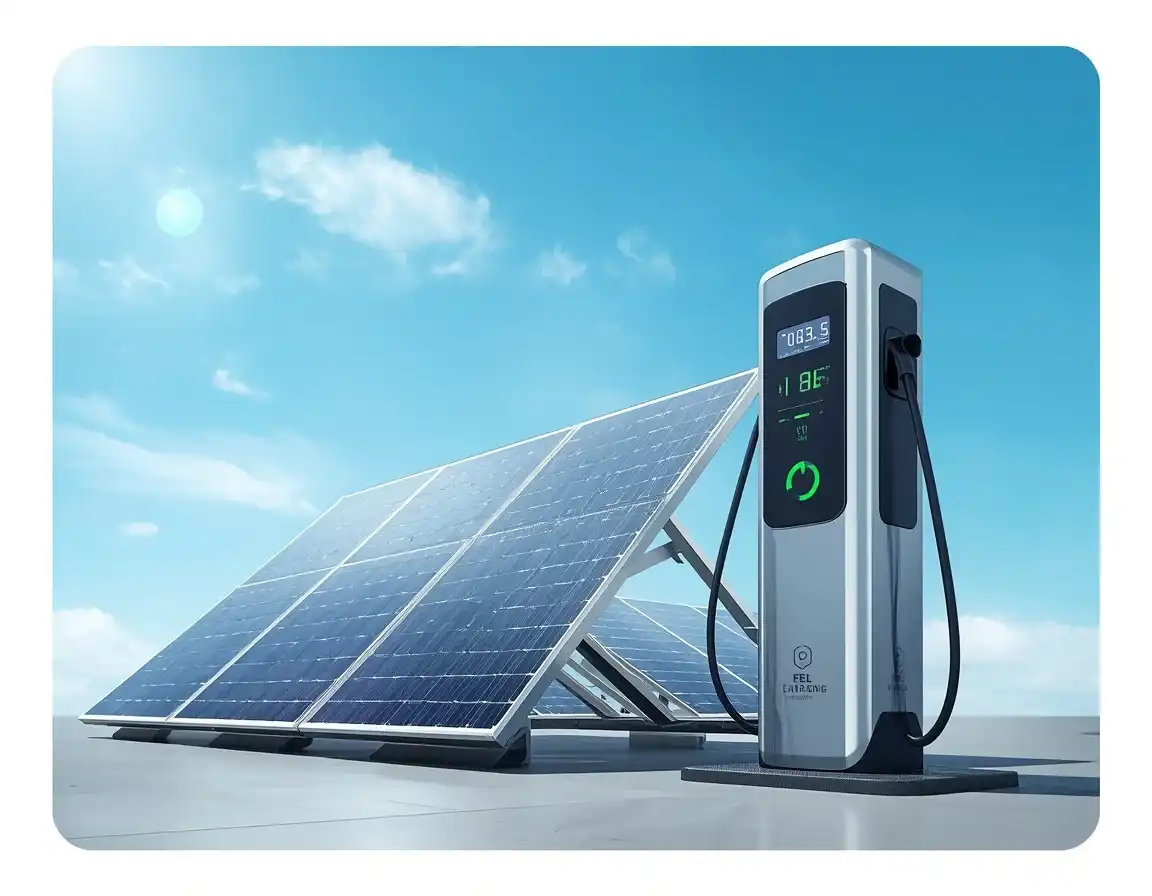
Solar + EV Charger Combos

Solar + EV Charger Combos: Is a Solar-Diverted Charger Actually Worth It?
If you’ve got solar panels and an EV, there’s a genuine case for making them talk to each other. Here’s how solar-diverting chargers like the Zappi actually work, what they cost, and the honest maths on whether it’s worth the extra spend.

Here’s the thing nobody tells you when you get solar panels fitted: on a decent sunny day, your house probably can’t use all the electricity you’re generating. Right now, that spare power is either going into the grid for a few pence via the Smart Export Guarantee, or it’s just being wasted if you’re not on an export tariff at all. If you’ve also got an electric car sitting on the drive, that’s genuinely daft — you could be putting that “free” electricity straight into your car instead.
That’s the whole idea behind a solar-diverting EV charger. It’s not a new gadget exactly, but 2026 is the year the technology has properly matured, and the maths has got a lot more favourable now that grid electricity and public charging both cost more than they used to. Let’s go through what these things actually are, what they cost, and when they genuinely pay for themselves.
What a solar-diverting EV charger actually does
A normal EV charger just delivers power at a fixed rate, whether that electricity came from your solar panels or the grid — it has no idea which. A solar-diverting charger uses a small clip-on sensor (a “CT clamp”) on your incoming electricity supply to measure, in real time, how much power your house is generating versus using. It then automatically ramps your car’s charging speed up and down to track whatever surplus is available.
Most solar chargers offer a couple of modes: a “boost” or “fast” setting that just charges at full speed from the grid regardless, and one or two solar-only modes that only draw power when there’s genuine surplus, topping up from the grid a little if needed to keep charging moving. The idea is simple: on a sunny day, your car quietly fills up on power you’ve already paid to generate, instead of that surplus disappearing off to the grid for a fraction of its value.
Popular solar-diverting chargers, compared
A handful of brands dominate this space in the UK right now, and they’re not all built the same way.
| Charger | True solar CT-clamp divert? | Typical installed price | Best for |
|---|---|---|---|
| myenergi Zappi | Yes | £800-£1,500 | The benchmark for solar households |
| Indra Smart PRO | Yes | Broadly similar to Zappi | Budget-conscious solar households |
| Ohme Home Pro | Partial / tariff-led | Cheaper than Zappi | Smart-tariff households (Octopus Go, Agile) |
| Ohme ePod | No | From around £499 | Non-solar homes wanting cheap smart charging |
| Hypervolt Home 3 | Yes | Comparable to Zappi | Design-led homes, though app is less mature |
| Andersen A2 / A3 | Yes | Premium pricing | Design-conscious solar households |
| Tesla Wall Connector | Via integration | Mid-range | Tesla owners, especially with a Powerwall |
The short version most installers land on: Zappi (or Indra) if solar is your priority, Ohme if you’re mainly chasing a cheap overnight tariff, and Tesla’s own charger if you’re already in the Tesla ecosystem. The Zappi remains the most-fitted solar charger in the UK simply because its CT-clamp divert system is the most mature and works with every solar inverter brand, not just specific pairings.
Is your solar system actually big enough?
This is where a lot of people overspend on a fancy charger they can’t really use to its potential. Solar diversion only helps when there’s genuine surplus to divert — if your panels are barely covering the house itself, there’s nothing left for the car.
Rule of thumb: a solar-diverting charger starts to earn its premium over a simple tariff-smart charger at around 4kWp and up — which happens to be roughly the size of a typical UK residential system anyway. Below that, you’re often better off with a cheaper charger and a good off-peak EV tariff instead.
Not sure what size your roof could realistically take? Our guide to what size solar system you actually need walks through it properly before you start pricing up chargers.
Cost per mile: solar vs every other way to charge
This is really the whole argument in one chart. Once your panels and inverter are paid for, every kWh of solar surplus costs you nothing extra to use — so diverting it into your car is about as close to free motoring as it gets in the UK right now.
Even the cheapest overnight EV tariffs (as low as 6.7-7p/kWh on deals like Octopus Intelligent Go) can’t quite match free solar. And it’s genuinely surprising how far the gap stretches at the top — public rapid charging at 65-85p/kWh can actually cost more per mile than driving a petrol car, which is exactly why home charging (solar or otherwise) is where the real savings live.
EV or immersion heater — where should surplus solar go?
If you’ve already got (or are considering) a solar diverter for your hot water cylinder, it’s worth knowing that diverting to an EV is generally the better move financially, where both are an option.
Every kWh of solar you divert into your car displaces electricity you’d otherwise buy at your standard import rate — typically 20-35p/kWh in 2026. The same kWh diverted to hot water only displaces the cost of heating water another way, which is usually a smaller saving. Put simply, a unit of solar sent to the car is often worth three to five times more than the same unit sent to the immersion heater, purely because petrol and public charging are so much more expensive than the gas or electricity you’d otherwise use to heat water.
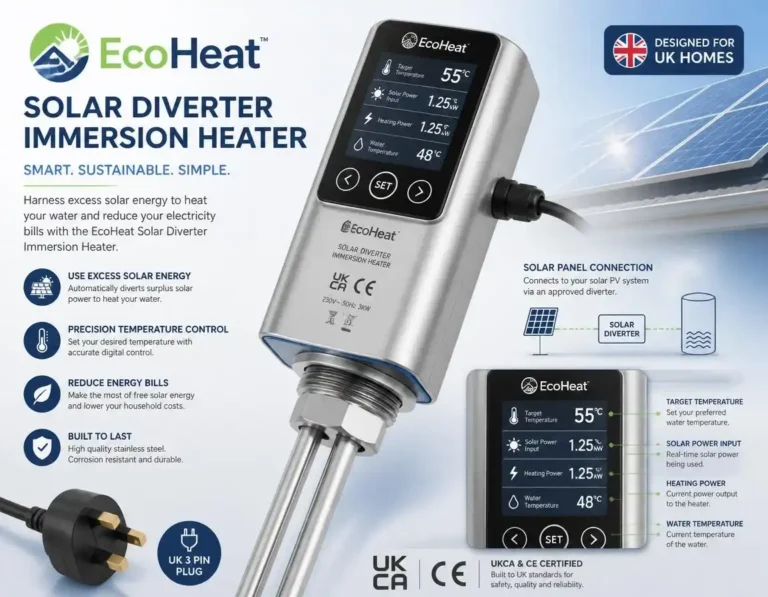
That doesn’t mean skip the water diverter entirely — most systems, like the myenergi Eddi paired with a Zappi, can run both together with a priority order set in the app, so hot water still gets whatever surplus the car doesn’t need. If you want the fuller picture on that side, our guides to the solar diverter immersion heater and solar diverter vs battery, which to buy first cover it in full.
A winter reality check
Solar diversion is brilliant from roughly March to October. In December and January, it’s a different story, and it’s worth going in with realistic expectations.
Real example: a typical 4kWp system might generate only around 75kWh across the whole of December — enough for roughly 250 miles of driving if every single unit went into the car, which it won’t, since your house needs power too. In winter, a cheap overnight tariff does far more heavy lifting than solar divert ever will.
This isn’t a reason to skip a solar charger — it’s a reason to make sure yours can also do smart overnight charging, so you’re not paying full price for winter top-ups. This is exactly why the better solar chargers combine both: solar-only mode by day, a scheduled cheap-rate charge window overnight.
The OZEV EV Chargepoint Grant in 2026
There’s a genuine government grant that can knock a chunk off the installation cost — but the eligibility rules trip a lot of people up.
| Detail | 2026 figure |
|---|---|
| Maximum grant | £500 per socket (up from £350, from 1 April 2026) |
| Covers | Up to 75% of combined charger + installation cost |
| Funding confirmed until | 31 March 2027 |
| Who’s eligible | Renters, flat owners/leaseholders, landlords |
| Who’s not eligible | Homeowners with a driveway or off-street parking (removed 2022) |
If you own your home outright with a driveway, this particular grant won’t apply to you — but it’s still worth checking our wider guide on solar panel grants and 0% VAT in 2026, since the VAT relief on panels and batteries is separate and much more widely available.
Getting more value from the combo
Time-shift daytime surplus
A home battery can store excess solar generated while you’re at work, then release it into the car overnight instead of losing that surplus to export.
Compare divert vs export
If your Smart Export Guarantee rate is unusually strong, run the numbers both ways — though for most households, diverting to the car still wins.
Look into V2G-style schemes
Some EV batteries can now be used to earn money by feeding stored power back at peak times, on top of your solar savings.
If any of that sounds interesting, our guides to the best solar batteries in 2026, the best SEG tariff rates and getting paid to share your battery capacity go into each of these in more depth.
Frequently asked questions
Is a solar-diverting EV charger worth it in the UK?
It usually is if you have a solar system of around 4kWp or larger and charge your car at home regularly. A solar-diverting charger like the Zappi routes your surplus solar generation into your car instead of exporting it to the grid for 4-15p/kWh, effectively making that electricity free rather than paying 20-35p/kWh to import it. Below around 4kWp, there often isn’t enough surplus to justify the extra cost over a simpler tariff-smart charger.
What’s the difference between a Zappi and an Ohme charger?
The Zappi uses a CT clamp to measure your home’s real-time energy flow and continuously ramps charging speed up and down to match your solar surplus, which makes it the strongest choice for solar households. The Ohme range is built primarily around smart tariff scheduling, such as Octopus Intelligent Go or Agile, and has more limited solar responsiveness rather than true CT-clamp solar diversion. In short: Zappi for solar, Ohme for tariff-led charging.
Can I get a government grant for a solar-compatible EV charger?
Possibly. The OZEV EV Chargepoint Grant covers up to £500 per socket (75% of costs) from 1 April 2026, funded until 31 March 2027. However, it’s only available to renters, flat owners/leaseholders and landlords, not to homeowners with off-street parking at a house, who were removed from eligibility in April 2022. You’ll need an OZEV-authorised installer and a charger from the approved product list, and you apply via the GOV.UK Find a Grant service.

One Comment