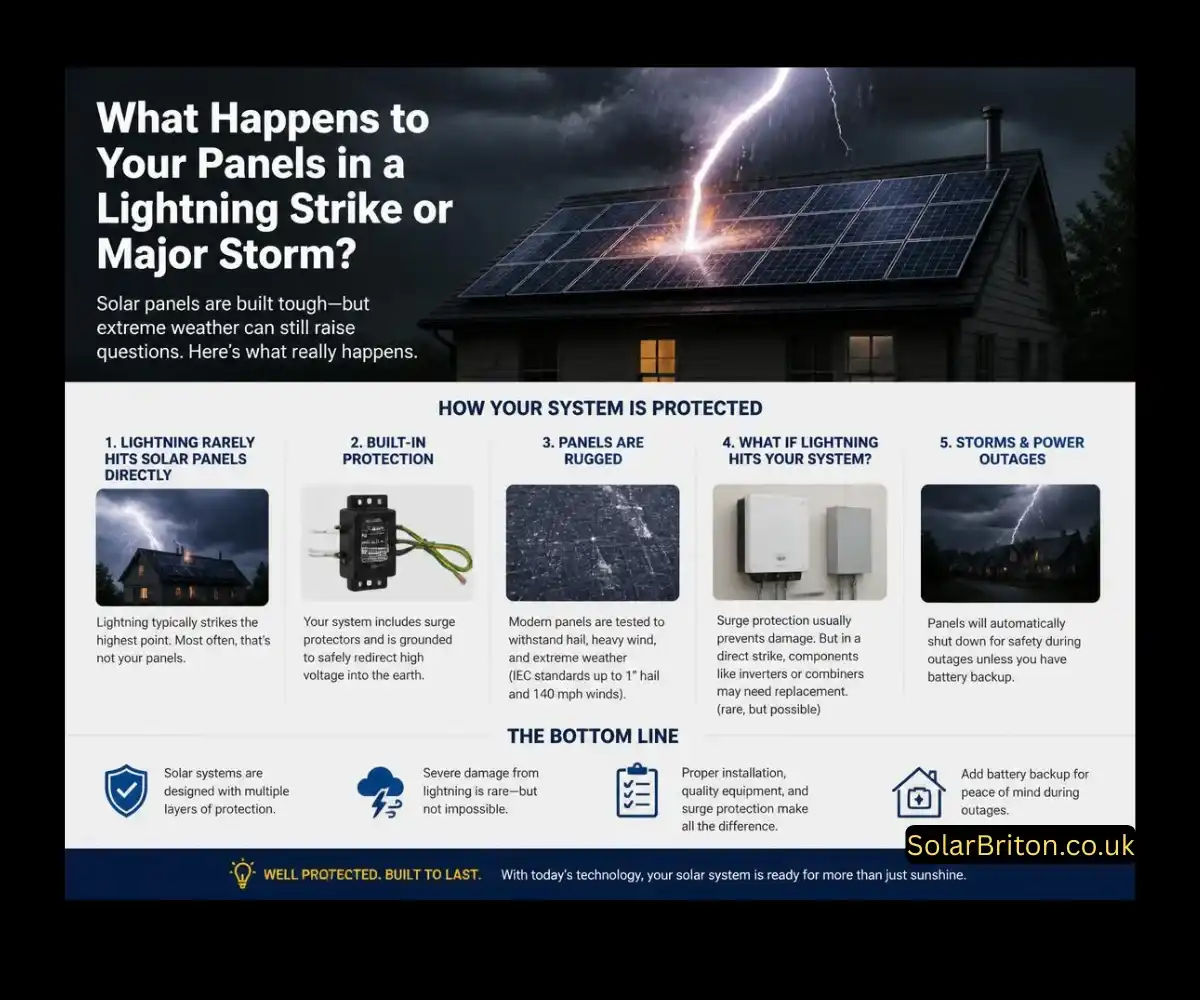
What Happens to Your Panels in a Lightning Strike or Major Storm?

I get this question every time a big storm is forecast. The honest answer surprises most people, it’s rarely the lightning you need to worry about.
A direct lightning strike on your solar panels is genuinely rare. What actually causes most solar-related storm damage in the UK is wind, flying debris, and power surges from a strike that lands nearby, sometimes a mile or more away, without ever touching your roof. Panels themselves are tough and don’t attract lightning any more than the rest of your house does. The parts most at risk are the inverter and cabling, which is exactly what proper earthing and surge protection are designed to guard against.
Right, let’s get into the actual physics and the actual paperwork, because this question always has two halves: what really happens to a system in a storm, and whether you’re covered if it does. I’ve gone through the UK insurance data, the wiring regulations, and the fire brigade’s own guidance to give you the straight answer.
First, the myth: do solar panels attract lightning?
No. There’s no good evidence that having solar panels on your roof makes your house more likely to be struck. Panels sit low and flat against the roofline, they’re not tall, pointed, or isolated the way an actual lightning rod is, and a lightning strike is driven by cloud-to-ground ionisation, not by the presence of a bit of glass and aluminium on your tiles.
What panels do add is more electrical hardware for a strike, direct or nearby, to damage once it happens. That’s a real and useful distinction, because it means the sensible response isn’t “don’t get solar,” it’s “make sure the electrical side is properly protected,” which almost every MCS-certified UK install already is.
Direct hit vs nearby strike: which one actually happens
Two very different scenarios, and one is far more likely
A direct strike on the panels
Lightning physically hits the array. This can crack cells, melt connectors, and in the worst cases start a fire. It’s the scenario everyone pictures, but it’s genuinely uncommon across the UK’s roughly two million installed systems.
Low probabilityA nearby strike causing a surge
Lightning hits the ground, a tree, or a power line within a mile or two. The electromagnetic pulse induces a voltage spike in your cabling, which travels into the inverter and can fry its electronics without a single volt hitting the panels directly.
Far more likelyThat second scenario is the one that actually shows up in claims data. The inverter is usually the first casualty, it’s the most electronically sensitive part of the whole system, followed by monitoring equipment and, occasionally, the consumer unit itself. The panels, meanwhile, often survive completely unscathed.
Our micro inverter vs string inverter guide covers how each type handles a fault, including whether a single surge takes out your whole system or just one panel’s worth of generation.
Wind is the real UK problem, and it’s not close
Here’s the bit most lightning-focused articles miss entirely. UK insurers classify a “storm” specifically by wind speed, not by lightning at all, and it’s wind damage that dominates the claims data for solar installations. The Association of British Insurers defines a storm as gusts of at least 55mph (48 knots), or torrential rain of 25mm an hour, or 30cm of snow in 24 hours, or damaging hail. Most solar-related weather claims fall under that wind threshold.
How UK storm-force winds compare
Beaufort scale context for the winds that matter to a rooftop solar array.
The current 2025-26 storm season has already been a live reminder of this. It opened on 1 September 2025 with Storm Amy, and by January 2026, Storm Goretti brought forecast gusts of up to 100mph to Cornwall and the Isles of Scilly, with the Channel Islands facing even higher. Wind at that level can lift poorly fitted panels, drive debris into the array, or strip flashing and mounting brackets clean off a roof, none of which has anything to do with a lightning bolt.
A correctly installed system, fitted by an MCS-certified installer to current UK mounting standards, is engineered to handle typical UK wind loading. Problems tend to trace back to poor original installation rather than the panels themselves being inherently fragile. If your roof or coastal location sees particularly high wind exposure, our guide on solar panels on coastal properties covers the extra checks worth asking your installer about, and solar in Cornwall looks at exactly the kind of exposure Storm Goretti tested.
What about fire risk?
Fire is the outcome everyone worries about most, and it’s worth being straight about it: it’s possible, but it’s the least likely outcome of the three. London Fire Brigade, which has done some of the most detailed UK-specific work on this, has publicly stated it isn’t aware of solar panels themselves posing a significantly increased fire risk, while still recommending that firefighters treat any live PV array with care during incidents. The brigade even developed a product called PVStop, a spray that renders panels safely non-conductive at speed during a fire response, precisely because de-energising a live array in an emergency isn’t always straightforward.
If you’re specifically concerned about battery fire risk rather than the panels themselves, that’s a genuinely different topic with its own causes and precautions, and we’ve covered it in full in our dedicated solar battery fire safety guide.
How UK installs are actually protected
This is the part that should be reassuring rather than alarming. UK solar installations are governed by clear standards, and most of what protects your system happens automatically as part of a compliant install.
Earthing and bonding, always required
Under BS 7671 (the IET Wiring Regulations), every UK solar installation must be properly earthed and bonded. This isn’t optional and isn’t specific to lightning risk, it’s baseline electrical safety that also happens to reduce surge damage.
A full lightning protection system, usually not needed
BS EN 62305 covers formal lightning protection systems, but installers apply this through a risk assessment based on your location, roof height and exposure. Most typical UK homes don’t come out of that assessment needing a dedicated lightning protection system, they’re adequately covered by standard earthing and surge protection.
Surge protection devices (SPDs)
These are the real workhorse against nearby strikes. A DC SPD at the inverter’s panel-side input and an AC SPD at its grid-side output absorb induced voltage spikes before they reach sensitive electronics. MCS installation guidance covers this directly, and it’s increasingly standard practice even where a full lightning protection system isn’t required.
An accessible array isolator
Required on virtually all modern string voltages, this lets you, or the fire service in an emergency, de-energise the array quickly and safely.
If you’re not sure whether your existing system has SPDs fitted, it’s a fair question to ask, and a relatively inexpensive retrofit if it doesn’t. Check installer credentials properly first, our guide to what MCS certification actually means explains exactly what standard you should expect them to be working to.
Are you actually covered if something happens?
Most UK buildings insurance covers storm and lightning damage as standard, and once panels are fitted to your roof, they’re generally treated as part of the building itself rather than a separate item. That said, insurers can be particular about the details.
| Route | Typical cost | What it covers |
|---|---|---|
| Declare panels on existing buildings policy | £25–£50/year | Adds panels to your existing cover; cheapest route for most homeowners |
| Specialist solar panel insurance | £70–£120/year | Dedicated cover, often with lower excess and faster claims for a system worth £8,000–£15,000 |
| Doing nothing / not declaring | £0 | Risk of a claim being reduced or refused if the insurer wasn’t told panels existed |
UK insurers paid out roughly £585 million in weather-related claims in 2024 alone, the most recent full-year figure published by the Association of British Insurers, and storm damage consistently ranks as the most common cause of solar-specific claims, ahead of lightning. A few things worth checking before you assume you’re covered:
- Confirm your installer was MCS-certified, insurers frequently ask for this at claim stage
- Check whether your policy applies a higher excess specifically for roof-mounted equipment
- Tell your insurer about the panels when you get them fitted, don’t assume it’s automatic
For the full detail on policy wording, typical exclusions and how claims actually get handled, our dedicated solar panel insurance guide goes much deeper than we’ve got room for here, and it’s worth reading alongside our warranty guide, since warranty and insurance cover genuinely different things and people mix them up constantly.
What to actually do after a storm
Look, don’t touch
Check for visible damage from the ground. Never climb onto a roof after a storm to inspect panels yourself.
Check your monitoring app
A sudden drop in generation is often the first sign something’s wrong, even with no visible damage. See our monitoring system guide for what to look for.
Call your MCS installer
Not a random tradesperson. They can assess and document damage properly for any insurance claim.
After any major storm, cold callers claiming to have “spotted damage from the street” are a well-known scam pattern in the UK trades generally, and solar is no exception. Never let anyone onto your roof without verifying who they are first. Our guide to solar panel scams and red flags covers this exact tactic in more detail.
Frequently asked questions
The short version, one more time: it’s wind, not lightning, that’s most likely to give your system a hard time, your panels are tougher than they look, and the electronics are the part that actually needs protecting, which is exactly what a properly earthed, MCS-compliant install already does.
Keep reading on SolarBriton
More on protecting your system and getting the paperwork right.

One Comment